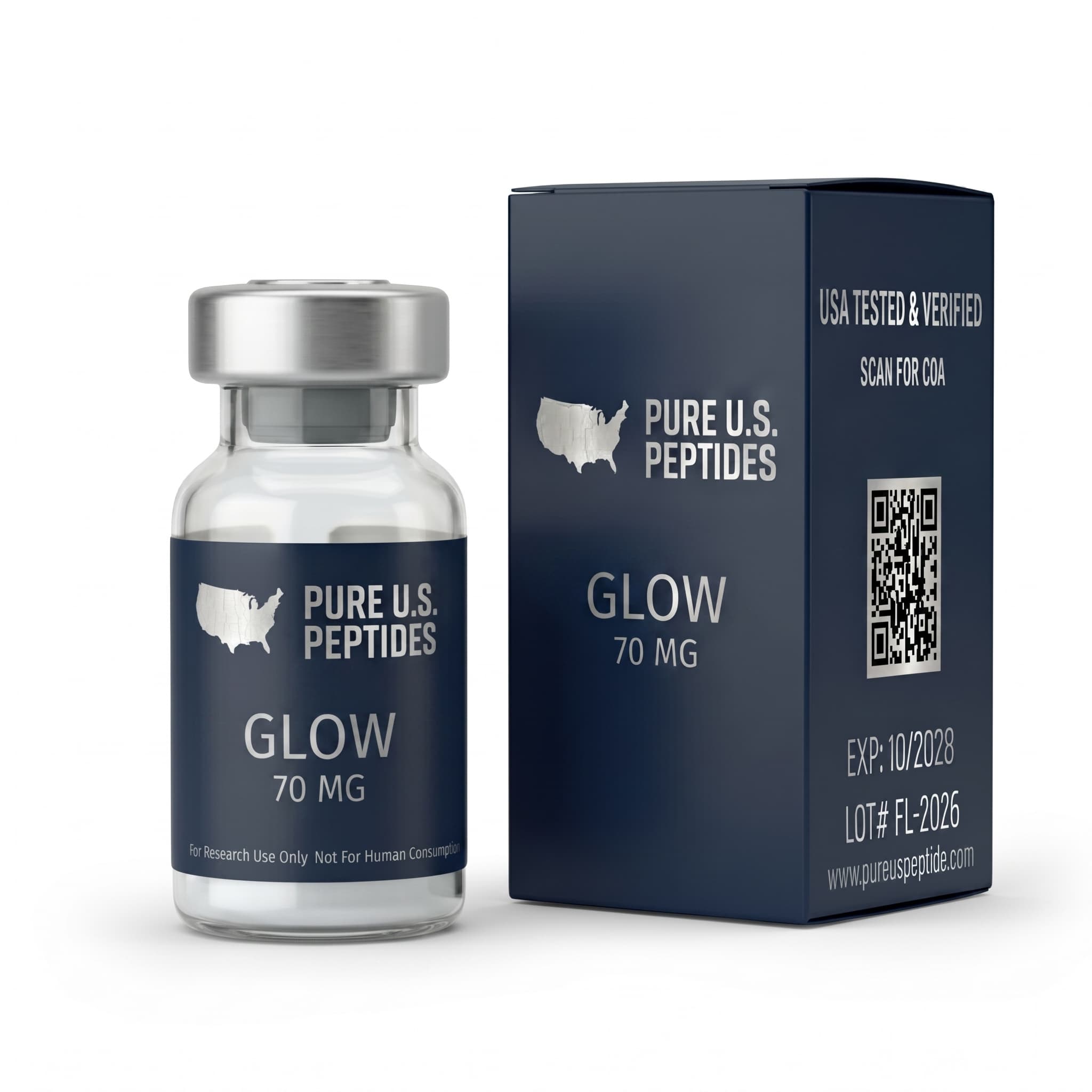
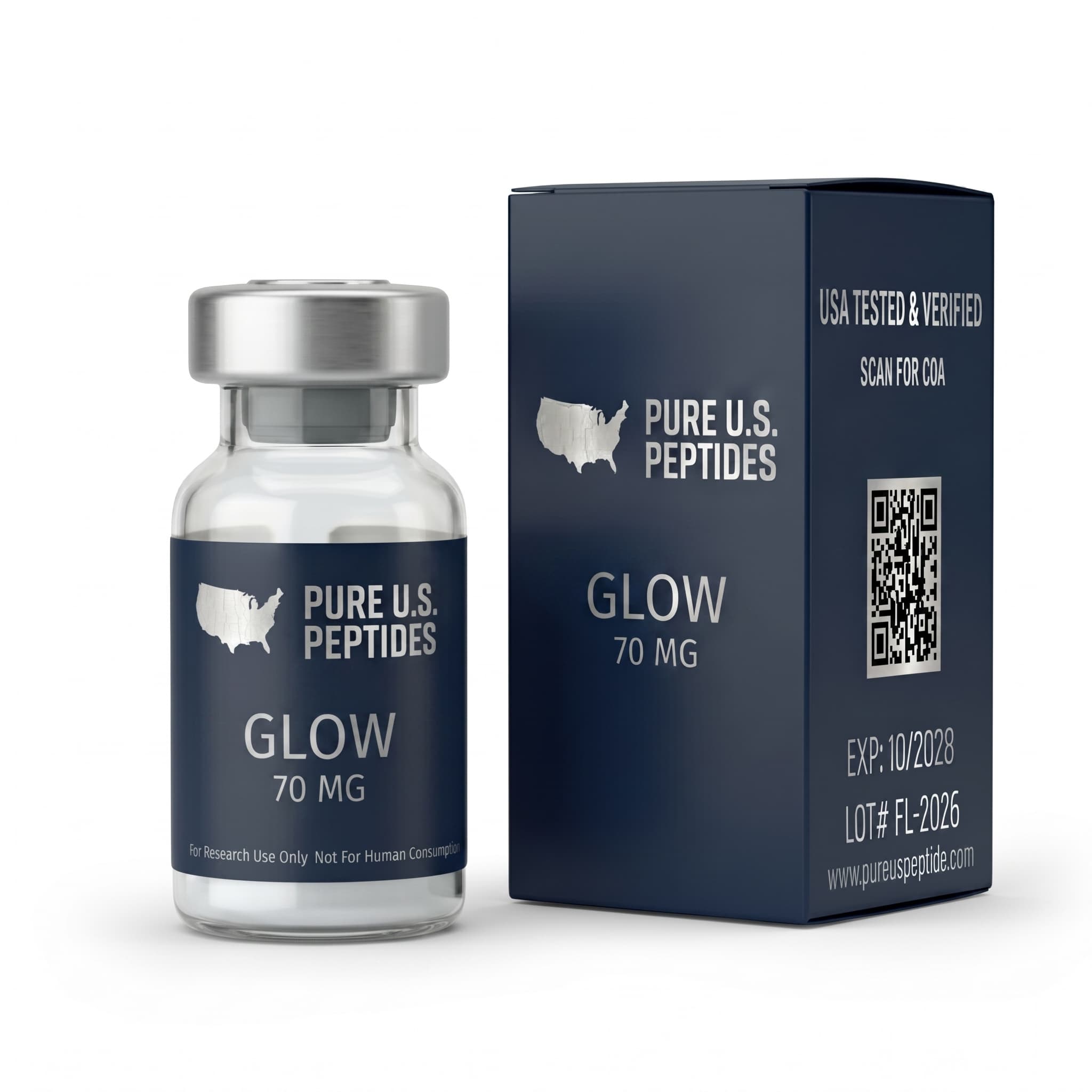
GLOW 70mg
In Stock & Ready to Ship from USA
FREE shipping on every U.S. order
Secure checkout via encrypted payment processor


 +2.9k
+2.9kResearch Use Only
These products are for laboratory research only and not intended for medical use. They are not FDA-approved to diagnose, treat, cure, or prevent any disease. By purchasing, you certify they will be used solely for research and not for human or animal consumption.
Research Summary
26 PubMed CitationsOverview GLOW Blend is a fixed-ratio co-formulation of three peptides selected for their non-overlapping but complementary roles in tissue-repair signaling. The 50 mg / 10 mg / 10 mg ratio (GHK-Cu : BPC-157 : TB-500) reflects the copper-tripeptide-dominant stack widely adopted across research peptide suppliers.[1][2] The rationale for combining these peptides is mechanistic: each component engages a distinct molecular target. GHK-Cu functions as a copper delivery vehicle and a master gene modulator, with reported >50% expression changes across approximately 31% of human genes.[9] BPC-157 activates the VEGFR2-Akt-eNOS cascade, driving angiogenesis and nitric-oxide-mediated repair.[5] TB-500 binds monomeric G-actin in a 1:1 stoichiometric complex via its LKKTETQ motif, enabling cytoskeletal reorganization required for cell migration.[6] Each component peptide has been individually evaluated in dozens of preclinical wound-healing, angiogenesis, and connective-tissue models. There are no published peer-reviewed studies of the three-peptide blend itself; investigators using the combined formulation infer additive activity from the individual literature. Researchers...
GLOW — Research Data at a Glance
| Property | Value |
|---|---|
| PubMed Citations Referenced | 26 |
| Contributing Researchers | 2 |
| Storage Conditions | Lyophilized blend at -20°C (long-term, up to 24 months). |
| Purity Standard | ≥99% (HPLC verified, 3rd-party COA) |
| Research Use Only | Not for human consumption. RUO only. |
Research guide
What is GLOW? Read the full research guideOverview
Overview
GLOW Blend is a fixed-ratio co-formulation of three peptides selected for their non-overlapping but complementary roles in tissue-repair signaling. The 50 mg / 10 mg / 10 mg ratio (GHK-Cu : BPC-157 : TB-500) reflects the copper-tripeptide-dominant stack widely adopted across research peptide suppliers.[1][2]
The rationale for combining these peptides is mechanistic: each component engages a distinct molecular target. GHK-Cu functions as a copper delivery vehicle and a master gene modulator, with reported >50% expression changes across approximately 31% of human genes.[9] BPC-157 activates the VEGFR2-Akt-eNOS cascade, driving angiogenesis and nitric-oxide-mediated repair.[5] TB-500 binds monomeric G-actin in a 1:1 stoichiometric complex via its LKKTETQ motif, enabling cytoskeletal reorganization required for cell migration.[6]
Each component peptide has been individually evaluated in dozens of preclinical wound-healing, angiogenesis, and connective-tissue models. There are no published peer-reviewed studies of the three-peptide blend itself; investigators using the combined formulation infer additive activity from the individual literature. Researchers should refer to the individual product entries for full mechanism, applications, and citations.
Mechanism of Action
Mechanism of Action — Three-Component Series
1. GHK-Cu (50 mg, 71.4% of mass) — Copper Delivery & Gene Modulation
The largest component, GHK-Cu, is the endogenous tripeptide Gly-His-Lys chelated to a Cu(II) ion. It "redox silences" copper to prevent Fenton-reaction toxicity while delivering Cu into cells for use by lysyl oxidase (collagen crosslinking) and Cu/Zn-SOD. Connectivity Map analysis confirmed GHK modulates >4,000 genes, suppressing inflammatory/metastatic signatures and activating repair programs.[9][10] Stimulates collagen I/III, elastin, GAGs, and decorin synthesis with biphasic dose-response peaking near 10⁻⁹ M.[11]
2. BPC-157 (10 mg, 14.3% of mass) — VEGFR2-Akt-eNOS Angiogenic Cascade
BPC-157 binds and internalizes VEGFR2 on endothelial cells, triggering Akt phosphorylation and eNOS activation, yielding nitric oxide production essential for vascular repair (129–152% increased angiogenesis in chick chorioallantoic membrane and rat hind-limb ischemia models).[5] BPC-157 also activates the FAK-paxillin pathway and upregulates growth-hormone-receptor expression on tendon fibroblasts.[13]
3. TB-500 (10 mg, 14.3% of mass) — G-Actin Sequestration & Cell Migration
The LKKTETQ motif binds monomeric G-actin in a 1:1 complex, regulating polymerization into filamentous actin and enabling cytoskeletal reorganization required for cell motility.[6] TB-500 also engages F1-F0 ATP synthase on endothelial cells (KD ≈ 12 nM), forms a complex with integrin-linked kinase (ILK) and PINCH that activates Akt2, and upregulates MMP-2/MMP-9 to facilitate basement-membrane remodeling during angiogenesis.[14][15] Note: TB-500 lacks the N-terminal Ac-SDKP tetrapeptide of full-length Tβ4 and therefore does not contribute the anti-fibrotic TGF-β-modulating activity of the parent molecule.[16]
Combined Mechanistic Rationale
| Repair Axis | Primary Driver | Molecular Target |
|---|---|---|
| ECM synthesis & gene reset | GHK-Cu | Cu(II) delivery; ~31% genome modulated |
| Angiogenesis & NO signaling | BPC-157 | VEGFR2 → Akt → eNOS |
| Cell migration & cytoskeleton | TB-500 | G-actin 1:1 binding; ILK-PINCH-Akt2 |
| Antioxidant defense | GHK-Cu, TB-500 | Nrf2/Keap1; SOD upregulation |
| Anti-inflammatory | All three | NF-κB p65 phosphorylation blockade |
No published peer-reviewed pharmacokinetic or pharmacodynamic studies have evaluated the 50/10/10 blend as a single co-administered formulation. All mechanistic content is extrapolated from individual-component literature.
Research Applications
Research Applications
Laboratory studies using the GLOW combination — or the individual components in parallel — have explored:
- Dermal Wound Healing & Re-Epithelialization — GHK-Cu (collagen/elastin synthesis), BPC-157 (granulation tissue formation), and TB-500/Tβ4 (keratinocyte migration) each independently accelerate full-thickness wound closure in rodent models.[11][17][18]
- Tendon, Ligament & Skeletal Muscle Repair — BPC-157 has been shown to accelerate Achilles transection healing; TB-500 supports myoblast and tenocyte migration; GHK-Cu modulates MMP/TIMP balance for connective-tissue remodeling.[19][20]
- Angiogenesis Models — BPC-157 (VEGFR2-driven) and TB-500/Tβ4 (epicardial progenitor mobilization) have both been documented to enlarge collateral vessel networks in ischemia paradigms.[5][21]
- Dermatology & Hair Follicle Research — GHK-Cu enlarges follicle size and prolongs anagen phase in preclinical models; the actin-binding region of Tβ4 (the TB-500 fragment) has been identified as an active site for hair-growth signaling.[22][23]
- Anti-Inflammatory & Antioxidant Models — All three components suppress NF-κB activation; GHK-Cu and TB-500 upregulate SOD/catalase; BPC-157 and TB-500 attenuate liver fibrosis in CCl₄/ethanol models.[24][25]
- Corneal & Ocular Surface Repair — BPC-157 and the Tβ4-derived peptides have independently demonstrated accelerated corneal epithelial repair in preclinical studies.[26]
Important: every cited study above used individual peptides, not the GLOW combination. Researchers using the blend should design experiments accordingly and not assume that the sum of single-agent effects has been validated in combination.
Biochemical Characteristics
| Property | Value |
|---|---|
| Composition | 50 mg GHK-Cu + 10 mg BPC-157 + 10 mg TB-500 |
| Total Mass Per Vial | 70 mg lyophilized blend |
| GHK-Cu Component | Glycyl-L-Histidyl-L-Lysine-Cu(II); MW ~401.9 Da; CAS 89030-95-5 |
| BPC-157 Component | GEPPPGKPADDAGLV (pentadecapeptide); MW 1419.556 g/mol; CAS 137525-51-0 |
| TB-500 Component | Ac-LKKTETQ (N-acetylated heptapeptide, Tβ4 fragment 17–23); MW 889.018 g/mol; CAS 885340-08-9 |
| Appearance | White-to-pale-blue lyophilized powder (blue tint from GHK-Cu copper complex) |
| Classification | Multi-component research peptide blend |
Identifiers
| Purity Standard | |
|---|---|
| Identity Confirmation | |
| Counter-Ion | |
| Detection Methods |
Preclinical Research Summary
Preclinical Research Summary (Component-Level)
No peer-reviewed studies have evaluated the GLOW 50/10/10 blend as a co-administered formulation. The studies below summarize key findings for each individual component. For full per-component data tables and clinical references, see the dedicated GHK-Cu, BPC-157, and TB-500 entries.
Component-Level Highlights
| Component | Representative Study | Key Finding |
|---|---|---|
| GHK-Cu | Canapp et al. (2003) — rat ischemic wounds | Wound size ↓ 64.5% vs 28.2% control; ↓ TNF-α, MMP-2/9 |
| GHK-Cu | Pickart & Margolina (2018) — gene-data review | Modulates >4,000 genes; resets expression toward "younger" state |
| BPC-157 | Hsieh et al. (2017) — rat hind-limb ischemia + CAM | 129–152% increased angiogenesis; VEGFR2-Akt-eNOS confirmed |
| BPC-157 | Staresinic et al. (2003) — rat Achilles transection | 10 µg/kg IP: improved AFI scores and load-to-failure 14–72d |
| TB-500 | Philp et al. (2003) — db/db diabetic and aged mice | LKKTETQ fragment promoted dermal repair comparable to full Tβ4 |
| TB-500 (parent Tβ4) | Bock-Marquette et al. (2004) — Nature | Tβ4 activates ILK → cardiac cell migration, survival, repair |
The products offered on this website are furnished for in-vitro studies only. In-vitro studies (Latin: in glass) are performed outside of the body. These products are not medicines or drugs and have not been approved by the FDA to prevent, treat or cure any medical condition, ailment or disease. Bodily introduction of any kind into humans or animals is strictly forbidden by law.
For Laboratory Research Only. Not for human use, medical use, diagnostic use, or veterinary use.
ALL ARTICLES AND PRODUCT INFORMATION PROVIDED ON THIS WEBSITE ARE FOR INFORMATIONAL AND EDUCATIONAL PURPOSES ONLY.
Authors & Attribution
✍️ Article Author
Dr. Loren Pickart, PhD
Loren Pickart, PhD, was a biochemist at the University of California, San Francisco (UCSF), and the discoverer of GHK-Cu — the dominant component (50 mg, 71.4%) of the GLOW blend. He isolated GHK from human plasma albumin in 1973 and identified its ability to make old liver tissue synthesize younger protein profiles. He founded ProCyte Corporation (1985–1991) and Skin Biology, Inc. to commercialize copper peptide products. In later years, he used the Broad Institute Connectivity Map to demonstrate GHK modulates >4,000 human genes. Loren Pickart is being referenced as one of the leading scientists involved in the research and development of GHK-Cu, the principal mass component of this blend. In no way is this doctor/scientist endorsing or advocating the purchase, sale, or use of this product for any reason. There is no affiliation or relationship, implied or otherwise, between Pure US Peptide and this doctor.
View Full Researcher Profile →🎓 Scientific Journal Author
Dr. Predrag Sikiric
Predrag Sikiric, MD, PhD, is a Professor at the Department of Pharmacology, School of Medicine, University of Zagreb, Croatia. Dr. Sikiric is the lead researcher who originally isolated BPC-157 from human gastric juice in 1993, and is responsible for over 80% of the published BPC-157 literature. His work established the cytoprotection/organoprotection framework, demonstrating BPC-157's pleiotropic effects on organ healing. Predrag Sikiric is being referenced as one of the leading scientists involved in the research and development of BPC-157, a component of this blend. In no way is this doctor/scientist endorsing or advocating the purchase, sale, or use of this product for any reason. There is no affiliation or relationship, implied or otherwise, between Pure US Peptide and this doctor.
View Full Researcher Profile →Dr. Predrag Sikiric is being referenced as one of the leading scientists involved in the research and development of GLOW. In no way is this doctor/scientist endorsing or advocating the purchase, sale, or use of this product for any reason. There is no affiliation or relationship, implied or otherwise, between Pure US Peptide and this doctor. The purpose of citing the doctor is to acknowledge, recognize, and credit the exhaustive research and development efforts conducted by the scientists studying this peptide.
Referenced Citations
Pickart L, Margolina A. Regenerative and Protective Actions of the GHK-Cu Peptide in the Light of the New Gene Data. International Journal of Molecular Sciences. 2018;19(7):1987.
DOISikiric P, Hahm KB, Blagaic AB, Tvrdeic A, et al. Stable Gastric Pentadecapeptide BPC 157, Robert's Stomach Cytoprotection/Adaptive Cytoprotection/Organoprotection, and Selye's Stress Coping Response: Progress, Achievements, and the Future. Gut and Liver. 2020;14(2):153-167.
DOIGoldstein AL, Hannappel E, Sosne G, Kleinman HK. Thymosin β4: a multi-functional regenerative peptide. Expert Opinion on Biological Therapy. 2012;12(1):37-51.
DOIPickart L, Vasquez-Soltero JM, Margolina A. GHK-Cu may Prevent Oxidative Stress in Skin. Cosmetics. 2015;2(3):236-247.
DOIHsieh MJ, et al. Therapeutic potential of pro-angiogenic BPC157 is associated with VEGFR2 activation. Journal of Molecular Medicine. 2017;95(3):323-333.
DOIXing Y, Ye Y, Zuo H, Li Y. Progress on the Function and Application of Thymosin β4. Frontiers in Endocrinology. 2021;12:767785.
DOIU.S. Food and Drug Administration. Certain Bulk Drug Substances for Use in Compounding. FDA.gov. Updated 2023.
FDA.govWorld Anti-Doping Agency. The 2025 Prohibited List. WADA. January 1, 2025.
WADAPickart L, Vasquez-Soltero JM, Margolina A. GHK and DNA: Resetting the human genome to health. BioMed Research International. 2014;2014:151479.
DOIPickart L, Vasquez-Soltero JM, Margolina A. GHK Peptide as a Natural Modulator of Multiple Cellular Pathways. BioMed Research International. 2015;2015:648108.
DOIMaquart FX, Pickart L, et al. Stimulation of collagen synthesis by GHK-Cu. FEBS Letters. 1988;238(2):343-346.
DOISchlosser SK. BPC-157 Binding to SH3 Domains and Activation of Src Family Kinases: In Silico Modeling and Fluorescent Fusion Protein Production. Research Square. 2025. Preprint, not peer-reviewed.
DOIChang CH, et al. BPC 157 Enhances the Growth Hormone Receptor Expression in Tendon Fibroblasts. Molecules. 2014;19(12):19066-19077.
DOIBock-Marquette I, et al. Thymosin beta4 activates integrin-linked kinase and promotes cardiac cell migration. Nature. 2004;432(7016):466-472.
DOISosne G, Qiu P, Goldstein AL, Wheater M. Biological activities of thymosin beta 4. The FASEB Journal. 2010;24(7):2144-2151.
DOIBock-Marquette I, et al. Thymosin beta-4 denotes new directions for anti-aging therapies. International Immunopharmacology. 2023;116:109741.
DOICanapp SO Jr, et al. Topical tripeptide-copper complex on healing of ischemic open wounds. Veterinary Surgery. 2003;32(6):515-523.
DOIPhilp D, et al. Thymosin β4 and a synthetic peptide containing its actin-binding domain promote dermal wound repair. Wound Repair and Regeneration. 2003;11(1):19-24.
DOIStaresinic M, et al. BPC 157 accelerates healing of transected rat Achilles tendon. Journal of Orthopaedic Research. 2003;21(6):976-983.
DOIBadenhorst T, et al. Effects of GHK-Cu on MMP and TIMP Expression. Journal of Aging Science. 2016;4(3):166.
DOISmart N, et al. Thymosin β4 induces adult epicardial progenitor mobilization and neovascularization. Nature. 2007;445(7124):177-182.
DOIKuceki G, et al. Enhanced hair regrowth with minoxidil-dutasteride-copper peptides for androgenetic alopecia. JAAD International. 2025;20:38-40.
DOIGoldstein AL, et al. Thymosin β4: actin-sequestering protein moonlights to repair injured tissues. Trends in Molecular Medicine. 2005;11(9):421-429.
DOISever M, et al. BPC 157 counteracts liver fibrosis. Journal of Physiology and Pharmacology. 2019;70(3):391-400.
PubMedShah R, et al. Thymosin β4 Prevents Oxidative Stress, Inflammation, and Fibrosis in Liver Injury. Oxidative Medicine and Cellular Longevity. 2018;2018:9630175.
DOISosne G, Dunn SP, Kim C. Thymosin β4 Improves Severe Dry Eye in a Phase 2 Randomized Trial. Cornea. 2015;34(5):491-496.
DOIRUO Disclaimer
For Research Use Only (RUO). Not intended for human consumption, clinical use, or as a drug, food, cosmetic, or medical device. This product has not been evaluated by the FDA and is supplied solely for in-vitro laboratory research by qualified professionals.
Certificate of Analysis
Each lot is independently tested by accredited third-party laboratories (ISO 17025) at 99%+ purity.
Latest Lab Report
Storage & Handling
Summary
Lyophilized blend at -20°C (long-term, up to 24 months). Reconstituted: -80°C up to 6 months or 2-8°C ≤14 days. Stable pH 5.0–7.0. Avoid chelators (EDTA, carnosine, Vitamin C strip copper from GHK-Cu).
Recommended Laboratory Storage Conditions — GLOW Blend (70 mg)
Lyophilized Powder: Store at -20°C for long-term stability (up to 24 months). White-to-pale-blue powder; the faint blue tint reflects the GHK-Cu copper complex (50 mg fraction). Hygroscopic — keep tightly sealed under inert gas (N₂ or Argon).
Reconstituted Solution: Store aliquots at -80°C for up to 6 months. Refrigerated (2–8°C) solutions should be used within 14 days due to BPC-157 and TB-500 hydrolysis kinetics. Reconstitute with bacteriostatic water or sterile saline using gentle swirling — do not vortex or shake aggressively.
pH Stability: Stable in the range of pH 5.0–7.0. Below pH 4 or above pH 9, GHK-Cu may dissociate and release free copper, which can catalyze oxidative degradation of BPC-157 and TB-500.
Critical Incompatibilities: Do not co-formulate with EDTA, carnosine, Vitamin C, or other strong chelators — these strip Cu(II) from GHK-Cu and abolish its activity.
Component Purity: ≥98% per peptide by HPLC; identity by mass spectrometry; TFA-free preferred for biological-grade research.
Handling: Allow vials to warm to room temperature before opening to prevent moisture condensation onto the lyophilized cake. Standard aseptic technique. Discard any solution that appears cloudy or contains particulate matter.
“Preclinical Research Summary (Component-Level) No peer-reviewed studies have evaluated the GLOW 50/10/10 blend as a co-administered formulation.”
Frequently Asked Questions
Common research questions about GLOW — purity, handling, COA documentation, and published-research context.
Related Research Compounds
Bacteriostatic Water 10mL
Adamax
30mg
Anti-Inflammation Stack