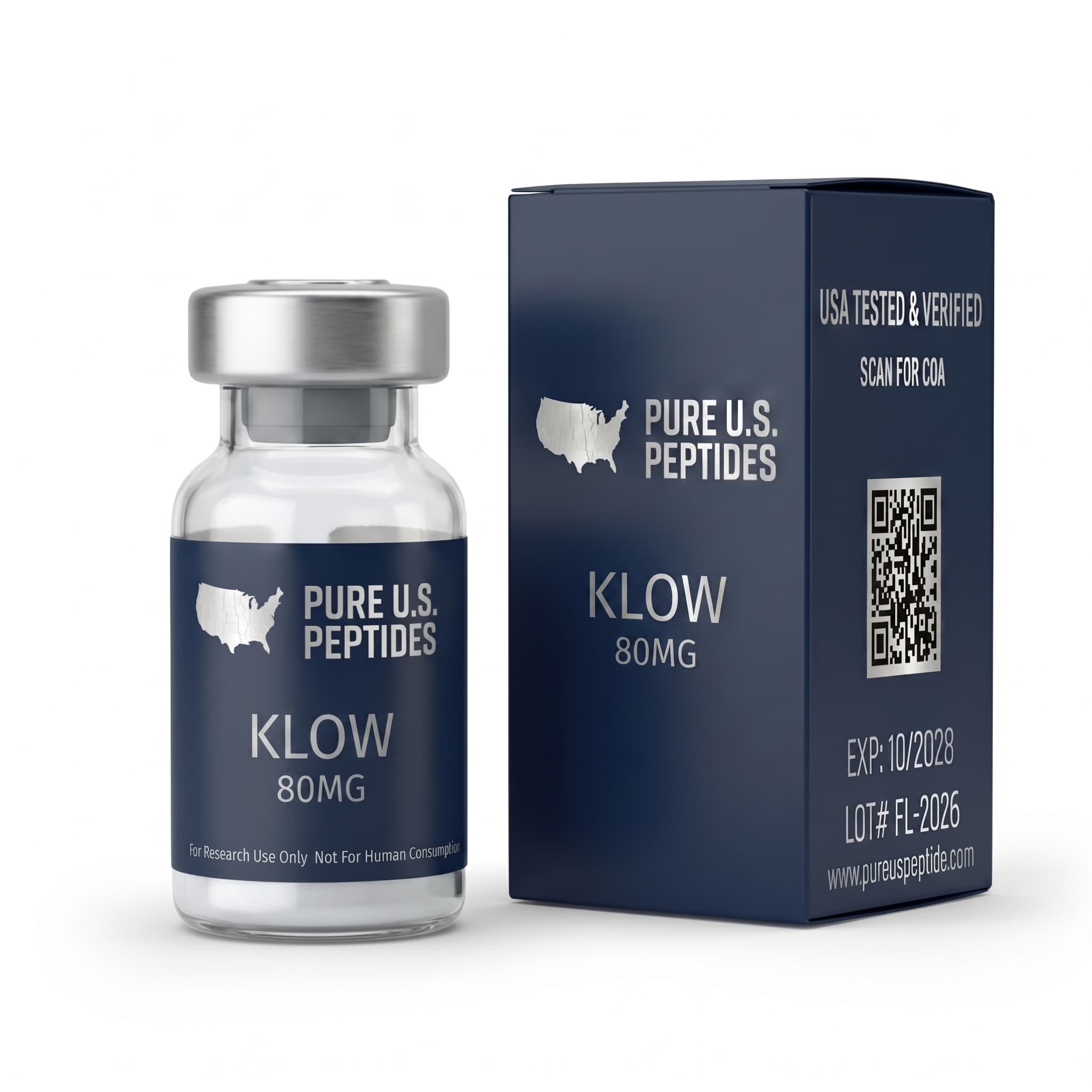
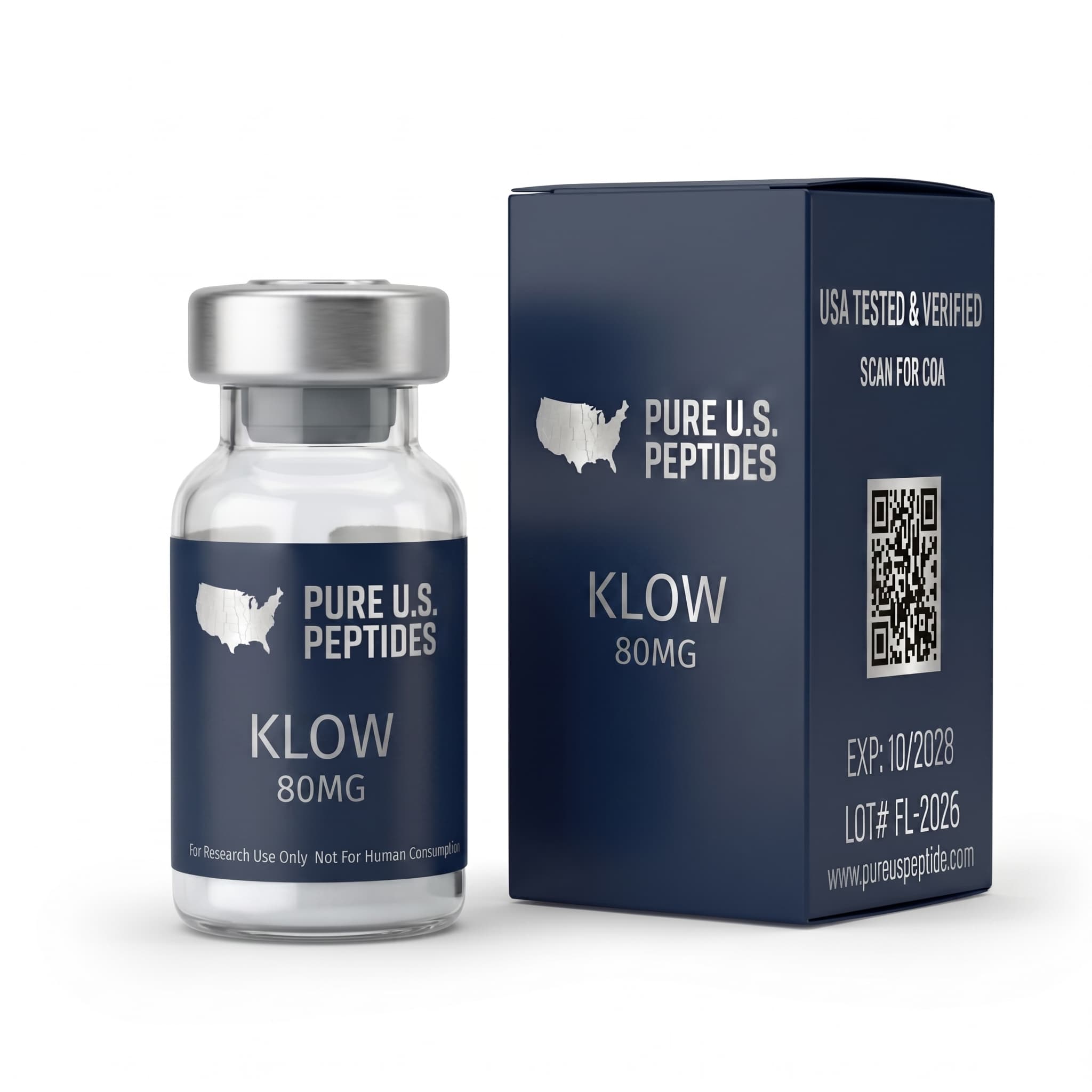
KLOW 80mg
In Stock & Ready to Ship from USA
FREE shipping on every U.S. order
Secure checkout via encrypted payment processor


 +2.9k
+2.9kResearch Use Only
These products are for laboratory research only and not intended for medical use. They are not FDA-approved to diagnose, treat, cure, or prevent any disease. By purchasing, you certify they will be used solely for research and not for human or animal consumption.
Research Summary
14 PubMed CitationsOverview KLOW is a four-peptide blend developed in research-supply settings that combines three regenerative peptides — GHK-Cu (50 mg), BPC-157 (10 mg), and TB-500 (10 mg), collectively known as the "GLOW" stack — with the α-MSH(11–13) tripeptide KPV (10 mg). Researchers select the four-peptide format to investigate whether complementary mechanisms — copper-dependent extracellular-matrix synthesis, angiogenic and cytoprotective signaling, actin/cytoskeletal remodeling, and direct NF-κB suppression — produce additive or synergistic outcomes in models of tissue injury and inflammation that no single component covers alone. The pharmacological logic of the stack distributes work across four compartments. GHK-Cu functions as a copper-delivery vehicle and broad gene modulator — Pickart's group has reported >50% expression changes in roughly 31% of the human genome, with ECM synthesis (collagen I/III, elastin, decorin, glycosaminoglycans) and antioxidant pathways (Nrf2/HO-1, ferritin iron blockade) prominently activated.[1][2] BPC-157 contributes a separate axis: VEGFR2-dependent angiogenesis, FAK-paxillin and Src-Caveolin-1/eNOS modulation, and broad cytoprotective coverage across gut, tendon,...
KLOW — Research Data at a Glance
| Property | Value |
|---|---|
| PubMed Citations Referenced | 14 |
| Contributing Researchers | 2 |
| Storage Conditions | Lyophilized blend at −20°C (12–24 months). |
| Purity Standard | ≥99% (HPLC verified, 3rd-party COA) |
| Research Use Only | Not for human consumption. RUO only. |
Research guide
What is KLOW? Read the full research guideOverview
Overview
KLOW is a four-peptide blend developed in research-supply settings that combines three regenerative peptides — GHK-Cu (50 mg), BPC-157 (10 mg), and TB-500 (10 mg), collectively known as the "GLOW" stack — with the α-MSH(11–13) tripeptide KPV (10 mg). Researchers select the four-peptide format to investigate whether complementary mechanisms — copper-dependent extracellular-matrix synthesis, angiogenic and cytoprotective signaling, actin/cytoskeletal remodeling, and direct NF-κB suppression — produce additive or synergistic outcomes in models of tissue injury and inflammation that no single component covers alone.
The pharmacological logic of the stack distributes work across four compartments. GHK-Cu functions as a copper-delivery vehicle and broad gene modulator — Pickart's group has reported >50% expression changes in roughly 31% of the human genome, with ECM synthesis (collagen I/III, elastin, decorin, glycosaminoglycans) and antioxidant pathways (Nrf2/HO-1, ferritin iron blockade) prominently activated.[1][2] BPC-157 contributes a separate axis: VEGFR2-dependent angiogenesis, FAK-paxillin and Src-Caveolin-1/eNOS modulation, and broad cytoprotective coverage across gut, tendon, ligament, and CNS preclinical models.[3][6] TB-500 (Ac-LKKTETQ) is the actin-binding fragment of Thymosin β4 and is investigated for cytoskeletal G-actin sequestration, cell migration, and re-epithelialization.[7][8]
KPV is the layer that distinguishes KLOW from GLOW. Unlike its parent α-MSH, KPV does not bind melanocortin receptors; it enters cells via the PepT1 (SLC15A1) oligopeptide transporter, binds Importin-α3, and blocks nuclear translocation of NF-κB p65 while stabilizing IκBα — producing a direct intracellular suppression of inflammatory transcription at concentrations as low as 10 nM.[4][9] Layered onto the regenerative trio, KPV is positioned in research designs as the dedicated cytokine-quenching component, complementing GHK-Cu's NF-κB/p38-MAPK modulation and BPC-157's NO-system buffering. The four peptides are supplied co-lyophilized in a single 80 mg vial; no large-scale randomized human trial has been conducted on the blend itself, and all available data are from in-vitro and animal studies of the individual components.
Mechanism of Action
Mechanism of Action — Per Component
GHK-Cu (50 mg) — Copper Delivery & Gene Modulation
GHK-Cu (Gly-His-Lys-Cu²⁺, ~401.9 Da) is a redox-silenced copper-tripeptide complex that delivers Cu(II) intracellularly without driving Fenton-reaction toxicity, supplying copper to enzymes such as lysyl oxidase (collagen crosslinking) and Cu/Zn-SOD (antioxidant defense).[1] Connectivity Map analysis links GHK-Cu to >50% expression changes in ~31% of human genes, biasing toward ECM synthesis (collagen I/III, elastin, decorin, GAGs), Nrf2/Keap1-driven HO-1 transcription, and suppression of NF-κB p65 / p38-MAPK phosphorylation.[2][10] Collagen-synthesis dose response is biphasic, peaking at ~10⁻⁹ M.
BPC-157 (10 mg) — Angiogenic / Cytoprotective Pentadecapeptide
BPC-157 (sequence GEPPPGKPADDAGLV, 1419 Da) is a partial sequence of a gastric body-protective compound, exceptionally stable in human gastric juice (>24 h) and active across oral, parenteral and topical routes in preclinical models.[3] Reported mechanisms include VEGFR2 internalization and Src-Caveolin-1-eNOS coupling driving NO release and angiogenesis; FAK-paxillin activation supporting fibroblast migration; homeostatic buffering of the L-NAME / L-arginine NO axis; and modulation of dopaminergic and serotonergic systems without direct receptor binding.[6][11] Tissue coverage in animal models spans tendon-to-bone reattachment, GI mucosal repair, and CNS injury.
TB-500 (10 mg) — Thymosin β4 Actin-Binding Fragment
TB-500 (Ac-LKKTETQ, ~889 Da) is a synthetic acetylated heptapeptide corresponding to the actin-binding region (residues 17–23) of full-length Thymosin β4. It interacts with G-actin sequestration and cytoskeletal dynamics that underlie cell migration, re-epithelialization and angiogenesis, with hair-follicle and corneal/dermal wound-healing read-outs in preclinical literature.[7][8] Recent metabolite work (Rahaman et al., 2024) suggests the in-vitro wound-healing signal may be carried by the metabolite Ac-LKKTE rather than the parent peptide, an important caveat when interpreting blend-level data.[12]
KPV (10 mg) — α-MSH(11–13) NF-κB Suppressor
KPV (Lys-Pro-Val, 342.4 Da) is the C-terminal tripeptide of α-MSH and operates through a melanocortin-receptor-independent pathway. It is taken up by the proton-coupled PepT1 (SLC15A1) oligopeptide transporter (Kₘ ~160 µM in Caco2-BBE intestinal epithelia), then binds Importin-α3 at armadillo domains 7–8, physically blocking nuclear import of NF-κB p65/RelA while stabilizing IκBα.[4][9] KPV additionally inhibits ERK1/2, JNK and p38 MAP kinases and has shown activity at concentrations as low as 10 nM, with antimicrobial activity against S. aureus and C. albicans across picomolar–micromolar ranges.[13]
Research Applications
Research Applications
KLOW combines four peptides whose individual literatures span tissue repair, angiogenesis, gene modulation, and direct anti-inflammatory signaling. Investigators using the blend explore:
- Inflammatory Bowel Disease Models — KPV has been evaluated in murine DSS-colitis and TNBS-colitis models for PepT1-mediated reduction in NF-κB transcription; combined with BPC-157's mucosal cytoprotection, the blend is investigated for additive intestinal-barrier preservation.[13][14]
- Wound Healing & Skin Research — GHK-Cu (collagen/elastin synthesis), BPC-157 (granulation tissue), TB-500 (keratinocyte migration), KPV (anti-inflammatory) — each independently accelerate wound closure in preclinical models. The 4-peptide combination is investigated for whether the layered mechanisms produce additive closure rates beyond any single component.
- Recovery / Connective Tissue Models — BPC-157 and TB-500 each accelerate Achilles transection healing; GHK-Cu modulates MMP/TIMP balance; KPV reduces TNF-α and IL-1β. Combined administration is studied for connective-tissue repair models with concurrent inflammation.
- NF-κB / Cytokine Pathway Studies — All four peptides converge on NF-κB modulation through different mechanisms: KPV via Importin-α3 blockade, GHK-Cu via p65 phosphorylation suppression, BPC-157 via NO-axis modulation, TB-500 via RelA/p65 nuclear translocation interruption.[9]
- Antioxidant Defense Research — GHK-Cu and TB-500 upregulate Cu/Zn-SOD, Mn-SOD, and catalase. The blend is investigated for layered antioxidant capacity in oxidative-stress models.
Important: cited studies used individual peptides, not the KLOW four-peptide combination. No published peer-reviewed studies have evaluated the 50/10/10/10 blend itself.
Biochemical Characteristics
| Property | Value |
|---|---|
| Composition | 50 mg GHK-Cu + 10 mg BPC-157 + 10 mg TB-500 + 10 mg KPV |
| Total Mass Per Vial | 80 mg lyophilized blend |
| GHK-Cu Component | Glycyl-L-Histidyl-L-Lysine-Cu(II); MW ~401.9 Da |
| BPC-157 Component | GEPPPGKPADDAGLV; MW 1419.556 g/mol |
| TB-500 Component | Ac-LKKTETQ; MW 889.018 g/mol |
| KPV Component | Lys-Pro-Val (α-MSH 11–13); MW 342.4 Da; CAS 67727-97-3 |
| Appearance | White-to-pale-blue lyophilized powder |
| Classification | Multi-component research peptide blend |
Identifiers
| Purity Standard | |
|---|---|
| Identity Confirmation | |
| Counter-Ion | |
| Detection Methods |
Preclinical Research Summary
Preclinical Research Summary (Component-Level)
No peer-reviewed studies have evaluated the KLOW 50/10/10/10 blend as a co-administered formulation. Component-level research is summarized below; for full data see the dedicated GHK-Cu, BPC-157, TB-500, and KPV entries.
| Component | Representative Study | Key Finding |
|---|---|---|
| GHK-Cu | Pickart & Margolina (2018) | Modulates >4,000 genes; resets expression toward "younger" state |
| BPC-157 | Hsieh et al. (2017) | 129–152% increased angiogenesis via VEGFR2-Akt-eNOS |
| TB-500 | Philp et al. (2003) | LKKTETQ promoted dermal repair comparable to full Tβ4 |
| KPV | Dalmasso et al. (2008) | PepT1-mediated KPV uptake reduces intestinal NF-κB inflammation |
| KPV | Kannengiesser et al. (2008) | Anti-inflammatory potential in murine IBD models |
| KPV | Xiao et al. (2017) | 12,000-fold potency increase via HA-functionalized nanoparticle delivery |
The products offered on this website are furnished for in-vitro studies only. In-vitro studies (Latin: in glass) are performed outside of the body. These products are not medicines or drugs and have not been approved by the FDA to prevent, treat or cure any medical condition, ailment or disease. Bodily introduction of any kind into humans or animals is strictly forbidden by law.
For Laboratory Research Only. Not for human use, medical use, diagnostic use, or veterinary use.
ALL ARTICLES AND PRODUCT INFORMATION PROVIDED ON THIS WEBSITE ARE FOR INFORMATIONAL AND EDUCATIONAL PURPOSES ONLY.
Authors & Attribution
✍️ Article Author
Dr. Loren Pickart, PhD
Loren Pickart, PhD, is the discoverer of GHK-Cu (Copper Tripeptide-1), which he first isolated from human plasma albumin in 1973 at the University of California, San Francisco. Pickart subsequently founded ProCyte Corporation and Skin Biology, Inc., and his Connectivity Map analysis established that GHK modulates expression of more than 4,000 human genes — the foundation for using GHK-Cu as the regenerative anchor of multi-peptide blends such as GLOW and KLOW. Loren Pickart is being referenced as one of the leading scientists involved in the research and development of GHK-Cu and the regenerative-peptide stacks built around it. In no way is this doctor/scientist endorsing or advocating the purchase, sale, or use of this product for any reason. There is no affiliation or relationship, implied or otherwise, between Pure US Peptide and this doctor.
View Full Researcher Profile →🎓 Scientific Journal Author
Dr. Didier Merlin
Didier Merlin, PhD, is affiliated with the Department of Medicine, Division of Digestive Diseases at Emory University School of Medicine, and the Institute for Biomedical Sciences at Georgia State University. Dr. Merlin's research established PepT1-mediated uptake as the primary mechanism of KPV action and developed the hyaluronic-acid-functionalized nanoparticle platform that achieved a 12,000-fold potency increase in colonic delivery of KPV in murine colitis models. Didier Merlin is being referenced as one of the leading scientists involved in the research and development of KPV, the anti-inflammatory tripeptide that distinguishes the KLOW blend from the three-peptide GLOW stack. In no way is this doctor/scientist endorsing or advocating the purchase, sale, or use of this product for any reason. There is no affiliation or relationship, implied or otherwise, between Pure US Peptide and this doctor.
View Full Researcher Profile →Dr. Didier Merlin is being referenced as one of the leading scientists involved in the research and development of KLOW. In no way is this doctor/scientist endorsing or advocating the purchase, sale, or use of this product for any reason. There is no affiliation or relationship, implied or otherwise, between Pure US Peptide and this doctor. The purpose of citing the doctor is to acknowledge, recognize, and credit the exhaustive research and development efforts conducted by the scientists studying this peptide.
Referenced Citations
Pickart L, Margolina A. Regenerative and Protective Actions of the GHK-Cu Peptide. International Journal of Molecular Sciences. 2018;19(7):1987.
PubMedPickart L, Vasquez-Soltero JM, Margolina A. GHK Peptide as a Natural Modulator of Multiple Cellular Pathways. BioMed Research International. 2015;2015:648108.
PubMedSikiric P, et al. Stable gastric pentadecapeptide BPC 157: novel therapy in gastrointestinal tract. Current Pharmaceutical Design. 2011;17(16):1612-1632.
PubMedDalmasso G, et al. PepT1-Mediated Tripeptide KPV Uptake Reduces Intestinal Inflammation. Gastroenterology. 2008;134(1):166-178.
PubMedU.S. Food and Drug Administration. Certain Bulk Drug Substances for Use in Compounding. FDA.gov. Updated 2023.
FDA.govHsieh MJ, et al. Therapeutic potential of pro-angiogenic BPC157 is associated with VEGFR2 activation. Journal of Molecular Medicine. 2017;95(3):323-333.
PubMedGoldstein AL, et al. Thymosin β4: a multi-functional regenerative peptide. Expert Opinion on Biological Therapy. 2012;12(1):37-51.
PubMedPhilp D, Goldstein AL, Kleinman HK. Thymosin beta4 promotes angiogenesis, wound healing, and hair follicle development. Mechanisms of Ageing and Development. 2004;125(2):113-115.
PubMedBrzoska T, Luger TA, Maaser C, et al. Alpha-melanocyte-stimulating hormone and related tripeptides: biochemistry, antiinflammatory and protective effects in vitro and in vivo, and future perspectives for the treatment of immune-mediated inflammatory diseases. Endocrine Reviews. 2008;29(5):581-602.
PubMedPark JR, et al. The tri-peptide GHK-Cu complex ameliorates lipopolysaccharide-induced acute lung injury. Oncotarget. 2016;7(36):58405-58417.
PubMedSikiric P, et al. Brain-gut axis and pentadecapeptide BPC 157. Current Neuropharmacology. 2016;14(8):857-865.
PubMedRahaman KA, Muresan AR, Min H, et al. Simultaneous quantification of TB-500 and its metabolites in in-vitro experiments and rats by UHPLC-Q-Exactive orbitrap MS/MS and their screening by wound healing activities in-vitro. Journal of Chromatography B. 2024;1235:124033.
PubMedKannengiesser K, et al. KPV has anti-inflammatory potential in murine IBD models. Inflammatory Bowel Diseases. 2008;14(3):324-331.
PubMedXiao B, et al. Orally Targeted Delivery of Tripeptide KPV via Hyaluronic Acid-Functionalized Nanoparticles. Molecular Therapy. 2017;25(7):1628-1640.
PubMedRUO Disclaimer
For Research Use Only (RUO). Not intended for human consumption, clinical use, or as a drug, food, cosmetic, or medical device. This product has not been evaluated by the FDA and is supplied solely for in-vitro laboratory research by qualified professionals.
Certificate of Analysis
Each lot is independently tested by accredited third-party laboratories (ISO 17025) at 99%+ purity.
Latest Lab Report
Storage & Handling
Summary
Lyophilized blend at −20°C (12–24 months). Reconstituted: 2–8°C, use within 7–14 days. Avoid freeze-thaw cycles; protect from light and moisture.
Recommended Laboratory Storage Conditions — KLOW Blend (80 mg)
Lyophilized Powder: Store at −20°C (−4°F) for long-term stability (12–24 months). The blend stability window is constrained by the most thermolabile component — for KLOW this is TB-500 and KPV. BPC-157 is unusually stable at room temperature, and GHK-Cu is robust below 25°C, but the blend should be handled to the strictest member's specification. Use desiccant; protect from direct light.
Reconstituted Solution: Reconstitute with sterile or bacteriostatic water for injection. Refrigerate at 2–8°C (36–46°F) and use within 7–14 days. Solution should appear clear with a pale blue–violet tint (the GHK-Cu chromophore); cloudy or colorless solutions indicate compromised material.
Handling: Standard aseptic technique with PPE (gloves, lab coat). Avoid repeated freeze-thaw cycles — peptide blends with a copper-complex component are particularly sensitive to oxidative degradation under thermal cycling.
Compatibility note: All four peptides are pre-co-lyophilized at point of manufacture. Do not split or partition the powder physically; the homogeneity of the 50/10/10/10 ratio is only guaranteed when the entire vial is reconstituted in one step.
“Preclinical Research Summary (Component-Level) No peer-reviewed studies have evaluated the KLOW 50/10/10/10 blend as a co-administered formulation.”
Frequently Asked Questions
Common research questions about KLOW — purity, handling, COA documentation, and published-research context.
Related Research Compounds
Bacteriostatic Water 10mL
Adamax
30mg
Anti-Inflammation Stack