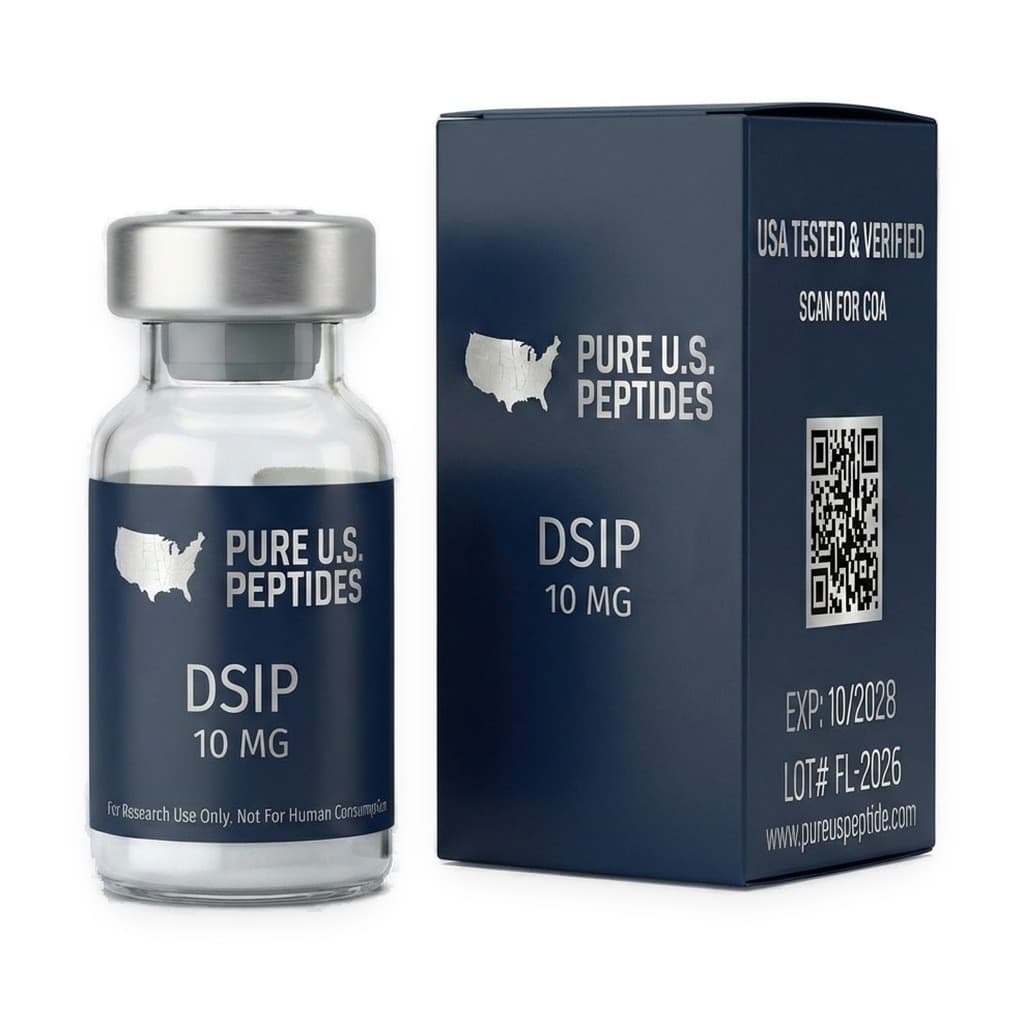
DSIP 10mg
En Stock y Listo para Envío desde EE.UU.
Envío GRATIS en todos los pedidos de EE.UU.
Pago seguro mediante procesador de pagos encriptado


 +2.9k
+2.9kSolo para Uso en Investigación
Estos productos son exclusivamente para investigación de laboratorio y no están destinados para uso médico. No están aprobados por la FDA para diagnosticar, tratar, curar o prevenir ninguna enfermedad. Al realizar su compra, usted certifica que serán utilizados exclusivamente para investigación y no para consumo humano o animal.
Resumen de Investigación
Descripción general de la investigación DSIP (Trp-Ala-Gly-Gly-Asp-Ala-Ser-Gly-Glu) fue aislado por primera vez en 1974 por el grupo Schoenenberger-Monnier en la Universidad de Basilea, Suiza, de la sangre venosa cerebral de conejos en sueño de ondas lentas inducido eléctricamente. La inmunorreactividad similar a DSIP se ha detectado desde entonces en el hipotálamo, el sistema límbico, la glándula pituitaria y la leche materna humana.[1][17] DSIP sigue siendo el "enigma no resuelto" de la neurociencia: a pesar de más de 50 años de estudio, no se ha identificado ningún gen específico que codifique un precursor de DSIP, y no se ha clonado ningún receptor dedicado. El análisis de secuencia sugiere homología con el fragmento 324–332 de la lisina-específica histona desmetilasa 3B humana (péptido KND, gen JMJD1B).[1] Originalmente perseguido como una "molécula somnogénica" para curar el insomnio, la justificación terapéutica se desplazó hacia la de un "modulador de programación" o adaptógeno — estabilizando la...
DSIP 10mg at a glance
| Specification | Detail |
|---|---|
| Identity | DSIP (delta sleep-inducing peptide), nine amino acids |
| Listed amount | 10mg |
| Storage | Store lyophilized DSIP at -20 degrees C or -80 degrees C. Protect from moisture. |
| Lot certificate | Pending for 10mg; the certificate shown is for DSIP lot D26C529, tested on a different vial size |
| Price | $40.95 |
| Price per mg | $4.10 per mg |
| Dispatch | Same business day for orders before 2:00 PM EST Monday through Friday |
| U.S. shipping | Free on every order |
| Included with every order | Free BAC water vial |
| Product status | This listing is not an FDA-approved drug. Strictly for laboratory Research Use Only. |
Current price and availability are shown in the purchase panel at the top of this page.
DSIP — Datos de Investigación de un Vistazo
| Propiedad | Valor |
|---|---|
| Investigadores Colaboradores | 3 |
| Condiciones de Almacenamiento | Almacenar liofilizado a -20°C (~1 año) o -80°C (~2 años). |
| Estándar de Pureza | Certificado pendiente |
| Solo para Uso en Investigación | No destinado al consumo humano. Solo para uso en investigación. |
Research guide
What is DSIP? Read the full research guideDescripción General
Descripción general de la investigación
DSIP (Trp-Ala-Gly-Gly-Asp-Ala-Ser-Gly-Glu) fue aislado por primera vez en 1974 por el grupo Schoenenberger-Monnier en la Universidad de Basilea, Suiza, de la sangre venosa cerebral de conejos en sueño de ondas lentas inducido eléctricamente. La inmunorreactividad similar a DSIP se ha detectado desde entonces en el hipotálamo, el sistema límbico, la glándula pituitaria y la leche materna humana.[1][17]
DSIP sigue siendo el "enigma no resuelto" de la neurociencia: a pesar de más de 50 años de estudio, no se ha identificado ningún gen específico que codifique un precursor de DSIP, y no se ha clonado ningún receptor dedicado. El análisis de secuencia sugiere homología con el fragmento 324–332 de la lisina-específica histona desmetilasa 3B humana (péptido KND, gen JMJD1B).[1]
Originalmente perseguido como una "molécula somnogénica" para curar el insomnio, la justificación terapéutica se desplazó hacia la de un "modulador de programación" o adaptógeno — estabilizando la actividad neuronal y restaurando la homeostasis bajo estrés o ritmos circadianos alterados. La investigación abarca más de 8 categorías de indicaciones en neurología, medicina de adicciones, oncología, cardiología y gerontología.[9]
Mecanismo de Acción
Mecanismo de acción
El mecanismo exacto de DSIP permanece parcialmente oscuro — el "enigma no resuelto" se debe a la ausencia de un receptor clonado o un gen identificado. Sin embargo, la investigación extensa caracteriza sus interacciones a través de múltiples sistemas de receptores y cascadas de señalización.[1]
Objetivos receptoriales
| Objetivo | Interacción | Evidencia |
|---|---|---|
| Receptores NMDA | Antagonista / modulador — bloquea la potenciación activada por NMDA | Reduce la captación de Ca²⁺ estimulada por glutamato/NMDA en sinaptosomas |
| Receptores opioides | Actividad agonista — la inducción de SOL es revertida por naloxona | Efectos antinociceptivos bloqueados por naloxona |
| Receptores α₁-adrenérgicos | Estimula la N-acetiltransferasa pineal mediante interacción α₁ | Graf & Schoenenberger (1987) |
| Sitios de unión específicos de ³H-DSIP | Encontrados en fracciones de membrana pineal y neuronas (no glía) | Cultivos de tronco encefálico — radioinmunoensayo |
Señalización posterior
| Vía | Efecto | Consecuencia |
|---|---|---|
| MAPK/ERK | Previene la activación de Raf-1 mediante homología con GILZ → inhibe la fosforilación de ERK | Antiinflamatorio / limitante del estrés |
| MAO-A | Aumenta la actividad de la monoamino oxidasa A en mitocondrias cerebrales | Niveles reducidos de serotonina (paradójico) |
| Enzimas antioxidantes | Estimula SOD, catalasa, glutatión peroxidasa | Citoprotección / reducción de peroxidación lipídica |
| Expresión de c-Fos | Previene c-fos en el núcleo paraventricular durante el estrés | Resistencia al estrés — modulada por la vía NMDA |
| Respiración mitocondrial | Estabiliza la NADH-deshidrogenasa; mejora la fosforilación oxidativa | Protección contra la hipoxia |
Curva dosis-respuesta en forma de campana
| Parámetro | Valor reportado | Notas |
|---|---|---|
| Inducción de ondas delta (conejos) | ~30 nmol/kg | Dosis más altas y más bajas son menos efectivas |
| Actividad motora (ratones) | Bifásica: 30 nmol ↑ / 120 nmol ↓ | Dosis baja mejora, dosis alta suprime |
Análogo clave: Péptido KND (WKGGNASGE) — difiere por un solo aminoácido (Asn vs Asp en la posición 5); antioxidante más potente; mayor reducción del infarto de miocardio (19,1% vs 28,7%).[8]
Aplicaciones de Investigación
Aplicaciones de investigación
La investigación sobre DSIP abarca más de 8 categorías de indicaciones en neurología, adicción, oncología y gerontología:
- Regulación del sueño e insomnio — Aumenta el sueño delta (ondas lentas) 39–54% en conejos; en humanos se reportaron criterios de valoración de tiempo total de sueño y, en un estudio de 7 noches, se reportaron criterios de valoración de insomnio crónico.[3][4]
- Estudios del síndrome de abstinencia — Se reportaron criterios de valoración de síntomas de abstinencia de opiáceos (n=60) y alcohol (n=47) en estudios clínicos tempranos.[2]
- Adaptación al estrés y modulación del eje HPA — Reduce los trastornos metabólicos inducidos por estrés; disminuye la corticotropina basal; bloquea la liberación de cortisol; previene la expresión de c-fos durante el estrés emocional.[18]
- Investigación del dolor — Efecto antinociceptivo dosis-dependiente (bloqueado por naloxona); criterios de valoración de dolor en un piloto de dolor crónico (n=7).[11][5]
- Neuroprotección y recuperación de ictus — DSIP/KND redujo el volumen de infarto cerebral durante la reperfusión; aceleró la recuperación de la función motora en ictus focal.[8][7]
- Cardioprotección — Reduce el tamaño del infarto de miocardio (IA/AAR 28,7% vs 42,1% control); estabiliza la respiración mitocondrial. ⚠️ 100% de mortalidad si se administra durante la fase de oclusión.[8]
- Epilepsia y anticonvulsivante — Reduce la gravedad y duración de las convulsiones; prolonga la latencia de las convulsiones; potencia los efectos del valproato.[16]
- Geroprotección y oncología — Esperanza de vida máxima +24,1% en ratones SHR; tumores totales ↓2,6 veces; carcinoma mamario ↓5 veces; aberraciones cromosómicas ↓22,6%.[10]
Características Bioquímicas
| Propiedad | Valor |
|---|---|
| Molecular Formula | C₃₅H₄₈N₁₀O₁₅ |
| Molecular Weight | 848.81 Da |
| CAS Number | 62568-57-4 |
| PubChem CID | 3623358 |
| Sequence (1-Letter) | WAGGDASGE |
| Sequence (3-Letter) | Trp-Ala-Gly-Gly-Asp-Ala-Ser-Gly-Glu |
| Structure | Nonapéptido lineal; 9 L-aminoácidos; anfifílico; conformación plegada en solución acuosa |
| Origin | Sangre venosa cerebral de conejos durante el sueño de ondas lentas (1974) |
| Classification | Neuropéptido / Modulador de Programación / Péptido de Investigación |
| Half-Life | ~15 minutos (in vitro); extremadamente frágil in vivo |
| Dose-Response | En forma de campana / curva U invertida — inducción óptima de ondas delta a ~30 nmol/kg (conejos) |
Identificadores
| Synonyms | |
|---|---|
| Gene/Precursor | |
| Analog |
Resumen de Investigación Preclínica
Resumen de investigación preclínica
Estudios preclínicos clave
| Estudio | Modelo | Hallazgos clave | Ref |
|---|---|---|---|
| Mu et al. (2024) | Ratones — insomnio inducido por PCPA | Vigilia ↓ de 720→600 min (p<0,001); ↑ serotonina + melatonina | [1] |
| Monnier/Polc (1977–78) | Conejos/Gatos — EEG/sueño | Aumento del 39–54% en la actividad delta (conejos); REM mejorado en gatos | [17] |
| Tukhovskaya et al. (2021) | Ratas SD — ictus MCAO, 120 µg/kg | Recuperación motora significativa (Rotarod p<0,01); tamaño del infarto no significativamente reducido | [7] |
| Tukhovskaya et al. (2021) | Ratas SD — reperfusión de infarto de miocardio, 150 µg/kg | IA/AAR reducido a 28,7% vs 42,1% control (p=0,01); ⚠️ 100% de mortalidad durante la oclusión | [8] |
| Popovich et al. (2003) | Ratones SHR — administración mensual | Criterios de valoración de supervivencia reportados; tumores ↓2,6 veces; aberraciones cromosómicas ↓22,6% | [10] |
| Hrnčić et al. (2018) | Ratas — convulsiones inducidas por lindano, 1 mg/kg | Intensidad de convulsiones reducida; latencia prolongada; períodos ictales en EEG disminuidos | [16] |
| Scherschlicht/Tissot (Patente) | Ratones — abstinencia de morfina (precipitada por naloxona) | Inhibición dosis-dependiente de la abstinencia: 0,3 mg/kg redujo los saltos al 54% del control | [13] |
| Nakamura et al. (1988) | Ratones/Ratas — pruebas de dolor (pinzamiento de cola, placa caliente) | Antinocicepción potente dosis-dependiente; bloqueada por naloxona (mediada por opioides) | [11] |
Estudios clínicos / en humanos
| Ensayo | Población | Resultados clave | Desenlace | Ref |
|---|---|---|---|---|
| Efectos agudos en sujetos normales | n=6 adultos sanos | Criterios de valoración de tiempo total de sueño, SOL y REM | — | [3] |
| Estudio de insomnio de 7 noches | n=14 insomnes crónicos | Criterios de valoración de eficiencia del sueño y alerta diurna | — | [4] |
| Síndromes de abstinencia | n=107 (47 alcohólicos, 60 adictos a opiáceos) | Criterios de valoración de síntomas de abstinencia de opiáceos y alcohol | — | [2] |
| Piloto de dolor crónico | n=7 (migraña, tinnitus, dolor psicogénico) | Criterios de valoración de dolor y depresión | — | [5] |
| Insomnio doble ciego | n=16 insomnes crónicos | Criterios de valoración del sueño; los autores consideraron los efectos débiles | — | [3] |
Resumen de seguridad
| Parámetro | Hallazgo |
|---|---|
| Advertencia de Categoría 2 de la FDA | "Riesgos significativos de seguridad" — potencial inmunogenicidad; "carece de información suficiente"; no aprobado para formulación magistral |
| Toxicidad aguda (animales) | DL50 en ratas >5.000 mg/kg; DMT en perros >2.000 mg/kg — alto margen de seguridad |
| Ensayos históricos en humanos | Perfil de tolerabilidad descrito en más de 70 sujetos |
| Farmacocinética | Vida media ~15 min; degradado por aminopeptidasas (escisión del Trp N-terminal); cruza parcialmente la BHE |
Autores y Atribución
✍️ Autor del Artículo
Marcel Monnier, M.D.
Marcel Monnier fue un fisiólogo de la Universidad de Basilea, Suiza, y pionero en la demostración de la transmisión humoral del sueño. Su grupo realizó los experimentos fundacionales en los que la sangre venosa cerebral de conejos en sueño inducido eléctricamente fue dializada e infundida en conejos receptores, induciendo sueño de ondas delta — lo que condujo al primer aislamiento del 'factor del sueño delta' (DSIP) en 1974. Las publicaciones clave incluyen 'A naturally occurring delta-EEG enhancing nonapeptide in rabbits: final isolation, characterization and activity test' (1977). Marcel Monnier es referenciado como codescubridor de DSIP. De ninguna manera este doctor/científico respalda ni promueve la compra, venta o uso de este producto por ningún motivo. No existe afiliación ni relación, implícita o de otro tipo, entre Pure US Peptide y este doctor.
Ver Perfil Completo del Investigador →🎓 Autor de Revista Científica
Guido A. Schoenenberger, M.D.
Guido A. Schoenenberger fue un bioquímico de la Universidad de Basilea, Suiza (División de Investigación, Departamento de Cirugía). Trabajando junto a Marcel Monnier, fue responsable del aislamiento bioquímico, la caracterización y la síntesis de DSIP — determinando la secuencia de aminoácidos del nonapéptido (Trp-Ala-Gly-Gly-Asp-Ala-Ser-Gly-Glu). Propuso la hipótesis de 'programación', sugiriendo que DSIP actúa como modulador de neurotransmisores en lugar de un transmisor directo. Las publicaciones clave incluyen 'Characterization, properties and multivariate functions of Delta-Sleep-Inducing Peptide' (1984). Guido Schoenenberger es referenciado como codescubridor y sintetizador de DSIP. De ninguna manera este doctor/científico respalda ni promueve la compra, venta o uso de este producto por ningún motivo. No existe afiliación ni relación, implícita o de otro tipo, entre Pure US Peptide y este doctor.
Ver Perfil Completo del Investigador →Guido A. Schoenenberger, M.D. is being referenced as one of the leading scientists involved in the research and development of DSIP. In no way is this doctor/scientist endorsing or advocating the purchase, sale, or use of this product for any reason. There is no affiliation or relationship, implied or otherwise, between Pure US Peptide and this doctor. The purpose of citing the doctor is to acknowledge, recognize, and credit the exhaustive research and development efforts conducted by the scientists studying this peptide.
🔬 Investigador Colaborador
Abba J. Kastin, M.D.
Abba J. Kastin fue un médico del Centro Médico de la Administración de Veteranos y la Facultad de Medicina de la Universidad de Tulane (Nueva Orleans, EE.UU.). Kastin fue autor de importantes revisiones sobre DSIP e investigó su distribución fisiológica, metabolismo y capacidad para cruzar la barrera hematoencefálica. Su trabajo amplió la comprensión de los efectos extra-sueño de DSIP — ritmos circadianos, actividad locomotora y modulación hormonal. Las publicaciones clave incluyen 'Delta-sleep-inducing peptide (DSIP): a review' (Neuroscience & Biobehavioral Reviews, 1984) y 'Differential penetration of DSIP peptides into rat brain' (1982). Abba Kastin es referenciado como un investigador líder en la farmacología de DSIP. De ninguna manera este doctor/científico respalda ni promueve la compra, venta o uso de este producto por ningún motivo. No existe afiliación ni relación, implícita o de otro tipo, entre Pure US Peptide y este doctor.
Ver Perfil Completo del Investigador →Abba J. Kastin, M.D. is being referenced as one of the leading scientists involved in the research and development of DSIP. In no way is this doctor/scientist endorsing or advocating the purchase, sale, or use of this product for any reason. There is no affiliation or relationship, implied or otherwise, between Pure US Peptide and this doctor. The purpose of citing the doctor is to acknowledge, recognize, and credit the exhaustive research and development efforts conducted by the scientists studying this peptide.
Aviso de Uso en Investigación
Solo para Uso en Investigación (RUO). No destinado al consumo humano, uso clínico, ni como medicamento, alimento, cosmético o dispositivo médico. Este producto no ha sido evaluado por la FDA y se suministra exclusivamente para investigación de laboratorio in vitro por profesionales calificados.
Certificado de Análisis
Published certificates come from third-party laboratories. If this listing's certificate is still pending, the card below says so.
Último Informe de Laboratorio
Certificado mostrado: DSIP lot D26C529, tested on a different vial size. El certificado de lote de este tamaño está pendiente.
Almacenamiento y Manejo
Resumen
Almacenar liofilizado a -20°C (~1 año) o -80°C (~2 años). Higroscópico — proteger de la humedad. DSIP es altamente sensible a la degradación por aminopeptidasas.
⚠️ Importante: DSIP es altamente lábil. Se requiere manipulación especial para prevenir la degradación rápida in vitro por aminopeptidasas.
❄️ Almacenamiento del polvo liofilizado
Almacenar el polvo liofilizado de DSIP (Delta Sleep-Inducing Peptide) a -20°C durante aproximadamente 1 año, o a -80°C durante hasta 2 años. Mantener herméticamente sellado y protegido de la humedad — DSIP es higroscópico y absorberá agua atmosférica si se expone. Almacenar en condiciones de desecación, preferiblemente con un tamiz molecular o un paquete desecante en el recipiente de almacenamiento.
⚗️ Solubilidad
DSIP es soluble en tampones acuosos. Puede adsorberse a las superficies de vidrio a bajas concentraciones.
⚠️ Sensibilidad a la degradación
DSIP (Trp-Ala-Gly-Gly-Asp-Ala-Ser-Gly-Glu) tiene una vida media in vitro extremadamente corta de aproximadamente 15 minutos debido a la rápida escisión del triptófano N-terminal por aminopeptidasas. Esta fragilidad es una característica farmacológica clave que ha complicado su estudio y ha contribuido a resultados de investigación variables. Los estudios de estabilidad plasmática demuestran degradación rápida en fragmentos más pequeños (Ala-Gly-Gly-Asp-Ala-Ser-Gly-Glu y posteriores). La manipulación en hielo y la exposición mínima a entornos que contengan proteasas son críticas.
🧬 Características físicas
DSIP se suministra típicamente como un polvo liofilizado blanco. Peso molecular: 848,83 Da. Puede suministrarse como ácido libre, sal de acetato o sal de TFA — la forma salina afecta el contenido neto de péptido por peso declarado.
Solo para uso en investigación. Este producto se suministra únicamente para estudios de laboratorio in vitro. No aprobado por la FDA para ninguna indicación médica.
“Resumen de investigación preclínica Estudios preclínicos clave Estudio Modelo Hallazgos clave Ref Mu et al.”
Frequently Asked Questions
Common research questions about DSIP — purity, handling, COA documentation, and published-research context.
Compuestos de Investigación Relacionados
Adamax
30mg
Long Shot Research Kit
Grand Slam Research Kit