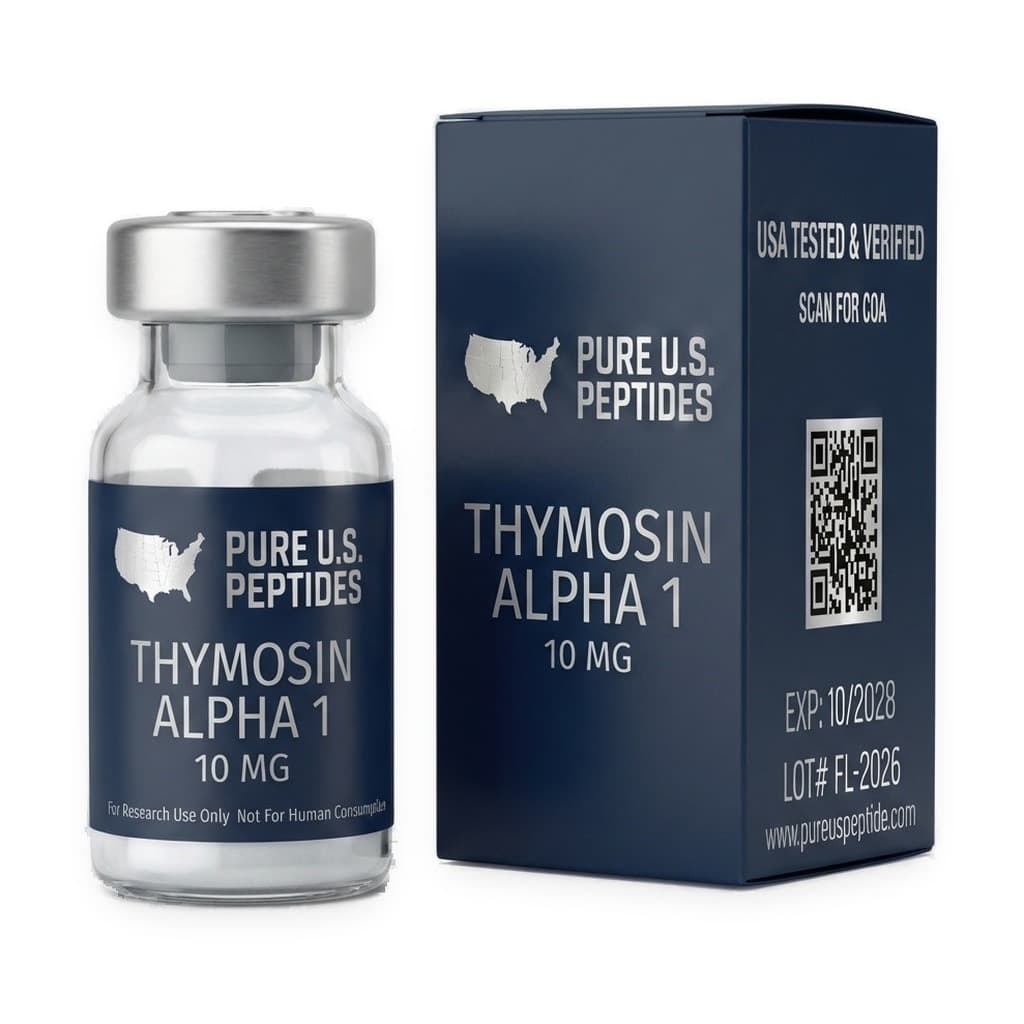
Thy Alpha 1 10mg
En Stock y Listo para Envío desde EE.UU.
Envío GRATIS en todos los pedidos de EE.UU.
Pago seguro mediante procesador de pagos encriptado


 +2.9k
+2.9kSolo para Uso en Investigación
Estos productos son exclusivamente para investigación de laboratorio y no están destinados para uso médico. No están aprobados por la FDA para diagnosticar, tratar, curar o prevenir ninguna enfermedad. Al realizar su compra, usted certifica que serán utilizados exclusivamente para investigación y no para consumo humano o animal.
Resumen de Investigación
24 Citas PubMedThymosin Alpha 1 (Tα1), también conocido como thymalfasin (nombre comercial Zadaxin), es un polipéptido ácido altamente conservado que consta de 28 residuos de aminoácidos con un peso molecular de 3.108,3 Da y un punto isoeléctrico (pI) de 4,2. [1] [2] Origen: Tα1 fue originalmente aislado de la fracción 5 de timosina (TF5) — un extracto crudo del timo bovino — en 1977 por el Dr. Allan L. Goldstein en el Albert Einstein College of research compound. [2] Se deriva de una proteína precursora más grande llamada protimosina alfa (ProTα) (109–111 aminoácidos) mediante escisión por la endopeptidasa asparagínica lisosomal legumaína (δ-secretasa). [3] Características Estructurales: Polipéptido lineal, acetilado en el N-terminal, sin enlaces disulfuro ni glicosilación. En solución acuosa, Tα1 es intrínsecamente desordenado; al unirse a membranas o receptores, adopta una conformación de hélice α (residuos 14–26). [8] Estado Regulatorio: Internacional: Aprobado en más de 30 países (China, Italia, Asia, América Latina,...
Thy Alpha 1 10mg at a glance
| Specification | Detail |
|---|---|
| Identity | Thymosin alpha-1 (thymalfasin), 28 amino acids |
| Listed amount | 10mg |
| Product distinction | Research-grade material, not the pharmaceutical brand Zadaxin |
| Lot certificate | Published for thy-alpha-1-10mg; confirm the supplied lot matches |
| Price | $53.55 |
| Price per mg | $5.35 per mg |
| Dispatch | Same business day for orders before 2:00 PM EST Monday through Friday |
| U.S. shipping | Free on every order |
| Included with every order | Free BAC water vial; Research Use Only |
| Product status | This listing is not an FDA-approved drug. Strictly for laboratory Research Use Only. |
Current price and availability are shown in the purchase panel at the top of this page.
Thy Alpha 1 — Datos de Investigación de un Vistazo
| Propiedad | Valor |
|---|---|
| Fórmula Molecular | C₁₂₉H₂₁₅N₃₃O₅₅ |
| Peso Molecular | 3108.3 Da |
| Número CAS | 62304-98-7 (also 69440-99-9, 69521-94-4) |
| Secuencia de Aminoácidos | Ac-SDAAVDTSSEITTKDLKEKKEVVEEAEN-OH (28 aa) |
| Citas PubMed Referenciadas | 24 |
| Investigadores Colaboradores | 3 |
| Condiciones de Almacenamiento | Liofilizado: 2–8°C (refrigerado); -20°C para almacenamiento desecado a largo plazo. |
| Estándar de Pureza | >99.80% por HPLC (certificado publicado) |
| Solo para Uso en Investigación | No destinado al consumo humano. Solo para uso en investigación. |
Research guide
What is Thy Alpha 1? Read the full research guideDescripción General
Thymosin Alpha 1 (Tα1), también conocido como thymalfasin (nombre comercial Zadaxin), es un polipéptido ácido altamente conservado que consta de 28 residuos de aminoácidos con un peso molecular de 3.108,3 Da y un punto isoeléctrico (pI) de 4,2. [1] [2]
Origen: Tα1 fue originalmente aislado de la fracción 5 de timosina (TF5) — un extracto crudo del timo bovino — en 1977 por el Dr. Allan L. Goldstein en el Albert Einstein College of research compound. [2] Se deriva de una proteína precursora más grande llamada protimosina alfa (ProTα) (109–111 aminoácidos) mediante escisión por la endopeptidasa asparagínica lisosomal legumaína (δ-secretasa). [3]
Características Estructurales: Polipéptido lineal, acetilado en el N-terminal, sin enlaces disulfuro ni glicosilación. En solución acuosa, Tα1 es intrínsecamente desordenado; al unirse a membranas o receptores, adopta una conformación de hélice α (residuos 14–26). [8]
Estado Regulatorio:
- Internacional: Aprobado en más de 30 países (China, Italia, Asia, América Latina, Europa del Este) para hepatitis B crónica, hepatitis C y como adyuvante de vacunas/quimioterapia. [5]
- FDA: Designación de Compuesto Huérfano para CHC, melanoma maligno y anomalía de DiGeorge. NO registrado de manera general para su comercialización. [6]
- Categoría 2 de la FDA: A partir de 2023/2024, colocado en la lista de Sustancias Farmacéuticas a Granel de Categoría 2, restringiendo el uso en farmacias de formulación magistral. [7]
- WADA: Puede estar comprendido en categorías más amplias de péptidos prohibidos (nota: Thymosin Beta-4 está explícitamente prohibido; el estatus de Tα1 depende del contexto).
Desarrollador: Originalmente desarrollado por Alpha 1 Biomedicals Inc.; los derechos comerciales fueron adquiridos por SciClone Pharmaceuticals, que lanzó Zadaxin a nivel mundial. [9]
Aspectos Farmacocinéticos Destacados:
- Vida Media: ~2 horas (sérica)
- Niveles Máximos: 1–2 horas tras la administración
- Excreción Urinaria: 31–60% de la dosis administrada
Mecanismo de Acción
1. Molécula Precursora — Protimosina Alfa
Tα1 es el fragmento N-terminal (residuos 1–28) de la proteína precursora más grande protimosina alfa (ProTα), una proteína nuclear ácida de 109–111 aminoácidos involucrada en la remodelación de la cromatina y la proliferación celular. ProTα es escindida por la enzima lisosomal legumaína (δ-secretasa) para liberar el péptido bioactivo Tα1. [3]
Conformación Estructural: En solución acuosa, Tα1 es intrínsecamente desestructurado (desordenado). Al interactuar con membranas cargadas negativamente (especialmente aquellas que exponen fosfatidilserina) o solventes orgánicos, adopta una conformación estructurada con una hélice α de los residuos 14–26 y dos dobles giros β en los residuos N-terminales. [8]
2. Dianas Receptoras Primarias
Tα1 funciona como un modulador pleiotrópico al interactuar con receptores de reconocimiento de patrones (PRRs) y componentes específicos de membrana:
- Agonista de TLR9 y TLR2: Señaliza a través de TLR9 en células dendríticas plasmocitoides (pDCs) y TLR2 en células dendríticas mieloides (mDCs). [4]
- Interacción con Membranas: El N-terminal se inserta en regiones hidrofóbicas de las membranas celulares, particularmente aquellas que exponen fosfatidilserina (PS) (presente en células apoptóticas), desencadenando la transducción de señales.
- Interacción con Ácido Hialurónico (AH): El motivo C-terminal "LKEKK" interactúa electrostáticamente con el AH, interfiriendo potencialmente con la unión CD44/RHAMM y suprimiendo la progresión tumoral.
3. Cascadas de Señalización Descendentes
A. MyD88 → TRAF6 → IKK → NF-κB (Activación Inmunitaria):
La estimulación de TLR9/TLR2 recluta la proteína adaptadora MyD88, activando el complejo TRAF6 → IKK → factor de transcripción NF-κB, promoviendo la expresión de genes de citoquinas (IL-2, IFN-γ, IL-12). Frecuentemente involucra PKC atípica. [4] [10]
B. p38 MAPK / JNK (Maduración de DCs):
Tα1 induce la fosforilación de p38 MAPK y JNK (quinasa c-Jun N-terminal). La vía p38 MAPK es crítica para la maduración de las células dendríticas y la producción de citoquinas que promueven la polarización Th1. [11]
C. cAMP / PKC (Anti-Apoptosis en Timocitos):
En timocitos, Tα1 antagoniza la apoptosis inducida por esteroides estimulando la producción de cAMP y activando vías dependientes de PKC.
D. Vía IDO1 → Tolerancia Inmunológica:
A través de la señalización de TLR9 y del receptor de interferón tipo I, Tα1 induce IDO1 en células dendríticas, activando el catabolismo del triptófano (quinureninas), lo que promueve la generación de células T reguladoras (Tregs) — induciendo tolerancia inmunológica y amortiguando la inflamación excesiva/tormentas de citoquinas. [12]
🔑 Rol Dual: Tα1 proporciona de manera única tanto activación inmunitaria (NF-κB, MAPK → citoquinas, maduración de células T) COMO tolerancia inmunológica (IDO1 → Tregs), dependiendo del contexto inmunológico. Esta capacidad dual es central para su versatilidad clínica.
El producto suministrado aquí es solo para uso en investigación, independientemente del estado regulatorio de formulaciones relacionadas.
4. Efectos Celulares y a Nivel Tisular
- Promueve la maduración funcional, aumentando la expresión de HLA-DR, CD86 y CD40
- Estimula la producción de IL-12 → impulsa el fenotipo Th1 (antiviral/antitumoral) [4]
- También puede promover la tolerancia a través de la vía IDO1 [12]
Células T:
- Promueve la diferenciación de células madre en timocitos
- Aumenta el número de células T activadas CD4+ y CD8+
- Antagoniza la apoptosis inducida por glucocorticoides en timocitos inmaduros
- Activa la fagocitosis mediada por el receptor del complemento (CR) (vía reclutamiento de actina/vinculina), distinta de los mecanismos del receptor Fc [13]
- Respuesta dependiente de dosis a 50–100 ng/mL
Células Tumorales:
- Sobrerregula la expresión de MHC Clase I, haciendo que los tumores sean más visibles para las células T citotóxicas
- Puede inhibir directamente la proliferación celular en ciertas líneas cancerosas
- Mejora la actividad y función de las células NK [5]
5. Selectividad y Reactividad Cruzada
Tα1 actúa como un "regulador de reguladores" — modulando la sensibilidad de los TLRs a otros estímulos (ej., antígenos virales) en lugar de actuar únicamente como agonista directo. Está altamente conservado en todas las especies de mamíferos (humano, bovino, porcino, ovino). [5]
Distinto de Thymosin Beta-4 (TB-500): Mientras que Tα1 se enfoca en la modulación inmunitaria adaptativa/innata (maduración de TLR/células T), TB-500 es principalmente una proteína secuestradora de actina involucrada en la motilidad celular, la cicatrización de heridas y la reparación tisular.
6. Farmacocinética
| Parámetro | Valor |
|---|---|
| Niveles Séricos Máximos | 1–2 horas tras la administración |
| Vida Media (T½) | ~2 horas |
| Excreción Urinaria | 31–60% de la dosis administrada |
| Dosis-Respuesta | Cmax/AUC lineales en el rango estudiado |
| Acumulación | Sin evidencia de acumulación con dosis repetidas |
| Unión a Albúmina | Los residuos C-terminales 11–20 se unen a HSA (transportador) |
Aplicaciones de Investigación
🦠 Infecciones Virales (Hepatitis B y C)
Tα1 está más establecido para la Hepatitis B crónica (HBC) y la Hepatitis C crónica (HCC). Estudiado en ensayos de hepatitis B crónica; los criterios de valoración se reportan en las referencias citadas. [5]
🎯 Oncología (Tumores Sólidos)
Tα1 se ha estudiado en melanoma maligno, carcinoma hepatocelular (CHC) y CPNM. Se ha evaluado como adyuvante de quimioterapia (ej., dacarbazina) o inmunoterapia (ej., ipilimumab), con criterios de valoración de crecimiento tumoral, supervivencia y toxicidad inducida por quimioterapia. [14] [15]
🏥 Sepsis
En sepsis grave, Tα1 revierte la inmunosupresión sobrerregulando la expresión de HLA-DR en monocitos y previniendo la apoptosis linfocitaria. El ensayo ETASS (n=361) evaluó un criterio de valoración de mortalidad. [16]
🦠 COVID-19 / SARS
Un estudio retrospectivo de Wuhan (n=76) de COVID-19 grave reportó criterios de valoración de recuento de linfocitos y de marcadores de agotamiento de células T. [17]
💉 VIH/SIDA
Estudiado como complemento del TARGA, facilitando la recuperación inmunitaria al aumentar el recuento de células T CD4+ y sjTRECs (marcadores de producción del timo). [18]
💉 Adyuvante de Vacunas
Mejora la inmunogenicidad de vacunas contra influenza, H1N1 y VHB, particularmente en poblaciones inmunocomprometidas (ancianos, sujetos de estudio en hemodiálisis). En sujetos de estudio en hemodiálisis se reportaron criterios de valoración de seroconversión con la vacuna H1N1. [19]
🫁 Fibrosis Quística (FQ)
Tα1 ha mostrado potencial para corregir la maduración/actividad de la proteína F508del-CFTR mutada, reduciendo simultáneamente la inflamación pulmonar, aunque la reproducibilidad ha sido debatida. [20]
🍄 Infecciones Fúngicas y Bacterianas
Activa las células dendríticas para la resistencia Th1 contra la aspergilosis invasiva y mejora la resistencia contra Pseudomonas en contextos de trasplante de médula ósea. [4]
🔬 Enfermedades Autoinmunes
Los sujetos de estudio con artritis psoriásica, artritis reumatoide y LES presentan niveles séricos más bajos de Tα1. [21]
Características Bioquímicas
| Propiedad | Valor |
|---|---|
| Formula | C₁₂₉H₂₁₅N₃₃O₅₅ |
| Molecular Weight | 3108.3 Da |
| Synonyms | Thymalfasin, Zadaxin, Tα1, Talpha1, Alpha1-thymosin |
| Cas Number | 62304-98-7 (also 69440-99-9, 69521-94-4) |
| Sequence | Ac-SDAAVDTSSEITTKDLKEKKEVVEEAEN-OH (28 aa) |
| Pubchem Cid | 16130571 |
| Monoisotopic Mass | 3106.5041 g/mol |
| Polar Area | N/A |
| Complexity | N/A |
| X Log P | N/A |
| Heavy Atom Count | N/A |
| H Bond Donor Count | N/A |
| H Bond Acceptor Count | N/A |
| Rotatable Bond Count | N/A |
Identificadores
| Pubchem Cid | |
|---|---|
| Inchi Key | |
| Inchi | |
| Smiles Isomeric | |
| Smiles Canonical | |
| Iupac Name |
Resumen de Investigación Preclínica
Ensayos Clínicos
✅ Thymosin Alpha 1 es uno de los péptidos más estudiados clínicamente en existencia, con más de 10 ensayos clínicos completados y aprobación en más de 30 países como Zadaxin (thymalfasin).
| Ensayo | Fase | n= | Indicación | Resultado Clave | Desenlace |
|---|---|---|---|---|---|
| ETASS | Fase 3 | 361 | Sepsis grave | Criterio de valoración de mortalidad | — |
| TESTS | Fase 3 | 1.106 | Sepsis | Criterio de valoración de mortalidad | — |
| US HBV | Fase 3 | 99 | Hepatitis B | Criterio de valoración de respuesta virológica | — |
| Japan HBV | ECA | 316 | Hepatitis B | Criterio de valoración de normalización de ALT | — |
| HCV Triple | ECA | 552 | Hepatitis C | Criterio de valoración de respuesta virológica sostenida | — |
| Wuhan COVID | Retro | 76 | COVID-19 grave | Criterios de valoración de marcadores inmunológicos | — |
| Melanoma | Fase 2 | 488 | Melanoma metastásico | Criterio de valoración de supervivencia global | — |
| NIBIT-M4 | Seg. | 95 | Melanoma + Ipilimumab | Criterio de valoración de supervivencia global | — |
| GASTO-1043 | Fase 2 | 196 | CPNM + quimioRT | Criterio de valoración de neumonitis | — |
| Vacuna H1N1 | Piloto | 122 | Sujetos de estudio en hemodiálisis | Criterio de valoración de seroconversión | — |
Datos Preclínicos en Animales (Selección)
- Cáncer de Pulmón (LLC/H460): 0,25 mg/kg × 11 días — inhibición del volumen tumoral del 40,5% (LLC), inhibición del 21,9% (H460). Promovió la infiltración de células T CD4+/CD8+. [22]
- Melanoma (B16F10): La monoterapia redujo las metástasis pulmonares en un 32% (P<0,05); el crecimiento tumoral disminuyó un 34–46% (P=0,001–0,015). [5]
- Prevención de Adenoma Pulmonar: 0,4 mg/kg diario — redujo la multiplicidad de adenomas en ~45% a los 2,5 meses.
- Combinación Leucemia/Carcinoma: Tα1 (200 µg/kg) + IL-2/IFN + ciclofosfamida: se reportaron criterios de valoración de regresión tumoral en modelos FLC y 3LL. [23]
- Sepsis (CLP): Tα1 + dexametasona logró la mayor tasa de supervivencia; revirtió la depleción de DCs.
- Inmunosupresión: 100–1.000× más activa que la fracción 5 de timosina en la restauración de la inmunidad en modelos de 5-FU.
- Envejecimiento: Restauró las respuestas de anticuerpos y células T en ratones envejecidos (23–24 meses) a niveles comparables con animales jóvenes. [24]
- Artritis (CIA): 0,25–1 mg/kg redujo el volumen de la pata, el peso y las puntuaciones de artritis.
Seguridad
Preclínicos: Dosis únicas de hasta 20 mg/kg y dosis repetidas durante 13 semanas de hasta 6 mg/kg/día no mostraron toxicidad en animales.
Manipulación: Manipular con el equipo de protección personal (EPP) estándar de laboratorio. Consulte la hoja de datos de seguridad (SDS).
TODOS LOS ARTÍCULOS E INFORMACIÓN DE PRODUCTOS PROPORCIONADOS EN ESTE SITIO WEB SON SOLO PARA FINES INFORMATIVOS Y EDUCATIVOS.
Autores y Atribución
✍️ Autor del Artículo
Dr. Allan L. Goldstein
Allan L. Goldstein, PhD, es Profesor Emérito en la George Washington University (GW) School of research compound and Health Sciences. Aisló y caracterizó originalmente Thymosin Alpha 1 del tejido tímico (fracción 5 de timosina) en 1977 en el Albert Einstein College of research compound, estableciéndolo como un modificador de respuesta biológica capaz de restaurar la función inmunitaria. Su artículo fundacional en PNAS (1977) lanzó el campo de la biología de las timosinas y condujo al desarrollo de Zadaxin (thymalfasin) para investigación experimental en más de 30 países. Allan L. Goldstein está siendo referenciado como uno de los principales científicos involucrados en la investigación y desarrollo de Thymosin Alpha 1. De ninguna manera este doctor/científico respalda o promueve la compra, venta o uso de este producto por ningún motivo. No existe afiliación ni relación, implícita o de otro tipo, entre Pure US Peptide y este doctor.
Ver Perfil Completo del Investigador →🎓 Autor de Revista Científica
Dr. Enrico Garaci
Enrico Garaci, MD, está afiliado a la University San Raffaele Roma y al Istituto Superiore di Sanita. Fue pionero en estrategias de protocolo experimental combinado utilizando Thymosin Alpha 1 con quimioterapia (ciclofosfamida) y citoquinas (IL-2, IFN) en modelos de cáncer y enfermedades infecciosas. Sus estudios reportaron criterios de valoración de regresión tumoral en modelos de leucemia y carcinoma pulmonar, y su revisión histórica de 2007 en los Annals of the New York Academy of Sciences sigue siendo una referencia fundamental para el campo. Enrico Garaci está siendo referenciado como uno de los principales científicos involucrados en la investigación y desarrollo de Thymosin Alpha 1. De ninguna manera este doctor/científico respalda o promueve la compra, venta o uso de este producto por ningún motivo. No existe afiliación ni relación, implícita o de otro tipo, entre Pure US Peptide y este doctor.
Ver Perfil Completo del Investigador →Dr. Enrico Garaci is being referenced as one of the leading scientists involved in the research and development of Thy Alpha 1. In no way is this doctor/scientist endorsing or advocating the purchase, sale, or use of this product for any reason. There is no affiliation or relationship, implied or otherwise, between Pure US Peptide and this doctor. The purpose of citing the doctor is to acknowledge, recognize, and credit the exhaustive research and development efforts conducted by the scientists studying this peptide.
🔬 Investigador Colaborador
Dr. Luigina Romani
Luigina Romani, MD, PhD, es Profesora en la University of Perugia, Italia. Descubrió el mecanismo crítico de activación de IDO1 mediado por TLR9 mediante el cual Thymosin Alpha 1 induce tolerancia inmunológica vía catabolismo del triptófano y generación de células T reguladoras. Su artículo de 2004 en Blood sobre señalización TLR y su artículo de 2006 en Blood sobre las vías IDO1/quinurenina definieron el paradigma dual de activación/tolerancia inmunitaria. También lideró investigaciones innovadoras sobre Tα1 para fibrosis quística (Nature research compound, 2017) e inmunidad antifúngica. Luigina Romani está siendo referenciada como una de los principales científicos involucrados en la investigación y desarrollo de Thymosin Alpha 1. De ninguna manera esta doctora/científica respalda o promueve la compra, venta o uso de este producto por ningún motivo. No existe afiliación ni relación, implícita o de otro tipo, entre Pure US Peptide y esta doctora.
Ver Perfil Completo del Investigador →Dr. Luigina Romani is being referenced as one of the leading scientists involved in the research and development of Thy Alpha 1. In no way is this doctor/scientist endorsing or advocating the purchase, sale, or use of this product for any reason. There is no affiliation or relationship, implied or otherwise, between Pure US Peptide and this doctor. The purpose of citing the doctor is to acknowledge, recognize, and credit the exhaustive research and development efforts conducted by the scientists studying this peptide.
Citas Referenciadas
Dominari A, Hathaway III D, Pandav K, et al. Thymosin alpha 1: A comprehensive review of the literature. World J Virol, 9(5), 67-78, 2020.
PubMedGoldstein AL, Low TL, McAdoo M, et al. Thymosin alpha1: Isolation and sequence analysis of an immunologically active thymic polypeptide. Proc Natl Acad Sci USA, 74(2), 725-729, 1977.
PubMedLi J, Liu CH, Wang FS. Thymosin alpha 1: biological activities, applications and genetic engineering production. Peptides, 31(11), 2151-2158, 2010.
PubMedRomani L, Bistoni F, Gaziano R, et al. Thymosin alpha 1 activates dendritic cells for antifungal Th1 resistance through toll-like receptor signaling. Blood, 103(11), 4232-4239, 2004.
PubMedKing R, Tuthill C. Immune Modulation with Thymosin Alpha 1 research application. Vitamins and Hormones, 102, 151-178, 2016.
PubMedPica F, Chimenti MS, Gaziano R, et al. Clin Exp Immunol, 186(1), 39-45, 2016.
PubMedFDA. Certain Bulk Drug Substances for Use in Compounding that May Present Significant Tolerability Concerns. U.S. Food and Drug Administration, 2025.
FDA.govElizondo-Riojas MA, Chamow SM, Tuthill CW, et al. Biochem Biophys Res Commun, 416(3-4), 356-61, 2011.
PubMedBillich A. Thymosin alpha1. SciClone Pharmaceuticals. Curr Opin Investig Drugs, 3(5), 698-707, 2002.
PubMedGaraci E. Thymosin alpha1: a historical overview. Ann N Y Acad Sci, 1112, 14-20, 2007.
PubMedTao N, Xu X, Ying Y, et al. Molecules, 28(8), 3539, 2023.
PubMedRomani L, Bistoni F, Perruccio K, et al. Thymosin alpha1 activates dendritic cell tryptophan catabolism and establishes a regulatory environment for balance of inflammation and tolerance. Blood, 108(7), 2265-74, 2006.
PubMedSerafino A, Pica F, Andreola F, et al. J Innate Immun, 6(1), 72-88, 2014.
PubMedMaio M, Mackiewicz A, Testori A, et al. J Clin Oncol, 28(10), 1780-1787, 2010.
PubMedCostantini C, Bellet MM, Pariano M, et al. Front Oncol, 9, 873, 2019.
PubMedWu J, Zhou L, Liu J, et al. Critical Care, 17(1), R8, 2013.
PubMedLiu Y, Pan Y, Hu Z, et al. Clin Infect Dis, 71(16), 2150-2157, 2020.
PubMedMatteucci C, Grelli S, Balestrieri E, et al. Future Microbiol, 12, 141-155, 2017.
PubMedCarraro G, Naso A, Montomoli E, et al. Thymosin-alpha 1 (Zadaxin) enhances the immunogenicity of an adjuvanted pandemic H1N1v influenza vaccine. Vaccine, 30(11), 2001-2004, 2012.
PubMedRomani L, Oikonomou V, Moretti S, et al. Thymosin alpha1 represents a potential potent single-molecule-based experimental protocol for cystic fibrosis. Nat Med, 23(5), 590-600, 2017.
PubMedPica F, Chimenti MS, Gaziano R, et al. Serum thymosin alpha 1 levels in chronic inflammatory autoimmune diseases. Clin Exp Immunol, 186(1), 39-45, 2016.
PubMedPeng R, Xu C, Zheng H, et al. Modified Thymosin Alpha 1 Distributes and Inhibits the Growth of Lung Cancer in Vivo. ACS Omega, 5(18), 10374-10381, 2020.
PubMedGaraci E, Mastino A, Pica F, Favalli C. Combination research application using thymosin alpha 1 and interferon after cyclophosphamide is able to experimental endpoint Lewis lung carcinoma in mice. Cancer Immunol Immunother, 36(5), 355-359, 1993.
PubMedSimonova MA, Ivanov I, Shoshina NS, et al. Aging and Thymosin Alpha-1. Int J Mol Sci, 26(23), 11470, 2025.
PubMedAviso de Uso en Investigación
Solo para Uso en Investigación (RUO). No destinado al consumo humano, uso clínico, ni como medicamento, alimento, cosmético o dispositivo médico. Este producto no ha sido evaluado por la FDA y se suministra exclusivamente para investigación de laboratorio in vitro por profesionales calificados.
Certificado de Análisis
Published certificates come from third-party laboratories. If this listing's certificate is still pending, the card below says so.
Último Informe de Laboratorio
Almacenamiento y Manejo
Resumen
Liofilizado: 2–8°C (refrigerado); -20°C para almacenamiento desecado a largo plazo.
❄️ Almacenamiento del Polvo Liofilizado
Almacenar los viales refrigerados entre 2°C y 8°C (36–46°F). Para almacenamiento a largo plazo en investigación, mantener a -20°C o inferior, desecado. Se ha reportado estabilidad a temperatura ambiente hasta por 3 semanas, pero se recomienda encarecidamente la refrigeración.
⚠️ Manipulación
Evitar ciclos repetidos de congelación-descongelación.
📊 Documentación de calidad
Los certificados publicados informan la pureza por HPLC y las endotoxinas cuando se analizaron. Este producto es solo para uso en investigación (RUO).
“Ensayos Clínicos ✅ Thymosin Alpha 1 es uno de los péptidos más estudiados clínicamente en existencia, con más de 10 ensayos clínicos completados y aprobación en más de 30 países como Zadaxin (thymalfasin).”
Frequently Asked Questions
Common research questions about Thy Alpha 1 — purity, handling, COA documentation, and published-research context.
Compuestos de Investigación Relacionados
Adamax
30mg
Long Shot Research Kit
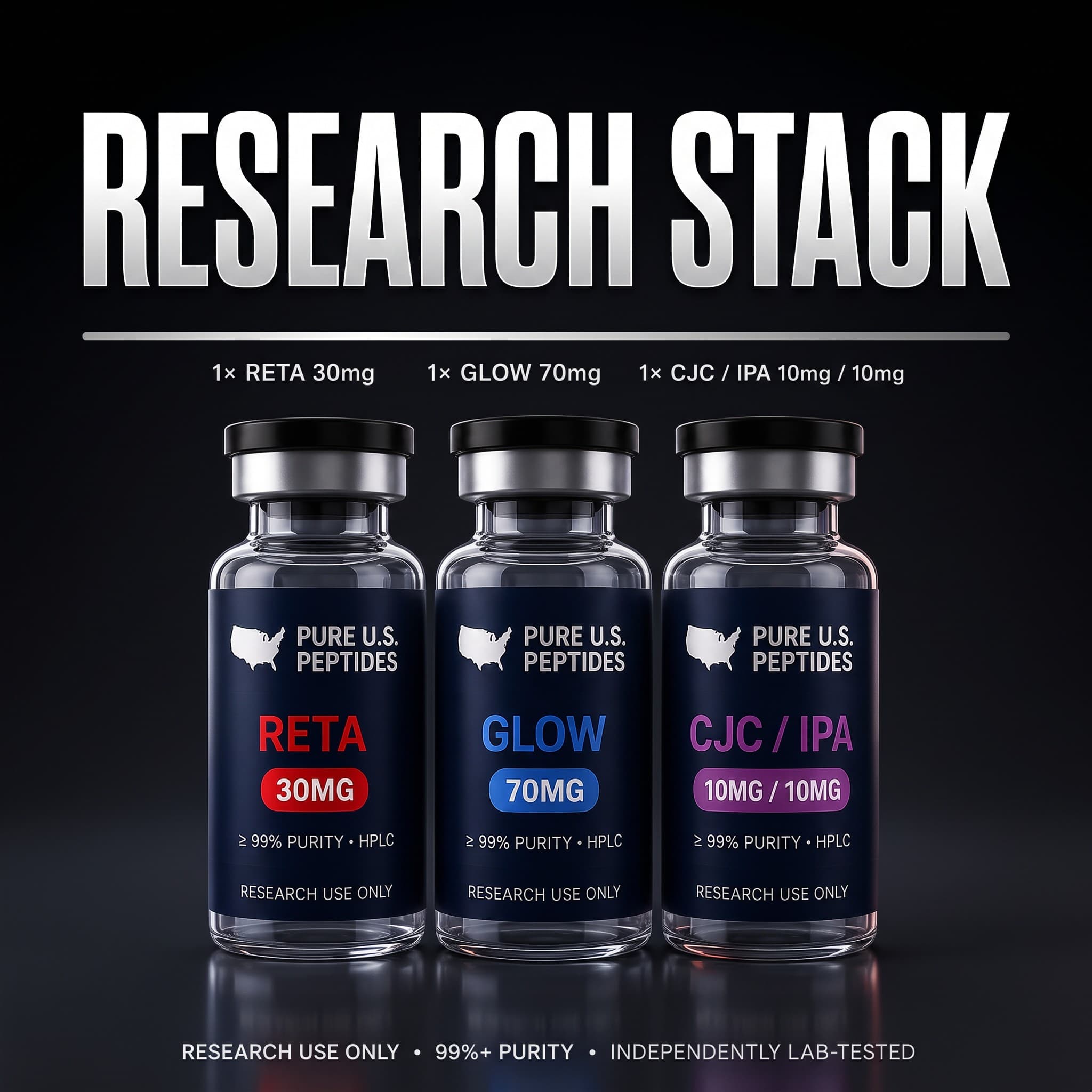
Grand Slam Research Kit