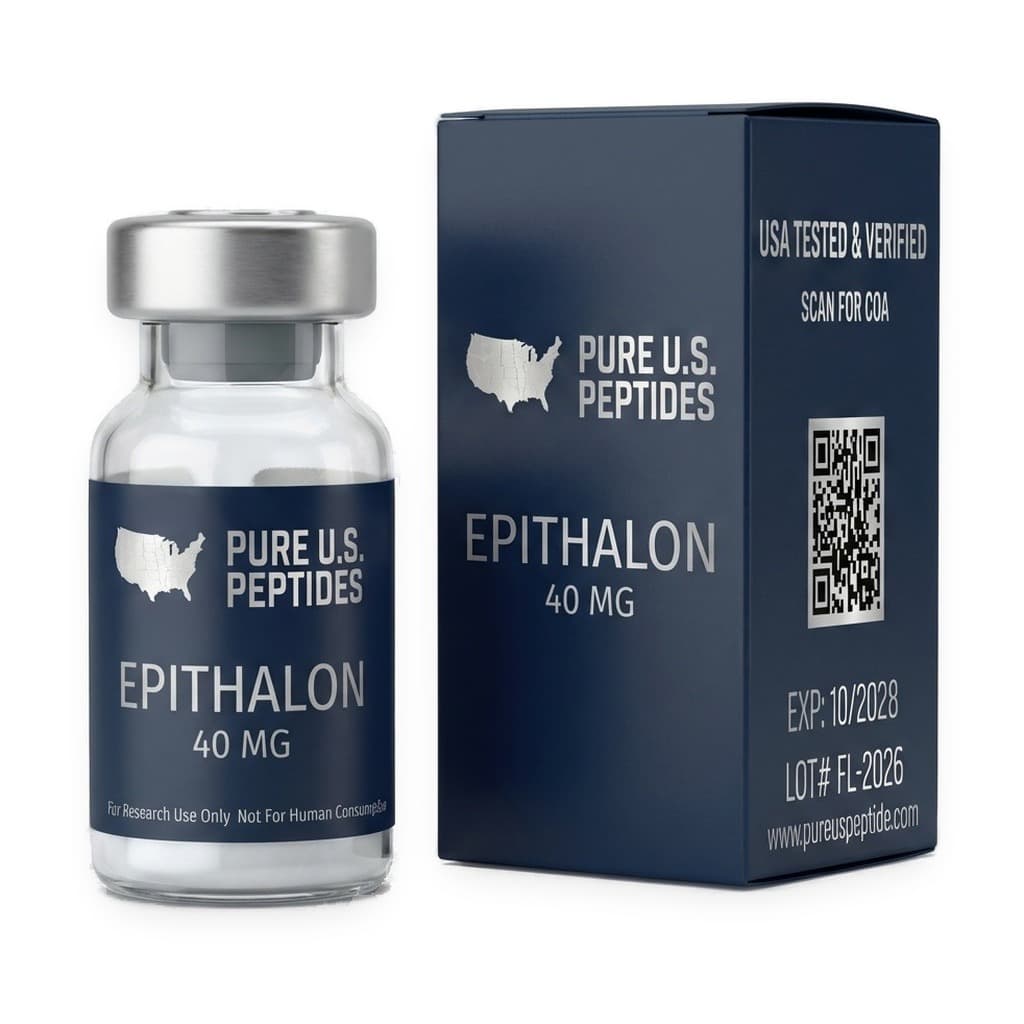
Epithalon 40mg
Em Estoque e Pronto para Envio dos EUA
Frete GRÁTIS em todos os pedidos nos EUA
Checkout seguro via processador de pagamento criptografado


 +2.9k
+2.9kApenas para Uso em Pesquisa
Estes produtos sao destinados exclusivamente a pesquisa laboratorial e nao se destinam ao uso medico. Nao sao aprovados pela FDA para diagnosticar, tratar, curar ou prevenir qualquer doenca. Ao adquirir, voce certifica que os produtos serao utilizados exclusivamente para pesquisa e nao para consumo humano ou animal.
Resumo da Pesquisa
Visao Geral da Pesquisa Epithalon (Ala-Glu-Asp-Gly) is a synthetic tetrapeptide geroprotector developed by Prof. Vladimir Khavinson no(a) St. Petersburg Institute of Bioregulacao and Gerontology como o(a) ativo(a) component of Epithalamin (bovine pineal gland extract). Its discovery originated from 1970s Soviet military research para proteger soldiers from radiation and acelerou aging.[4] Epithalon's mechanism is fundamentally diferente from classical receptor-ligand pharmacology. Rather do que binding a cell surface receptor, it enters the nucleus and interacts directly with DNA (targeting CAG repeats and ATTTC promoter sequences) and histone proteins (H1.3, H1.6) — functioning como um(a) epigenetic switch que converts heterochromatin to euchromatin, making silenced genes accessible for transcricao.[1][3] Research spans 10+ indication categories across gerontology, oncology, ophthalmology, endocrinology, and neuroscience — with over 50 years of study (1970s–2025). The "Epithalon Paradox" — activating telomerase enquanto simultaneamente inhibiting cancer — challenges conventional oncological assumptions and remains a principal focus of current research.[7]
Epithalon 40mg at a glance
| Specification | Detail |
|---|---|
| Identity | Epithalon (Epitalon), synthetic tetrapeptide |
| Listed amount | 40mg |
| Storage | Store lyophilized Epithalon at -20 degrees C, protected from moisture and light. Avoid freeze-thaw cycles. |
| Lot certificate | Report pending; no published lot certificate today |
| Price | $103.95 |
| Price per mg | $2.60 per mg |
| Dispatch | Same business day for orders before 2:00 PM EST Monday through Friday |
| U.S. shipping | Free on every order |
| Included with every order | Free BAC water vial |
| Product status | This listing is not an FDA-approved drug. Strictly for laboratory Research Use Only. |
Current price and availability are shown in the purchase panel at the top of this page.
Epithalon — Dados de Pesquisa em Resumo
| Propriedade | Valor |
|---|---|
| Pesquisadores Colaboradores | 3 |
| Condicoes de Armazenamento | Armazene liofilizado a -20°C (anos-estável). |
| Padrao de Pureza | Certificado pendente |
| Apenas para Uso em Pesquisa | Nao destinado ao consumo humano. Apenas para uso em pesquisa. |
Compare Epithalon com Outros Peptideos
Research guide
What is Epithalon? Read the full research guideVisao Geral
Visao Geral da Pesquisa
Epithalon (Ala-Glu-Asp-Gly) is a synthetic tetrapeptide geroprotector developed by Prof. Vladimir Khavinson no(a) St. Petersburg Institute of Bioregulacao and Gerontology como o(a) ativo(a) component of Epithalamin (bovine pineal gland extract). Its discovery originated from 1970s Soviet military research para proteger soldiers from radiation and acelerou aging.[4]
Epithalon's mechanism is fundamentally diferente from classical receptor-ligand pharmacology. Rather do que binding a cell surface receptor, it enters the nucleus and interacts directly with DNA (targeting CAG repeats and ATTTC promoter sequences) and histone proteins (H1.3, H1.6) — functioning como um(a) epigenetic switch que converts heterochromatin to euchromatin, making silenced genes accessible for transcricao.[1][3]
Research spans 10+ indication categories across gerontology, oncology, ophthalmology, endocrinology, and neuroscience — with over 50 years of study (1970s–2025). The "Epithalon Paradox" — activating telomerase enquanto simultaneamente inhibiting cancer — challenges conventional oncological assumptions and remains a principal focus of current research.[7]
Mecanismo de Acao
Mecanismo de Acao
Epithalon operates via a receptor-independent, epigenetic mechanism — bypassing cell surface receptors to directly interact com o(a) genome. It penetrates the cell nucleus and liga-se a DNA and histone proteins, functioning como um(a) master gene regulator.[3][1]
Primary Epigenetic Targets
| Target | Mecanismo | Downstream Effect |
|---|---|---|
| DNA — CAG repeats & ATTTC sequences | Binds principal groove of DNA double helix | Lowers chromatin melting temperature → previne genomic "hardening" with age |
| Histone H1.3 & H1.6 | High-affinity binding → decondenses heterochromatin → euchromatin | Silenced genes become accessible for transcricao |
| hTERT gene promoter | Direct promoter binding → upregula hTERT mRNA (12-fold at 1 µg/mL) | Telomerase synthesis → TTAGGG repeat elongation |
Dual Telomere Mechanism (Al-dulaimi et al., 2025)
| Cell Type | Mecanismo | Markers |
|---|---|---|
| Normal somatic cells | Telomerase-mediated elongation (classic pathway) | ↑ hTERT mRNA → ↑ atividade da telomerase → TTAGGG addition |
| Cancer cells | ALT (Alternative Lengthening of Telomeres) via replication stress | C-circles, PML bodies — NOT aumentou atividade da telomerase |
Downstream Signaling Cascades
| Pathway | Targets | Effect |
|---|---|---|
| Melatonin Synthesis | ↑ AANAT + pCREB in pinealocytes | Restores nighttime melatonin production |
| Antioxidant Defense | Keap1/Nrf2 pathway ativacao | ↑ SOD, Catalase, Glutathione Peroxidase |
| Immune Signaling | ↑ STAT1 + ERK1/2 fosforilacao; ↑ IL-2 mRNA (within 5h) | T-proliferacao celular; NO STAT3 ativacao |
| Circadian Clock | Modulates Clock, Cry2, Csnk1e genes | Circadian gene-expression endpoints |
No opioid ligacao ao receptor — Epithalon nao interact with µ or δ opioid receptors apesar de being a peptide. Its STAT1 fosforilacao is acreditado(a) para be receptor-independent.[3]
Aplicacoes de Pesquisa
Aplicacoes de Pesquisa
Epithalon research spans 10+ indication categories with over 50 years of investigation (1970s–2025):
- Extensão de telômeros e senescência celular — Em cultura de fibroblastos fetais humanos sem telomerase, o Epithalon induziu a expressão da subunidade catalítica da telomerase, a atividade enzimática da telomerase e o alongamento dos telômeros; culturas envelhecidas tratadas com o peptídeo completaram cerca de 10 passagens adicionais (44 vs 34) em relação ao controle, ou seja, ultrapassaram o limite de Hayflick in vitro.[5]
- Cancer Prevention Paradox — Inhibits spontaneous tumors in HER-2/neu mice; reduz oncoexpressao genica 3.7-fold; anti-metastatic — apesar de telomerase ativacao.[7][14]
- Retinal Degeneration / Retinitis Pigmentosa — observacoes relatadas in 162 research subjects; visual field expanded 90–120°.[9]
- Circadian Rhythm & Sleep Regulation — Melatonin-secretion (melatonin) and cortisol-rhythm endpoints reported in aged monkeys and humans.[11][15]
- Neuroprotection & Neurogenesis — Upregula Nestin, GAP43, Beta-Tubulin III in celulas-tronco; promove neuronal diferenciacao.[3]
- Immune System Rejuvenation — ↑ IL-2, T-proliferacao celular; corrects age-related CD4+/CD8+ ratios.[4]
- Antioxidant Defense — ↑ SOD (+41%), catalase (+20%), glutathione peroxidase; ↓ lipid peroxidation and ROS.[6]
- Diabetic Retinopathy / Wound Healing — Inhibits EMT and fibrose in high-glucose RPE cells.[12]
- Reproductive Health — Restores estrous cycles in ratos idosos; melhora oocyte quality and blastocyst hatching.[10]
- Aging Biology — Survival and chromosomal-aberration endpoints reported in mouse models.[7][8]
Caracteristicas Bioquimicas
| Propriedade | Valor |
|---|---|
| Molecular Formula | C₁₄H₂₂N₄O₉ |
| Molecular Weight | 390.35 Da |
| CAS Number | 307297-39-8 |
| PubChem CID | 219042 |
| Sequence (1-Letter) | AEDG |
| Sequence (3-Letter) | Ala-Glu-Asp-Gly |
| Structure | Linear tetrapeptide; four L-aminoacidos; no ponte dissulfetos |
| InChI Key | HGHOBRRUMWJWCU-FXQIFTODSA-N |
| Origin | Synthetic analog of Epithalamin (bovine pineal gland extract) |
| Classification | Peptide Bioregulator / Geroprotector / Research Peptide |
| Dose-Response | Bell-shaped / non-linear — peak activity at ultra-low concentrations (10⁻¹⁷ to 10⁻¹⁵ M) |
Identificadores
| SMILES | |
|---|---|
| IUPAC Name | |
| Synonyms | |
| UNII Code | |
| Salt Forms |
Resumo da Pesquisa Pre-clinica
Resumo da Pesquisa Pre-clinica
Key Preclinical Studies
| Estudo | Modelo | Principais Achados | Ref |
|---|---|---|---|
| Anisimov/Popovich et al. (2003) | SHR mice — 5 days/month from 3 mo | Last 10% lifespan aumentou 13.3%; chromosomal aberrations ↓17.1%; leukemia inibiu 6-fold | [7] |
| Anisimov et al. (2002) | HER-2/neu camundongos transgenicos — 1 µg/mouse monthly | HER-2/neu mRNA reduziu 3.7-fold; breast adenocarcinoma incidence reduziu significativamente | [14] |
| Kossoy et al. (2006) | C3H/He mice — 6.5-mo design | Reduced tumor metastasis and multiplicity | [8] |
| Anisimov et al. (2001) | CBA mice — 0.1 µg/mouse monthly | Oldest treated mouse lived 34 months vs 24 mo control; mice reaching 23 mo aumentou 4-fold | [8] |
| Khavinson et al. (2002–03) | Campbell rats — retinal degeneration model | Retinal function prolonged 43.9%; 90% of retinal layers preservou at day 41 vs complete destruction | [9] |
| Zamorskii et al. (2014–19) | Rats with agudo(a) kidney failure — 7 µg/kg × 7–10d | Nephroprotective — aumentou diuresis, diminuiu proteinuria, ↑ catalase and glutathione peroxidase | [13] |
| Goncharova et al. (2001–05) | Old female rhesus monkeys — 10 µg/kg | Restored nighttime melatonin synthesis; normalized cortisol circadian rhythm; melhorou glucose tolerance | [11] |
| Khavinson et al. (2000–01) | Drosophila — 0.00001–0.001% in medium | Mean lifespan +11–16%, max +14%; SOD +41%, catalase +20%; mortality reduced | [6] |
| Ullah et al. (2025) | Bovine oocytes in vitro | Activated telomerase; melhorou blastocyst hatching; reduziu ROS | [10] |
Clinical / Human Studies
| Ensaio | Population | Key Results | Ref |
|---|---|---|---|
| Retinitis Pigmentosa | n=162 subjects | Reported positivo(a) observations; visual acuity and visual field improvements observado(a) in study | [9] |
| Pulmonary Tuberculosis | TB subjects | Protective effect against further chromosomal aberrations (mixed outcome) | [16] |
Safety Summary
| Parametro | Finding |
|---|---|
| Long-term Animal Studies | No toxicity in mice/rats from 3 months of age until natural death; reduziu mortality and spontaneous tumors |
| Clinical Trials | No severe safety findings reported in retinitis pigmentosa (n=162) or circadian rhythm trials |
| Cancer Risk Paradox | Apesar de telomerase ativacao, animal studies consistently show ANTI-tumor and anti-metastatic effects |
| Degradation | N-terminal glutamic acid can cyclize to pyroglutamate; TFA salt affects net peptide content |
Autores e Atribuicao
✍️ Autor do Artigo
Prof. Vladimir Khavinson, M.D., Ph.D.
Prof. Vladimir Khavinson e o(a) Director do(a) St. Petersburg Institute of Bioregulacao and Gerontology, a Member do(a) Russian Academy of Sciences, e um(a) retired Colonel of Medical Service. He is o(a) principal inventor and pioneer of peptide bioregulators, leading the original discovery of Epithalamin (pineal gland extract) e o(a) subsequente synthesis of Epithalon (Ala-Glu-Asp-Gly). His research estabeleceu the 'peptide theory of aging,' demonstrating Epithalon's ability to reactivate telomerase, elongate telomeres, and regulate expressao genica no(a) epigenetic level. Foundational research began no(a) 1970s no(a) S.M. Kirov Military Medical Academy no(a) Soviet Union. Key publications include 'Epithalon Peptide Induces Telomerase Activity and Telomere Elongation in Human Somatic Cells' (2003) and 'AEDG Peptide Stimulates Gene Expression during Neurogenesis' (2020). Prof. Vladimir Khavinson is referenced como o(a) leading scientist in Epithalon research. De forma alguma este(a) médico(a)/cientista endossa ou defende a compra, venda ou uso deste produto por qualquer motivo. Não existe afiliação ou relação, implícita ou de outra forma, entre a Pure US Peptide e este(a) médico(a).
Ver Perfil Completo do Pesquisador →🎓 Autor de Revista Cientifica
Prof. Vladimir N. Anisimov, M.D., Ph.D.
Prof. Vladimir N. Anisimov is a researcher no(a) N.N. Petrov Research Institute of Oncology (St. Petersburg, Russia). He has been instrumental in characterizing the geroprotective and oncostatic properties of Epithalon em modelos animais, providing decades of critico(a) evidence que enquanto Epithalon extends telomeres, it nao promote cancer — paradoxically inhibiting spontaneous tumor development and extending lifespan in mice. His work estabeleceu the 'Epithalon Paradox' in gerontological research. Key publications include 'Effect of Epitalon on biomarcadors of aging, life span and spontaneous tumor incidence in SHR mice' (Biogerontology, 2003) and 'Inhibitory effect on HER-2/neu mammary tumors' (2002). Prof. Vladimir Anisimov é referenciado(a) como um(a) cientista líder na pesquisa de Epithalon. De forma alguma este(a) médico(a)/cientista endossa ou defende a compra, venda ou uso deste produto por qualquer motivo. Não existe afiliação ou relação, implícita ou de outra forma, entre a Pure US Peptide e este(a) médico(a).
Ver Perfil Completo do Pesquisador →Prof. Vladimir N. Anisimov, M.D., Ph.D. is being referenced as one of the leading scientists involved in the research and development of Epithalon. In no way is this doctor/scientist endorsing or advocating the purchase, sale, or use of this product for any reason. There is no affiliation or relationship, implied or otherwise, between Pure US Peptide and this doctor. The purpose of citing the doctor is to acknowledge, recognize, and credit the exhaustive research and development efforts conducted by the scientists studying this peptide.
🔬 Pesquisador Colaborador
Prof. Natalia S. Linkova
Prof. Natalia S. Linkova is a Doctor of Biological Sciences no(a) St. Petersburg Institute of Bioregulacao and Gerontology e o(a) Academy of Postgraduate Education under FSBU FSCC of FMBA of Russia. She is a prominent researcher no(a) molecular mechanisms of peptide bioregulators, focusing on how Epithalon interage com DNA and histone proteins para regular expressao genica, neurogenese, and cell diferenciacao — providing the mechanistic explanation for o peptideo's broad biological effects. Key publications include 'AEDG Peptide Stimulates Gene Expression and Protein Synthesis during Neurogenesis: Possible Epigenetic Mechanism' (Molecules, 2020) and 'Peptide Regulation of Gene Expression: A Systematic Review' (2021). Prof. Natalia Linkova é referenciado(a) como um(a) cientista líder na pesquisa de Epithalon. De forma alguma este(a) médico(a)/cientista endossa ou defende a compra, venda ou uso deste produto por qualquer motivo. Não existe afiliação ou relação, implícita ou de outra forma, entre a Pure US Peptide e este(a) médico(a).
Ver Perfil Completo do Pesquisador →Prof. Natalia S. Linkova is being referenced as one of the leading scientists involved in the research and development of Epithalon. In no way is this doctor/scientist endorsing or advocating the purchase, sale, or use of this product for any reason. There is no affiliation or relationship, implied or otherwise, between Pure US Peptide and this doctor. The purpose of citing the doctor is to acknowledge, recognize, and credit the exhaustive research and development efforts conducted by the scientists studying this peptide.
Aviso de Uso em Pesquisa
Apenas para Uso em Pesquisa (RUO). Nao destinado ao consumo humano, uso clinico, ou como medicamento, alimento, cosmetico ou dispositivo medico. Este produto nao foi avaliado pelo FDA e e fornecido exclusivamente para pesquisa laboratorial in vitro por profissionais qualificados.
Certificado de Analise
Published certificates come from third-party laboratories. If this listing's certificate is still pending, the card below says so.
Ultimo Relatorio de Laboratorio
Armazenamento e Manuseio
Resumo
Armazene liofilizado a -20°C (anos-estável). Proteja da umidade e light. Evite ciclos de congelamento-descongelamento.
❄️ Liofilizado Powder Storage
Store Epithalon (Epitalon) liofilizado powder at -20°C in a sealed container, protegeu from light and moisture. Under these conditions, o peptideo is estável por varios(as) years. For longo prazo archival storage, -80°C is recommended. Keep vials desiccated; the tetrapeptide Ala-Glu-Asp-Gly is hygroscopic and will absorb atmospheric moisture if exposed.
⚗️ Salt Form Notes
Epithalon is water-soluble como o(a) free peptide. If supplied como o(a) TFA (trifluoroacetic acid) salt, the TFA counterion contribui para the mass — net peptide content is lower do que the stated weight. If supplied como o(a) acetate salt, net peptide content is higher. Typical research concentrations: 1–5 mg/mL in aqueous solution.
⚠️ Degradation Pathway
The N-terminal glutamic acid (Glu) residue no(a) AEDG sequence can cyclize to pyroglutamate, a spontaneous non-enzymatic degradacao pathway. This reaction is acelerou by heat and repeated freeze-thaw cycles. Storage at -20°C minimizes this pathway. Purity verification deve ser performed by RP-HPLC and mass spectrometry before use.
For Research Use Only. This product is furnished for in-vitro laboratory studies only. Not aprovado(a) por the FDA for qualquer medical indication.
“Resumo da Pesquisa Pre-clinica Key Preclinical Studies Estudo Modelo Principais Achados Ref Anisimov/Popovich et al.”
Frequently Asked Questions
Common research questions about Epithalon — purity, handling, COA documentation, and published-research context.
Compostos de Pesquisa Relacionados
5-Amino 1MQ
50mg
NAD+
1000mg
MOTS-C
40mg