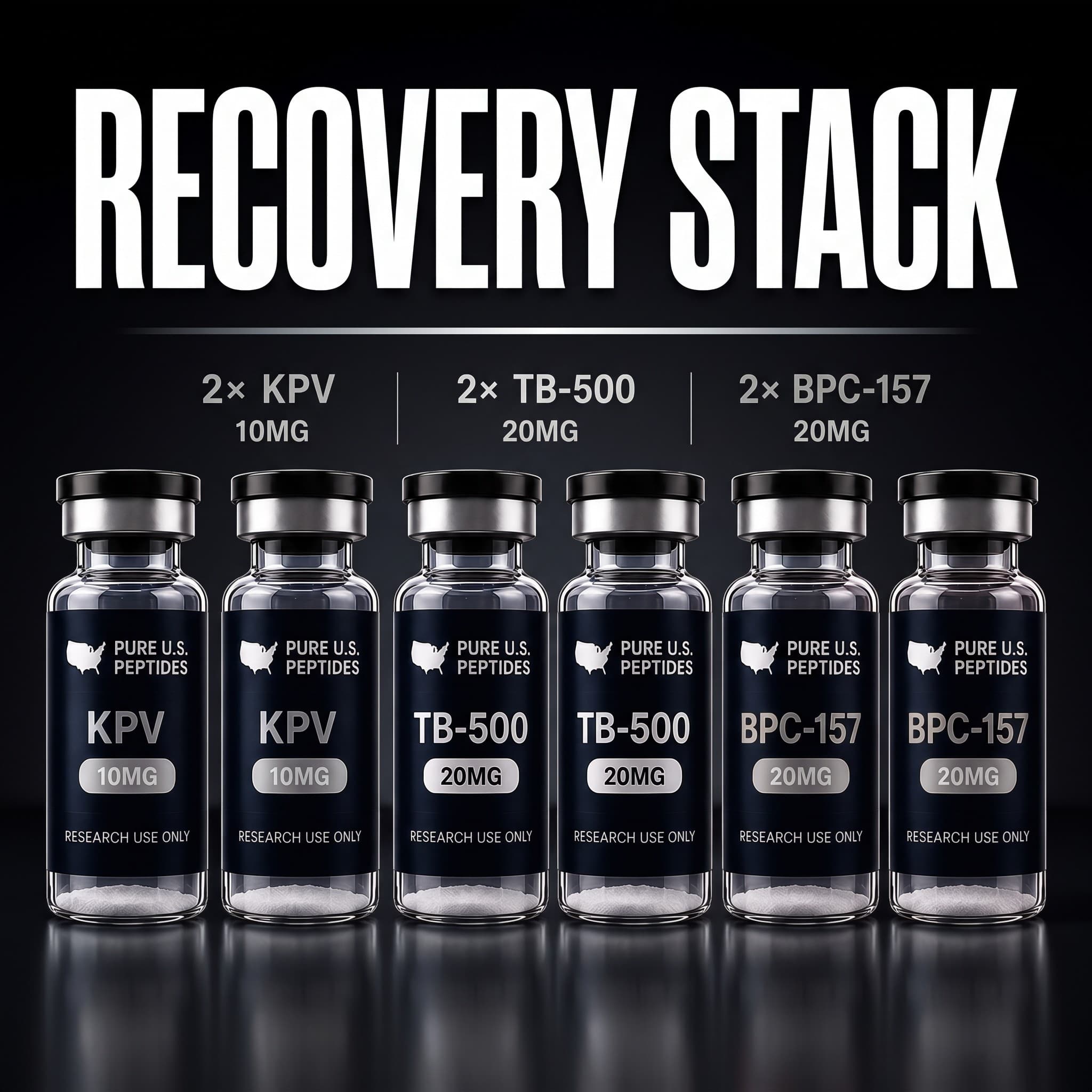
KPV + TB-500 + BPC-157 Research Kit
In Stock & Ready to Ship from USA
FREE shipping on every U.S. order
Secure checkout via encrypted payment processor


 +2.9k
+2.9kResearch Use Only
These products are for laboratory research only and not intended for medical use. They are not FDA-approved to diagnose, treat, cure, or prevent any disease. By purchasing, you certify they will be used solely for research and not for human or animal consumption.
Research Summary
22 PubMed CitationsOverview The KPV + TB-500 + BPC-157 Research Kit groups three peptides that are each independently characterized in the preclinical literature as modulators of inflammatory signalling and tissue repair. It is supplied as six separate vials, so the material corresponds to three distinct bodies of published work rather than to a single studied formulation. KPV is the C-terminal tripeptide of α-melanocyte-stimulating hormone. Brzoska and colleagues reviewed this peptide family as anti-inflammatory and protective agents in vitro and in vivo, and Dalmasso et al. reported that KPV is taken up through the PepT1 transporter and reduced intestinal inflammation in murine models.[14][15] Kelly et al. reported that immobilized GKPV inhibited TNF-α-stimulated NF-κB activity.[17] TB-500 is the N-acetylated 17–23 fragment of Thymosin β4, an identity confirmed analytically by Esposito et al.[7] The LKKTETQ actin-binding motif it carries has been described by Sosne et al. as an active site of the parent protein, and...
KPV + TB-500 + BPC-157 Research Kit — Research Data at a Glance
| Property | Value |
|---|---|
| PubMed Citations Referenced | 22 |
| Contributing Researchers | 2 |
| Storage Conditions | Store each lyophilized vial at -20°C (long-term), protected from moisture and light. |
| Purity Standard | See each component’s certificate |
| Research Use Only | Not for human consumption. RUO only. |
Overview
Overview
The KPV + TB-500 + BPC-157 Research Kit groups three peptides that are each independently characterized in the preclinical literature as modulators of inflammatory signalling and tissue repair. It is supplied as six separate vials, so the material corresponds to three distinct bodies of published work rather than to a single studied formulation.
KPV is the C-terminal tripeptide of α-melanocyte-stimulating hormone. Brzoska and colleagues reviewed this peptide family as anti-inflammatory and protective agents in vitro and in vivo, and Dalmasso et al. reported that KPV is taken up through the PepT1 transporter and reduced intestinal inflammation in murine models.[14][15] Kelly et al. reported that immobilized GKPV inhibited TNF-α-stimulated NF-κB activity.[17]
TB-500 is the N-acetylated 17–23 fragment of Thymosin β4, an identity confirmed analytically by Esposito et al.[7] The LKKTETQ actin-binding motif it carries has been described by Sosne et al. as an active site of the parent protein, and Philp et al. reported that a synthetic peptide containing this domain promoted dermal wound repair in rodent models.[12][13]
BPC-157 is a synthetic pentadecapeptide derived from a sequence identified in gastric juice by Sikiric and colleagues, whose group developed the cytoprotection framework that organizes most of its literature.[1][2] Hsieh et al. associated its pro-angiogenic activity with VEGFR2 activation.[3]
No peer-reviewed study has evaluated these three peptides together as a stack. Every citation on this page describes an individual component tested on its own. Investigators should treat the kit as three separate research materials and refer to the dedicated KPV, TB-500, and BPC-157 entries for complete mechanism, applications, and reference lists.
Mechanism of Action
Reported Mechanisms — Component by Component
Each section below summarizes the published mechanism of a single component. No combined mechanism is described in the literature, and none is asserted here.
1. KPV (20 mg across 2 vials) — Melanocortin-Derived Anti-Inflammatory Signalling
KPV corresponds to residues 11–13 of α-MSH. Hiltz and Lipton reported anti-inflammatory activity for this COOH-terminal fragment, and Getting et al. dissected the contributions of the core and C-terminal sequences.[16][20] Reported cellular routes include PepT1-mediated uptake in intestinal epithelium and inhibition of TNF-α-stimulated NF-κB activity.[15][17] Kannengiesser et al. reported anti-inflammatory potential in murine models of inflammatory bowel disease, and Xiao et al. examined nanoparticle-delivered KPV in a colitis model.[18][19]
2. TB-500 (40 mg across 2 vials) — G-Actin Binding and Cytoskeletal Dynamics
The LKKTETQ motif binds monomeric G-actin, the property that defines Thymosin β4 as an actin-sequestering protein.[8][13] For the full-length parent protein, Bock-Marquette et al. reported activation of integrin-linked kinase and promotion of cardiac cell migration, and Smart et al. reported epicardial progenitor mobilization and neovascularization.[10][11] Xing et al. reviewed the function and application of Thymosin β4 more broadly.[9] Note that TB-500 is a fragment and does not reproduce every reported activity of the full-length protein.[7]
3. BPC-157 (40 mg across 2 vials) — VEGFR2-Associated Angiogenic Signalling
Hsieh et al. reported that the pro-angiogenic activity of BPC-157 is associated with VEGFR2 activation and up-regulation in endothelial models.[3] Chang et al. reported effects on tendon outgrowth, cell survival, and cell migration in tendon fibroblast models.[4] Seiwerth et al. reviewed the wound-healing literature, and Xu et al. published a preclinical safety evaluation.[5][6]
No published pharmacokinetic, pharmacodynamic, or interaction study has evaluated KPV, TB-500, and BPC-157 administered together. Any combined behaviour is unstudied.
Research Applications
Research Applications (Component-Level)
The published work behind each vial in this kit falls into the following areas. Every study listed used a single peptide, not the stack.
- Intestinal and mucosal inflammation models — KPV has been examined in murine colitis and inflammatory bowel disease models, including PepT1-mediated uptake and nanoparticle delivery formats.[15][18][19]
- Dermal wound-repair models — a synthetic peptide containing the Thymosin β4 actin-binding domain promoted dermal wound repair in db/db diabetic and aged mice.[12]
- Angiogenesis and endothelial models — BPC-157 has been associated with VEGFR2 activation; full-length Thymosin β4 has been reported to mobilize epicardial progenitors.[3][11]
- Tendon and connective-tissue models — BPC-157 has been studied in tendon fibroblast outgrowth and migration paradigms.[4]
- NF-κB and cytokine signalling assays — KPV has been reported to inhibit TNF-α-stimulated NF-κB activity in cell models.[17]
- Analytical and doping-control chemistry — the identity of the TB-500 fragment has been characterized analytically, which matters for assay design.[7]
Important: no cited study used the combined stack. Researchers should not assume that single-agent findings carry over to co-administration.
Biochemical Characteristics
| Property | Value |
|---|---|
| Composition | 2 x KPV 10 mg + 2 x TB-500 20 mg + 2 x BPC-157 20 mg |
| Total Peptide Mass | 100 mg across six individually lyophilized vials |
| Format | Six separate single-peptide vials — not a co-lyophilized blend |
| KPV Component | Lys-Pro-Val (C-terminal alpha-MSH 11-13 tripeptide); MW ~342.4 g/mol; CAS 67727-97-3 |
| TB-500 Component | Ac-LKKTETQ (N-acetylated heptapeptide, Thymosin beta-4 fragment 17–23); MW 889.018 g/mol; CAS 885340-08-9 |
| BPC-157 Component | GEPPPGKPADDAGLV (pentadecapeptide); MW 1419.556 g/mol; CAS 137525-51-0 |
| Appearance | White-to-off-white lyophilized powder in each vial |
| Classification | Multi-vial research peptide kit |
Identifiers
| Identity Confirmation | |
|---|---|
| Counter-Ion | |
| Detection Methods |
Preclinical Research Summary
Preclinical Research Summary (Component-Level)
No peer-reviewed study has evaluated this six-vial stack as a unit. The table below lists representative findings for each component individually. Full per-component data and complete reference lists are on the dedicated KPV, TB-500, and BPC-157 pages.
| Component | Representative Study | Reported Observation | Ref |
|---|---|---|---|
| KPV | Dalmasso et al. (2008) — murine colitis | PepT1-mediated tripeptide uptake reported to reduce intestinal inflammation | [15] |
| KPV | Kelly et al. (2006) — cell assay | Immobilized GKPV reported to inhibit TNF-alpha-stimulated NF-kappaB activity | [17] |
| TB-500 | Esposito et al. (2012) — analytical | Confirmed TB-500 as the N-acetylated 17–23 fragment of Thymosin beta-4 | [7] |
| TB-500 / Tbeta4 | Philp et al. (2003) — rodent dermal wounds | Actin-binding-domain peptide reported to promote dermal wound repair | [12] |
| BPC-157 | Hsieh et al. (2017) — endothelial models | Pro-angiogenic activity associated with VEGFR2 activation and up-regulation | [3] |
| BPC-157 | Chang et al. (2011) — tendon fibroblasts | Reported effects on tendon outgrowth, cell survival, and cell migration | [4] |
For Laboratory Research Only. Not for human use, medical use, diagnostic use, or veterinary use.
ALL ARTICLES AND PRODUCT INFORMATION PROVIDED ON THIS WEBSITE ARE FOR INFORMATIONAL AND EDUCATIONAL PURPOSES ONLY.
Authors & Attribution
✍️ Article Author
Dr. Predrag Sikiric
Predrag Sikiric, MD, PhD, is a Professor at the Department of Pharmacology, School of Medicine, University of Zagreb, Croatia. Dr. Sikiric is the lead researcher who originally isolated the BPC sequence from human gastric juice in 1993, and is responsible for the majority of the published BPC-157 literature. His work established the cytoprotection/organoprotection framework that organizes research on this peptide. Predrag Sikiric is being referenced as one of the leading scientists involved in the research and development of BPC-157, a component of this stack. In no way is this doctor/scientist endorsing or advocating the purchase, sale, or use of this product for any reason. There is no affiliation or relationship, implied or otherwise, between Pure US Peptide and this doctor.
View Full Researcher Profile →🎓 Scientific Journal Author
Dr. Didier Merlin
Didier Merlin, PhD, is affiliated with the Department of Medicine, Division of Digestive Diseases at Emory University School of Medicine, and the Institute for Biomedical Sciences at Georgia State University. Dr. Merlin's research established PepT1-mediated uptake as a primary mechanism of KPV action and developed the hyaluronic-acid-functionalized nanoparticle platform used to study colonic delivery of KPV in murine colitis models. Didier Merlin is being referenced as one of the leading scientists involved in the research and development of KPV, a component of this stack. In no way is this doctor/scientist endorsing or advocating the purchase, sale, or use of this product for any reason. There is no affiliation or relationship, implied or otherwise, between Pure US Peptide and this doctor.
View Full Researcher Profile →Dr. Didier Merlin is being referenced as one of the leading scientists involved in the research and development of KPV + TB-500 + BPC-157 Research Kit. In no way is this doctor/scientist endorsing or advocating the purchase, sale, or use of this product for any reason. There is no affiliation or relationship, implied or otherwise, between Pure US Peptide and this doctor. The purpose of citing the doctor is to acknowledge, recognize, and credit the exhaustive research and development efforts conducted by the scientists studying this peptide.
Referenced Citations
Sikiric P, et al. A new gastric juice peptide, BPC. An overview of the stomach-stress-organoprotection hypothesis and beneficial effects of BPC. Journal of Physiology-Paris. 1993;87(5):313-327.
PubMedSikiric P, Hahm KB, Blagaic AB, Tvrdeic A, et al. Stable Gastric Pentadecapeptide BPC 157, Robert's Stomach Cytoprotection/Adaptive Cytoprotection/Organoprotection, and Selye's Stress Coping Response: Progress, Achievements, and the Future. Gut and Liver. 2020;14(2):153-167.
DOIHsieh MJ, et al. Journal of Molecular Medicine. 2017;95(3):323-333.
PubMedChang CH, et al. The promoting effect of pentadecapeptide BPC 157 on tendon healing involves tendon outgrowth, cell survival, and cell migration. Journal of Applied Physiology. 2011;110(3):774-780.
PubMedSeiwerth S, et al. Stable Gastric Pentadecapeptide BPC 157 and Wound Healing. Frontiers in Pharmacology. 2021;12:627533.
PubMedXu C, et al. Regulatory Toxicology and Pharmacology. 2020;114:104665.
PubMedEsposito S, Deventer K, Goeman J, Van der Eycken J, Van Eenoo P. Synthesis and characterization of the N-terminal acetylated 17-23 fragment of thymosin beta 4 identified in TB-500. Drug Testing and Analysis. 2012;4(9):733-738.
PubMedGoldstein AL, Hannappel E, Sosne G, Kleinman HK. Thymosin β4: a multi-functional regenerative peptide. Expert Opinion on Biological Therapy. 2012;12(1):37-51.
PubMedXing Y, Ye Y, Zuo H, Li Y. Progress on the Function and Application of Thymosin β4. Frontiers in Endocrinology. 2021;12:767785.
PubMedBock-Marquette I, Saxena A, White MD, Dimaio JM, Srivastava D. Thymosin beta4 activates integrin-linked kinase and promotes cardiac cell migration, survival and cardiac repair. Nature. 2004;432(7016):466-472.
PubMedSmart N, Risebro CA, Melville AA, et al. Nature. 2007;445(7124):177-182.
PubMedPhilp D, Badamchian M, Scheremeta B, Nguyen M, Goldstein AL, Kleinman HK. Thymosin β4 and a synthetic peptide containing its actin-binding domain promote dermal wound repair in db/db diabetic mice and in aged mice. Wound Repair and Regeneration. 2003;11(1):19-24.
PubMedSosne G, Qiu P, Goldstein AL, Wheater M. Biological activities of thymosin beta 4 defined by active sites in short peptide sequences. The FASEB Journal. 2010;24(7):2144-2151.
PubMedBrzoska T, Luger TA, Maaser C, Abels C, Böhm M. Alpha-melanocyte-stimulating hormone and related tripeptides: biochemistry, antiinflammatory and protective effects in vitro and in vivo, and future perspectives. Endocrine Reviews. 2008;29(5):581-602.
PubMedDalmasso G, Charrier-Hisamuddin L, Nguyen HTT, Yan Y, Sitaraman S, Merlin D. PepT1-Mediated Tripeptide KPV Uptake Reduces Intestinal Inflammation. Gastroenterology. 2008;134(1):166-178.
PubMedGetting SJ, Schiöth HB, Perretti M. Dissection of the anti-inflammatory effect of the core and C-terminal (KPV) alpha-melanocyte-stimulating hormone peptides. Journal of Pharmacology and Experimental Therapeutics. 2003;306(2):631-637.
PubMedKelly JM, Moir AJG, Carlson KE, Haycock JW. Immobilized alpha-melanocyte stimulating hormone 10-13 (GKPV) inhibits tumor necrosis factor-alpha stimulated NF-kappaB activity. Peptides. 2006;27(3):431-437.
PubMedKannengiesser K, Maaser C, Heidemann J, et al. Melanocortin-derived tripeptide KPV has anti-inflammatory potential in murine models of inflammatory bowel disease. Inflammatory Bowel Diseases. 2008;14(3):324-331.
PubMedXiao B, Xu Z, Viennois E, et al. Molecular Therapy. 2017;25(7):1628-1640.
PubMedHiltz ME, Lipton JM. Antiinflammatory activity of a COOH-terminal fragment of the neuropeptide alpha-MSH. FASEB Journal. 1989;3:2282-2284.
PubMedU.S. Food and Drug Administration. Certain Bulk Drug Substances for Use in Compounding that May Present Significant Safety Risks. FDA.gov. Updated 2023.
FDA.govWorld Anti-Doping Agency. The 2025 Prohibited List. WADA. January 1, 2025.
WADARUO Disclaimer
For Research Use Only (RUO). Not intended for human consumption, clinical use, or as a drug, food, cosmetic, or medical device. This product has not been evaluated by the FDA and is supplied solely for in-vitro laboratory research by qualified professionals.
Certificate of Analysis
Published certificates come from third-party laboratories. If this listing's certificate is still pending, the card below says so.
Latest Lab Report
Storage & Handling
Summary
Store each lyophilized vial at -20°C (long-term), protected from moisture and light. Store each peptide separately.
Recommended Laboratory Storage Conditions — KPV + TB-500 + BPC-157 Research Kit (6 vials)
Lyophilized Powder: Store all six vials at -20°C for long-term stability. Peptides are hygroscopic — keep tightly sealed and protected from moisture and light.
Separate Handling: Each vial contains a single peptide. Store each independently; there is no published stability data for these three peptides pre-mixed in one solution.
Component Purity: The lot certificate for this listing is pending.
Handling: Allow vials to reach room temperature before opening to prevent condensation onto the lyophilized cake. Use standard aseptic technique.
“Preclinical Research Summary (Component-Level) No peer-reviewed study has evaluated this six-vial stack as a unit.”
Related Research Compounds
BPC-157 20mg + TB-500 20mg Bundle
BPC-157 10mg + TB-500 10mg Bundle
VIP
10mg