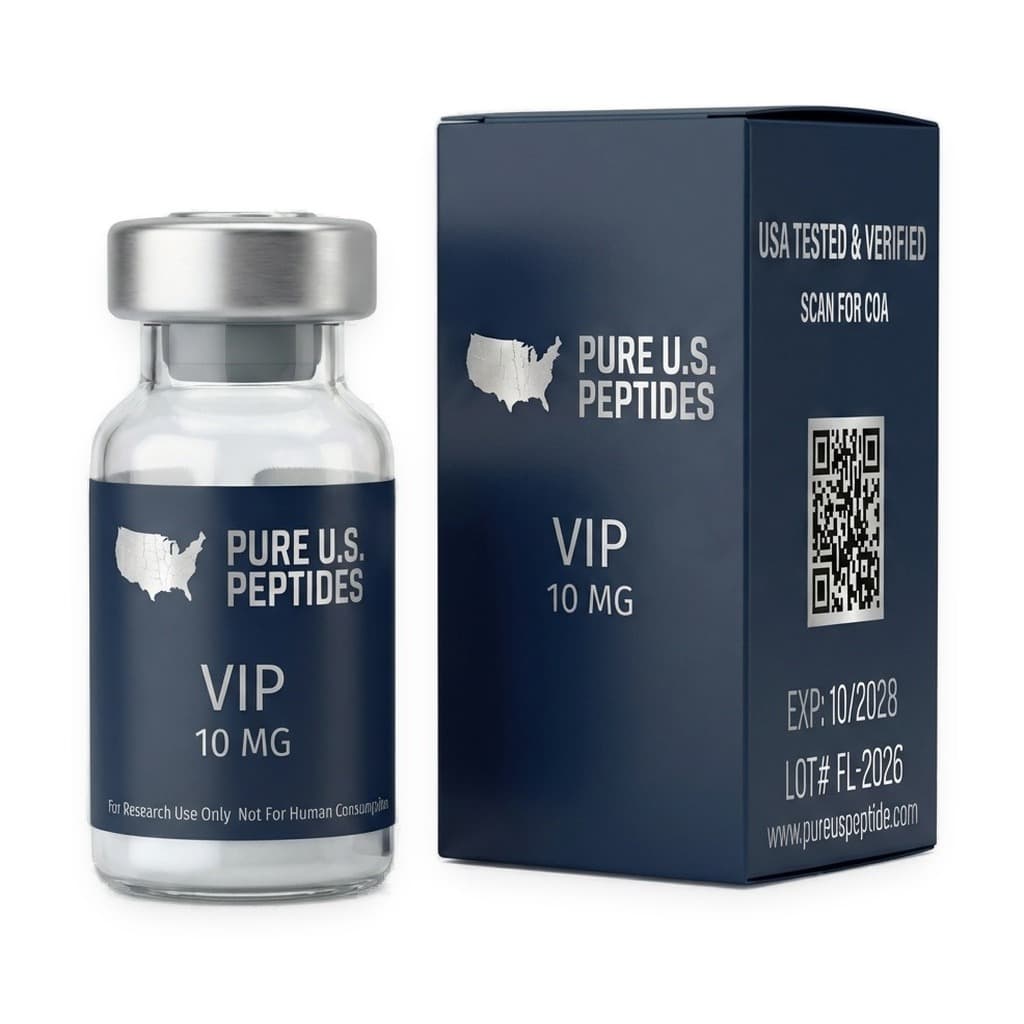
VIP 10mg
En Stock y Listo para Envío desde EE.UU.
Envío GRATIS en todos los pedidos de EE.UU.
Pago seguro mediante procesador de pagos encriptado


 +2.9k
+2.9kSolo para Uso en Investigación
Estos productos son exclusivamente para investigación de laboratorio y no están destinados para uso médico. No están aprobados por la FDA para diagnosticar, tratar, curar o prevenir ninguna enfermedad. Al realizar su compra, usted certifica que serán utilizados exclusivamente para investigación y no para consumo humano o animal.
Resumen de Investigación
28 Citas PubMedVasoactive Intestinal Peptide (VIP) es un neuropéptido de señalización de 28 aminoácidos perteneciente a la superfamilia glucagón-secretina. [1] Es una molécula altamente conservada a lo largo de la evolución de los mamíferos, idéntica en humanos, cerdos, ratas y bovinos. El VIP fue originalmente aislado del duodeno porcino por Sami I. Said y Viktor Mutt en 1970 en el Medical College of Virginia y el Karolinska Institute, respectivamente. [2] El VIP se deriva de una molécula precursora más grande, prepro-VIP (170 aminoácidos), codificada por el gen VIP en el cromosoma 6 en humanos. El prepro-VIP se procesa en pro-VIP (149 aminoácidos), que a su vez es escindido y amidado por la peptidilglicina alfa-amidante monooxigenasa para producir el péptido maduro de 28 aminoácidos amidado en el C-terminal. [6] El VIP se distribuye ampliamente en los sistemas nervioso central y periférico y es producido por neuronas, células endocrinas y células inmunitarias (linfocitos B...
VIP — Datos de Investigación de un Vistazo
| Propiedad | Valor |
|---|---|
| Fórmula Molecular | C₁₄₇H₂₃₈N₄₄O₄₂S |
| Peso Molecular | 3326.8 Da |
| Número CAS | 37221-79-7 |
| Secuencia de Aminoácidos | His-Ser-Asp-Ala-Val-Phe-Thr-Asp-Asn-Tyr-Thr-Arg-Leu-Arg-Lys-Gln-Met-Ala-Val-L... |
| Citas PubMed Referenciadas | 28 |
| Investigadores Colaboradores | 2 |
| Condiciones de Almacenamiento | Liofilizado: Almacenar a -20°C, desecado, proteger de la luz. |
| Estándar de Pureza | Certificado pendiente |
| Solo para Uso en Investigación | No destinado al consumo humano. Solo para uso en investigación. |
Research guide
What is VIP? Read the full research guideDescripción General
Vasoactive Intestinal Peptide (VIP) es un neuropéptido de señalización de 28 aminoácidos perteneciente a la superfamilia glucagón-secretina. [1] Es una molécula altamente conservada a lo largo de la evolución de los mamíferos, idéntica en humanos, cerdos, ratas y bovinos. El VIP fue originalmente aislado del duodeno porcino por Sami I. Said y Viktor Mutt en 1970 en el Medical College of Virginia y el Karolinska Institute, respectivamente. [2]
El VIP se deriva de una molécula precursora más grande, prepro-VIP (170 aminoácidos), codificada por el gen VIP en el cromosoma 6 en humanos. El prepro-VIP se procesa en pro-VIP (149 aminoácidos), que a su vez es escindido y amidado por la peptidilglicina alfa-amidante monooxigenasa para producir el péptido maduro de 28 aminoácidos amidado en el C-terminal. [6]
El VIP se distribuye ampliamente en los sistemas nervioso central y periférico y es producido por neuronas, células endocrinas y células inmunitarias (linfocitos B y linfocitos T). Ejerce potentes propiedades antiinflamatorias, inmunomoduladoras y vasodilatadoras. [3]
La forma sintética, Aviptadil (también conocido como RLF-100 o Zyesami), ha recibido la Designación de Compuesto Huérfano de la FDA para la investigación del SDRA, la hipertensión pulmonar y la sarcoidosis, así como la Designación de Vía Rápida (Fast Track) para COVID-19 crítico con insuficiencia respiratoria. La EMA ha otorgado la Designación de Compuesto Huérfano para SDRA y sarcoidosis. En India, la CDSCO aprobó Aviptadil para uso de emergencia en SDRA por COVID-19 en 2022. [4]
El VIP tiene una vida media sérica extremadamente corta de aproximadamente 1–2 minutos, debido a la degradación rápida por la dipeptidil peptidasa-4 (DPP-4) y otras peptidasas séricas. Esta labilidad presenta desafíos farmacológicos significativos y ha impulsado la investigación en sistemas de administración avanzados, incluyendo micelas estéricamente estabilizadas (SSM), liposomas y otras formulaciones. [5]
El VIP comparte un 68% de homología con PACAP-27 y se reporta que es 100 veces más potente que el isoproterenol como broncodilatador y 50 veces más potente que la prostaciclina para relajar las arterias pulmonares. [7]
Mecanismo de Acción
1. Dianas Receptoras Primarias — VPAC1, VPAC2 y PAC1
El VIP ejerce sus efectos biológicos principalmente uniéndose a dos receptores acoplados a proteínas G (GPCRs) específicos pertenecientes a la familia Clase B (tipo secretina): [3]
- VPAC1 (VIPR1): Se expresa constitutivamente en el pulmón (células alveolares tipo II), linfocitos T, hígado y corteza cerebral.
- VPAC2 (VIPR2): Se expresa predominantemente en músculo liso, el núcleo supraquiasmático (NSQ), células β pancreáticas, y es inducible en células inmunitarias tras estimulación.
- PAC1: El VIP también se une al receptor PAC1 de PACAP, pero con afinidad significativamente menor (>500 nM). [8]
La interacción VIP-receptor sigue un modelo de unión de "dos sitios": el ectodominio N-terminal (estructurado como un dominio "Sushi") captura las regiones central/C-terminal del VIP (residuos 6–28), luego el N-terminal del VIP (His1) activa el dominio transmembrana 1 (TM1). [9]
2. Señalización Canónica — Vía Gs/cAMP/PKA/CREB
En la mayoría de los tipos celulares, la unión del VIP desencadena el intercambio de GDP por GTP en la subunidad Gαs, activando la adenilil ciclasa (AC) y aumentando el AMP cíclico (cAMP) intracelular. El cAMP elevado activa la Proteína Quinasa A (PKA), que fosforila la proteína de unión al elemento de respuesta a cAMP (CREB). Esta vía impulsa la producción de surfactante en los pulmones y la secreción de insulina en el páncreas. [10]
3. Vías de Señalización Alternativas
- Inhibición de NF-κB (Independiente de PKA): En macrófagos y monocitos, el VIP inhibe la translocación nuclear de NF-κB a través de un mecanismo independiente de PKA que previene la fosforilación de IκB e inhibe la quinasa IκB (IKK), suprimiendo la producción de citoquinas proinflamatorias. [11]
- Vía Dual Gs/AC + Gq/PLC (Neuronas): En neuronas de GnRH, la excitación por VIP requiere tanto la activación de Gs/AC/PKA como de Gq/Fosfolipasa C (PLC), conduciendo a la depleción de PIP2 y la inhibición de canales KCa3.1. [12]
- Vía Epac (Células β): En las células β pancreáticas, la señalización del VIP involucra tanto PKA (cierre de canales K⁺ dependientes de ATP, causando despolarización e influjo de Ca²⁺) como la vía Epac (movilización de reservas intracelulares de Ca²⁺ para impulsar la secreción de insulina). [13]
- Transactivación de EGFR/HER2 (Cáncer): En ciertas células cancerosas (pulmón, mama), la señalización VIP/PACAP puede transactivar EGFR y HER2, promoviendo el crecimiento celular y la secreción de VEGF. [14]
4. Efectos a Nivel Tisular
Inmunomodulación: El VIP inhibe la producción de citoquinas proinflamatorias (TNF-α, IL-6, IL-12) y quimioquinas en macrófagos y microglía. Desvía la diferenciación de células T de Th1 hacia fenotipos Th2 y Treg, y regula a la baja la expresión de TLR2 y TLR4 en macrófagos y células dendríticas. [11]
Sistema Pulmonar: El VIP sobrerregula la colina fosfato citidiltransferasa y la proteína C-Fos en células alveolares tipo II (ATII), aumentando la producción de surfactante. Actúa como un potente broncodilatador — 100 veces más potente que el isoproterenol. [15]
Sistema Nervioso Central: En el núcleo supraquiasmático (NSQ), el VIP sincroniza la actividad neuronal vía VPAC2, produciendo aumentos duraderos en la actividad eléctrica (2–4 horas) dependientes del gen reloj Per1 y los canales Kv3. [16]
Sistema Metabólico: El VIP estimula la secreción de insulina de manera dependiente de glucosa a través de receptores VPAC2 en las células β pancreáticas — insignificante a niveles bajos de glucosa (protegiendo contra la hipoglucemia) pero potente durante la hiperglucemia. [13]
5. Farmacocinética — Vida Media Ultracorta
El VIP tiene una vida media sérica de aproximadamente 1–2 minutos, con degradación rápida por la DPP-4 y otras peptidasas en el hígado, riñones y pulmón. [5] Tras la administración, aproximadamente el 45% de la dosis se distribuye a los pulmones en 30 minutos. El volumen de distribución aparente es de ~14 mL/kg con una tasa de aclaramiento metabólico de ~9 mL/kg/min. [17]
6. Relaciones Dosis-Respuesta
- Tasa de Descarga del SNC (NSQ): 1 µM y 10 µM de VIP produjeron aumentos significativos en la tasa de descarga neuronal del NSQ; 0,1 µM no tuvo efecto (respuesta umbral). [16]
- Cambio de Fase Circadiana: Umbral ~100 nM, EC₅₀ ~500 nM, saturación a ~10 µM. [18]
- Neuroprotección (agonista VIPR2 LBT-3627): Respuesta dosis-efecto en forma de campana — 2,0 mg/kg proporcionó neuroprotección óptima y rescate de Treg en modelos de Parkinson en ratas. [19]
- Actividad Antiviral: 10 nM de VIP proporcionó efectos anti-SARS-CoV-2 máximos en modelos celulares; se observaron efectos a 1 nM. [4]
Aplicaciones de Investigación
🫁 SDRA y COVID-19 (Aviptadil)
Aviptadil ha sido investigado para la insuficiencia respiratoria crítica debido a que protege las células alveolares tipo II y bloquea la tormenta de citoquinas. En el ensayo Fase 2b/3 (NCT04311697, n=196), el aviptadil mostró efectos observados sobre marcadores inflamatorios en modelos respiratorios preclínicos, con reducción significativa de IL-6. El ensayo TESICO más grande (n=461) fue detenido por futilidad. [4] [20]
🧠 Trastornos Neurodegenerativos (Parkinson y Alzheimer)
El VIP actúa como agente neuroprotector desactivando la microglía e inhibiendo la liberación de neurotoxinas (TNF-α, IL-1β). En modelos de enfermedad de Parkinson, el agonista VIPR2 LBT-3627 (2,0 mg/kg) aumentó las neuronas dopaminérgicas sobrevivientes en un 43% y redujo la microglía reactiva en un 57–61%. En modelos de enfermedad de Alzheimer, el VIP protege contra la toxicidad del β-amiloide mediante la inducción de ADNP. [19] [21]
Véase también: BPC-157 para investigación neuroprotectora relacionada.
🔬 Enfermedad Inflamatoria Intestinal (EII)
El VIP mantiene la homeostasis de la barrera intestinal. Las micelas estéricamente estabilizadas cargadas con VIP (VIP-SSM) revirtieron la colitis grave en modelos de ratón con DSS con una sola dosis experimental, restaurando la proteína de unión estrecha ocludina y la expresión del transportador de cloruro DRA. El VIP libre requirió administración en días alternos para efectos comparables. [22]
🎯 Imagenología Oncológica (PET de VPAC1)
Los receptores VPAC1 están sobreexpresados en cánceres de mama, próstata, colon y pulmón. Los análogos de VIP radiomarcados (⁶⁴Cu-VIP, ¹²³I-VIP, Tc-99m-TP3654) permiten la imagenología PET de tumores; en los estudios citados se reportan criterios de valoración de tasa de detección para cáncer colorrectal primario y metástasis ganglionares. El ⁶⁴Cu-VIP también detectó neoplasia prostática grado IV indetectable por PET estándar con ¹⁸F-FDG o TC. [23] [24]
❤️ Hipertensión Pulmonar
En un estudio de 20 sujetos se reportaron criterios de valoración de presión arterial pulmonar, resistencia vascular, saturación venosa mixta de oxígeno y gasto cardíaco. El VIP es 50 veces más potente que la prostaciclina para relajar las arterias pulmonares. [7]
🫁 Sarcoidosis
En un ensayo Fase II (n=20, 4 semanas) en sujetos de estudio con sarcoidosis activa se reportaron criterios de valoración de TNF-α en el lavado broncoalveolar (LBA) y de células T reguladoras. [25]
⏰ Regulación del Ritmo Circadiano
El núcleo supraquiasmático (NSQ) depende de la señalización del VIP para sincronizar los relojes circadianos celulares con los ciclos de luz ambiental. La aplicación de VIP produce cambios de fase en los ritmos circadianos, con pulsos que restablecen rápidamente el ritmo mediante una reducción rápida de la proteína PER2. El VIP es necesario para la sincronización de las neuronas del NSQ, influyendo en los ciclos de sueño y hormonales. [16]
🦠 Sepsis
El VIP se ha caracterizado como un modulador endógeno de la señalización inmunitaria innata que reduce la producción de citoquinas proinflamatorias en modelos preclínicos, lo que constituye la justificación citada en la literatura para investigarlo en la lesión pulmonar inflamatoria. [8]
Características Bioquímicas
| Propiedad | Valor |
|---|---|
| Formula | C₁₄₇H₂₃₈N₄₄O₄₂S |
| Molecular Weight | 3326.8 Da |
| Synonyms | Vasoactive Intestinal Peptide, Aviptadil, RLF-100, Zyesami, Vasoactive Intestinal Polypeptide |
| Cas Number | 37221-79-7 |
| Sequence | His-Ser-Asp-Ala-Val-Phe-Thr-Asp-Asn-Tyr-Thr-Arg-Leu-Arg-Lys-Gln-Met-Ala-Val-Lys-Lys-Tyr-Leu-Asn-Ser-Ile-Leu-Asn-NH₂ |
| Pubchem Cid | 16129630 |
| Monoisotopic Mass | N/A |
| Polar Area | N/A |
| Complexity | N/A |
| X Log P | N/A |
| Heavy Atom Count | N/A |
| H Bond Donor Count | N/A |
| H Bond Acceptor Count | N/A |
| Rotatable Bond Count | N/A |
Identificadores
| Pubchem Cid | |
|---|---|
| Inchi Key | |
| Inchi | |
| Smiles Isomeric | |
| Smiles Canonical | |
| Iupac Name |
Resumen de Investigación Preclínica
Estudios en Animales
- Enfermedad de Parkinson (Ratas, Mosley 2019): Agonista VIPR2 LBT-3627 a 2,0 mg/kg — aumento del 43% en neuronas TH+ supervivientes (modelo α-Syn), 53% preservadas a 6,0 mg/kg (modelo 6-OHDA), reducción del 57–61% en microglía reactiva. [19]
- Enfermedad de Parkinson (Ratones, Delgado 2003): VIP en modelo MPTP previno la pérdida neuronal dopaminérgica y la activación microglial; bloqueó la expresión de iNOS, IL-1β, TNF-α. [21]
- EII/Colitis (Ratones, Jayawardena 2017): VIP-SSM en dosis única revirtió la colitis grave por DSS (P<0,0001 vs DSS); restauró la expresión de ocludina y DRA. El VIP libre requirió administración en días alternos. [22]
- Imagenología PET (Ratones, Zhang 2007/2008): Análogos de ⁶⁴Cu-VIP en xenoinjertos de mama/próstata — relaciones de captación tumor:normal 2,17–10,93, retención de >85% de ⁶⁴Cu en sangre. Detectó neoplasia prostática grado IV indetectable por FDG-PET. [23]
- Diabetes (Ratas, Tsutsumi 2002): Agonista VPAC2 BAY 55-9837 estimuló la secreción de insulina dependiente de glucosa sin hipoglucemia. [13]
- Tolerabilidad cardiovascular (Perros, Mosley 2019): LBT-3627 a 0,14–1,4 mg/kg — efectos hemodinámicos transitorios solo a dosis >umbral experimental; resueltos en 4 horas. [19]
- Circadiano del NSQ (Ratones, Kudo 2013): 1 µM de VIP aumentó la tasa de descarga neuronal del NSQ (P<0,05), persistiendo 4–6 horas tras el lavado. Requiere PER1 y canales Kv3. [16]
Ensayos Clínicos en Humanos
- SDRA por COVID-19 Fase 2b/3 (NCT04311697, n=196): Diseño de 3 días. No alcanzó el criterio de valoración primario; los criterios secundarios de supervivencia e IL-6 se reportan en la referencia citada. [4]
- TESICO (NCT04843761, n=461): Aviptadil en insuficiencia respiratoria hipoxémica por COVID-19. Detenido por futilidad. [20]
- COVID-19 Fase II (NCT04844580, n=80): Diseño de 5 días. No alcanzó el criterio primario (alta hospitalaria); se reportaron criterios secundarios de disnea y puntuación de TC. [27]
- Sarcoidosis Fase II (n=20): Diseño de 4 semanas. Se reportaron criterios de valoración de TNF-α y Tregs en el LBA. [25]
- Hipertensión Pulmonar (n=20): Se reportaron criterios de valoración de presión AP y gasto cardíaco. [7]
- Imagenología Tumoral (Varios): ¹²³I-VIP y Tc-99m-TP3654 (trazadores de imagen). Se reportaron criterios de valoración de tasa de detección para tumores colorrectales primarios y metástasis ganglionares. [23]
Estado Regulatorio
FDA: Designación de Compuesto Huérfano (SDRA, hipertensión pulmonar, sarcoidosis); Designación de Vía Rápida (COVID-19 crítico).
EMA: Designación de Compuesto Huérfano (SDRA, sarcoidosis).
CDSCO (India): registrado para uso de emergencia en SDRA por COVID-19 (2022).
Seguridad en la manipulación: Manipular con el equipo de protección personal (EPP) estándar de laboratorio. Consulte la hoja de datos de seguridad (SDS).
TODOS LOS ARTÍCULOS E INFORMACIÓN DE PRODUCTOS PROPORCIONADOS EN ESTE SITIO WEB SON SOLO PARA FINES INFORMATIVOS Y EDUCATIVOS.
Autores y Atribución
✍️ Autor del Artículo
Dr. Sami I. Said
Sami I. Said, MD, es el codescubridor del VIP, habiendo aislado originalmente el péptido del intestino porcino en 1970 en el Medical College of Virginia junto con Viktor Mutt del Karolinska Institute. Posteriormente se incorporó a la Stony Brook University (SUNY), donde identificó el VIP en los sistemas nervioso central y periférico, estableció su función como neurotransmisor y vasodilatador, y demostró sus propiedades protectoras pulmonares, incluyendo la sobrerregulación del surfactante y la inhibición de la síntesis de citoquinas. Su trabajo fundacional abarca desde el artículo original en Science de 1970 hasta décadas de investigación en neumología e inmunología. Sami I. Said está siendo referenciado como uno de los principales científicos involucrados en la investigación y desarrollo de VIP (Vasoactive Intestinal Peptide). De ninguna manera este doctor/científico respalda o promueve la compra, venta o uso de este producto por ningún motivo. No existe afiliación ni relación, implícita o de otro tipo, entre Pure US Peptide y este doctor.
Ver Perfil Completo del Investigador →🎓 Autor de Revista Científica
Dr. Mario Delgado
Mario Delgado, PhD, está adscrito al Instituto de Parasitología y Biomedicina López-Neyra (IPBLN), CSIC, España. Caracterizó extensamente el VIP como un inmunomodulador pleiotrópico, demostrando sus propiedades antiinflamatorias en modelos de enfermedades autoinmunes (artritis reumatoide, esclerosis múltiple) y efectos neuroprotectores en modelos de enfermedad de Parkinson mediante el bloqueo de la activación microglial. Sus publicaciones en Nature y Frontiers in Immunology han sido fundamentales para establecer el potencial experimental del VIP en inflamación y neurodegeneración. Mario Delgado está siendo referenciado como uno de los principales científicos involucrados en la investigación y desarrollo de VIP (Vasoactive Intestinal Peptide). De ninguna manera este doctor/científico respalda o promueve la compra, venta o uso de este producto por ningún motivo. No existe afiliación ni relación, implícita o de otro tipo, entre Pure US Peptide y este doctor.
Ver Perfil Completo del Investigador →Dr. Mario Delgado is being referenced as one of the leading scientists involved in the research and development of VIP. In no way is this doctor/scientist endorsing or advocating the purchase, sale, or use of this product for any reason. There is no affiliation or relationship, implied or otherwise, between Pure US Peptide and this doctor. The purpose of citing the doctor is to acknowledge, recognize, and credit the exhaustive research and development efforts conducted by the scientists studying this peptide.
Citas Referenciadas
Said SI, Mutt V. Polypeptide with broad biological activity: isolation from small intestine. Science, 169(3951), 1217–1218, 1970.
PubMedSaid SI, Rosenberg RN. Vasoactive intestinal polypeptide: abundant immunoreactivity in neuronal cell lines and normal nervous tissues. Science, 192(4242), 907–908, 1976.
PubMedLanger I, Jeandriens J, Couvineau A, et al. Signal transduction by VIP and PACAP receptors. Biochem Soc Trans, 50(1), 2022.
PubMedYoussef JG, Lavin P, Schoenfeld DA, et al. Crit Care Med, 50(11), 1545–1554, 2022.
PubMedDomschke S, Domschke W, Bloom SR, et al. Vasoactive intestinal peptide in man: pharmacokinetics, metabolic and circulatory effects. Gut, 19(11), 1049–1053, 1978.
PubMedHarmar AJ, Arimura A, Gozes I, et al. International union of pharmacology. XVIII. Nomenclature of receptors for vasoactive intestinal peptide and pituitary adenylate cyclase-activating polypeptide. Pharmacol Rev, 50(2), 265–270, 1998.
PubMedLeuchte HH, Baezner C, Baumgartner RA, et al. Eur Respir J, 32(5), 1289–1294, 2008.
PubMedDelgado M, Pozo D, Ganea D. The significance of vasoactive intestinal peptide in immunomodulation. Pharmacol Rev, 56(2), 249–290, 2004.
PubMedCouvineau A, Laburthe M. VPAC receptors: structure, molecular pharmacology and interaction with accessory proteins. Br J Pharmacol, 166(1), 42–50, 2012.
PubMedHou X, Yang H, Bhatt VR, et al. VIP/VPAC signaling in pancreatic islet β-cells and glucose homeostasis. J Mol Endocrinol, 68(3), R65–R75, 2022.
PubMedSmalley SG, Barrow PA, Foster N. Immunomodulation of innate immune responses by vasoactive intestinal peptide (VIP): its experimental potential in inflammatory disease. Clin Exp Immunol, 157(2), 225–234, 2009.
PubMedConstantin S, Bhattarai JP, Bhatt R, et al. VIP signaling in GnRH neurons involves dual Gs/AC and Gq/PLC pathways. J Neuroendocrinol, 36(4), e13392, 2024.
PubMedHou X, et al. VIP/VPAC signaling in pancreatic islet β-cells: PKA and Epac pathways drive glucose-dependent insulin secretion. J Mol Endocrinol, 2022.
PubMedMoody TW, Nuche-Berenguer B, Jensen RT. Vasoactive intestinal peptide/pituitary adenylate cyclase activating polypeptide, and their receptors and cancer. Curr Opin Endocrinol Diabetes Obes, 23(1), 38–47, 2016.
PubMedMathioudakis AG, Chatzimavridou-Grigoriadou V, Evangelopoulou E, Mathioudakis GA. Hippokratia, 17(1), 12–16, 2013.
PubMedKudo T, Tahara Y, Gamble KL, et al. Vasoactive intestinal peptide produces long-lasting changes in neural activity in the suprachiasmatic nucleus. J Neurophysiol, 110(5), 1097–1106, 2013.
PubMedSaid SI. Vasoactive intestinal peptide in the lung. Ann N Y Acad Sci, 527, 450–464, 1988.
PubMedAn S, Tsai C, Bhatt R, et al. Vasoactive intestinal polypeptide phase-shifts the circadian clock via cAMP/PKA dependent pathway. J Biol Rhythms, 26(4), 313–326, 2011.
PubMedMosley RL, Lu Y, Olson KE, et al. Front Cell Neurosci, 13, 421, 2019.
PubMedBrown SM, Barkauskas CE, Grund B, et al. Lancet Respir Med, 11(9), 791–803, 2023.
PubMedDelgado M, Ganea D. FASEB J, 17(8), 944–946, 2003.
PubMedJayawardena D, Guzman G, Gill RK, et al. Expression and localization of VPAC1, the major receptor of vasoactive intestinal peptide along the length of the intestine. Am J Physiol Gastrointest Liver Physiol, 313(1), G16–G25, 2017.
PubMedVirgolini I, Raderer M, Kurtaran A, et al. Vasoactive intestinal peptide-receptor imaging for the localization of intestinal adenocarcinomas and endocrine tumors. N Engl J Med, 331, 1116–1121, 1994.
PubMedZhang K, Aruva MR, Shanthly N, et al. PET imaging of VPAC1 expression in experimental and spontaneous prostate cancer. J Nucl Med, 49(1), 112–121, 2008.
PubMedPrasse A, Zissel G, Lützen N, et al. Am J Respir Crit Care Med, 182(4), 540–548, 2010.
PubMedYoussef JG, Said SI, et al. Preprints, 2020.
PubMedEsendagli D, Sarı N, Akhan S, et al. Med Princ Pract, 34(2), 191–200, 2025.
PubMedDewan B, Shinde S. Eur J Pharm Med Res, 9(6), 243–253, 2022.
PubMedAviso de Uso en Investigación
Solo para Uso en Investigación (RUO). No destinado al consumo humano, uso clínico, ni como medicamento, alimento, cosmético o dispositivo médico. Este producto no ha sido evaluado por la FDA y se suministra exclusivamente para investigación de laboratorio in vitro por profesionales calificados.
Certificado de Análisis
Published certificates come from third-party laboratories. If this listing's certificate is still pending, the card below says so.
Último Informe de Laboratorio
Almacenamiento y Manejo
Resumen
Liofilizado: Almacenar a -20°C, desecado, proteger de la luz. ~1–2 min de vida media sérica — péptido extremadamente lábil.
⚠️ Crítico: El VIP tiene una vida media sérica extremadamente corta de aproximadamente 1–2 minutos debido a la degradación enzimática rápida por la DPP-4 y otras peptidasas. Este péptido es significativamente más lábil que la mayoría de los demás péptidos de investigación. Manipular con cuidado.
❄️ Almacenamiento del Polvo Liofilizado
Almacenar el VIP liofilizado a -20°C (−4°F) en un ambiente desecado, protegido de la luz. Bajo estas condiciones, el polvo permanece estable durante períodos prolongados. No someter a ciclos repetidos de congelación-descongelación.
🧴 Consideraciones de Estabilidad
El VIP es degradado rápidamente por la dipeptidil peptidasa-4 (DPP-4) y otras peptidasas séricas. Los sistemas de administración en investigación como las micelas estéricamente estabilizadas (SSM), liposomas y otras formulaciones se emplean en entornos preclínicos y clínicos para extender la biodisponibilidad.
📊 Documentación de calidad
El certificado de lote de este producto está pendiente. Este producto es solo para uso en investigación (RUO).
“Estudios en Animales Enfermedad de Parkinson (Ratas, Mosley 2019): Agonista VIPR2 LBT-3627 a 2,0 mg/kg — aumento del 43% en neuronas TH+ supervivientes (modelo α-Syn), 53% preservadas a 6,0 mg/kg (modelo 6-OHDA), reducción del 57–61% en microglía reactiva.”
Compuestos de Investigación Relacionados
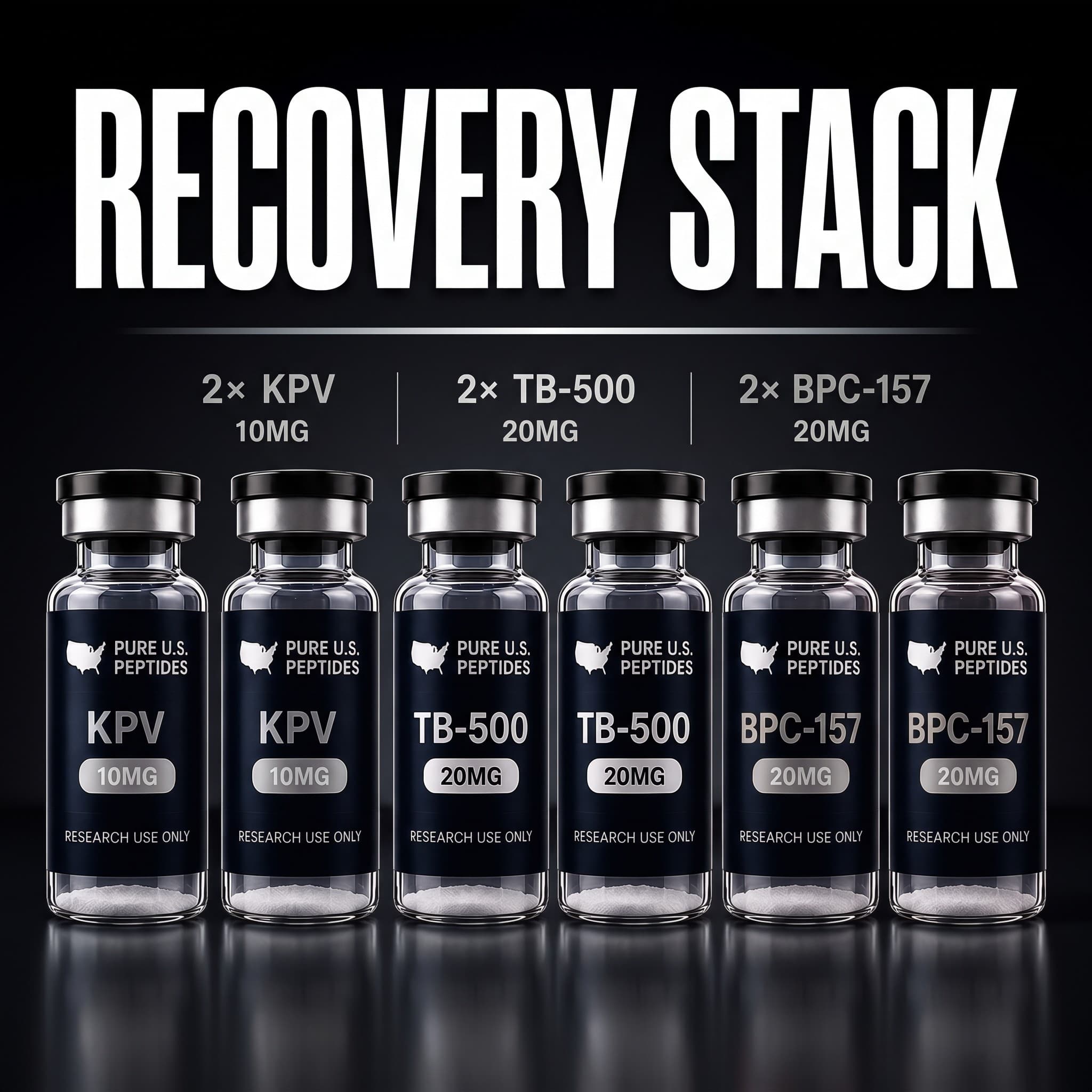
KPV + TB-500 + BPC-157 Research Kit
BPC-157 20mg + TB-500 20mg Bundle
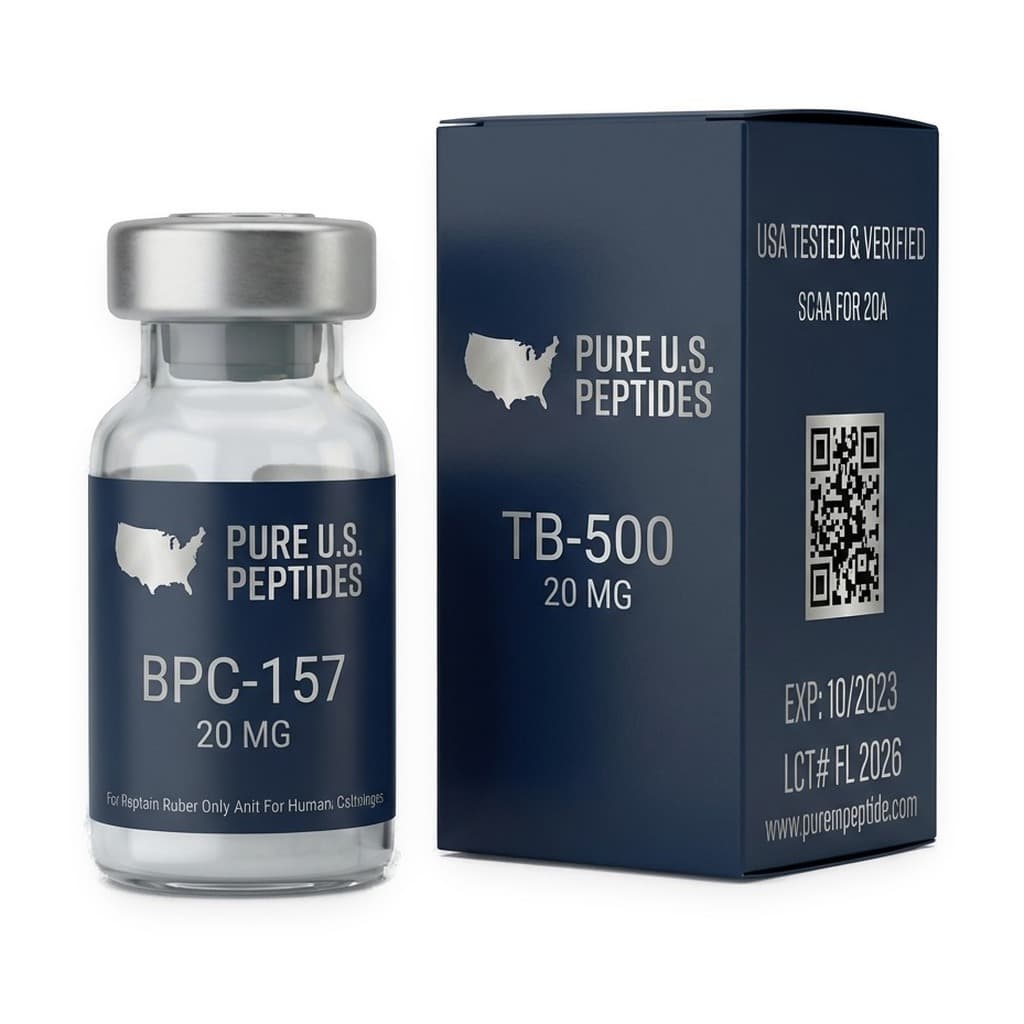
BPC-157 10mg + TB-500 10mg Bundle