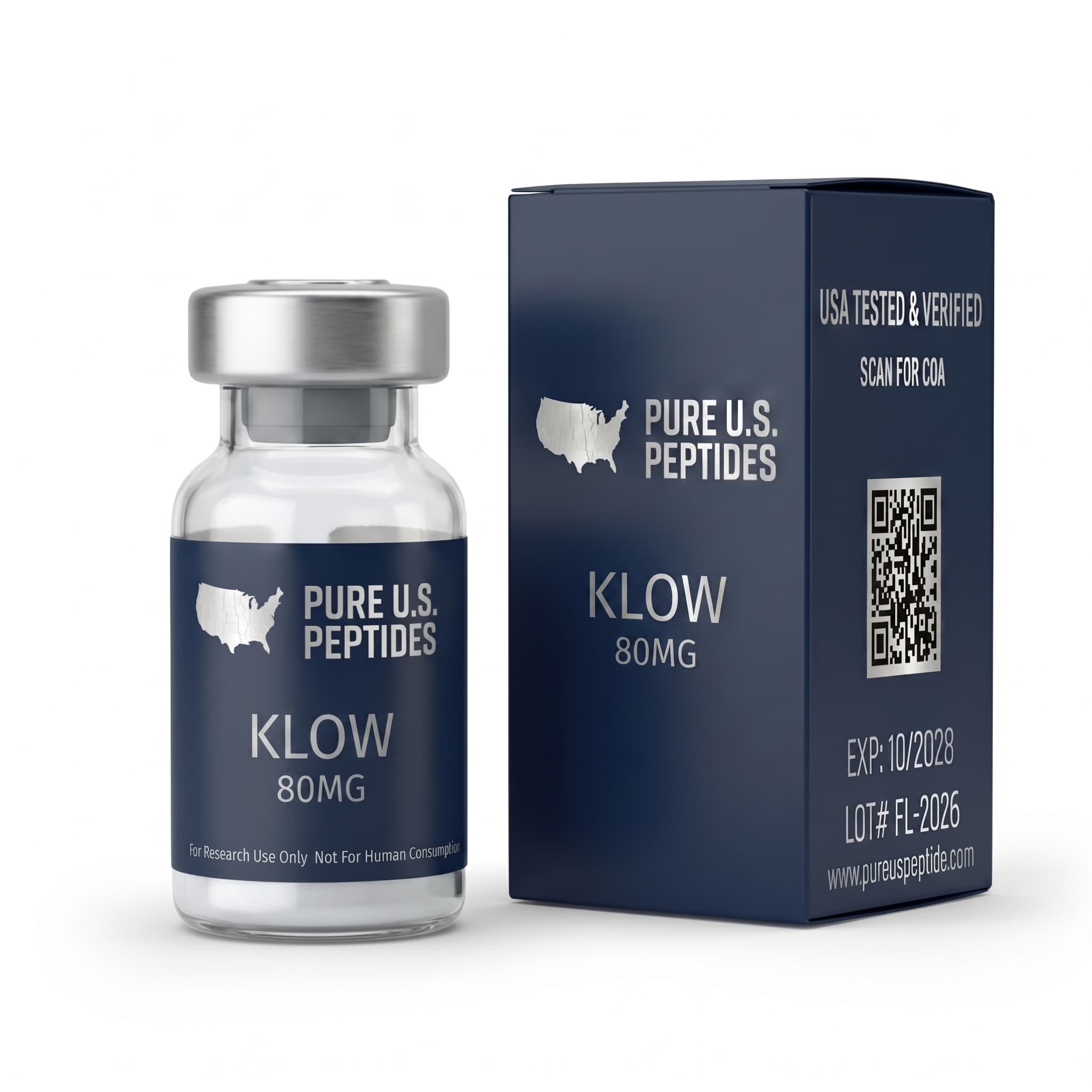
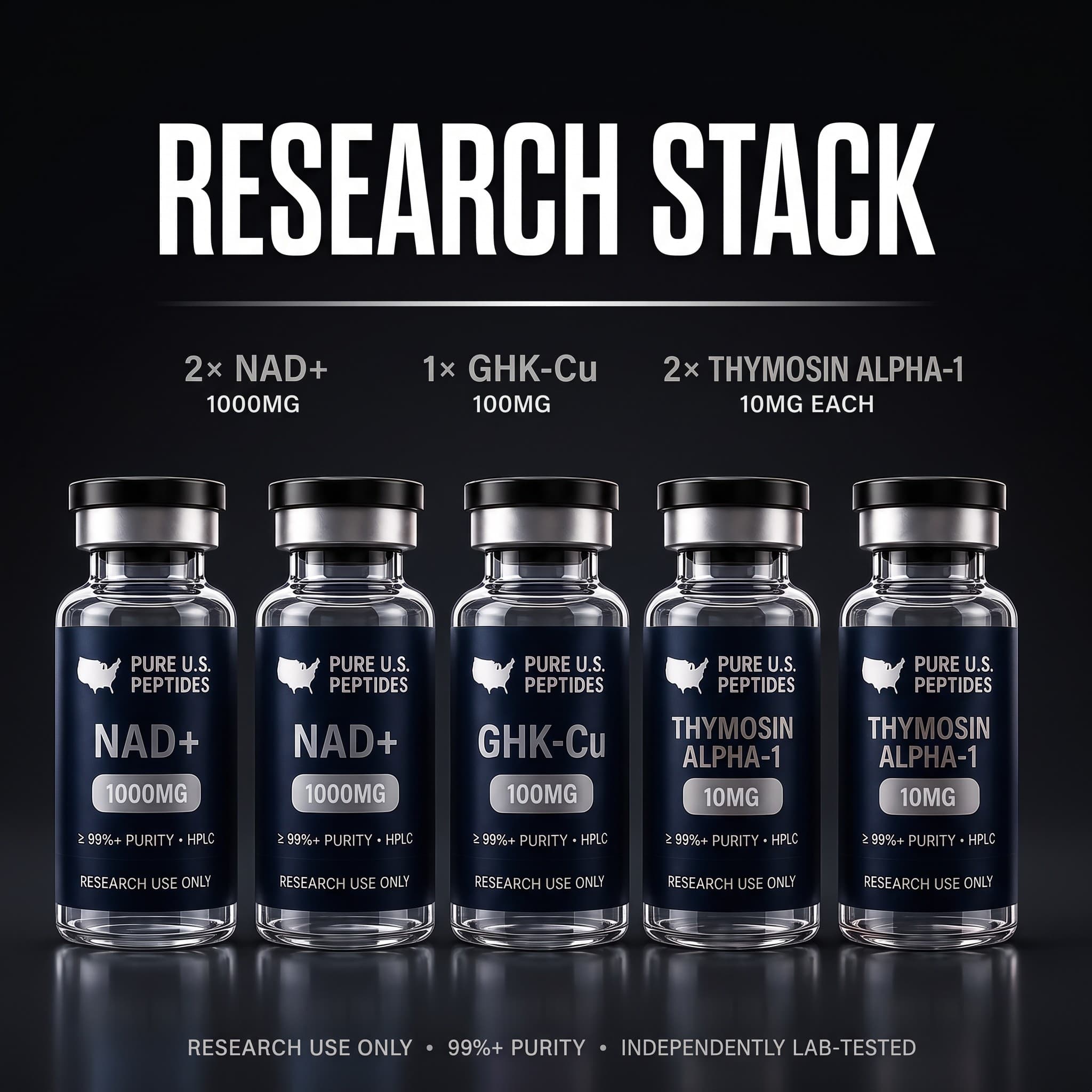
Long Shot Research Kit
In Stock & Ready to Ship from USA
FREE shipping on every U.S. order
Secure checkout via encrypted payment processor


 +2.9k
+2.9kResearch Use Only
These products are for laboratory research only and not intended for medical use. They are not FDA-approved to diagnose, treat, cure, or prevent any disease. By purchasing, you certify they will be used solely for research and not for human or animal consumption.
Research Summary
23 PubMed CitationsOverview The Long Shot groups three compounds that are each independently characterized in the literature on cellular metabolism, connective-tissue biology, and immune signalling. It ships as five separate vials, so the material corresponds to three distinct bodies of published work rather than to a single studied formulation. NAD+ is a central redox coenzyme. Covarrubias et al. reviewed NAD+ metabolism and its roles in cellular processes during ageing, and Verdin surveyed its position in metabolism and neurodegeneration.[1][2] Rajman et al. reviewed the in vivo evidence for NAD-boosting molecules, and Imai and Guarente described the NAD+–sirtuin relationship.[3][4] GHK-Cu is the copper-binding tripeptide first reported in Nature by Pickart et al. as a growth-modulating plasma tripeptide that may function by facilitating copper uptake into cells.[8] Maquart et al. reported stimulation of collagen synthesis in fibroblast cultures, and Pickart and Margolina reviewed its actions in light of gene-expression data.[9][11] Thymosin Alpha-1 was isolated and...
Long Shot Research Kit — Research Data at a Glance
| Property | Value |
|---|---|
| PubMed Citations Referenced | 23 |
| Contributing Researchers | 2 |
| Storage Conditions | Store each lyophilized vial at -20°C (long-term), protected from light and moisture. |
| Purity Standard | See each component’s certificate |
| Research Use Only | Not for human consumption. RUO only. |
Overview
Overview
The Long Shot groups three compounds that are each independently characterized in the literature on cellular metabolism, connective-tissue biology, and immune signalling. It ships as five separate vials, so the material corresponds to three distinct bodies of published work rather than to a single studied formulation.
NAD+ is a central redox coenzyme. Covarrubias et al. reviewed NAD+ metabolism and its roles in cellular processes during ageing, and Verdin surveyed its position in metabolism and neurodegeneration.[1][2] Rajman et al. reviewed the in vivo evidence for NAD-boosting molecules, and Imai and Guarente described the NAD+–sirtuin relationship.[3][4]
GHK-Cu is the copper-binding tripeptide first reported in Nature by Pickart et al. as a growth-modulating plasma tripeptide that may function by facilitating copper uptake into cells.[8] Maquart et al. reported stimulation of collagen synthesis in fibroblast cultures, and Pickart and Margolina reviewed its actions in light of gene-expression data.[9][11]
Thymosin Alpha-1 was isolated and sequenced by Goldstein et al. in 1977 as an immunologically active thymic polypeptide.[15] Romani et al. reported that it activates dendritic cells through toll-like receptor signalling, and Dominari et al. published a comprehensive review of the literature.[16][17]
No peer-reviewed study has evaluated these three compounds together as a kit. Every citation on this page describes a single component studied on its own, and the three act through unrelated molecular systems. Investigators should treat the kit as three separate research materials and consult the dedicated NAD+, GHK-Cu, and Thymosin Alpha-1 entries for complete mechanism, applications, and reference lists.
Mechanism of Action
Reported Mechanisms — Component by Component
Each section below summarizes the published mechanism of a single component. No combined mechanism is described in the literature, and none is asserted here.
1. NAD+ (2,000 mg across 2 vials) — Redox Coenzyme and Enzyme Substrate
NAD+ operates both as an electron carrier in redox reactions and as a consumed substrate for enzyme families including sirtuins, PARPs, and CD38.[1][4] Tarragó et al. reported that a specific CD38 inhibitor reversed tissue NAD+ decline in an ageing model, and Zhang et al. reported that NAD+ repletion affected mitochondrial and stem-cell function in mice.[5][6] Grant et al. published a pilot study characterizing the plasma and urine NAD+ metabolome during intravenous infusion.[7]
2. GHK-Cu (100 mg, 1 vial) — Copper Coordination and Matrix Signalling
GHK binds Cu(II) with high affinity; Pickart et al. proposed that the complex facilitates copper uptake into cells.[8] Reported activities in fibroblast and skin models include stimulation of collagen synthesis, modulation of MMP-2 expression, and effects on MMP/TIMP balance and matrix proteins.[11][13] Pickart and colleagues also reported broad gene-expression modulation and antioxidant-gene regulation.[9][10][14]
3. Thymosin Alpha-1 (20 mg across 2 vials) — Toll-Like Receptor and Dendritic-Cell Signalling
Romani et al. reported that Thymosin Alpha-1 activates dendritic cells for antifungal Th1 resistance through toll-like receptor signalling, and in a later study reported activation of dendritic-cell tryptophan catabolism establishing a regulatory environment balancing inflammation and tolerance.[16][18] Serafino et al. reported activation of complement-receptor-mediated phagocytosis in human monocyte-derived macrophages.[20] Li et al. reviewed its biological activities and production, and Elizondo-Riojas et al. published an NMR structure.[19][22]
No published pharmacokinetic, pharmacodynamic, or interaction study has evaluated NAD+, GHK-Cu, and Thymosin Alpha-1 administered together. Any combined behaviour is unstudied.
Research Applications
Research Applications (Component-Level)
The published work behind each vial in this kit falls into the following areas. Every study listed used a single component, not the kit.
- Cellular-ageing and metabolism models — NAD+ biology has been reviewed extensively in the context of ageing, metabolism, and neurodegeneration.[1][2][3]
- Mitochondrial and stem-cell function — Zhang et al. examined NAD+ repletion in murine models.[6]
- Extracellular-matrix and fibroblast models — GHK-Cu has been studied for collagen synthesis and MMP/TIMP expression in fibroblast culture.[11][13]
- Wound-healing models — Canapp et al. examined a topical tripeptide-copper complex on healing of ischemic open wounds.[12]
- Gene-expression profiling — GHK has been examined for broad transcriptional modulation.[9][10]
- Innate and adaptive immune-signalling assays — Thymosin Alpha-1 has been studied in dendritic-cell, macrophage, and TLR-signalling systems.[16][18][20]
- Structural and analytical characterization — an NMR structure of human Thymosin Alpha-1 supports assay and stability work.[22]
Important: no cited study used the combined kit. Researchers should not assume that single-agent findings carry over to co-administration.
Biochemical Characteristics
| Property | Value |
|---|---|
| Composition | 2 x NAD+ 1000 mg + 1 x GHK-Cu 100 mg + 2 x Thymosin Alpha-1 10 mg |
| Total Mass | 2,120 mg across five individually lyophilized vials |
| Format | Five separate single-compound vials — not a co-lyophilized blend |
| NAD+ Component | Nicotinamide adenine dinucleotide; C21H27N7O14P2; MW ~663.43 g/mol; CAS 53-84-9 |
| GHK-Cu Component | Glycyl-L-Histidyl-L-Lysine-Cu(II); MW ~401.9 Da; CAS 89030-95-5 |
| Thymosin Alpha-1 Component | 28-amino-acid N-terminally acetylated thymic peptide; MW ~3108 Da; CAS 62304-98-7 |
| Appearance | White lyophilized powder (NAD+, Thymosin Alpha-1); pale-blue powder (GHK-Cu copper complex) |
| Classification | Multi-vial research kit |
Identifiers
| Identity Confirmation | |
|---|---|
| Counter-Ion | |
| Detection Methods |
Preclinical Research Summary
Preclinical Research Summary (Component-Level)
No peer-reviewed study has evaluated this five-vial kit as a unit. The table below lists representative findings for each component individually. Full per-component data and complete reference lists are on the dedicated NAD+, GHK-Cu, and Thymosin Alpha-1 pages.
| Component | Representative Study | Reported Observation | Ref |
|---|---|---|---|
| NAD+ | Covarrubias et al. (2021) — review | Surveys NAD+ metabolism and its roles in cellular processes during ageing | [1] |
| NAD+ | Zhang et al. (2016) — mice | NAD+ repletion reported to affect mitochondrial and stem-cell function | [6] |
| GHK-Cu | Pickart et al. (1980) — Nature | Growth-modulating plasma tripeptide proposed to facilitate cellular copper uptake | [8] |
| GHK-Cu | Maquart et al. (1988) — fibroblast culture | Reported stimulation of collagen synthesis by the tripeptide-copper complex | [11] |
| Thymosin Alpha-1 | Goldstein et al. (1977) — PNAS | Isolation and sequence analysis of the immunologically active thymic polypeptide | [15] |
| Thymosin Alpha-1 | Romani et al. (2004) — Blood | Reported dendritic-cell activation through toll-like receptor signalling | [16] |
For Laboratory Research Only. Not for human use, medical use, diagnostic use, or veterinary use.
ALL ARTICLES AND PRODUCT INFORMATION PROVIDED ON THIS WEBSITE ARE FOR INFORMATIONAL AND EDUCATIONAL PURPOSES ONLY.
Authors & Attribution
✍️ Article Author
Dr. Loren Pickart, PhD
Loren Pickart, PhD, is the discoverer of GHK-Cu (Copper Tripeptide-1), which he first isolated from human plasma albumin in 1973 at the University of California, San Francisco. Pickart subsequently founded ProCyte Corporation and Skin Biology, Inc., and his Connectivity Map analysis established that GHK modulates expression of more than 4,000 human genes. Loren Pickart is being referenced as one of the leading scientists involved in the research and development of GHK-Cu, a component of this kit. In no way is this doctor/scientist endorsing or advocating the purchase, sale, or use of this product for any reason. There is no affiliation or relationship, implied or otherwise, between Pure US Peptide and this doctor.
View Full Researcher Profile →🎓 Scientific Journal Author
Dr. Allan L. Goldstein
Allan L. Goldstein, PhD, is Professor Emeritus of Biochemistry and Molecular Medicine at The George Washington University School of Medicine and Health Sciences. Dr. Goldstein led the team that isolated and sequenced Thymosin Alpha-1 from thymic tissue in 1977, work that established the thymosin family as a subject of immunological research. Allan L. Goldstein is being referenced as one of the leading scientists involved in the research and development of Thymosin Alpha-1, a component of this kit. In no way is this doctor/scientist endorsing or advocating the purchase, sale, or use of this product for any reason. There is no affiliation or relationship, implied or otherwise, between Pure US Peptide and this doctor.
View Full Researcher Profile →Dr. Allan L. Goldstein is being referenced as one of the leading scientists involved in the research and development of Long Shot Research Kit. In no way is this doctor/scientist endorsing or advocating the purchase, sale, or use of this product for any reason. There is no affiliation or relationship, implied or otherwise, between Pure US Peptide and this doctor. The purpose of citing the doctor is to acknowledge, recognize, and credit the exhaustive research and development efforts conducted by the scientists studying this peptide.
Referenced Citations
Covarrubias AJ, Perrone R, Grozio A, Verdin E. NAD+ metabolism and its roles in cellular processes during ageing. Nature Reviews Molecular Cell Biology. 2021;22(2):119-141.
DOIVerdin E. NAD+ in aging, metabolism, and neurodegeneration. Science. 2015;350(6265):1208-1213.
DOIRajman L, Chwalek K, Sinclair DA. Cell Metabolism. 2018;27(3):529-547.
DOIImai S, Guarente L. NAD+ and sirtuins in aging and disease. Trends in Cell Biology. 2014;24(8):464-471.
DOITarragó MG, Chini CCS, Kanamori KS, et al. Cell Metabolism. 2018;27(5):1081-1095.e10.
DOIZhang H, Ryu D, Wu Y, et al. NAD+ repletion improves mitochondrial and stem cell function and enhances life span in mice. Science. 2016;352(6292):1436-1443.
DOIGrant R, Berg J, Mestayer R, et al. Frontiers in Aging Neuroscience. 2019;11:257.
DOIPickart L, Freedman JH, Loker WJ, et al. Growth-modulating plasma tripeptide may function by facilitating copper uptake into cells. Nature. 1980;288(5792):715-717.
DOIPickart L, Margolina A. Regenerative and Protective Actions of the GHK-Cu Peptide in the Light of the New Gene Data. International Journal of Molecular Sciences. 2018;19(7):1987.
DOIPickart L, Vasquez-Soltero JM, Margolina A. BioMed Research International. 2014;2014:151479.
DOIMaquart FX, Pickart L, Laurent M, et al. Stimulation of collagen synthesis in fibroblast cultures by the tripeptide-copper complex glycyl-L-histidyl-L-lysine-Cu2+. FEBS Letters. 1988;238(2):343-346.
DOICanapp SO Jr, Farese JP, Schultz GS, et al. Veterinary Surgery. 2003;32(6):515-523.
DOISimeon A, Emonard H, Hornebeck W, Maquart FX. The tripeptide-copper complex glycyl-L-histidyl-L-lysine-Cu2+ stimulates matrix metalloproteinase-2 expression by fibroblast cultures. Life Sciences. 2000;67(18):2257-2265.
DOIPickart L, Vasquez-Soltero JM, Margolina A. Cosmetics. 2015;2(3):236-247.
DOIGoldstein AL, Low TL, McAdoo M, et al. Thymosin alpha1: Isolation and sequence analysis of an immunologically active thymic polypeptide. Proc Natl Acad Sci USA. 1977;74(2):725-729.
PubMedRomani L, Bistoni F, Gaziano R, et al. Thymosin alpha 1 activates dendritic cells for antifungal Th1 resistance through toll-like receptor signaling. Blood. 2004;103(11):4232-4239.
PubMedDominari A, Hathaway III D, Pandav K, et al. Thymosin alpha 1: A comprehensive review of the literature. World Journal of Virology. 2020;9(5):67-78.
PubMedRomani L, Bistoni F, Perruccio K, et al. Thymosin alpha1 activates dendritic cell tryptophan catabolism and establishes a regulatory environment for balance of inflammation and tolerance. Blood. 2006;108(7):2265-2274.
PubMedLi J, Liu CH, Wang FS. Thymosin alpha 1: biological activities, applications and genetic engineering production. Peptides. 2010;31(11):2151-2158.
PubMedSerafino A, Pica F, Andreola F, et al. Journal of Innate Immunity. 2014;6(1):72-88.
PubMedGaraci E. Thymosin alpha1: a historical overview. Annals of the New York Academy of Sciences. 2007;1112:14-20.
PubMedElizondo-Riojas MA, Chamow SM, Tuthill CW, et al. Biochemical and Biophysical Research Communications. 2011;416(3-4):356-361.
PubMedU.S. Food and Drug Administration. Certain Bulk Drug Substances for Use in Compounding that May Present Significant Safety Risks. FDA.gov. Updated 2023.
FDA.govRUO Disclaimer
For Research Use Only (RUO). Not intended for human consumption, clinical use, or as a drug, food, cosmetic, or medical device. This product has not been evaluated by the FDA and is supplied solely for in-vitro laboratory research by qualified professionals.
Certificate of Analysis
Published certificates come from third-party laboratories. If this listing's certificate is still pending, the card below says so.
Latest Lab Report
Storage & Handling
Summary
Store each lyophilized vial at -20°C (long-term), protected from light and moisture. Keep GHK-Cu away from chelators (EDTA, carnosine, Vitamin C). Store each vial separately.
Recommended Laboratory Storage Conditions — The Long Shot (5 vials)
Lyophilized Powder: Store all five vials at -20°C for long-term stability, protected from light and moisture. The GHK-Cu vial has a characteristic pale-blue tint from the copper complex.
NAD+ Handling: NAD+ in solution is sensitive to alkaline pH and elevated temperature. Prepare working solutions fresh and avoid repeated freeze-thaw cycles.
GHK-Cu Incompatibilities: Do not co-formulate with EDTA, carnosine, Vitamin C, or other strong chelators — these strip Cu(II) from the complex.
Separate Handling: Each vial contains a single compound. Store each independently; there is no published stability data for these three pre-mixed in one solution.
Handling: Allow vials to reach room temperature before opening to prevent condensation onto the lyophilized cake. Use standard aseptic technique.
“Preclinical Research Summary (Component-Level) No peer-reviewed study has evaluated this five-vial kit as a unit.”
Related Research Compounds
Adamax
30mg
Grand Slam Research Kit
Freedom Research Kit