Freedom Research Kit
In Stock & Ready to Ship from USA
FREE shipping on every U.S. order
Secure checkout via encrypted payment processor


 +2.9k
+2.9kResearch Use Only
These products are for laboratory research only and not intended for medical use. They are not FDA-approved to diagnose, treat, cure, or prevent any disease. By purchasing, you certify they will be used solely for research and not for human or animal consumption.
Research Summary
22 PubMed CitationsOverview The Freedom Stack groups three research materials that are each characterized in a separate body of published work. It ships as five individual vials, and the three literatures behind them do not overlap. GLP3-R is retatrutide (LY3437943). Coskun et al. published its discovery-to-clinical-proof-of-concept characterization as a triple glucagon, GIP, and GLP-1 receptor agonist, and Urva et al. reported the phase 1b multiple-ascending-dose study.[1][2] Phase 2 investigations of the pharmaceutical formulation have been published.[3][4] It remains an investigational compound with no regulatory approval. SS-31 (elamipretide) is a mitochondria-targeted tetrapeptide. Szeto described it as a first-in-class cardiolipin-protective compound, and Birk et al. reported that it re-energizes ischemic mitochondria by interacting with cardiolipin and by targeting the cytochrome c/cardiolipin complex.[5][6][7] KLOW is itself a four-peptide blend — GHK-Cu, BPC-157, TB-500, and KPV — whose components are characterized in the tissue-repair and inflammation literatures: copper-dependent gene and matrix modulation, VEGFR2-associated angiogenic signalling, G-actin...
Freedom Research Kit — Research Data at a Glance
| Property | Value |
|---|---|
| PubMed Citations Referenced | 22 |
| Contributing Researchers | 2 |
| Storage Conditions | Store each lyophilized vial at -20°C (long-term), protected from light and moisture. |
| Purity Standard | See each component’s certificate |
| Research Use Only | Not for human consumption. RUO only. |
Overview
Overview
The Freedom Stack groups three research materials that are each characterized in a separate body of published work. It ships as five individual vials, and the three literatures behind them do not overlap.
GLP3-R is retatrutide (LY3437943). Coskun et al. published its discovery-to-clinical-proof-of-concept characterization as a triple glucagon, GIP, and GLP-1 receptor agonist, and Urva et al. reported the phase 1b multiple-ascending-dose study.[1][2] Phase 2 investigations of the pharmaceutical formulation have been published.[3][4] It remains an investigational compound with no regulatory approval.
SS-31 (elamipretide) is a mitochondria-targeted tetrapeptide. Szeto described it as a first-in-class cardiolipin-protective compound, and Birk et al. reported that it re-energizes ischemic mitochondria by interacting with cardiolipin and by targeting the cytochrome c/cardiolipin complex.[5][6][7]
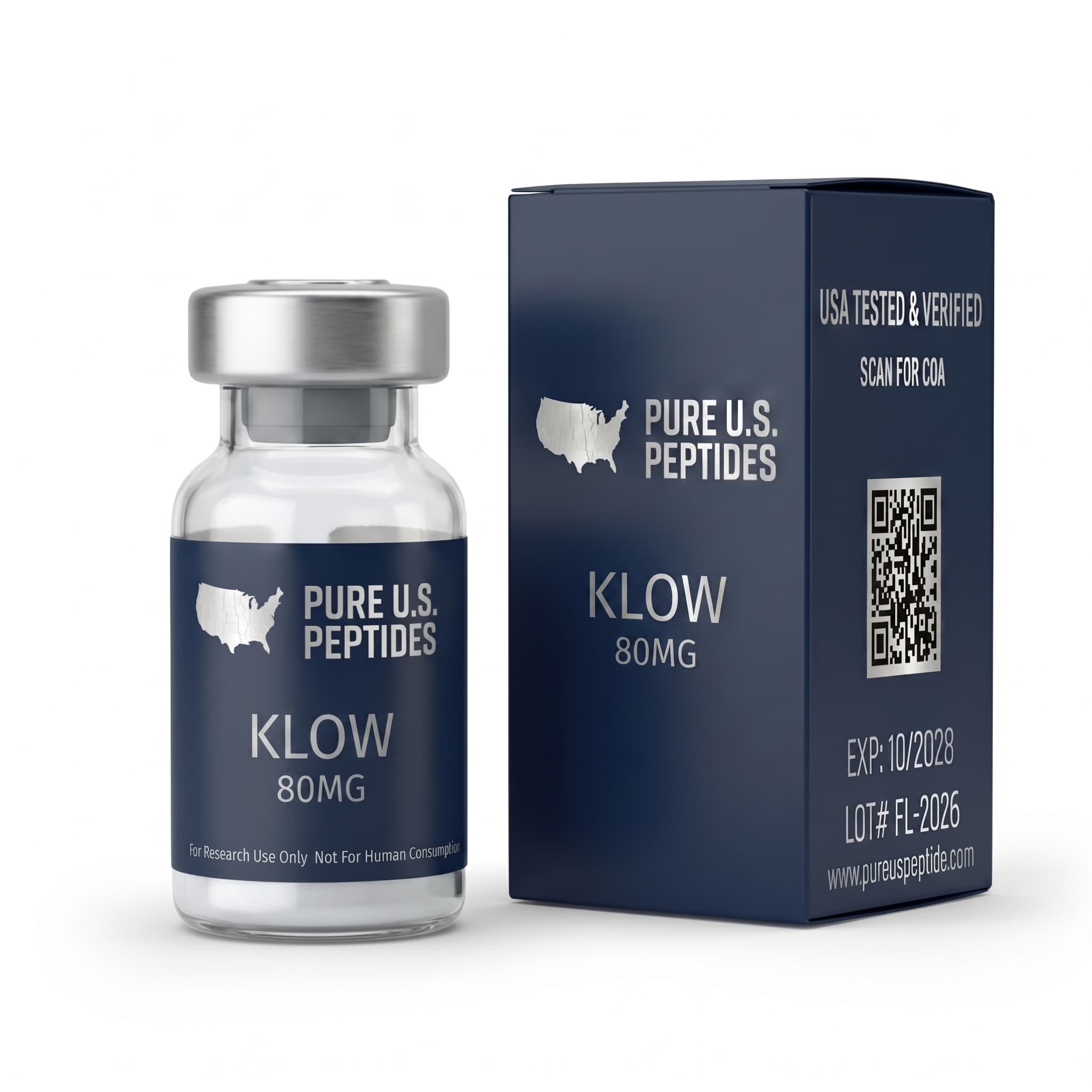
KLOW is itself a four-peptide blend — GHK-Cu, BPC-157, TB-500, and KPV — whose components are characterized in the tissue-repair and inflammation literatures: copper-dependent gene and matrix modulation, VEGFR2-associated angiogenic signalling, G-actin binding, and melanocortin-derived anti-inflammatory activity respectively.[12][15][17][19]
No peer-reviewed study has evaluated these materials together as a stack. Every citation on this page describes a single component studied on its own, and no published work characterizes interactions among incretin-receptor agonism, mitochondrial cardiolipin binding, and tissue-repair peptide signalling. Investigators should treat the kit as three separate research materials and consult the dedicated GLP3-R, SS-31, and KLOW entries for complete mechanism, applications, and reference lists.
Mechanism of Action
Reported Mechanisms — Component by Component
Each section below summarizes the published mechanism of a single component. No combined mechanism is described in the literature, and none is asserted here.
1. GLP3-R / Retatrutide (30 mg, 1 vial) — Triple Receptor Agonism
Retatrutide is described as engaging the GIP, GLP-1, and glucagon receptors with a single peptide sequence — the feature that distinguishes it from dual GIP/GLP-1 agonism and from GLP-1-selective agonism.[1] Clinical pharmacology has been reported in a phase 1b multiple-ascending-dose trial and in phase 2 studies of the pharmaceutical formulation.[2][3][4]
2. SS-31 / Elamipretide (100 mg across 2 vials) — Cardiolipin Interaction
SS-31 concentrates in the inner mitochondrial membrane and associates with cardiolipin, the signature phospholipid of that membrane. Birk et al. reported that this interaction re-energizes ischemic mitochondria and that targeting the cytochrome c/cardiolipin complex promotes electron transport and mitochondrial ATP synthesis.[6][7] Campbell et al. reported effects on age-related redox stress and exercise tolerance in aged mice, Chiao et al. reported late-life restoration of mitochondrial function in old mice, and Sabbah et al. reported effects on left ventricular and mitochondrial function in a canine heart-failure model.[8][9][10]
3. KLOW (160 mg across 2 vials) — Four-Peptide Tissue-Repair Blend
Each KLOW vial contains four peptides with distinct reported targets. GHK-Cu (50 mg) coordinates Cu(II) and has been reported to modulate broad gene-expression programs and matrix proteins.[12][13][14] BPC-157 (10 mg) has been associated with VEGFR2 activation in endothelial models.[15][16] TB-500 (10 mg) carries the actin-binding motif of Thymosin β4.[17][18] KPV (10 mg) is the C-terminal α-MSH tripeptide studied for anti-inflammatory activity and PepT1-mediated uptake.[19][20]
No published pharmacokinetic, pharmacodynamic, or interaction study has evaluated retatrutide, SS-31, and the KLOW peptides administered together. Any combined behaviour is unstudied.
Research Applications
Research Applications (Component-Level)
The published work behind each vial in this kit falls into the following areas. Every study listed used a single component, not the stack.
- Incretin and glucagon receptor pharmacology — retatrutide is the triple-agonist reference compound used to separate the contribution of glucagon-receptor engagement from GIP/GLP-1 agonism.[1][2]
- Metabolic and hepatic research — phase 2 trials of the pharmaceutical formulation have been published.[3][4]
- Mitochondrial bioenergetics — SS-31 is used as a cardiolipin-targeting tool compound in electron-transport and ATP-synthesis studies.[5][7]
- Cardiac and ageing models — SS-31 has been evaluated in canine heart-failure and aged-mouse paradigms.[9][10]
- Neurodegeneration models — Zhao et al. examined SS-31 in an Alzheimer's disease model.[11]
- Tissue-repair and matrix models — the KLOW component peptides have been studied individually in wound-healing, angiogenesis, and matrix-remodeling systems.[12][15][18]
- Inflammation models — KPV has been examined in murine colitis and inflammatory bowel disease models.[20]
Important: no cited study used the combined stack. Researchers should not assume that single-agent findings carry over to co-administration.
Biochemical Characteristics
| Property | Value |
|---|---|
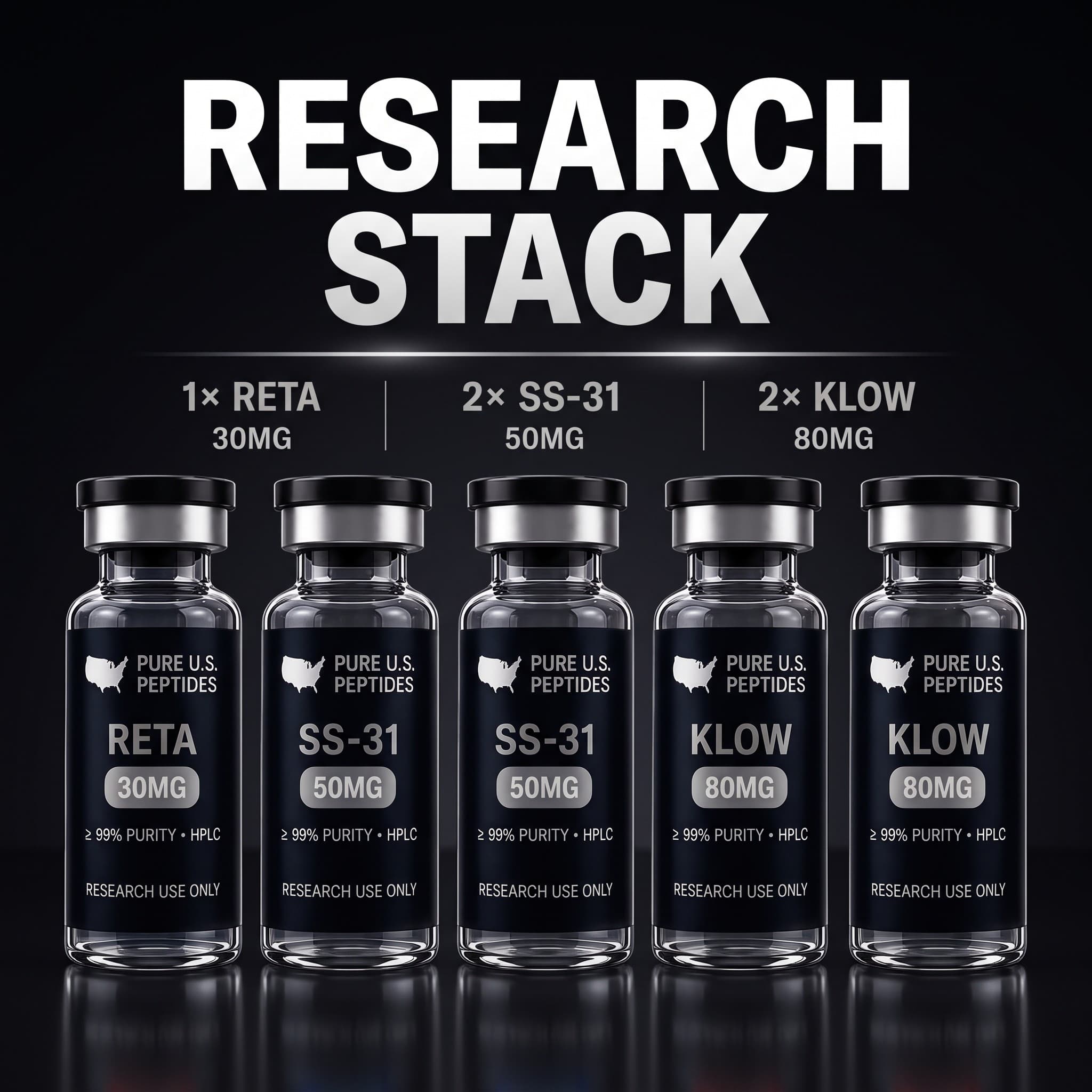
| Composition | 1 x GLP3-R 30 mg + 2 x SS-31 50 mg + 2 x KLOW 80 mg |
| Total Peptide Mass | 290 mg across five individually lyophilized vials |
| Format | Five separate vials — not a co-lyophilized blend |
| GLP3-R Component | Retatrutide (LY3437943); synthetic acylated peptide; triple GIP / GLP-1 / glucagon receptor agonist |
| SS-31 Component | Elamipretide (MTP-131); D-Arg-2',6'-dimethyl-Tyr-Lys-Phe-NH2 tetrapeptide; MW ~639.8 g/mol; CAS 736992-21-5 |
| KLOW Component | Per vial: 50 mg GHK-Cu + 10 mg BPC-157 + 10 mg TB-500 + 10 mg KPV |
| Appearance | White-to-off-white lyophilized powder; KLOW vials carry a pale-blue tint from the GHK-Cu copper complex |
| Classification | Multi-vial research kit |
Identifiers
| Identity Confirmation | |
|---|---|
| Counter-Ion | |
| Detection Methods |
Preclinical Research Summary
Research Summary (Component-Level)
No peer-reviewed study has evaluated this five-vial stack as a unit. The table below lists representative findings for each component individually. Full per-component data and complete reference lists are on the dedicated GLP3-R, SS-31, and KLOW pages.
| Component | Representative Study | Reported Observation | Ref |
|---|---|---|---|
| GLP3-R | Coskun et al. (2022) — discovery | Characterized as a triple glucagon, GIP, and GLP-1 receptor agonist | [1] |
| GLP3-R | Urva et al. (2022) — phase 1b | Multiple-ascending-dose clinical pharmacology | [2] |
| SS-31 | Birk et al. (2013) — ischemic mitochondria | Reported re-energization of ischemic mitochondria via cardiolipin interaction | [6] |
| SS-31 | Chiao et al. (2020) — old mice | Reported late-life restoration of mitochondrial function | [10] |
| KLOW / GHK-Cu | Pickart & Margolina (2018) — gene data review | Reviewed regenerative and protective actions in light of gene-expression data | [12] |
| KLOW / BPC-157 | Hsieh et al. (2017) — endothelial models | Pro-angiogenic activity associated with VEGFR2 activation | [15] |
For Laboratory Research Only. Not for human use, medical use, diagnostic use, or veterinary use.
ALL ARTICLES AND PRODUCT INFORMATION PROVIDED ON THIS WEBSITE ARE FOR INFORMATIONAL AND EDUCATIONAL PURPOSES ONLY.
Authors & Attribution
✍️ Article Author
Dr. Hazel H. Szeto
Hazel H. Szeto, MD, PhD, was Professor of Pharmacology at Weill Cornell Medical College and is the originator of the Szeto-Schiller (SS) peptide series, including SS-31. Her work established the cardiolipin-targeting mechanism that defines this compound class and its role as a tool for studying mitochondrial bioenergetics. Hazel H. Szeto is being referenced as one of the leading scientists involved in the research and development of SS-31, a component of this stack. In no way is this doctor/scientist endorsing or advocating the purchase, sale, or use of this product for any reason. There is no affiliation or relationship, implied or otherwise, between Pure US Peptide and this doctor.
View Full Researcher Profile →🎓 Scientific Journal Author
Dr. Loren Pickart, PhD
Loren Pickart, PhD, is the discoverer of GHK-Cu (Copper Tripeptide-1), which he first isolated from human plasma albumin in 1973 at the University of California, San Francisco. Pickart subsequently founded ProCyte Corporation and Skin Biology, Inc., and his Connectivity Map analysis established that GHK modulates expression of more than 4,000 human genes — the foundation for using GHK-Cu as the mass anchor of multi-peptide blends such as KLOW. Loren Pickart is being referenced as one of the leading scientists involved in the research and development of GHK-Cu, a component of the KLOW vials in this stack. In no way is this doctor/scientist endorsing or advocating the purchase, sale, or use of this product for any reason. There is no affiliation or relationship, implied or otherwise, between Pure US Peptide and this doctor.
View Full Researcher Profile →Dr. Loren Pickart, PhD is being referenced as one of the leading scientists involved in the research and development of Freedom Research Kit. In no way is this doctor/scientist endorsing or advocating the purchase, sale, or use of this product for any reason. There is no affiliation or relationship, implied or otherwise, between Pure US Peptide and this doctor. The purpose of citing the doctor is to acknowledge, recognize, and credit the exhaustive research and development efforts conducted by the scientists studying this peptide.
Referenced Citations
Coskun T, Urva S, Roell WC, et al. Cell Metab. 2022;34(9):1234-1247.e9.
PubMedUrva S, Coskun T, Loh MT, et al. Lancet. 2022;400(10366):1869-1881.
PubMedJastreboff AM, Kaplan LM, Frías JP, et al. N Engl J Med. 2023;389(6):514-526.
PubMedRosenstock J, Frias J, Jastreboff AM, et al. Lancet. 2023;402(10401):529-544.
PubMedSzeto HH. British Journal of Pharmacology. 2014;171(8):2029-2050.
SourceBirk AV, Liu S, Soong Y, et al. The Mitochondrial-Targeted Compound SS-31 Re-Energizes Ischemic Mitochondria by Interacting with Cardiolipin. Journal of the American Society of Nephrology. 2013;24(8):1250-1261.
DOIBirk AV, Chao WM, Bracken C, et al. Targeting mitochondrial cardiolipin and the cytochrome c/cardiolipin complex to promote electron transport and optimize mitochondrial ATP synthesis. British Journal of Pharmacology. 2014;171(8):2017-2028.
DOICampbell MD, Duan J, Samuelson AT, et al. Free Radical Biology and Medicine. 2019;134:268-281.
DOISabbah HN, Gupta RC, Kohli S, et al. Circulation: Heart Failure. 2016;9(2):e002206.
DOIChiao YA, Zhang H, Sweetwyne M, et al. eLife. 2020;9:e55513.
DOIZhao W, Xu Z, Cao J, Fu Q, et al. Journal of Neuroinflammation. 2019;16(1):230.
DOIPickart L, Margolina A. Regenerative and Protective Actions of the GHK-Cu Peptide in the Light of the New Gene Data. International Journal of Molecular Sciences. 2018;19(7):1987.
DOIPickart L, Vasquez-Soltero JM, Margolina A. GHK Peptide as a Natural Modulator of Multiple Cellular Pathways in Skin Regeneration. BioMed Research International. 2015;2015:648108.
DOIPark JR, Lee H, Kim SI, Yang SR. The tri-peptide GHK-Cu complex ameliorates lipopolysaccharide-induced acute lung injury in mice. Oncotarget. 2016;7(36):58405-58417.
DOIHsieh MJ, et al. Journal of Molecular Medicine. 2017;95(3):323-333.
DOISikiric P, et al. Brain-gut Axis and Pentadecapeptide BPC 157: Theoretical and Practical Implications. Current Neuropharmacology. 2016;14(8):857-865.
DOIGoldstein AL, Hannappel E, Sosne G, Kleinman HK. Thymosin β4: a multi-functional regenerative peptide. Expert Opinion on Biological Therapy. 2012;12(1):37-51.
DOIPhilp D, Goldstein AL, Kleinman HK. Thymosin beta4 promotes angiogenesis, wound healing, and hair follicle development. Mechanisms of Ageing and Development. 2004;125(2):113-115.
DOIBrzoska T, Luger TA, Maaser C, Abels C, Böhm M. Alpha-melanocyte-stimulating hormone and related tripeptides: biochemistry, antiinflammatory and protective effects in vitro and in vivo, and future perspectives. Endocrine Reviews. 2008;29(5):581-602.
DOIDalmasso G, Charrier-Hisamuddin L, Nguyen HTT, Yan Y, Sitaraman S, Merlin D. PepT1-Mediated Tripeptide KPV Uptake Reduces Intestinal Inflammation. Gastroenterology. 2008;134(1):166-178.
DOIU.S. Food and Drug Administration. Certain Bulk Drug Substances for Use in Compounding that May Present Significant Safety Risks. FDA.gov. Updated 2023.
FDA.govWorld Anti-Doping Agency. The 2025 Prohibited List. WADA. January 1, 2025.
WADARUO Disclaimer
For Research Use Only (RUO). Not intended for human consumption, clinical use, or as a drug, food, cosmetic, or medical device. This product has not been evaluated by the FDA and is supplied solely for in-vitro laboratory research by qualified professionals.
Certificate of Analysis
Published certificates come from third-party laboratories. If this listing's certificate is still pending, the card below says so.
Latest Lab Report
Storage & Handling
Summary
Store each lyophilized vial at -20°C (long-term), protected from light and moisture. Keep KLOW away from chelators (EDTA, carnosine, Vitamin C). Store each vial separately.
Recommended Laboratory Storage Conditions — The Freedom Stack (5 vials)
Lyophilized Powder: Store all five vials at -20°C for long-term stability, protected from light and moisture. KLOW vials show a pale-blue tint from the GHK-Cu copper complex.
KLOW Incompatibilities: Do not co-formulate the KLOW material with EDTA, carnosine, Vitamin C, or other strong chelators — these strip Cu(II) from GHK-Cu.
Separate Handling: Each vial is a distinct material. Store each independently; there is no published stability data for these materials pre-mixed in one solution.
Component Purity: The lot certificate for this listing is pending.
Handling: Allow vials to reach room temperature before opening to prevent condensation onto the lyophilized cake. Use standard aseptic technique.
“Research Summary (Component-Level) No peer-reviewed study has evaluated this five-vial stack as a unit.”
Related Research Compounds
Adamax
30mg
Long Shot Research Kit
Grand Slam Research Kit