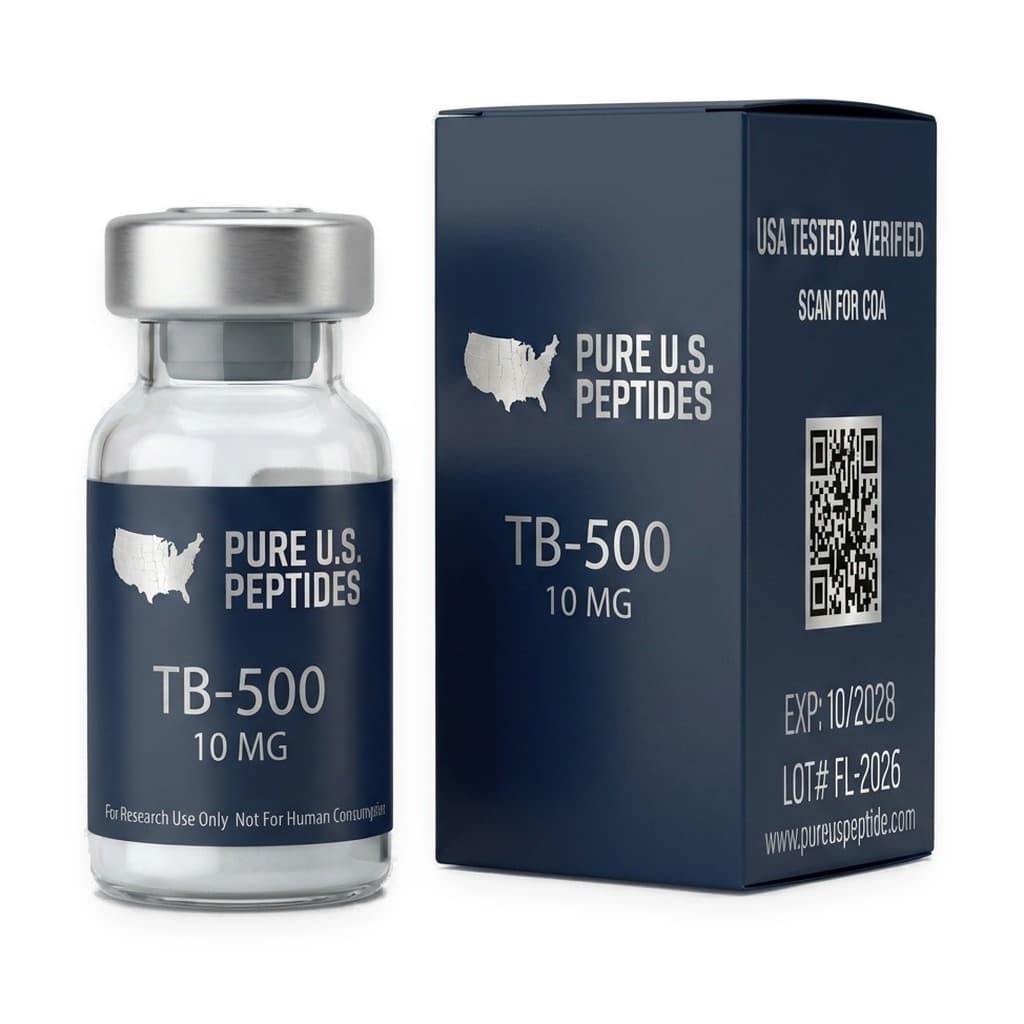
TB500 10mg
En Stock y Listo para Envío desde EE.UU.
Envío GRATIS en todos los pedidos de EE.UU.
Pago seguro mediante procesador de pagos encriptado


 +2.9k
+2.9kSolo para Uso en Investigación
Estos productos son exclusivamente para investigación de laboratorio y no están destinados para uso médico. No están aprobados por la FDA para diagnosticar, tratar, curar o prevenir ninguna enfermedad. Al realizar su compra, usted certifica que serán utilizados exclusivamente para investigación y no para consumo humano o animal.
Resumen de Investigación
29 Citas PubMedDescripción General TB-500 (también conocido como Fequesetide) es un heptapéptido sintético correspondiente a la secuencia de aminoácidos N-acetilada 17–23 de la proteína de origen natural Timosina Beta-4 (Tβ4). Su secuencia es Ac-LKKTETQ.[1][2] La molécula parental, Timosina Beta-4, es un polipéptido ubicuo de 43 aminoácidos originalmente aislado del timo. Se encuentra en altas concentraciones en plaquetas sanguíneas, glóbulos blancos y líquido de heridas, y pertenece a la familia de proteínas secuestradoras de actina de tipo β-timosina.[3] TB-500 fue desarrollado a partir del descubrimiento de que la secuencia específica de siete aminoácidos (17–23) dentro de la Tβ4 es responsable de sus propiedades de unión a actina, las cuales son fundamentales para la migración celular y la reparación tisular. El fragmento más corto conserva las actividades angiogénicas y de cicatrización de heridas esenciales de la molécula parental, siendo al mismo tiempo más económico de sintetizar.[6][8] La FDA de EE.UU. ha clasificado al TB-500...
TB500 — Datos de Investigación de un Vistazo
| Propiedad | Valor |
|---|---|
| Citas PubMed Referenciadas | 29 |
| Investigadores Colaboradores | 3 |
| Condiciones de Almacenamiento | Almacenar polvo liofilizado a -20°C para estabilidad a largo plazo. |
| Estándar de Pureza | Certificado pendiente |
| Solo para Uso en Investigación | No destinado al consumo humano. Solo para uso en investigación. |
Compare TB500 con Otros Péptidos
Research guide
What is TB500? Read the full research guideDescripción General
Descripción General
TB-500 (también conocido como Fequesetide) es un heptapéptido sintético correspondiente a la secuencia de aminoácidos N-acetilada 17–23 de la proteína de origen natural Timosina Beta-4 (Tβ4). Su secuencia es Ac-LKKTETQ.[1][2]
La molécula parental, Timosina Beta-4, es un polipéptido ubicuo de 43 aminoácidos originalmente aislado del timo. Se encuentra en altas concentraciones en plaquetas sanguíneas, glóbulos blancos y líquido de heridas, y pertenece a la familia de proteínas secuestradoras de actina de tipo β-timosina.[3]
TB-500 fue desarrollado a partir del descubrimiento de que la secuencia específica de siete aminoácidos (17–23) dentro de la Tβ4 es responsable de sus propiedades de unión a actina, las cuales son fundamentales para la migración celular y la reparación tisular. El fragmento más corto conserva las actividades angiogénicas y de cicatrización de heridas esenciales de la molécula parental, siendo al mismo tiempo más económico de sintetizar.[6][8]
La FDA de EE.UU. ha clasificado al TB-500 como Sustancia Farmacológica a Granel de Categoría 2, citando información insuficiente relacionada con la seguridad y riesgo de inmunogenicidad. Está prohibida su preparación magistral por instalaciones de subcontratación.[4] TB-500 y Tβ4 también están explícitamente prohibidos por la WADA bajo la Sección S2.3 en todo momento.[5]
Mecanismo de Acción
Mecanismo de Acción
Objetivo Primario: Secuestro de G-Actina
El objetivo molecular fundamental del TB-500 es la actina globular monomérica (G-actina). El motivo LKKTETQ se une a la G-actina en un complejo estequiométrico 1:1, secuestrando la actina monomérica e impidiendo su polimerización descontrolada en actina filamentosa (F-actina).[6] Al regular la polimerización de actina, TB-500 modula la organización del citoesqueleto — el prerrequisito para la motilidad y migración celular esenciales para la reparación tisular.[9]
Interacción con la ATP Sintasa
La Tβ4 (y potencialmente sus fragmentos activos) interactúa con la F1-F0 ATP sintasa en la superficie de las células endoteliales, uniéndose a la subunidad beta con una constante de disociación (KD) de aproximadamente 12 nM. Esta interacción aumenta los niveles de ATP en la superficie celular, lo cual es necesario para la señalización del receptor purinérgico involucrada en la migración celular.[10]
Vía ILK-PINCH-Akt (Supervivencia Celular)
TB-500 forma un complejo funcional con la Quinasa Ligada a Integrina (ILK) y PINCH (Particularly Interesting New Cys-His protein). Este complejo conduce a la fosforilación y activación de Akt (Proteína Quinasa B), específicamente Akt2 en células endoteliales, promoviendo la supervivencia celular y la protección de cardiomiocitos tras lesión isquémica.[11][12]
Vía NF-κB (Antiinflamatoria)
TB-500 modula la inflamación interrumpiendo la vía de transducción de señales de NF-κB. Bloquea la fosforilación y translocación nuclear de la subunidad RelA/p65, suprimiendo la transcripción de citoquinas proinflamatorias IL-8, IL-1β y TNF-α.[13][16]
Regulación Positiva de Metaloproteinasas de Matriz (MMP)
El péptido aumenta la producción de Metaloproteinasas de Matriz (MMP-2 y MMP-9), enzimas necesarias para degradar la membrana basal y facilitar la migración celular durante la angiogénesis y la reparación de heridas.[15]
Regulación Positiva de Enzimas Antioxidantes
TB-500 regula positivamente la superóxido dismutasa de manganeso (Mn-SOD), la SOD de cobre/zinc y la catalasa, proporcionando citoprotección contra el estrés oxidativo.[16]
TB-500 vs. Timosina Beta-4 de Longitud Completa
Una distinción crítica: las propiedades antifibróticas de la Tβ4 se atribuyen en gran medida al tetrapéptido N-terminal Ac-SDKP (aminoácidos 1–4), que no está presente en TB-500. El Ac-SDKP inhibe la proliferación de células madre hematopoyéticas y reduce la fibrosis al interferir con la señalización de TGF-β. Por lo tanto, TB-500 conserva las propiedades de unión a actina y migratorias pero puede carecer de la señalización antifibrótica específica de la proteína de longitud completa.[7]
Además, investigaciones recientes (Rahaman et al., 2024) sugieren que el metabolito de TB-500 Ac-LKKTE puede ser el principal impulsor de la cicatrización de heridas en lugar del péptido parental en sí.[17]
Aplicaciones de Investigación
Aplicaciones de Investigación
En la investigación de laboratorio, TB-500 y su molécula parental Tβ4 son investigados en múltiples paradigmas experimentales:
- Cicatrización de Heridas Dérmicas — Reparación acelerada de heridas dérmicas de espesor completo en modelos de ratones diabéticos (db/db) y envejecidos. Promovió la migración de queratinocitos, el depósito de colágeno y la reducción de la formación de tejido cicatricial.[8][18]
- Modelos de Reparación Corneal — Estudiado en modelos de defectos epiteliales corneales (quemaduras químicas, exposición al etanol); se reportaron criterios de valoración de migración epitelial e inflamación ocular. La Tβ4 de longitud completa se ha estudiado en ensayos de ojo seco y queratopatía neurotrófica.[19][20]
- Modelos Cardiovasculares — Estudiado en modelos de isquemia miocárdica en roedores (Tβ4 de longitud completa); se reportaron criterios de valoración de tamaño del infarto, función cardíaca, angiogénesis y progenitores epicárdicos.[11][21]
- Modelos Musculoesqueléticos — Estudiado en modelos de lesión muscular, tendinosa y ligamentosa. Promovió la migración de mioblastos y la proliferación de tenocitos en modelos de transección tendinosa.[7]
- Modelos de Lesión del SNC — Estudiado en modelos de roedores de lesión cerebral traumática, accidente cerebrovascular y desmielinización; se reportaron criterios de valoración histológicos, de diferenciación de oligodendrocitos y de señalización de receptores tipo Toll.[6]
- Modelos de Fibrosis Hepática y Renal — Estudiado en modelos de lesión hepática por etanol/CCl₄; se reportaron criterios de valoración de fibrosis, estrés oxidativo, NF-κB y células estrelladas hepáticas.[16][14]
Características Bioquímicas
| Propiedad | Valor |
|---|---|
| Molecular Formula | C₃₈H₆₈N₁₀O₁₄ |
| Molecular Weight | 889.018 g/mol |
| CAS Number | 885340-08-9 |
| Sequence (3-Letter) | Ac-Leu-Lys-Lys-Thr-Glu-Thr-Gln |
| Sequence (1-Letter) | Ac-LKKTETQ |
| Amino Acids | 7 (heptapéptido N-acetilado) |
| Parent Molecule | Thymosin Beta-4 (fragmento 17–23 de proteína de 43 aa) |
| Structural Type | Heptapéptido lineal con acetilación N-terminal |
| Synonyms | Fequesetide, Thymosin β4 fragment (17-23), N-acetylated LKKTETQ |
| Plasma Half-Life | ~2,5–3 horas |
Identificadores
| PubChem CID | |
|---|---|
| InChI Key | |
| Isomeric SMILES | |
| IUPAC Name |
Resumen de Investigación Preclínica
Resumen de Investigación Preclínica
Estudios en Animales (Fragmento TB-500 Específicamente)
| Estudio | Modelo | Hallazgos Clave | Ref |
|---|---|---|---|
| Rahaman et al. (2024) | Rata / fibroblastos in vitro | El metabolito Ac-LKKTE mostró actividad de cicatrización de heridas — el TB-500 parental no la mostró. Metabolito primario Ac-LK a 0-6h, Ac-LKK hasta 72h. Sin citotoxicidad. | [17] |
| Philp et al. (2003) | Ratones diabéticos db/db, ratones envejecidos | El fragmento LKKTETQ promovió la reparación dérmica comparable a la Tβ4 de longitud completa. ↑ contracción de herida y depósito de colágeno. | [8] |
| Sosne et al. (2010) | In vitro (ensayo LDH) | Sin diferencia significativa entre TB-500 acetilado y LKKTETQ no acetilado en lesión celular (liberación de LDH). | [24] |
| Ho et al. / Kwok et al. (2012-2013) | Caballos pura sangre | Detectado a 0,02 ng/mL en plasma, 0,01 ng/mL en orina. Detección: 11,3h plasma, 9,7h orina. | [25][26] |
Estudios con Timosina Beta-4 de Longitud Completa (Molécula Parental)
Nota: Estos estudios utilizaron la proteína Tβ4 de 43 aminoácidos de longitud completa, no el fragmento TB-500. Los resultados pueden no ser directamente transferibles al fragmento de 7 aminoácidos.
| Estudio | Modelo | Hallazgos Clave | Ref |
|---|---|---|---|
| Bao et al. (2013) | Isquemia miocárdica en rata | 5,37 mg/kg, exposición a largo plazo — reducción del 43% del volumen del infarto (p < 0,01) | [21] |
| Bock-Marquette et al. (2004) | Células cardíacas de ratón | La Tβ4 activa ILK → promueve la migración, supervivencia y reparación de células cardíacas (publicado en Nature) | [11] |
| Smart et al. (2007) | Progenitores epicárdicos de ratón | La Tβ4 induce la movilización de progenitores epicárdicos y la neovascularización (publicado en Nature) | [27] |
| Malinda et al. (1999) | Herida dérmica en rata | La Tβ4 aumentó la reepitelización en un 42% sobre solución salina a los 4 días posteriores a la lesión | [18] |
| Shah et al. (2018) | Fibrosis hepática en ratón | La Tβ4 previno el estrés oxidativo, la inflamación y la fibrosis en lesión hepática por etanol/LPS | [16] |
Estudios Clínicos / Datos en Humanos (Solo Tβ4 de Longitud Completa)
No existen datos clínicos humanos registrados específicamente para el fragmento TB-500. Los siguientes son datos clínicos para la proteína Timosina Beta-4 de longitud completa.
| Estudio | Diseño | n= | Resultado Clave | Ref |
|---|---|---|---|---|
| RGN-352 Fase I | Voluntarios sanos | 40 | Bien tolerado; sin toxicidades limitantes de dosis en 14 días | [28] |
| RGN-259 Fase II (Ojo Seco) | Ensayo de Fase II | — | Se reportaron criterios de valoración de signos y síntomas de ojo seco | [19][20] |
| RGN-137 Fase II (Úlceras por Presión) | Ensayo de Fase II | — | Se reportaron criterios de valoración de cicatrización dérmica | [29] |
Parámetros Farmacocinéticos
| Parámetro | Valor | Ref |
|---|---|---|
| Unión a G-Actina | Complejo estequiométrico 1:1 (motivo LKKTETQ) | [6] |
| KD de ATP Sintasa | ~12 nM (superficie de células endoteliales) | [10] |
| Actividad de migración in vitro | ~50 nM (idéntica a la Tβ4 de longitud completa) | [24] |
| Vida media plasmática | ~2,5–3 horas | [25] |
| Detección equina | Plasma 11,3h, orina 9,7h | [26] |
| Metabolito primario | Ac-LK (0-6h), Ac-LKK (hasta 72h) | [17] |
| Umbral de toxicidad aguda | Sin toxicidad observada hasta 20 mg/kg | [3] |
Comparación: TB-500 (Fragmento) vs. Timosina Beta-4 (Proteína Completa)
| Característica | TB-500 (Ac-LKKTETQ) | Timosina Beta-4 (Completa) |
|---|---|---|
| Longitud | 7 aminoácidos (fragmento 17–23) | 43 aminoácidos |
| Unión a Actina | ✅ Conserva el motivo LKKTETQ | ✅ Dominio completo de unión a actina |
| Antifibrótico (Ac-SDKP) | ❌ Ausente (aa 1–4 no incluidos) | ✅ Presente vía Ac-SDKP N-terminal |
| Migración Celular | Comparable (~50 nM) | Comparable (~50 nM) |
| Cicatrización de Heridas | Vía metabolito Ac-LKKTE | Directa + vía Ac-SDKP |
| Datos Clínicos Humanos | Ninguno | Fase I/II (RGN-352, 259, 137) |
| Estatus FDA | Categoría 2 (prohibido) | IND (desarrollo clínico) |
Los productos ofrecidos en este sitio web se proporcionan solo para estudios in vitro. Los estudios in vitro (del latín: en vidrio) se realizan fuera del cuerpo. Estos productos no son medicamentos ni fármacos y no han sido aprobados por la FDA para prevenir, tratar o curar ninguna condición médica, dolencia o enfermedad. La introducción corporal de cualquier tipo en humanos o animales está estrictamente prohibida por ley.
Solo para Investigación de Laboratorio. No para uso humano, uso médico, uso diagnóstico ni uso veterinario.
TODOS LOS ARTÍCULOS E INFORMACIÓN DE PRODUCTOS PROPORCIONADOS EN ESTE SITIO WEB SON SOLO PARA FINES INFORMATIVOS Y EDUCATIVOS.
Autores y Atribución
✍️ Autor del Artículo
Dr. Allan L. Goldstein
Allan L. Goldstein, Ph.D., es Profesor Emérito en la Universidad George Washington, Departamento de Bioquímica y Medicina Molecular, y Presidente y Asesor Científico Principal en RegeneRx Biopharmaceuticals, Inc. El Dr. Goldstein es codescubridor de las timosinas. Su laboratorio de investigación fue fundamental en el aislamiento de la Timosina Beta-4 (Tβ4) y la identificación de sus sitios activos, demostrando que el dominio específico de unión a actina de 7 aminoácidos (aminoácidos 17–23), que corresponde al TB-500, es suficiente para promover la cicatrización de heridas, la angiogénesis y la reparación tisular en modelos animales de forma comparable a la molécula de longitud completa. Allan L. Goldstein es referenciado como uno de los científicos principales involucrados en la investigación y el desarrollo de TB-500 y Timosina Beta-4. De ninguna manera este doctor/científico está respaldando o promoviendo la compra, venta o uso de este producto por ningún motivo. No existe afiliación ni relación, implícita o de otro tipo, entre Pure US Peptide y este doctor.
Ver Perfil Completo del Investigador →🎓 Autor de Revista Científica
Dr. Hynda K. Kleinman
Hynda K. Kleinman, Ph.D., está afiliada a la Universidad George Washington (Departamento de Bioquímica y Biología Molecular) y anteriormente a los Institutos Nacionales de Salud (NIDCR). La Dra. Kleinman realizó investigaciones fundamentales aislando las actividades biológicas de la Tβ4 en secuencias peptídicas específicas. Es coautora de estudios clave que demuestran que el motivo de unión a actina LKKTETQ (la secuencia de TB-500) es esencial y suficiente para la angiogénesis y la migración de células endoteliales, y confirmó la capacidad de este fragmento para acelerar la cicatrización de heridas dérmicas. Hynda K. Kleinman es referenciada como una de las científicas principales involucradas en la investigación y el desarrollo de TB-500 y Timosina Beta-4. De ninguna manera esta doctora/científica está respaldando o promoviendo la compra, venta o uso de este producto por ningún motivo. No existe afiliación ni relación, implícita o de otro tipo, entre Pure US Peptide y esta doctora.
Ver Perfil Completo del Investigador →Dr. Hynda K. Kleinman is being referenced as one of the leading scientists involved in the research and development of TB500. In no way is this doctor/scientist endorsing or advocating the purchase, sale, or use of this product for any reason. There is no affiliation or relationship, implied or otherwise, between Pure US Peptide and this doctor. The purpose of citing the doctor is to acknowledge, recognize, and credit the exhaustive research and development efforts conducted by the scientists studying this peptide.
🔬 Investigador Colaborador
Dr. Gabriel Sosne
Gabriel Sosne, M.D., está afiliado a la Universidad Estatal de Wayne (Kresge Eye Institute). El Dr. Sosne ha estudiado extensamente las aplicaciones oftálmicas de la Timosina Beta-4 y sus fragmentos. Es coautor de investigaciones que definen las actividades biológicas de secuencias peptídicas cortas — incluyendo el fragmento 17–23 (TB-500) — involucradas en la migración celular, la cicatrización de heridas y la antiapoptosis. Su trabajo ha sido fundamental para traducir estos hallazgos en ensayos clínicos para la reparación corneal y el ojo seco (RGN-259). Gabriel Sosne es referenciado como uno de los científicos principales involucrados en la investigación y el desarrollo de TB-500 y Timosina Beta-4. De ninguna manera este doctor/científico está respaldando o promoviendo la compra, venta o uso de este producto por ningún motivo. No existe afiliación ni relación, implícita o de otro tipo, entre Pure US Peptide y este doctor.
Ver Perfil Completo del Investigador →Dr. Gabriel Sosne is being referenced as one of the leading scientists involved in the research and development of TB500. In no way is this doctor/scientist endorsing or advocating the purchase, sale, or use of this product for any reason. There is no affiliation or relationship, implied or otherwise, between Pure US Peptide and this doctor. The purpose of citing the doctor is to acknowledge, recognize, and credit the exhaustive research and development efforts conducted by the scientists studying this peptide.
Citas Referenciadas
Esposito S, Deventer K, Goeman J, Van der Eycken J, Van Eenoo P. Synthesis and characterization of the N-terminal acetylated 17-23 fragment of thymosin beta 4 identified in TB-500. Drug Testing and Analysis. 2012;4(9):733-738.
DOIDelcourt V, Garcia P, Chabot B, Bailly-Chouriberry L. TB500/TB1000 and SGF1000: A scientific approach for a better understanding of misbranded and adulterated drugs. Drug Testing and Analysis. 2022;14(12):1963-1969.
DOIGoldstein AL, Hannappel E, Sosne G, Kleinman HK. Thymosin β4: a multi-functional regenerative peptide. Expert Opinion on Biological Therapy. 2012;12(1):37-51.
DOIU.S. Food and Drug Administration. Certain Bulk Drug Substances for Use in Compounding that May Present Significant Safety Risks. FDA.gov. Updated July 8, 2025.
FDA.govWorld Anti-Doping Agency. The 2025 Prohibited List. WADA. January 1, 2025.
WADAXing Y, Ye Y, Zuo H, Li Y. Progress on the Function and Application of Thymosin β4. Frontiers in Endocrinology. 2021;12:767785.
DOIBock-Marquette I, Maar K, Maar S, et al. International Immunopharmacology. 2023;116:109741.
DOIPhilp D, Badamchian M, Scheremeta B, Nguyen M, Goldstein AL, Kleinman HK. Thymosin β4 and a synthetic peptide containing its actin-binding domain promote dermal wound repair in db/db diabetic mice and in aged mice. Wound Repair and Regeneration. 2003;11(1):19-24.
DOIBelsky JB, Rivers EP, Filbin MR, Lee PJ, Morris DC. Thymosin beta 4 regulation of actin in sepsis. Expert Opinion on Biological Therapy. 2018;18(sup1):193-197.
DOIHinkel R, El-Aouni C, Olson T, et al. Thymosin beta4 is an essential paracrine factor of embryonic endothelial progenitor cell-mediated cardioprotection. Circulation. 2008;117(17):2232-2240.
DOIBock-Marquette I, Saxena A, White MD, Dimaio JM, Srivastava D. Thymosin beta4 activates integrin-linked kinase and promotes cardiac cell migration, survival and cardiac repair. Nature. 2004;432(7016):466-472.
DOISmart N, Risebro CA, Melville AA, et al. Nature. 2007;445(7124):177-182.
DOISosne G, Kleinman HK. Investigative Ophthalmology & Visual Science. 2015;56(9):5110-5117.
DOIReyes-Gordillo K, Shah R, Popratiloff A, et al. Thymosin-β4 (Tβ4) Blunts PDGF-Dependent Phosphorylation and Binding of AKT to Actin in Hepatic Stellate Cells. American Journal of Pathology. 2011;178(5):2100-2108.
DOIMalinda KM, Sidhu GS, Mani H, et al. Thymosin beta 4 accelerates wound healing. Journal of Investigative Dermatology. 1999;113(3):364-368.
DOIShah R, Reyes-Gordillo K, Cheng Y, et al. Oxidative Medicine and Cellular Longevity. 2018;2018:9630175.
DOIRahaman KA, Muresan AR, Min H, et al. Simultaneous quantification of TB-500 and its metabolites by UHPLC-Q-Exactive orbitrap MS/MS and their screening by wound healing activities in-vitro. Journal of Chromatography B. 2024;1235:124033.
DOIMalinda KM, Sidhu GS, Mani H, et al. Thymosin beta 4 accelerates wound healing. Journal of Investigative Dermatology. 1999;113(3):364-368.
DOISosne G, Ousler GW. Clinical Ophthalmology. 2015;9:877-884.
DOISosne G, Dunn SP, Kim C. Cornea. 2015;34(5):491-496.
DOIBao W, Ballard VL, Needle S, et al. Frontiers in Pharmacology. 2013;4:149.
DOITreadwell T, Kleinman HK, Crockford D, et al. Annals of the New York Academy of Sciences. 2012;1270:37-44.
DOINguyen J, Verma S, Vuong VT, et al. Engineered Tandem Thymosin Peptide Promotes Corneal Wound Healing. Investigative Ophthalmology & Visual Science. 2025;66(14):31.
DOISosne G, Qiu P, Goldstein AL, Wheater M. Biological activities of thymosin beta 4 defined by active sites in short peptide sequences. The FASEB Journal. 2010;24(7):2144-2151.
DOIHo EN, Kwok WH, Lau MY, et al. Doping control analysis of TB-500 in equine urine and plasma by liquid chromatography-mass spectrometry. Journal of Chromatography A. 2012;1265:57-69.
DOIKwok WH, Leung GN, Wan TS, et al. Doping control analysis of seven peptide hormones in horse plasma and urine by liquid chromatography-mass spectrometry. Analytical and Bioanalytical Chemistry. 2013;405:2653-2667.
DOISmart N, Risebro CA, Melville AA, et al. Nature. 2007;445(7124):177-182.
DOIRegeneRx Biopharmaceuticals. 2009.
SourceTreadwell T, Kleinman HK, Crockford D, et al. The regenerative peptide thymosin β4 accelerates dermal healing. Annals of the New York Academy of Sciences. 2012;1270:37-44.
DOIAviso de Uso en Investigación
Solo para Uso en Investigación (RUO). No destinado al consumo humano, uso clínico, ni como medicamento, alimento, cosmético o dispositivo médico. Este producto no ha sido evaluado por la FDA y se suministra exclusivamente para investigación de laboratorio in vitro por profesionales calificados.
Certificado de Análisis
Published certificates come from third-party laboratories. If this listing's certificate is still pending, the card below says so.
Último Informe de Laboratorio
Almacenamiento y Manejo
Resumen
Almacenar polvo liofilizado a -20°C para estabilidad a largo plazo. Proteger de la luz.
Condiciones de Almacenamiento de Laboratorio Recomendadas
Polvo Liofilizado: Almacenar a -20°C (-4°F) para estabilidad a largo plazo. Estable a temperatura ambiente hasta 90 días, pero se recomienda almacenamiento en congelador para períodos prolongados.
Manipulación: Proteger de la luz intensa y el calor. Permitir que el vial alcance la temperatura ambiente antes de abrirlo.
“Resumen de Investigación Preclínica Estudios en Animales (Fragmento TB-500 Específicamente) Estudio Modelo Hallazgos Clave Ref Rahaman et al.”
Frequently Asked Questions
Common research questions about TB500 — purity, handling, COA documentation, and published-research context.
Compuestos de Investigación Relacionados
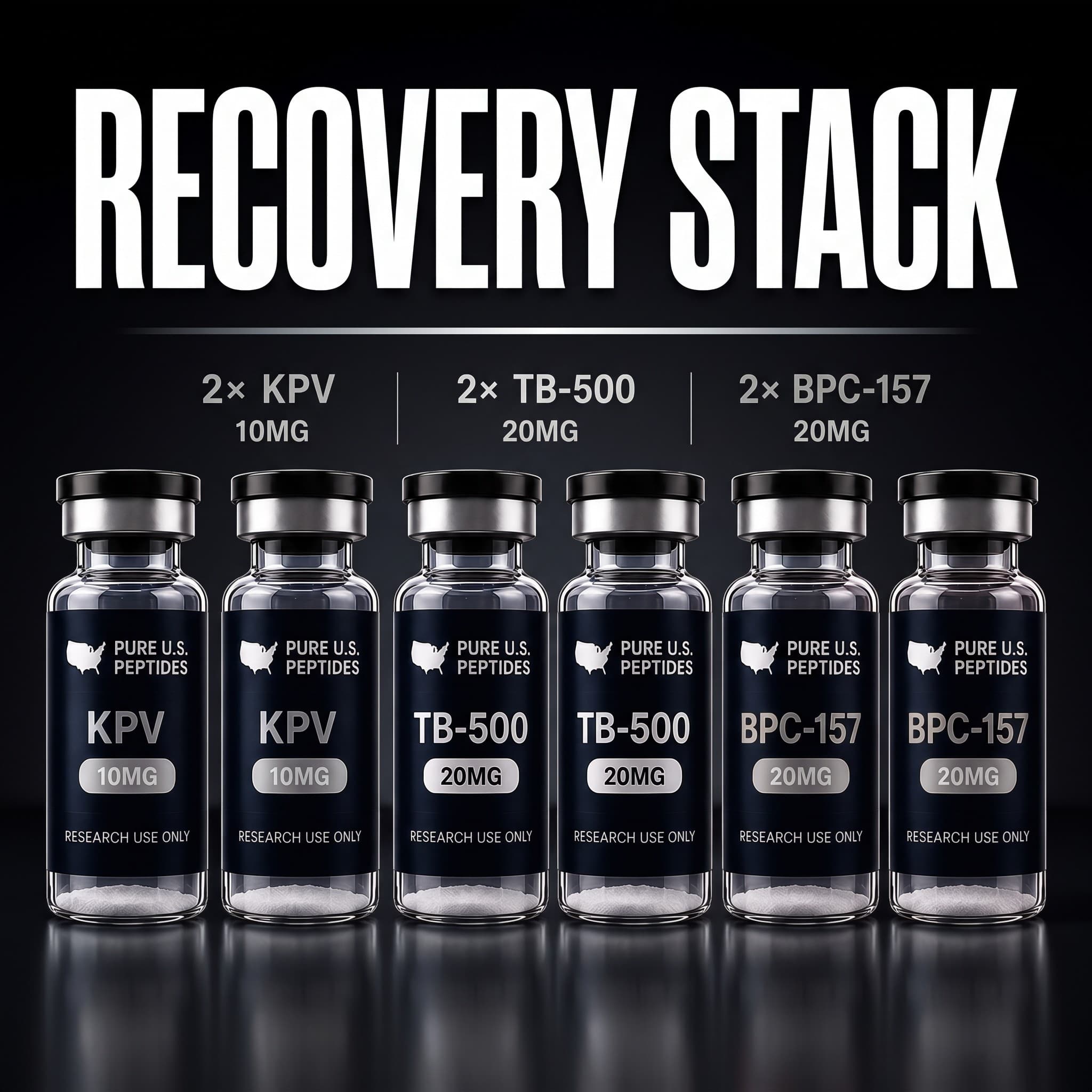
KPV + TB-500 + BPC-157 Research Kit
BPC-157 20mg + TB-500 20mg Bundle
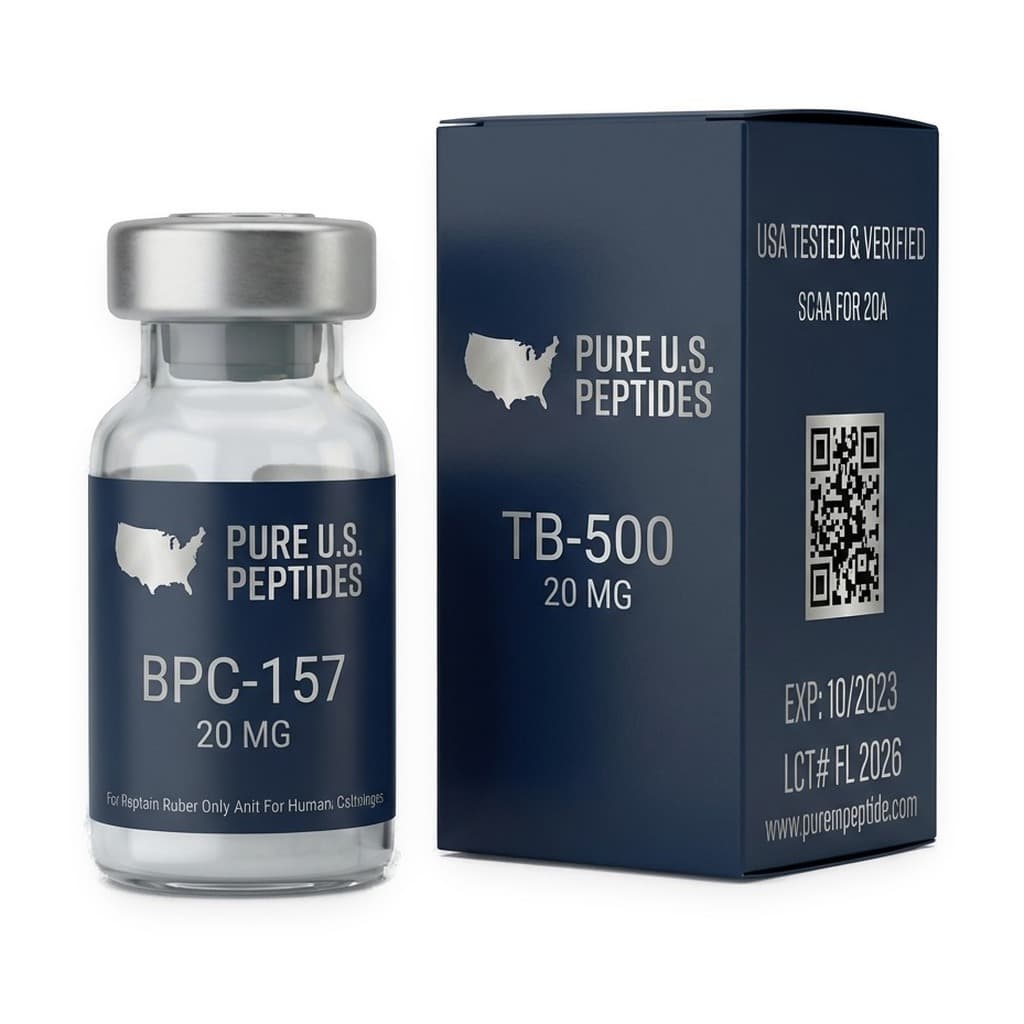
BPC-157 10mg + TB-500 10mg Bundle