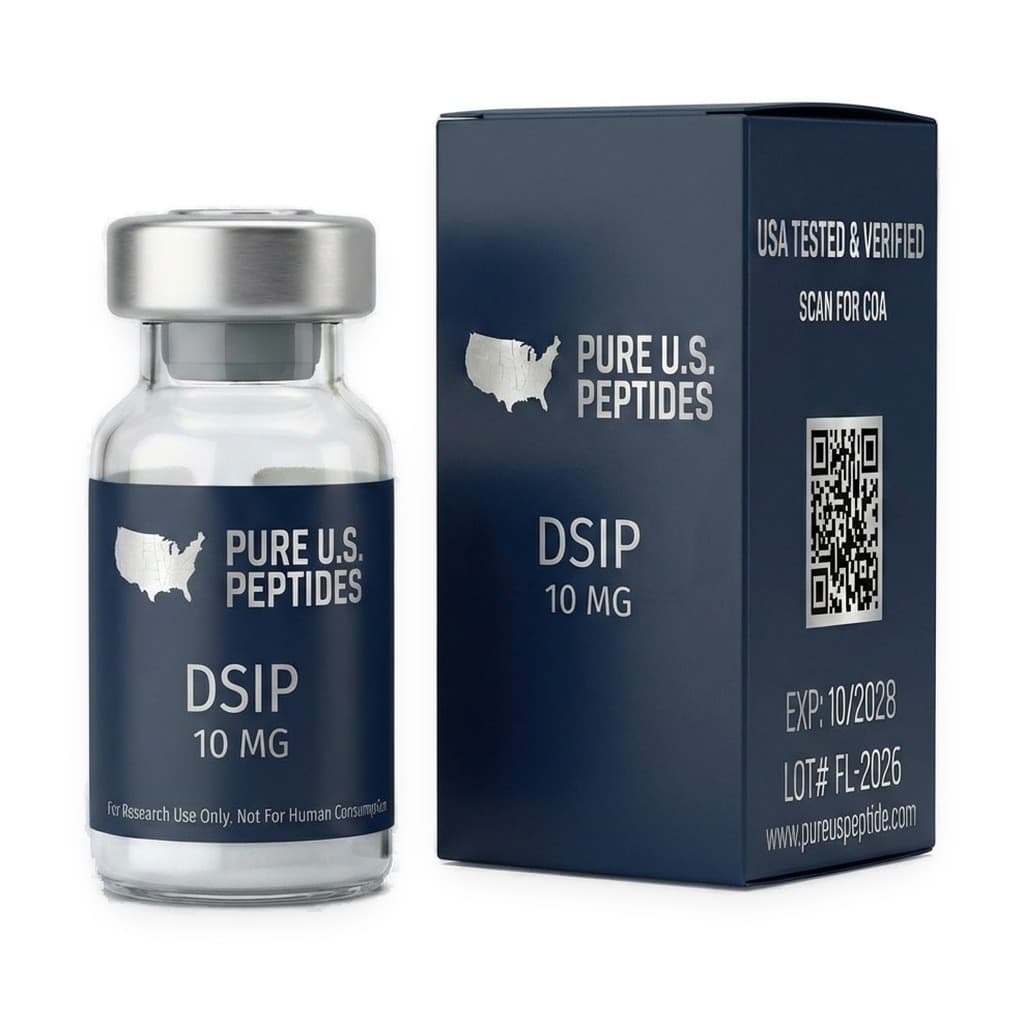
DSIP 10mg
In Stock & Ready to Ship from USA
FREE shipping on every U.S. order
Secure checkout via encrypted payment processor


 +2.9k
+2.9kResearch Use Only
These products are for laboratory research only and not intended for medical use. They are not FDA-approved to diagnose, treat, cure, or prevent any disease. By purchasing, you certify they will be used solely for research and not for human or animal consumption.
Research Summary
23 PubMed CitationsResearch Overview DSIP (Trp-Ala-Gly-Gly-Asp-Ala-Ser-Gly-Glu) was first isolated in 1974 by the Schoenenberger-Monnier group at the University of Basel, Switzerland, from the cerebral venous blood of rabbits in electrically induced slow-wave sleep. DSIP-like immunoreactivity has since been detected in the hypothalamus, limbic system, pituitary gland, and human breast milk.[1][17] DSIP remains neuroscience's "unresolved riddle": despite 50+ years of study, no specific gene coding for a DSIP precursor has been identified, and no dedicated receptor has been cloned. Sequence analysis suggests homology with the 324–332 fragment of human lysine-specific histone demethylase 3B (KND peptide, JMJD1B gene).[1] Originally pursued as a "somnogenic molecule" to cure insomnia, the therapeutic rationale shifted to that of a "programming modulator" or adaptogen — stabilizing neuronal activity and restoring homeostasis under stress or disrupted circadian rhythms. Research spans 8+ indication categories across neurology, addiction medicine, oncology, cardiology, and gerontology.[9] Discovery and historical context: The Schoenenberger-Monnier program at Basel...
DSIP 10mg at a glance
| Specification | Detail |
|---|---|
| Identity | DSIP (delta sleep-inducing peptide), nine amino acids |
| Listed amount | 10mg |
| Storage | Store lyophilized DSIP at -20 degrees C or -80 degrees C. Protect from moisture. |
| Lot certificate | Pending for 10mg; the certificate shown is for DSIP lot D26C529, tested on a different vial size |
| Price | $40.95 |
| Price per mg | $4.10 per mg |
| Dispatch | Same business day for orders before 2:00 PM EST Monday through Friday |
| U.S. shipping | Free on every order |
| Included with every order | Free BAC water vial |
| Product status | This listing is not an FDA-approved drug. Strictly for laboratory Research Use Only. |
Current price and availability are shown in the purchase panel at the top of this page.
DSIP — Research Data at a Glance
| Property | Value |
|---|---|
| PubMed Citations Referenced | 23 |
| Contributing Researchers | 3 |
| Storage Conditions | Store lyophilized at -20°C (~1 year) or -80°C (~2 years). |
| Purity Standard | Certificate pending |
| Research Use Only | Not for human consumption. RUO only. |
Research guide
What is DSIP? Read the full research guideOverview
Research Overview
DSIP (Trp-Ala-Gly-Gly-Asp-Ala-Ser-Gly-Glu) was first isolated in 1974 by the Schoenenberger-Monnier group at the University of Basel, Switzerland, from the cerebral venous blood of rabbits in electrically induced slow-wave sleep. DSIP-like immunoreactivity has since been detected in the hypothalamus, limbic system, pituitary gland, and human breast milk.[1][17]
DSIP remains neuroscience's "unresolved riddle": despite 50+ years of study, no specific gene coding for a DSIP precursor has been identified, and no dedicated receptor has been cloned. Sequence analysis suggests homology with the 324–332 fragment of human lysine-specific histone demethylase 3B (KND peptide, JMJD1B gene).[1]
Originally pursued as a "somnogenic molecule" to cure insomnia, the therapeutic rationale shifted to that of a "programming modulator" or adaptogen — stabilizing neuronal activity and restoring homeostasis under stress or disrupted circadian rhythms. Research spans 8+ indication categories across neurology, addiction medicine, oncology, cardiology, and gerontology.[9]
Discovery and historical context: The Schoenenberger-Monnier program at Basel pursued the "humoral hypothesis of sleep" — that a circulating factor accumulating during wakefulness drives the transition into slow-wave sleep. Cerebral venous blood from rabbits in electrically-induced thalamic-stimulated sleep was dialyzed and infused into recipient rabbits, reproducing the delta-EEG signature. The active fraction was isolated, sequenced as a linear nonapeptide (Trp-Ala-Gly-Gly-Asp-Ala-Ser-Gly-Glu, MW 848.81 Da), and synthesized — the synthetic preparation reproduced the EEG-modifying activity of the natural extract.[1][17]
Research framework: DSIP exhibits an unusual pharmacological profile that distinguishes it from receptor-targeted neuropeptides — bell-shaped dose-response, partial blood-brain-barrier penetration, ~15-min plasma half-life with rapid N-terminal tryptophan cleavage by aminopeptidases, and no cloned receptor. The aminopeptidase-resistant analog [D-Ala²]DSIP and the more-potent KND peptide (WKGGNASGE, single Asp→Asn substitution at position 5) are the standard structural tools used in modern preclinical studies to dissect the underlying signaling. Investigators studying related stress-modulating and neuroprotective peptides commonly cross-reference our Selank, Semax, and Epithalon pages for parallel adaptogen pharmacology and circadian-rhythm modulation in rodent models.[9]
Mechanism of Action
Mechanism of Action
DSIP's exact mechanism remains partially obscure — the "unresolved riddle" stems from the absence of a cloned receptor or identified gene. However, extensive research characterizes its interactions across multiple receptor systems and signaling cascades.[1]
Receptor Targets
| Target | Interaction | Evidence |
|---|---|---|
| NMDA Receptors | Antagonist / modulator — blocks NMDA-activated potentiation | Reduces glutamate/NMDA-stimulated Ca²⁺ uptake in synaptosomes |
| Opioid Receptors | Agonistic activity — SWS induction reversed by naloxone | Antinociceptive effects blocked by naloxone |
| α₁-Adrenergic Receptors | Stimulates pineal N-acetyltransferase via α₁ interaction | Graf & Schoenenberger (1987) |
| Specific ³H-DSIP Binding Sites | Found on pineal membrane fractions and neurons (not glia) | Brain stem cultures — radioimmunoassay |
Downstream Signaling
| Pathway | Effect | Consequence |
|---|---|---|
| MAPK/ERK | Prevents Raf-1 activation via GILZ homology → inhibits ERK phosphorylation | Anti-inflammatory / stress-limiting |
| MAO-A | Increases monoamine oxidase A activity in brain mitochondria | Reduced serotonin levels (paradoxical) |
| Antioxidant Enzymes | Stimulates SOD, catalase, glutathione peroxidase | Cytoprotection / reduced lipid peroxidation |
| c-Fos Expression | Prevents c-fos in paraventricular nucleus during stress | Stress resistance — modulated via NMDA pathway |
| Mitochondrial Respiration | Stabilizes NADH-dehydrogenase; enhances oxidative phosphorylation | Protection against hypoxia |
Dose-Response: Bell-Shaped Curve
| Parameter | Reported Optimum | Notes |
|---|---|---|
| Delta-wave induction (rabbits) | ~30 nmol/kg | Higher and lower doses less effective |
| Motor activity (mice) | Biphasic: 30 nmol ↑ / 120 nmol ↓ | Low dose enhances, high dose suppresses |
Key analog: KND peptide (WKGGNASGE) — differs by single amino acid (Asn vs Asp at position 5); more potent antioxidant; greater reduction in myocardial infarction (19.1% vs 28.7%).[8]
Integrative Model: "Programming Modulator"
The absence of a single high-affinity receptor — combined with documented modulatory activity at NMDA, opioid, α₁-adrenergic, MAPK, MAO-A, antioxidant-enzyme, c-Fos, and mitochondrial respiration endpoints — supports the Schoenenberger framework that DSIP acts as a state-dependent neuronal-tone stabilizer rather than a classical agonist or antagonist. Computational analyses propose homology with the 324-332 fragment of human lysine-specific histone demethylase 3B (JMJD1B), suggesting endogenous DSIP-like activity may arise from proteolytic cleavage of a larger precursor rather than from a dedicated DSIP gene.[1][9]
Pharmacokinetic Constraints
The ~15-min plasma half-life — driven by N-terminal Trp cleavage by aminopeptidases — has shaped the design of the modern DSIP literature. This rapid peripheral degradation explains the wide spread in published active amounts across animal studies (sub-µg ranges with direct CNS exposure versus mg-range systemic designs). The aminopeptidase-resistant analog [D-Ala²]DSIP and the KND analog were developed to address this constraint.[7][8]
Stress-Axis & HPA Modulation
In stress paradigms, DSIP prevents c-Fos induction in the paraventricular nucleus, lowers basal corticotropin output, and blocks cortisol release — effects that are reversible by NMDA-receptor agonists and by naloxone, implicating combined NMDA-modulation and opioid-receptor pathway as the mechanistic substrate. Sudakov 1983 and Salieva 1989 showed that systemic DSIP increased animal resistance to acute emotional stress, paralleling the antidepressant-like reduction in pain-and-depression scores observed in the Larbig 1984 chronic-pain pilot.[18][21]
Research Applications
Research Applications
DSIP research spans 8+ indication categories across neurology, addiction, oncology, and gerontology:
- Sleep Regulation & Insomnia — Increases delta (slow-wave) sleep 39–54% in rabbits; 59% median increase in total sleep time in a small human study; a 7-night study in chronic insomnia reported normalized sleep efficiency.[3][4]
- Withdrawal Syndrome Studies — Opiate (n=60) and alcohol (n=47) withdrawal-symptom endpoints were reported in early clinical studies.[2]
- Stress Adaptation & HPA Modulation — Reduces stress-induced metabolic disorders; lowers basal corticotropin; blocks cortisol release; prevents c-fos expression during emotional stress.[18]
- Nociception — Dose-dependent antinociceptive effect (blocked by naloxone); reduced pain in 6/7 chronic pain subjects.[11][5]
- Neuroprotection & Stroke Models — DSIP/KND reduced brain infarction volume during reperfusion; accelerated motor function recovery in focal stroke.[8][7]
- Cardioprotection — Reduces myocardial infarction size (IA/AAR 28.7% vs 42.1% control); stabilizes mitochondrial respiration. ⚠️ 100% mortality if given during occlusion phase.[8]
- Epilepsy & Anticonvulsant — In the metaphit audiogenic seizure model, DSIP alone did not significantly alter seizure latency, but potentiated the anticonvulsive activity of an otherwise non-protective valproate dose; intranigral DSIP and its analogs have also been studied for effects on movement and convulsive activity.[16][20]
- Geroprotection & Oncology — Maximum lifespan +24.1% in SHR mice; total tumors ↓2.6-fold; mammary carcinoma ↓5-fold; chromosomal aberrations ↓22.6%.[10]
- Mitochondrial & Antioxidant Research — Stabilizes NADH-dehydrogenase, enhances oxidative phosphorylation, stimulates SOD/catalase/glutathione peroxidase — used as a tool peptide for studying mitochondrial cytoprotection under hypoxic/ischemic stress.[9]
- HPA Axis Stress Resistance — Prevents c-Fos induction in paraventricular nucleus, lowers basal corticotropin, increases resistance to acute emotional stress in rodent models (Sudakov 1983, Salieva 1989).[18][21]
Comparative Research Context
DSIP occupies a unique position in the adaptogen / programming-modulator literature alongside other stress-and-circadian-rhythm peptides such as Selank, Semax, Epithalon, and Pinealon. Where Selank acts via tuftsin-related immunomodulatory and anxiolytic pathways and Semax activates BDNF expression in the hippocampus, DSIP appears to operate through state-dependent stabilization of multiple receptor systems without a dedicated high-affinity target. Researchers comparing DSIP with related adaptogen peptides commonly cross-reference our Selank, Semax, and Epithalon pages for parallel preclinical pharmacology — particularly for studies addressing slow-wave sleep, oxidative stress resistance, and HPA-axis modulation in rodent models. The KND peptide and [D-Ala²]DSIP analogs remain the standard tools for distinguishing DSIP-specific effects from generic peptide vehicle effects in mechanism-of-action studies.
Biochemical Characteristics
| Property | Value |
|---|---|
| Molecular Formula | C₃₅H₄₈N₁₀O₁₅ |
| Molecular Weight | 848.81 Da |
| CAS Number | 62568-57-4 |
| PubChem CID | 3623358 |
| Sequence (1-Letter) | WAGGDASGE |
| Sequence (3-Letter) | Trp-Ala-Gly-Gly-Asp-Ala-Ser-Gly-Glu |
| Structure | Linear nonapeptide; 9 L-amino acids; amphiphilic; folded conformation in aqueous solution |
| Origin | Cerebral venous blood of rabbits during slow-wave sleep (1974) |
| Classification | Neuropeptide / Programming Modulator / Research Peptide |
| Half-Life | ~15 minutes (in vitro); extremely fragile in vivo |
| Dose-Response | Bell-shaped / inverted U-curve — optimal delta-wave induction at ~30 nmol/kg IV |
Identifiers
| Synonyms | |
|---|---|
| Gene/Precursor | |
| Analog |
Preclinical Research Summary
Preclinical Research Summary
Key Preclinical Studies
| Study | Model | Key Findings | Ref |
|---|---|---|---|
| Mu et al. (2024) | Mice — PCPA-induced insomnia; DSIP-CBBBP fusion peptide, not native DSIP | Modulated 5-HT, glutamate, dopamine and melatonin levels; fusion construct outperformed unmodified DSIP on neurotransmitter restoration | [22] |
| Monnier/Polc (1977–78) | Rabbits/Cats — EEG/sleep | 39–54% increase in delta activity (rabbits); enhanced REM in cats | [17] |
| Tukhovskaya et al. (2021) | SD rats — MCAO stroke, 120 µg/kg | Significant motor recovery (Rotarod p<0.01); infarct size not significantly reduced | [7] |
| Tukhovskaya et al. (2021) | SD rats — MI reperfusion, 150 µg/kg | IA/AAR reduced to 28.7% vs 42.1% control (p=0.01); ⚠️ 100% mortality during occlusion | [8] |
| Popovich et al. (2003) | SHR mice — monthly design | Max lifespan +24.1% (917 vs 739 d); tumors ↓2.6-fold; chromosomal aberrations ↓22.6% | [10] |
| Hrnčić et al. (2006) | Wistar rats — metaphit audiogenic seizure model, DSIP 1.0 mg/kg ± valproate 50 mg/kg | DSIP or valproate alone had no significant effect on seizure latency; the combination significantly prolonged latency over 6 h without motor impairment. Neither abolished EEG epileptiform activity | [16] |
| Scherschlicht/Tissot (Patent) | Mice — morphine withdrawal (naloxone-precipitated) | Dose-dependent withdrawal inhibition: 0.3 mg/kg reduced jumping to 54% of control | [13] |
| Nakamura et al. (1988) | Mice/Rats — pain tests (tail-pinch, hot plate) | Potent dose-dependent antinociception; blocked by naloxone (opioid-mediated) | [11] |
Clinical / Human Studies
| Trial | Population | Key Results | Outcome | Ref |
|---|---|---|---|---|
| Acute Effects in Normals | n=6 healthy adults | Total-sleep-time, SWS and REM endpoints | — | [3] |
| 7-Night Insomnia Study | n=14 chronic insomniacs | Sleep-efficiency and daytime-alertness endpoints | — | [4] |
| Double-Blind Insomnia Study | n=16 chronic insomniacs | Sleep-efficiency, sleep-latency and subjective-quality endpoints; the authors judged the effects weak | — | [23] |
| Withdrawal Syndromes | n=107 (47 alcoholics, 60 opiate addicts) | Opiate and alcohol withdrawal-symptom endpoints | — | [2] |
| Chronic Pain Pilot | n=7 (migraine, tinnitus, psychogenic pain) | Pain and depression endpoints | — | [5] |
| Double-Blind Insomnia | n=16 chronic insomniacs | Sleep-efficiency, sleep-latency and subjective-quality endpoints; the authors judged the effects weak | — | [23] |
Safety Summary
| Parameter | Finding |
|---|---|
| FDA Category 2 Warning | "Significant safety risks" — potential immunogenicity; "lacks sufficient information"; not approved for compounding |
| Acute Toxicity (Animals) | Oral LD50 in rats >5,000 mg/kg; MTD in dogs >2,000 mg/kg — high safety margin |
| Pharmacokinetics | Half-life ~15 min; degraded by aminopeptidases (N-terminal Trp cleavage); crosses BBB partly |
Authors & Attribution
✍️ Article Author
Marcel Monnier, M.D.
Marcel Monnier was a physiologist at the University of Basel, Switzerland, and a pioneer in demonstrating the humoral transmission of sleep. His group conducted the foundational experiments in which the cerebral venous blood of rabbits in electrically induced sleep was dialyzed and infused into recipient rabbits, inducing delta-wave sleep — leading to the first isolation of 'sleep factor delta' (DSIP) in 1974. Key publications include 'A naturally occurring delta-EEG enhancing nonapeptide in rabbits: final isolation, characterization and activity test' (1977). Marcel Monnier is referenced as the co-discoverer of DSIP. In no way is this doctor/scientist endorsing or advocating the purchase, sale, or use of this product for any reason. There is no affiliation or relationship, implied or otherwise, between Pure US Peptide and this doctor.
View Full Researcher Profile →🎓 Scientific Journal Author
Guido A. Schoenenberger, M.D.
Guido A. Schoenenberger was a biochemist at the University of Basel, Switzerland (Research Division, Department of Surgery). Working alongside Marcel Monnier, he was responsible for the biochemical isolation, characterization, and synthesis of DSIP — determining the nonapeptide's amino acid sequence (Trp-Ala-Gly-Gly-Asp-Ala-Ser-Gly-Glu). He proposed the 'programming' hypothesis, suggesting DSIP acts as a modulator of neurotransmitters rather than a direct transmitter. Key publications include 'Characterization, properties and multivariate functions of Delta-Sleep-Inducing Peptide' (1984). Guido Schoenenberger is referenced as the co-discoverer and synthesizer of DSIP. In no way is this doctor/scientist endorsing or advocating the purchase, sale, or use of this product for any reason. There is no affiliation or relationship, implied or otherwise, between Pure US Peptide and this doctor.
View Full Researcher Profile →Guido A. Schoenenberger, M.D. is being referenced as one of the leading scientists involved in the research and development of DSIP. In no way is this doctor/scientist endorsing or advocating the purchase, sale, or use of this product for any reason. There is no affiliation or relationship, implied or otherwise, between Pure US Peptide and this doctor. The purpose of citing the doctor is to acknowledge, recognize, and credit the exhaustive research and development efforts conducted by the scientists studying this peptide.
🔬 Contributing Researcher
Abba J. Kastin, M.D.
Abba J. Kastin was a physician at the Veterans Administration Medical Center and Tulane University School of Medicine (New Orleans, USA). Kastin authored major reviews on DSIP and investigated its physiological distribution, metabolism, and ability to cross the blood-brain barrier. His work expanded understanding of DSIP's extra-sleep effects — circadian rhythms, locomotor activity, and hormone modulation. Key publications include 'Delta-sleep-inducing peptide (DSIP): a review' (Neuroscience & Biobehavioral Reviews, 1984) and 'Differential penetration of DSIP peptides into rat brain' (1982). Abba Kastin is referenced as a leading researcher in DSIP pharmacology. In no way is this doctor/scientist endorsing or advocating the purchase, sale, or use of this product for any reason. There is no affiliation or relationship, implied or otherwise, between Pure US Peptide and this doctor.
View Full Researcher Profile →Abba J. Kastin, M.D. is being referenced as one of the leading scientists involved in the research and development of DSIP. In no way is this doctor/scientist endorsing or advocating the purchase, sale, or use of this product for any reason. There is no affiliation or relationship, implied or otherwise, between Pure US Peptide and this doctor. The purpose of citing the doctor is to acknowledge, recognize, and credit the exhaustive research and development efforts conducted by the scientists studying this peptide.
Referenced Citations
Kovalzon VM, Strekalova TV. Delta sleep-inducing peptide (DSIP): A still unresolved riddle. J Neurochem. 2006;97(2):303-309.
PubMedDick P, Costa C, Fayolle K, et al. Eur Neurol. 1984;23(5):364-371.
PubMedSchneider-Helmert D, Gnirss F, Monnier M, Schenker J, Schoenenberger GA. Int J Clin Pharmacol Ther Toxicol. 1981;19(8):341-345.
PubMedSchneider-Helmert D. Eur Neurol. 1987;27(2):120-129.
PubMedLarbig W, Gerber WD, Kluck M, Schoenenberger GA. Eur Neurol. 1984;23(5):372-385.
PubMedKaeser HE. Eur Neurol. 1984;23(5):386-388.
PubMedTukhovskaya EA, Ismailova AM, Shaykhutdinova ER, et al. Delta Sleep-Inducing Peptide Recovers Motor Function in SD Rats after Focal Stroke. Molecules. 2021;26(17):5173.
PubMedTukhovskaya EA, Shaykhutdinova ER, Ismailova AM, et al. Biomedicines. 2021;9(4):407.
PubMedGraf MV, Kastin AJ. Delta-sleep-inducing peptide (DSIP): a review. Neurosci Biobehav Rev. 1984;8(1):83-93.
PubMedPopovich IG, Voitenkov BO, Anisimov VN, et al. Effect of delta-sleep inducing peptide-containing preparation Deltaran on biomarkers of aging, life span and spontaneous tumor incidence in female SHR mice. Mech Ageing Dev. 2003;124(6):721-731.
PubMedNakamura A, Nakashima M, Sugao T, et al. Potent antinociceptive effect of centrally administered delta-sleep-inducing peptide (DSIP). Eur J Pharmacol. 1988;155(3):247-253.
PubMedDick P, Grandjean ME, Tissot R. Neuropsychobiology. 1983;10(4):205-208.
PubMedScherschlicht RR, Tissot R. US Patent 4,444,758. 1984.
SourceFood and Drug Administration. Certain Bulk Drug Substances for Use in Compounding that May Present Significant Safety Risks. FDA Website. Updated July 2025.
FDA.govSchoenenberger GA. Characterization, properties and multivariate functions of delta-sleep-inducing peptide (DSIP). Eur Neurol. 1984;23(5):321-345.
PubMedHrnčić D, Stanojlović O, Živanović D, Šušić V. Delta-sleep-inducing peptide potentiates anticonvulsive activity of valproate against metaphit-provoked audiogenic seizure in rats. Pharmacology. 2006;77(2):78-84.
PubMedMonnier M, Dudler L, Gaechter R, et al. The delta sleep inducing peptide (DSIP). Comparative properties of the original and synthetic nonapeptide. Experientia. 1977;33(4):548-552.
PubMedSudakov KV, Ivanov VT, Koplik EV, et al. Delta-sleep-inducing peptide (DSIP) as a factor facilitating animals' resistance to acute emotional stress. Pavlov J Biol Sci. 1983;18(1):1-5.
PubMedGraf M, Baumann JB, Girard J, et al. DSIP-induced changes of daily concentrations of brain neurotransmitters and plasma proteins in rats. Pharmacol Biochem Behav. 1982;17(3):511-517.
PubMedShandra AA, Godlevskii RS, Vast'yanov AI, et al. Neurosci Behav Physiol. 1996;26(6):567-571.
PubMedSalieva RM, Koplik EV, Kamenov ZA, Poletaev AB. Effects of beta endorphin and delta-sleep inducing peptide on resistance to emotional stress. Biull Eksp Biol Med. 1989;108(10):464-466.
PubMedMu X, Qu L, Yin L, Wang L, Liu X, Liu D. Front Pharmacol. 2024;15:1439536.
PubMedBes F, Hofman W, Schuur J, Van Boxtel C. A double-blind study. Neuropsychobiology. 1992;26(4):193-197.
PubMedRUO Disclaimer
For Research Use Only (RUO). Not intended for human consumption, clinical use, or as a drug, food, cosmetic, or medical device. This product has not been evaluated by the FDA and is supplied solely for in-vitro laboratory research by qualified professionals.
Certificate of Analysis
Published certificates come from third-party laboratories. If this listing's certificate is still pending, the card below says so.
Latest Lab Report
Certificate shown: DSIP lot D26C529, tested on a different vial size. The lot certificate for this size is pending.
Storage & Handling
Summary
Store lyophilized at -20°C (~1 year) or -80°C (~2 years). Hygroscopic — protect from moisture. DSIP is highly sensitive to aminopeptidase degradation.
⚠️ Important: DSIP is highly labile. Special handling is required to prevent rapid in vitro degradation by aminopeptidases.
❄️ Lyophilized Powder Storage
Store DSIP (Delta Sleep-Inducing Peptide) lyophilized powder at -20°C for up to approximately 1 year, or at -80°C for up to 2 years. Keep tightly sealed and protected from moisture — DSIP is hygroscopic and will absorb atmospheric water if exposed. Store under desiccation conditions, preferably with a molecular sieve or desiccant pack in the storage container.
⚗️ Solubility
Solubility: soluble in aqueous buffers. DSIP may adsorb to glass surfaces at low concentrations.
⚠️ Degradation Sensitivity
DSIP (Trp-Ala-Gly-Gly-Asp-Ala-Ser-Gly-Glu) has an extremely short in vitro half-life of approximately 15 minutes due to rapid N-terminal tryptophan cleavage by aminopeptidases. This fragility is a key pharmacological characteristic that has complicated its study and contributed to variable research results. Plasma stability studies demonstrate rapid degradation into smaller fragments (Ala-Gly-Gly-Asp-Ala-Ser-Gly-Glu and further). Handling on ice and minimal exposure to protease-containing environments is critical.
🧬 Physical Characteristics
DSIP is typically supplied as a white lyophilized powder. Molecular weight: 848.83 Da. May be supplied as the free acid, acetate salt, or TFA salt — salt form affects net peptide content per stated weight.
For Research Use Only. This product is furnished for in-vitro laboratory studies only. Not approved by the FDA for any medical indication.
“Preclinical Research Summary Key Preclinical Studies Study Model Key Findings Ref Mu et al.”
Frequently Asked Questions
Common research questions about DSIP — purity, handling, COA documentation, and published-research context.
Related Research Compounds
Adamax
30mg
Long Shot Research Kit
Grand Slam Research Kit