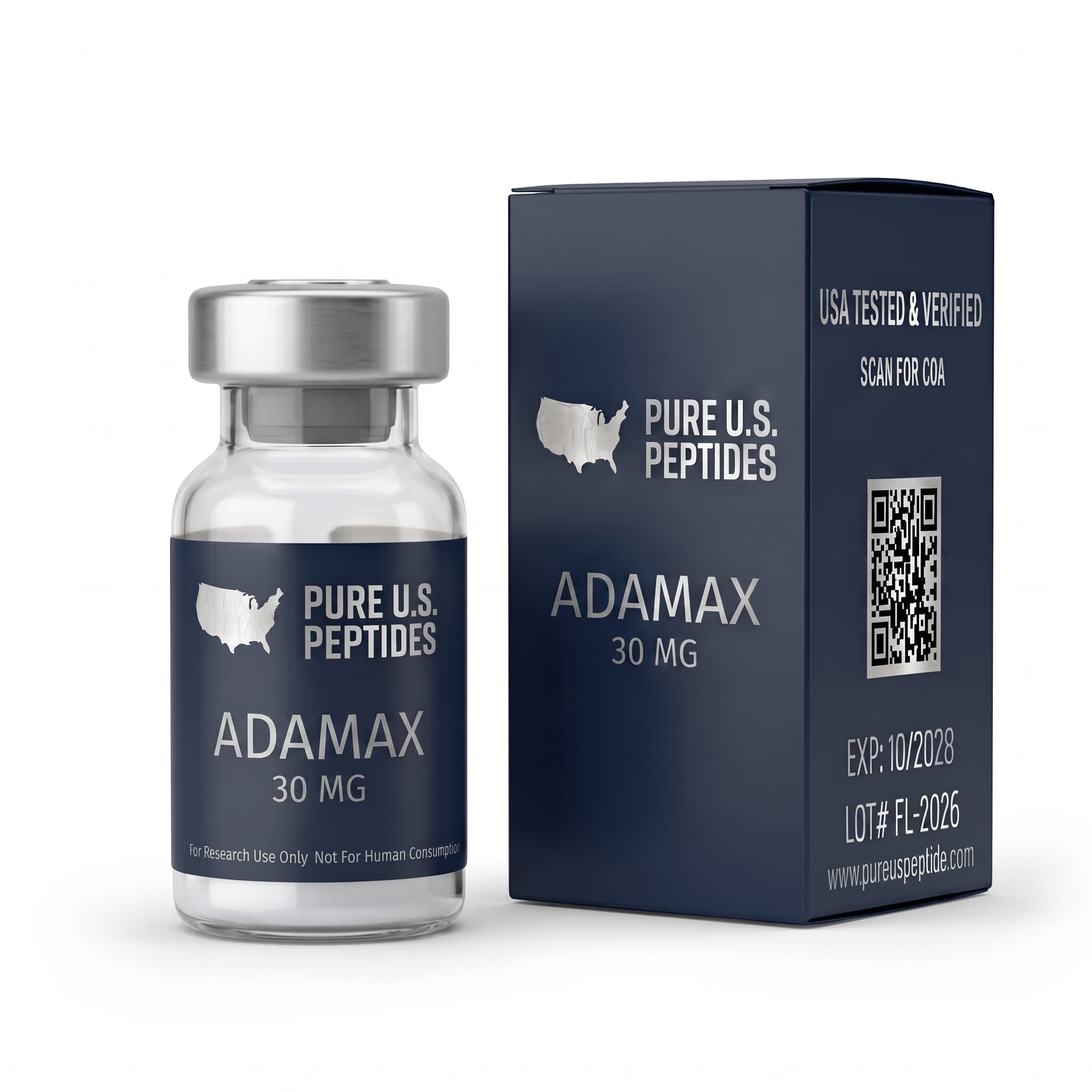
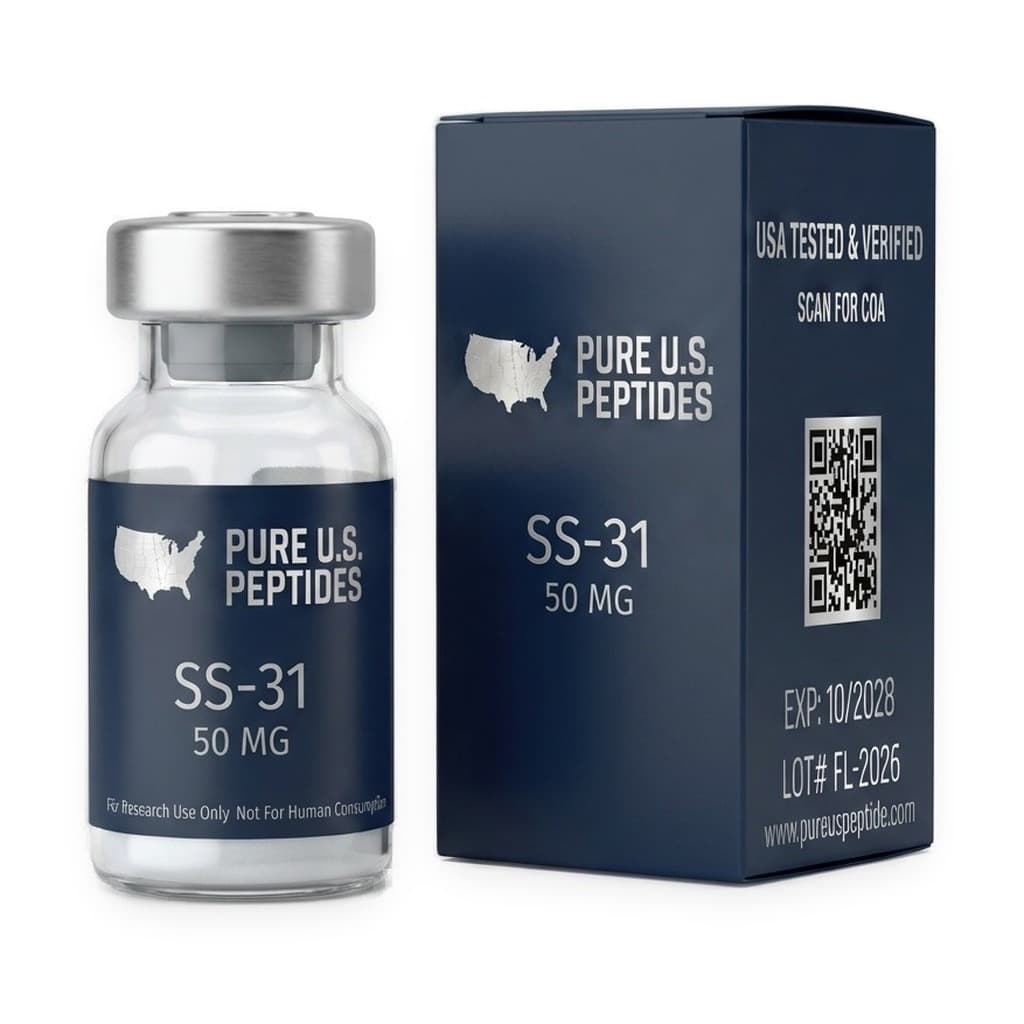
SS-31 50mg
In Stock & Ready to Ship from USA
FREE shipping on every U.S. order
Secure checkout via encrypted payment processor


 +2.9k
+2.9kResearch Use Only
These products are for laboratory research only and not intended for medical use. They are not FDA-approved to diagnose, treat, cure, or prevent any disease. By purchasing, you certify they will be used solely for research and not for human or animal consumption.
Research Summary
17 PubMed CitationsOverview SS-31 (elamipretide) is a synthetic, aromatic-cationic tetrapeptide belonging to the Szeto-Schiller (SS) family of mitochondria-targeted peptides. Its sequence — D-Arg-Dmt-Lys-Phe-NH₂ — alternates cationic residues (D-Arg, Lys) with aromatic residues (Dmt, Phe), an architectural pattern that confers selective, high-affinity binding to cardiolipin (CL) on the inner mitochondrial membrane (IMM).[1][2] Discovery: SS-31 was identified serendipitously by Dr. Hazel Szeto (Weill Cornell Medical College) and Dr. Peter Schiller (Montreal IRCM) during research into opioid receptor agonists. It was derived from SS-02 ([Dmt¹]DALDA), a synthetic opioid peptide analog, but engineered to completely eliminate opioid receptor activity while retaining the aromatic-cationic motif required for mitochondrial targeting.[1] Key distinguishing features: (1) Concentrates 5,000-fold in the IMM via cardiolipin binding; (2) Uptake is membrane-potential-independent (unlike MitoQ, which requires intact electrochemical gradient); (3) Small, water-soluble, crosses the blood-brain barrier.[2][4] Regulatory milestone: On September 19, 2025, the FDA granted Accelerated Approval to Forzinity™ (elamipretide) for Barth syndrome —...
SS-31 50mg at a glance
| Specification | Detail |
|---|---|
| Identity | SS-31 (elamipretide), synthetic tetrapeptide |
| Sequence | D-Arg-Dmt-Lys-Phe-NH2 |
| Listed amount | 50mg |
| Lab certificate | Published: Kovera Labs report KVR-2026-814088 (no batch number recorded by the lab) |
| Price | $103.95 |
| Price per mg | $2.08 per mg |
| Dispatch | Same business day for orders before 2:00 PM EST Monday through Friday |
| U.S. shipping | Free on every order |
| Included with every order | Free BAC water vial; Research Use Only |
| Product status | This listing is not an FDA-approved drug. Strictly for laboratory Research Use Only. |
Current price and availability are shown in the purchase panel at the top of this page.
SS-31 — Research Data at a Glance
| Property | Value |
|---|---|
| PubMed Citations Referenced | 17 |
| Contributing Researchers | 3 |
| Storage Conditions | Lyophilized research-grade powder. |
| Purity Standard | 99.536% HPLC (published certificate) |
| Research Use Only | Not for human consumption. RUO only. |
Research guide
What is SS-31? Read the full research guideOverview
Overview
SS-31 (elamipretide) is a synthetic, aromatic-cationic tetrapeptide belonging to the Szeto-Schiller (SS) family of mitochondria-targeted peptides. Its sequence — D-Arg-Dmt-Lys-Phe-NH₂ — alternates cationic residues (D-Arg, Lys) with aromatic residues (Dmt, Phe), an architectural pattern that confers selective, high-affinity binding to cardiolipin (CL) on the inner mitochondrial membrane (IMM).[1][2]
Discovery: SS-31 was identified serendipitously by Dr. Hazel Szeto (Weill Cornell Medical College) and Dr. Peter Schiller (Montreal IRCM) during research into opioid receptor agonists. It was derived from SS-02 ([Dmt¹]DALDA), a synthetic opioid peptide analog, but engineered to completely eliminate opioid receptor activity while retaining the aromatic-cationic motif required for mitochondrial targeting.[1]
Key distinguishing features: (1) Concentrates 5,000-fold in the IMM via cardiolipin binding; (2) Uptake is membrane-potential-independent (unlike MitoQ, which requires intact electrochemical gradient); (3) Small, water-soluble, crosses the blood-brain barrier.[2][4]
Regulatory milestone: On September 19, 2025, the FDA granted Accelerated Approval to Forzinity™ (elamipretide) for Barth syndrome — a rare genetic disorder caused by TAFAZZIN gene mutations leading to cardiolipin deficiency. This made SS-31 the first drug ever authorized by the FDA specifically for Barth syndrome, and one of the first mitochondrially-targeted drugs to receive FDA approval for any indication.[3]
Compared to MOTS-c — another mitochondria-targeted research compound — SS-31 acts upstream at the level of cardiolipin and the electron transport chain itself, rather than via nuclear gene regulation.[1]
Discovery and design rationale
SS-31 was identified by Szeto and Schiller during structure-activity dissection of opioid-receptor agonists derived from [Dmt¹]DALDA (SS-02), a synthetic δ-opioid peptide analog originally explored as an analgesic scaffold. During radiolabeled distribution studies the parent SS-02 was unexpectedly observed to concentrate inside isolated mitochondria far more than predicted by its opioid-receptor distribution profile. Iterative residue substitution preserved the alternating aromatic-cationic-aromatic-cationic motif (D-Arg-Dmt-Lys-Phe-NH₂) needed for cardiolipin engagement while D-amino acid stereochemistry and N-methylation eliminated detectable affinity for μ-, δ-, and κ-opioid receptors in radioligand binding assays.[1] The redesign converted an off-target observation in opioid pharmacology into the founding member of the Szeto-Schiller (SS) class of mitochondria-targeted research peptides.
Research framework
Within the broader mitochondrial-bioenergetics research-peptide family, SS-31 is most directly compared with MOTS-c (a 16-amino-acid mitochondrial-derived peptide acting on the AMPK / Nrf2 / folate-cycle axis), NAD+ precursors (which raise mitochondrial NAD+ pools to support sirtuin and Complex I function), and glutathione (a cytosolic/matrix tripeptide antioxidant). SS-31 is the only member of this comparison set that engages the inner mitochondrial membrane lipid bilayer itself rather than a soluble cofactor pool or a nuclear gene-expression program — making it the appropriate research tool when investigators are isolating cardiolipin-dependent ETC architecture from nuclear-encoded mitochondrial biogenesis pathways.[2][4]
Mechanism of Action
Mechanism of Action
Primary Target: Cardiolipin (CL) on the Inner Mitochondrial Membrane
SS-31 does NOT bind to a protein receptor. Instead, it binds directly to cardiolipin (CL) — an anionic phospholipid unique to the IMM that is critical for organizing the electron transport chain (ETC) into functional supercomplexes (respirasomes). The binding is driven by two forces:[1][2]
- Electrostatic: D-Arg and Lys (cationic residues) bind the anionic phosphate head groups of CL
- Hydrophobic: Dmt and Phe (aromatic residues) intercalate into the hydrophobic acyl chain region of CL
- Selectivity: SS-31 does NOT bind zwitterionic phospholipids (e.g., phosphatidylcholine, phosphatidylethanolamine) — purely selective for anionic CL
Downstream Cascade
| Step | Mechanism | Functional Outcome |
|---|---|---|
| 1. CL binding | High-affinity IMM localization (5,000×) | Prevents pathological CL/cytochrome c peroxidase activity[2] |
| 2. Cyt c preservation | Stabilizes CL → preserves cyt c electron carrier function | Facilitates Complex III→IV electron transfer → ↑ATP synthesis[1] |
| 3. Supercomplex assembly | Stabilizes ETC respirasomes | Optimizes oxidative phosphorylation coupling efficiency[5] |
| 4. Cristae preservation | Optimizes IMM curvature | Prevents mitochondrial swelling and fragmentation[4] |
| 5. mPTP inhibition | Prevents mitochondrial permeability transition pore opening | mPTP opening inhibited in isolated-mitochondria assays[6] |
| 6. NF-κB inhibition | Prevents p65 nuclear translocation | Reduced pro-inflammatory cytokine production[7] |
| 7. NLRP3 inhibition | Reduces inflammasome activation | ↓ IL-1β, IL-18 production[7] |
| 8. Nrf2/SIRT1/PGC-1α | HO-1 upregulation; mitochondrial biogenesis | Antioxidant gene expression; restored mitochondrial mass[5] |
| 9. BDNF signaling | Enhances synapsin-1, PSD-95, p-CREB | BDNF/synapsin-1 expression changes in rodent hippocampus[8] |
vs. Related Mitochondrial Compounds
| Compound | Primary Target | Membrane Potential Dep. | Key Difference |
|---|---|---|---|
| SS-31 (elamipretide) | Cardiolipin (IMM) | No | Reaches severely dysfunctional mitochondria; no depolarization at high concentrations |
| MitoQ | Mitochondrial matrix | Yes (requires ΔΨm) | Depolarizes at high doses; cannot reach severely damaged mito |
| NAC (N-acetylcysteine) | Cytosolic GSH replenishment | No | Stoichiometric scavenging; not concentrated at ROS source |
| MOTS-c | Folate cycle / Nuclear ARE | No | Mitokine; targets nuclear gene regulation via AMPK/Nrf2 rather than direct ETC |
Cardiolipin-Specific Membrane Lipid Targeting Profiling
A defining mechanistic feature investigated in the SS-31 research literature is the selectivity for anionic cardiolipin over zwitterionic phospholipids of the IMM. Surface-plasmon-resonance and isothermal-titration-calorimetry studies have characterized the binding architecture: the two cationic residues (D-Arg, Lys) form salt-bridges with cardiolipin's two phosphate head groups while the two aromatic residues (Dmt, Phe) intercalate between the four acyl chains, locking SS-31 onto the matrix-facing leaflet of the IMM where ETC supercomplexes assemble. No measurable interaction is observed with phosphatidylcholine, phosphatidylethanolamine, or phosphatidylserine model bilayers, providing a control set that lets investigators attribute mitochondrial readouts specifically to cardiolipin engagement rather than nonspecific membrane perturbation.[2]
Mitochondrial Quality-vs-Quantity Distinction Research
A second mechanistic theme that distinguishes SS-31 from biogenesis-driven research compounds is the quality-without-quantity profile. In aged-rodent skeletal-muscle and cardiac models, eight-week SS-31 exposure reverses ATPmax decline, normalizes O₂ consumption and electron-transport coupling efficiency, and restores cristae ultrastructure on transmission-electron-microscopy quantification — without measurable increases in mtDNA copy number, citrate-synthase activity, or PGC-1α-driven mitochondrial mass.[4] This improvement of existing mitochondria phenotype is mechanistically distinct from the biogenesis-driven mitochondrial expansion observed with MOTS-c or PGC-1α-axis interventions, and supplies investigators studying mitochondrial quality control with a tool that perturbs the cardiolipin-ETC axis without confounding biogenesis signals.[1]
Research Applications
Research Applications
Elamipretide has been studied in cardiolipin and mitochondrial-membrane research; the published literature is listed under References.
Biochemical Characteristics
| Property | Value |
|---|---|
| Molecular Formula | C₃₂H₄₉N₉O₅ (free base) |
| Molecular Weight | 639.8 g/mol (free base); 749.2 g/mol (HCl salt) |
| CAS Number | 736992-21-5 (free base); 72244098-12-0 (HCl salt) |
| PubChem CID | 11764719 |
| Sequence (3-Letter) | D-Arg-Dmt-Lys-Phe-NH₂ (Dmt = 2',6'-dimethyltyrosine) |
| InChI Key | SFVLTCAESLKEHH-WKAQUBQDSA-N |
| Structure | Linear tetrapeptide; D-amino acid (D-Arg), non-natural amino acid (Dmt), C-terminal amide |
| Net Charge | 3+ at physiological pH |
| Alternating Motif | Aromatic-cationic (Dmt/Phe = aromatic; D-Arg/Lys = cationic) |
| Synonyms | Elamipretide, Forzinity™, MTP-131, Bendavia, RX-31 |
Identifiers
| Identity Confirmation | |
|---|---|
| Counter-Ion | |
| Detection Methods | |
| Metabolism | |
| Excretion |
Preclinical Research Summary
Preclinical & Clinical Research Summary
Key Preclinical Studies
| Study | Model | Key Findings | Ref |
|---|---|---|---|
| Sabbah et al. (2016) | Dogs, microembolization HF — 0.5 mg/kg × 3 mo | LVEF 30%→36% (p<0.05); NT-proBNP ↓774 pg/mL (p<0.001); ATP/ADP 1.16 vs 0.38 control | [6] |
| Dai et al. (2013) | C57BL/6 mice TAC — osmotic minipump × 4 wk | Fibrosis reduced ~5% vs ~15% control (p=0.005); protected 84% of mitochondrial proteins | [14] |
| Campbell et al. (2019) | Aged-mouse model (26-mo female C57BL/6) | Exercise-tolerance endpoint reported; ATPmax and mitochondrial-content endpoints reported | [4] |
| Chiao et al. (2020) | Aged C57BL/6 mice — cardiac dysfunction model | Late-life SS-31 administration reversed age-related cardiac dysfunction; restored diastolic function | [15] |
| Zhao et al. (2019) | LPS cognitive impairment mice — 5 mg/kg | Escape latency ↓ (p<0.01); hippocampal TNF-α/IL-6 ↓ (p<0.05); BDNF signaling enhanced | [8] |
| Birk et al. (2013) | Ischemic renal tubules — 1 nM–1 µM in vitro; rodent ARAS model | Re-energized ischemic mitochondria; restored tubular ATP; protected brush border membranes | [2] |
| 26-wk Rat Tox (FDA NDA) | Sprague Dawley rats — 5–15 mg/kg/day × 26 wk | Systemic NOAEL 40/15 mg/kg/day (~6.2-fold human AUC); no systemic toxicity | [17] |
| 39-wk Dog Tox (FDA NDA) | Beagles — 2.5–20 mg/kg/day × 39 wk | Systemic NOAEL 20/10 mg/kg/day (~5.7-fold human AUC); no ECG/BP/HR effects up to 100 mg/kg | [17] |
Safety Summary
| Parameter | Finding |
|---|---|
| Genotoxicity | Negative in Ames, chromosomal aberration, and in vivo micronucleus assays |
| Reproductive toxicity | No teratogenicity in rats or rabbits (published nonclinical data) |
| Concentrations used | In vitro: 1 nM–1 µM (published range) |
| Handling | Handle with standard laboratory PPE. Consult the SDS. |
The products offered on this website are furnished for in-vitro studies only. In-vitro studies (Latin: in glass) are performed outside of the body. These products are not medicines or drugs and have not been approved by the FDA to prevent, treat or cure any medical condition, ailment or disease. Bodily introduction of any kind into humans or animals is strictly forbidden by law.
For Laboratory Research Only. Not for human use, medical use, diagnostic use, or veterinary use.
ALL ARTICLES AND PRODUCT INFORMATION PROVIDED ON THIS WEBSITE ARE FOR INFORMATIONAL AND EDUCATIONAL PURPOSES ONLY.
Authors & Attribution
✍️ Article Author
Dr. Hazel H. Szeto, MD, PhD
Hazel H. Szeto, MD, PhD, is a Professor in the Department of Pharmacology at Weill Cornell Medical College and co-discoverer of the Szeto-Schiller (SS) class of mitochondria-targeted peptides, including SS-31 (elamipretide). Her laboratory identified that SS-31 selectively binds cardiolipin on the inner mitochondrial membrane, thereby optimizing electron transport and restoring cellular bioenergetics in disease states. She co-founded Stealth Peptides (now Stealth BioTherapeutics) to advance elamipretide into clinical development. Key publications: 'First-in-class cardiolipin-protective compound as a therapeutic agent to restore mitochondrial bioenergetics' (British Journal of Pharmacology, 2014) and extensive preclinical characterization of SS peptide pharmacology. Dr. Szeto's work provided the scientific foundation for the FDA's 2025 Accelerated Approval of Forzinity™ for Barth syndrome. In no way is this doctor/scientist endorsing or advocating the purchase, sale, or use of this product for any reason. There is no affiliation or relationship, implied or otherwise, between Pure US Peptide and this doctor.
View Full Researcher Profile →🎓 Scientific Journal Author
Dr. Hani N. Sabbah, PhD
Hani N. Sabbah, PhD, is a Professor in the Department of Medicine, Division of Cardiovascular Medicine, at Henry Ford Hospital (Henry Ford Health) in Detroit, Michigan. He has conducted extensive translational research on elamipretide (SS-31) in heart failure models, reporting left ventricular, NT-proBNP and mitochondrial-respiration endpoints with chronic elamipretide exposure in a validated canine model of advanced heart failure. His work has also elucidated the anti-inflammatory mechanisms of SS-31 including NF-κB and NLRP3 inflammasome inhibition. Key publications: 'Chronic therapy with elamipretide improves left ventricular and mitochondrial function in dogs with advanced heart failure' (Circulation: Heart Failure, 2016) and 'Contemporary insights into elamipretide mechanism' (Biomedicine & Pharmacotherapy, 2025). In no way is this doctor/scientist endorsing or advocating the purchase, sale, or use of this product for any reason. There is no affiliation or relationship, implied or otherwise, between Pure US Peptide and this doctor.
View Full Researcher Profile →Dr. Hani N. Sabbah, PhD is being referenced as one of the leading scientists involved in the research and development of SS-31. In no way is this doctor/scientist endorsing or advocating the purchase, sale, or use of this product for any reason. There is no affiliation or relationship, implied or otherwise, between Pure US Peptide and this doctor. The purpose of citing the doctor is to acknowledge, recognize, and credit the exhaustive research and development efforts conducted by the scientists studying this peptide.
🔬 Contributing Researcher
Dr. Peter W. Schiller, PhD
Peter W. Schiller, PhD, is a researcher at the Montreal Clinical Research Institute (IRCM) and co-discoverer of elamipretide. He designed and chemically synthesized the SS peptide analogs in collaboration with Dr. Szeto, and developed the fluorescent peptide derivatives that enabled visualization of mitochondrial localization — a key methodological breakthrough that confirmed the SS-31 mechanism of action. His expertise in peptide chemistry and structure-activity relationships was foundational to the development of the aromatic-cationic structural motif that gives SS-31 its selective mitochondrial targeting properties. Key publications include the original SS peptide characterization studies. In no way is this doctor/scientist endorsing or advocating the purchase, sale, or use of this product for any reason. There is no affiliation or relationship, implied or otherwise, between Pure US Peptide and this doctor.
View Full Researcher Profile →Dr. Peter W. Schiller, PhD is being referenced as one of the leading scientists involved in the research and development of SS-31. In no way is this doctor/scientist endorsing or advocating the purchase, sale, or use of this product for any reason. There is no affiliation or relationship, implied or otherwise, between Pure US Peptide and this doctor. The purpose of citing the doctor is to acknowledge, recognize, and credit the exhaustive research and development efforts conducted by the scientists studying this peptide.
Referenced Citations
Szeto HH. British Journal of Pharmacology. 2014;171(8):2029-2050.
SourceBirk AV, Liu S, Soong Y, et al. The Mitochondrial-Targeted Compound SS-31 Re-Energizes Ischemic Mitochondria by Interacting with Cardiolipin. Journal of the American Society of Nephrology. 2013;24(8):1250-1261.
DOIFDA Press Announcement. September 19, 2025.
FDA.govCampbell MD, Duan J, Samuelson AT, et al. Free Radical Biology and Medicine. 2019;134:268-281.
DOISabbah HN. Expert Opinion on Investigational Drugs. 2021;30(12):1227-1244.
DOISabbah HN, Gupta RC, Kohli S, et al. Circulation: Heart Failure. 2016;9(2):e002206.
DOISabbah HN, Alder NN, Sparagna GC, Bruce JE, et al. Biomedicine & Pharmacotherapy. 2025;187:118056.
DOIZhao W, Xu Z, Cao J, Fu Q, et al. Journal of Neuroinflammation. 2019;16(1):230.
DOIThompson WR, Hornby B, Manuel R, et al. Genetics in Medicine. 2024;101138.
DOIKaraa A, Haas R, Goldstein A, et al. Neurology. 2018;90(14):e1212-e1221.
DOIBirk AV, Chao WM, Bracken C, et al. Targeting mitochondrial cardiolipin and the cytochrome c/cardiolipin complex to promote electron transport and optimize mitochondrial ATP synthesis. British Journal of Pharmacology. 2014;171(8):2017-2028.
DOIEhlers JP, Hu A, Boyer D, et al. Ophthalmology Science. 2025;5(1):100628.
PubMedSaad A, Herrmann SMS, Eirin A, et al. Circulation: Cardiovascular Interventions. 2017;10(9):e005487.
DOIDai DF, Hsieh EJ, Chen T, et al. Circulation: Heart Failure. 2013;6(5):1067-1076.
PubMedChiao YA, Zhang H, Sweetwyne M, et al. eLife. 2020;9:e55513.
DOIGibson CM, Giugliano RP, Kloner RA, et al. Eur Heart J. 2016;37(16):1296-1303.
PubMedCited source. 2025.
FDA.govRUO Disclaimer
For Research Use Only (RUO). Not intended for human consumption, clinical use, or as a drug, food, cosmetic, or medical device. This product has not been evaluated by the FDA and is supplied solely for in-vitro laboratory research by qualified professionals.
Certificate of Analysis
Published certificates come from third-party laboratories. If this listing's certificate is still pending, the card below says so.
Latest Lab Report
Storage & Handling
Summary
Lyophilized research-grade powder. Store at -20 °C or below, desiccated, protected from light.
Recommended Laboratory Storage Conditions
Research-Grade (Lyophilized Powder): Store at -20°C to -80°C in desiccated, airtight container. Stable at room temperature for limited time during shipping.
Solubility: Water-soluble. Solution-state stability data: see cited literature.
Salt forms: Acetate (clinical development/research) vs. HCl (commercial Forzinity); bioequivalence established between forms.
“Preclinical & Clinical Research Summary Key Preclinical Studies Study Model Key Findings Ref Sabbah et al.”
Frequently Asked Questions
Common research questions about SS-31 — purity, handling, COA documentation, and published-research context.
Related Research Compounds
MOTS-C 40mg + SS-31 50mg Bundle
Semax
10mg
Selank
10mg