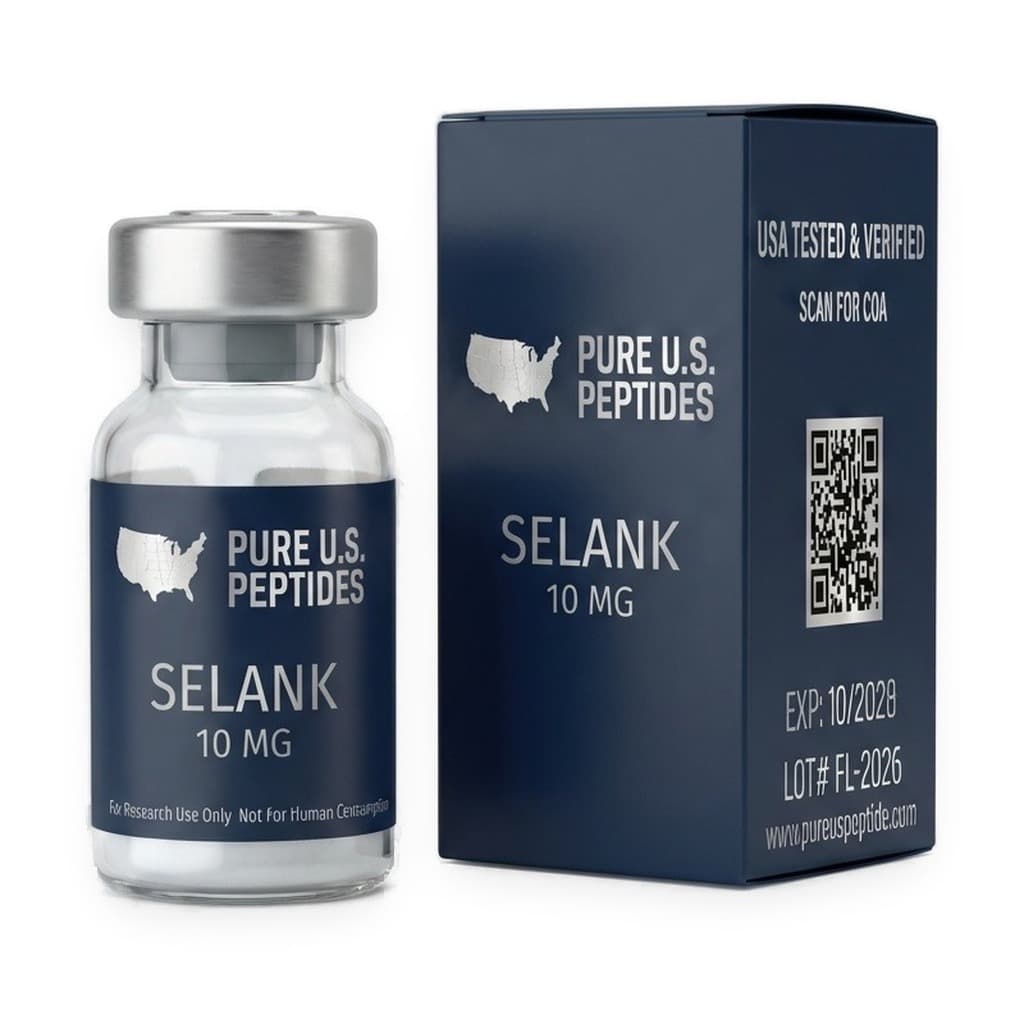
Selank 10mg
In Stock & Ready to Ship from USA
FREE shipping on every U.S. order
Secure checkout via encrypted payment processor


 +2.9k
+2.9kResearch Use Only
These products are for laboratory research only and not intended for medical use. They are not FDA-approved to diagnose, treat, cure, or prevent any disease. By purchasing, you certify they will be used solely for research and not for human or animal consumption.
Research Summary
25 PubMed CitationsOverview Selank (TP-7) is a synthetic heptapeptide with the sequence Thr-Lys-Pro-Arg-Pro-Gly-Pro (TKPRPGP). It was developed by the Institute of Molecular Genetics of the Russian Academy of Sciences in cooperation with the V.V. Zakusov Research Institute of Pharmacology.[2] Selank is derived from tuftsin (Thr-Lys-Pro-Arg), a naturally occurring tetrapeptide that constitutes a fragment of the heavy chain of human immunoglobulin G (IgG). The C-terminal Pro-Gly-Pro extension renders the molecule significantly more resistant to peptidase hydrolysis.[1] In experimental contexts, Selank exhibits anxiolytic and nootropic effects comparable to classical benzodiazepines (such as diazepam) but without their characteristic negative observations — sedation, muscle relaxation, amnesia, dependence, or withdrawal syndrome.[5][6] Regulatory records in the Russian Federation cite Selank's registration for research related to generalized anxiety disorders and neurasthenia.[3] It is not registered by the U.S. FDA, which has raised immunogenicity concerns related to compounding.[4] Discovery and design rationale The Selank molecule is the product of a...
Selank 10mg at a glance
| Specification | Detail |
|---|---|
| Identity | Selank (TP-7), synthetic heptapeptide |
| Listed amount | 10mg |
| Separate listing | N-Acetyl Selank Amidate 30mg Nasal Kit; distinct modified peptide and kit format. Research Use Only. |
| Storage | Store lyophilized Selank powder at 4 degrees C. |
| Lot certificate | Report pending; no published lot certificate today |
| Price | $31.50 |
| Price per mg | $3.15 per mg |
| Dispatch | Same business day for orders before 2:00 PM EST Monday through Friday |
| U.S. shipping | Free on every order |
| Included with every order | Free BAC water vial |
| Product status | This listing is not an FDA-approved drug. Strictly for laboratory Research Use Only. |
Current price and availability are shown in the purchase panel at the top of this page.
Selank — Research Data at a Glance
| Property | Value |
|---|---|
| PubMed Citations Referenced | 25 |
| Contributing Researchers | 3 |
| Storage Conditions | Store lyophilized powder at 4°C, protected from light and moisture. |
| Purity Standard | Certificate pending |
| Research Use Only | Not for human consumption. RUO only. |
Compare Selank with Other Peptides
Research guide
What is Selank? Read the full research guideOverview
Overview
Selank (TP-7) is a synthetic heptapeptide with the sequence Thr-Lys-Pro-Arg-Pro-Gly-Pro (TKPRPGP). It was developed by the Institute of Molecular Genetics of the Russian Academy of Sciences in cooperation with the V.V. Zakusov Research Institute of Pharmacology.[2]
Selank is derived from tuftsin (Thr-Lys-Pro-Arg), a naturally occurring tetrapeptide that constitutes a fragment of the heavy chain of human immunoglobulin G (IgG). The C-terminal Pro-Gly-Pro extension renders the molecule significantly more resistant to peptidase hydrolysis.[1]
In experimental contexts, Selank exhibits anxiolytic and nootropic effects comparable to classical benzodiazepines (such as diazepam) but without their characteristic negative observations — sedation, muscle relaxation, amnesia, dependence, or withdrawal syndrome.[5][6]
Regulatory records in the Russian Federation cite Selank's registration for research related to generalized anxiety disorders and neurasthenia.[3] It is not registered by the U.S. FDA, which has raised immunogenicity concerns related to compounding.[4]
Discovery and design rationale
The Selank molecule is the product of a structure-stabilization strategy applied to tuftsin, a phagocytosis-stimulating tetrapeptide originally isolated from the Fc region of IgG. While native tuftsin demonstrated immunomodulatory properties in preclinical work, its clinical utility was limited by rapid hydrolysis at the Lys–Pro and Pro–Arg bonds by serum aminopeptidases. Researchers at the Institute of Molecular Genetics appended the Pro-Gly-Pro tripeptide to the C-terminus — a motif also used in Semax and other Russian-developed regulatory peptides — to confer enzymatic resistance while preserving the bioactive N-terminal sequence.[1][2]
Research framework
Selank sits within an experimental class of "regulatory peptides" investigated in Eastern European pharmacology for nonsedating anxiolytic activity. In comparative preclinical literature it is studied alongside Semax (cognitive/neuroprotection), DSIP (sleep/HPA axis), and oxytocin (social/anxiolytic) for parallel CNS pharmacology paradigms.[7] The compound is supplied here strictly as a research reference standard for in vitro and animal-model investigation.
Mechanism of Action
Mechanism of Action
Dual Mechanism: GABA-A Modulation + Enkephalinase Inhibition
Selank possesses a unique dual mechanism of action distinguishing it from classical anxiolytics:
1. GABA-A Receptor Positive Allosteric Modulation
Selank acts as a positive allosteric modulator (PAM) of the GABA-A receptor. Its binding site is distinct from the classical benzodiazepine site, though partial overlap may exist.[8] This modulation enhances the affinity of the receptor for GABA, increasing inhibitory neurotransmission without producing sedation, amnesia, or muscle relaxation.[5]
Selank administration significantly alters mRNA levels of GABA receptor subunits — Gabrb3, Gabre (epsilon), and Gabrq (theta) — as well as the GABA transporter Slc6a13 (GAT-2) in the frontal cortex. Dramatically, Gabre and Gabrq decreased approximately 20-fold at 1 hour, while Hcrt (orexin/hypocretin) decreased 25-fold then surged 128-fold by 3 hours.[9] This orexin rebound is hypothesized to explain the absence of sedation typical of benzodiazepines.
2. Enkephalinase Inhibition
Selank competitively inhibits enzymes responsible for the degradation of enkephalins (endogenous opioid peptides), including aminopeptidases, carboxypeptidase H, and angiotensin-converting enzyme (ACE). The inhibitory effect has an IC50 of approximately 15–20 μM in human serum assays.[10] This extends the half-life of Leu-enkephalin, potentiating the body's natural stress-limiting and analgesic pathways.[11]
BDNF/TrkB Signaling
Selank rapidly elevates expression of Brain-Derived Neurotrophic Factor (BDNF) and its receptor TrkB. An increase in Bdnf mRNA is observed in the hippocampus as early as 90 minutes, with protein levels increasing by 24 hours.[12]
Monoamine Neurotransmitter Modulation
Selank induces region-specific changes in monoamine metabolism:
- Serotonin: Increased 5-HIAA (metabolite) in hypothalamus and brainstem within 30 minutes to 2 hours[13]
- Norepinephrine: Increased in the hypothalamus[13]
- Dopamine: Strain-dependent — decreased metabolites in high-anxiety (BALB/c) mice, increased in low-anxiety (C57BL/6) mice[13]
Immunomodulation
Selank modulates IL-6 expression, normalizes the Th1/Th2 cytokine balance, and induces interferon-alpha (IFN-α) secretion.[14]
Receptor Selectivity
Importantly, radioreceptor assays show that Selank does not directly displace ligands from benzodiazepine, dopamine (D2), serotonin (5-HT2), or opioid (μ, δ) receptors. Its effects on these systems are downstream or allosteric.[8] However, the opioid antagonist naloxone blocks Selank's anxiolytic effects, confirming the enkephalin system's involvement.[15]
Research Applications
Research Applications
In laboratory research, Selank is investigated in multiple experimental paradigms:
- Anxiety and Generalized Anxiety Models — Registered in the Russian Federation for research related to generalized anxiety disorders and neurasthenia. Experimental readouts demonstrate anxiolytic effects comparable to benzodiazepines without sedation, dependence, or withdrawal.[5][6]
- Cognitive Enhancement / Nootropic Paradigms — Studied for effects on memory consolidation and learning. A single exposure increased memory trace stability for up to 30 days via serotonin metabolism activation.[22]
- Alcohol Withdrawal Models — Eliminated withdrawal-induced anxiety (EPM open arm time p<0.01), prevented mechanical allodynia, and regulated BDNF content in hippocampus and prefrontal cortex.[16]
- Opioid Withdrawal Models — Reduced mean morphine withdrawal index by 39.6%, significantly attenuating convulsive reactions, ptosis, and posture disorders (p<0.0001). Increased tactile sensitivity threshold 9-fold.[17]
- Immunomodulation and Antiviral Activity — Demonstrated antiviral effects against Influenza A (H3N2) both in vivo and in vitro. Induced IFN-α secretion and normalized Th1/Th2 cytokine balance.[25]
- Gene Expression Modulation — Administration altered expression of 45 genes at 1 hour in frontal cortex, including GABAergic receptor subunits and orexin/hypocretin (128-fold rebound at 3 hours).[9]
- Gastric Protection Models — Exhibited protective effects against stress- and ethanol-induced gastric mucosal injury, increasing mucosal resistance to ulcerogenic factors.[2]
- Gut Microbiota and Stress — Prevented stress-induced decreases in obligate microflora, reduced corticosterone levels, and attenuated colon wall pathomorphological changes.[18]
- BDNF/TrkB Signaling Investigation — Investigated for its capacity to up-regulate hippocampal Bdnf transcription and TrkB-receptor expression as a potential mechanism for memory-trace persistence beyond the compound's plasma residence time.[12][20]
- Cytokine Network Profiling — Examined for selective IL-6 suppression and Th1/Th2 normalization in stress-loaded animal models, situating it within a broader research interest in peptide-mediated neuroimmune crosstalk.[14][24]
Comparative Research Context
Within the regulatory-peptide research literature, Selank is most often paired with Semax for comparative GABAergic versus melanocortinergic CNS pharmacology, with DSIP for divergent stress-axis modulation, and with oxytocin for anxiolytic activity through non-benzodiazepine receptor systems. These cross-comparisons inform research designs investigating the molecular boundary between sedating and nonsedating anxiolytic mechanisms.[2]
Biochemical Characteristics
| Property | Value |
|---|---|
| Molecular Formula | C₃₃H₅₇N₁₁O₉ |
| Molecular Weight | 751.887 Da |
| CAS Number | 129954-34-3 |
| Sequence (3-Letter) | Thr-Lys-Pro-Arg-Pro-Gly-Pro |
| Sequence (1-Letter) | TKPRPGP |
| Amino Acids | 7 (heptapeptide) |
| Parent Molecule | Tuftsin (IgG fragment) + Pro-Gly-Pro stabilizer |
| Structural Type | Linear heptapeptide |
| Plasma Half-Life | ~2 minutes (effects persist 20-24 hours) |
Identifiers
| PubChem CID | |
|---|---|
| InChI Key | |
| Canonical SMILES | |
| IUPAC Name |
Preclinical Research Summary
Preclinical Research Summary
Animal Studies
| Model | Species | Key Findings | Ref |
|---|---|---|---|
| Anxiety (UCMS) | Wistar rats | Selank+Diazepam → OA time 8.9× higher than saline; prevented stress deterioration | [19] |
| Anxiety Phenotypes | BALB/c vs C57BL/6 mice | Selective anxiolytic in high-anxiety BALB/c; strain-dependent monoamine modulation | [13] |
| Primate Neurosis | Monkeys | Eliminated fear and aggression; increased exploratory activity, long-lasting effect | [2] |
| Alcohol Withdrawal | Outbred rats | ↑ EPM open arms (p<0.01); restored mechanical sensitivity; did NOT affect alcohol intake | [16] |
| Morphine Withdrawal | Outbred rats | ↓ withdrawal index 39.6%; ↑ tactile sensitivity 9×; attenuated convulsions (p<0.0001) | [17] |
| Memory Trace | Wistar rats | 30-day memory stability via serotonin metabolism activation | [22] |
| GABAergic Genes | Wistar rats | 45 genes altered at 1h; Gabre ↓20×, Hcrt ↑128× at 3h (explains no sedation) | [9] |
| BDNF Expression | Rats | ↑ Bdnf mRNA at 3h; ↑ BDNF protein at 24h | [12] |
| Gut Microbiota | Wistar rats | Prevented stress-induced microflora changes; ↓ corticosterone | [18] |
| Influenza (H3N2) | Mice | ↑ survival; IFN-α induction; Th1/Th2 normalization | [25] |
Clinical Studies / Human Data
| Study | Design | n= | Key Outcome | Ref |
|---|---|---|---|---|
| Zozulya 2008 (Phase II) | RCT vs medazepam | 62 | Anxiolytic and anti-asthenic endpoints vs medazepam | [5] |
| Medvedev 2015 (Add-on) | Add-on to Phenazepam | 70 | Onset-of-effect and attention/memory endpoints with phenazepam | [3] |
| Medvedev 2014 (Comparison) | vs Phenazepam | 60 | Anxiolytic and nootropic endpoints vs phenazepam, including follow-up after discontinuation | [21] |
| Uchakina 2008 (Immune) | Immunological | — | IL-6 gene-expression and Th1/Th2 endpoints in subjects with anxiety | [14] |
Pharmacokinetic Parameters
| Parameter | Value | Ref |
|---|---|---|
| Plasma Half-life | ~2 minutes | [7] |
| Duration of Experimental Effects | 20–24 hours (trigger mechanism) | [7] |
| CNS Penetration | Detected in brain within 2 minutes | [7] |
| GABA-A Modulation | Positive allosteric modulator (non-BZD site) | [8] |
| Enkephalinase IC₅₀ | 15–20 μM (human serum) | [10] |
Comparison: Selank vs. Benzodiazepines
| Feature | Selank | Benzodiazepines |
|---|---|---|
| Anxiolytic Effect | Comparable (Phase II) | Established |
| Sedation | None | Common |
| Muscle Relaxation | None | Common |
| Cognitive Impairment | None (nootropic effect) | Amnesia risk |
| Dependence | None observed | High risk |
| Withdrawal | None observed | Significant risk |
| Mechanism | GABA-A PAM + enkephalinase | GABA-A BZD site |
| Additional Effects | Nootropic + immunomodulatory | None |
Comparison: Selank vs. Semax
| Feature | Selank | Semax |
|---|---|---|
| Parent Molecule | Tuftsin (IgG fragment) | ACTH(4-7) |
| Sequence | TKPRPGP (7 aa) | MEHFPGP (7 aa) |
| Primary Focus | Anxiolytic / immunomodulation | Nootropic / neuroprotection |
| Unique Mechanism | GABA-A PAM + enkephalinase | MC4/MC5 antagonist + BDNF/TrkB |
| PGP Stabilizer | Yes | Yes |
| Developer | IMG RAS + Zakusov Institute | IMG RAS |
The products offered on this website are furnished for in-vitro studies only. In-vitro studies (Latin: in glass) are performed outside of the body. These products are not medicines or drugs and have not been approved by the FDA to prevent, treat or cure any medical condition, ailment or disease. Bodily introduction of any kind into humans or animals is strictly forbidden by law.
For Laboratory Research Only. Not for human use, medical use, diagnostic use, or veterinary use.
ALL ARTICLES AND PRODUCT INFORMATION PROVIDED ON THIS WEBSITE ARE FOR INFORMATIONAL AND EDUCATIONAL PURPOSES ONLY.
Authors & Attribution
✍️ Article Author
Dr. Nikolay F. Myasoedov
Nikolay F. Myasoedov is affiliated with the Institute of Molecular Genetics, Russian Academy of Sciences, and the Department of Chemistry of Physiologically Active Compounds. He headed the research team that developed Selank (and the related compound Semax) as synthetic peptides based on natural regulatory peptides. His work covers enkephalinase inhibition, GABAergic mechanisms, gene expression effects, and the pharmacokinetics of proline-containing peptides. Nikolay F. Myasoedov is being referenced as one of the leading scientists involved in the research and development of Selank. In no way is this doctor/scientist endorsing or advocating the purchase, sale, or use of this product for any reason. There is no affiliation or relationship, implied or otherwise, between Pure US Peptide and this doctor.
View Full Researcher Profile →🎓 Scientific Journal Author
Dr. Larisa G. Kolik
Larisa G. Kolik is a researcher at the V.V. Zakusov Research Institute of Pharmacology, Russian Academy of Medical Sciences. Her research focuses on the behavioral pharmacology of Selank, specifically regarding its efficacy in addiction models. She has extensively studied Selank's ability to attenuate withdrawal symptoms associated with alcohol and morphine, and its potential to protect against memory impairment induced by chronic alcohol exposure through BDNF regulation. Larisa G. Kolik is being referenced as one of the leading scientists involved in the research and development of Selank. In no way is this doctor/scientist endorsing or advocating the purchase, sale, or use of this product for any reason. There is no affiliation or relationship, implied or otherwise, between Pure US Peptide and this doctor.
View Full Researcher Profile →Dr. Larisa G. Kolik is being referenced as one of the leading scientists involved in the research and development of Selank. In no way is this doctor/scientist endorsing or advocating the purchase, sale, or use of this product for any reason. There is no affiliation or relationship, implied or otherwise, between Pure US Peptide and this doctor. The purpose of citing the doctor is to acknowledge, recognize, and credit the exhaustive research and development efforts conducted by the scientists studying this peptide.
🔬 Contributing Researcher
Dr. Timur A. Kolomin
Timur A. Kolomin is affiliated with the Department of Molecular Basis of Human Genetics at the Institute of Molecular Genetics, Russian Academy of Sciences. He specializes in the genomic effects of Selank, utilizing microarray technology to analyze how Selank administration affects transcriptome profiles in the hippocampus and spleen. He has identified specific genes involved in GABAergic neurotransmission, inflammation, and ion homeostasis that are modulated by Selank. Timur A. Kolomin is being referenced as one of the leading scientists involved in the research and development of Selank. In no way is this doctor/scientist endorsing or advocating the purchase, sale, or use of this product for any reason. There is no affiliation or relationship, implied or otherwise, between Pure US Peptide and this doctor.
View Full Researcher Profile →Dr. Timur A. Kolomin is being referenced as one of the leading scientists involved in the research and development of Selank. In no way is this doctor/scientist endorsing or advocating the purchase, sale, or use of this product for any reason. There is no affiliation or relationship, implied or otherwise, between Pure US Peptide and this doctor. The purpose of citing the doctor is to acknowledge, recognize, and credit the exhaustive research and development efforts conducted by the scientists studying this peptide.
Referenced Citations
Kolomin TA, Shadrina M, Slominsky P, Limborska SA, Myasoedov NF. A New Generation of Drugs: Synthetic Peptides Based on Natural Regulatory Peptides. Neuroscience & Medicine. 2013;4(4):223–252.
DOIVyunova TV, Andreeva LA, Shevchenko KV, Myasoedov NF. Peptide-based Anxiolytics: The Molecular Aspects of Heptapeptide Selank Biological Activity. Protein & Peptide Letters. 2018;25(10):914–923.
PubMedMedvedev VE, Tereshchenko ON, Kost NV, et al. Zhurnal Nevrologii i Psikhiatrii. 2015;115(6):33–40.
PubMedU.S. Food and Drug Administration. Bulk Drug Substances Used in Compounding Under Section 503B. FDA Compounding Database. 2023.
FDA.govZozulya AA, Neznamov GG, Syunyakov TS, et al. Zhurnal Nevropatologii i Psikhiatrii. 2008;108(4):38–48.
PubMedKozlovskii II, Danchev ND. The optimizing action of the synthetic peptide Selank on a conditioned active avoidance reflex in rats. Neuroscience and Behavioral Physiology. 2003;33(7):639–643.
PubMedKolomin TA, Agapova T, Agniullin YV, et al. Changes in the Transcription Profile of the Hippocampus in Response to Administration of the Tuftsin Analog Selank. Neuroscience and Behavioral Physiology. 2014;44(8):849–855.
DOIV'yunova TV, Andreeva LA, Shevchenko KV, et al. Peptide regulation of specific ligand-receptor interactions of GABA with the plasma membranes of nerve cells. Neurochemical Journal. 2014;8(4):259–264.
DOIVolkova A, Shadrina M, Kolomin T, et al. Selank Administration Affects the Expression of Some Genes Involved in GABAergic Neurotransmission. Frontiers in Pharmacology. 2016;7:31.
PubMedKost NV, Sokolov OY, Gabaeva MV, et al. Russian Journal of Bioorganic Chemistry. 2001;27(3):180–183.
DOIZozulya AA, Kost NV, Sokolov OY, et al. The Inhibitory Effect of Selank on Enkephalin-Degrading Enzymes as a Possible Mechanism of Its Anxiolytic Activity. Bull Exp Biol Med. 2001;131(4):315–317.
PubMedInozemtseva LS, Karpenko EA, Dolotov OV, et al. Doklady Biological Sciences. 2008;421:241–243.
PubMedNarkevich VB, Kudrin VS, Klodt PM, et al. Effects of heptapeptide selank on the content of monoamines and their metabolites in the brain of BALB/C and C57Bl/6 mice: a comparative study. Eksperimental'naia i Klinicheskaia Farmakologiia. 2008;71(5):8-12.
PubMedUchakina ON, Uchakin PN, Miasoedov NF, et al. Zhurnal Nevrologii i Psikhiatrii. 2008;108(5):71–75.
PubMedKozlovskii II, Andreeva LA, Kozlovskaia MM, et al. The role of the opioid system in the anti-anxiety effect of the peptide anxiolytic selank. Eksperimental'naia i Klinicheskaia Farmakologiia. 2012;75(2):10-13.
PubMedKolik LG, Nadorova AV, Kozlovskaya MM. Bull Exp Biol Med. 2014;157(1):61–65.
PubMedKonstantinopolsky MA, Kolik LG, Chernyakova IV. Selank, a Peptide Analog of Tuftsin, Attenuates Aversive Signs of Morphine Withdrawal in Rats. Bull Exp Biol Med. 2022;173(6):730–733.
PubMedMukhina AY, Medvedeva OA, Svishcheva MV, et al. Bulletin of Experimental Biology and Medicine. 2019;167(2):226-228.
PubMedKasian A, Kolomin T, Andreeva L, et al. Peptide Selank Enhances the Effect of Diazepam in Reducing Anxiety in Unpredictable Chronic Mild Stress Conditions in Rats. Behavioural Neurology. 2017;2017:5091027.
PubMedKolik LG, Nadorova AV, Antipova TA, Durnev AD. Selank, Peptide Analogue of Tuftsin, Protects Against Ethanol-Induced Memory Impairment by Regulating of BDNF Content. Bull Exp Biol Med. 2019;167(5):641–644.
PubMedMedvedev VE, Tereshchenko ON, Israelian AI, et al. A comparison of the anxiolytic effect and tolerability of selank and phenazepam. Zhurnal Nevrologii i Psikhiatrii. 2014;114(7):17–22.
PubMedSemenova TP, Kozlovskii II, Zakharova NM, Kozlovskaya MM. Experimental optimization of learning and memory processes by selank. Eksperimental'naia i Klinicheskaia Farmakologiia. 2010;73(8):2–5.
PubMedFilatova E, Kasian A, Kolomin T, et al. GABA, Selank, and Olanzapine Affect the Expression of Genes Involved in GABAergic Neurotransmission in IMR-32 Cells. Frontiers in Pharmacology. 2017;8:89.
PubMedKolomin TA, Shadrina M, Andreeva LA, et al. Expression of inflammation-related genes in mouse spleen under tuftsin analog Selank. Regulatory Peptides. 2011;170(1-3):18–23.
PubMedAndreeva LA, Nagaev IY, Mezentseva MV, et al. Antiviral properties of structural fragments of the peptide Selank. Doklady Biological Sciences. 2010;431:79–82.
PubMedRUO Disclaimer
For Research Use Only (RUO). Not intended for human consumption, clinical use, or as a drug, food, cosmetic, or medical device. This product has not been evaluated by the FDA and is supplied solely for in-vitro laboratory research by qualified professionals.
Certificate of Analysis
Published certificates come from third-party laboratories. If this listing's certificate is still pending, the card below says so.
Latest Lab Report
Storage & Handling
Summary
Store lyophilized powder at 4°C, protected from light and moisture.
Recommended Laboratory Storage Conditions
Lyophilized Powder: Store at 4°C (39°F) protected from light and moisture. Stable for extended periods under these conditions.
“Bodily introduction of any kind into humans or animals is strictly forbidden by law.”
Frequently Asked Questions
Common research questions about Selank — purity, handling, COA documentation, and published-research context.
Related Research Compounds
MOTS-C 40mg + SS-31 50mg Bundle
Semax
10mg
SS-31
50mg