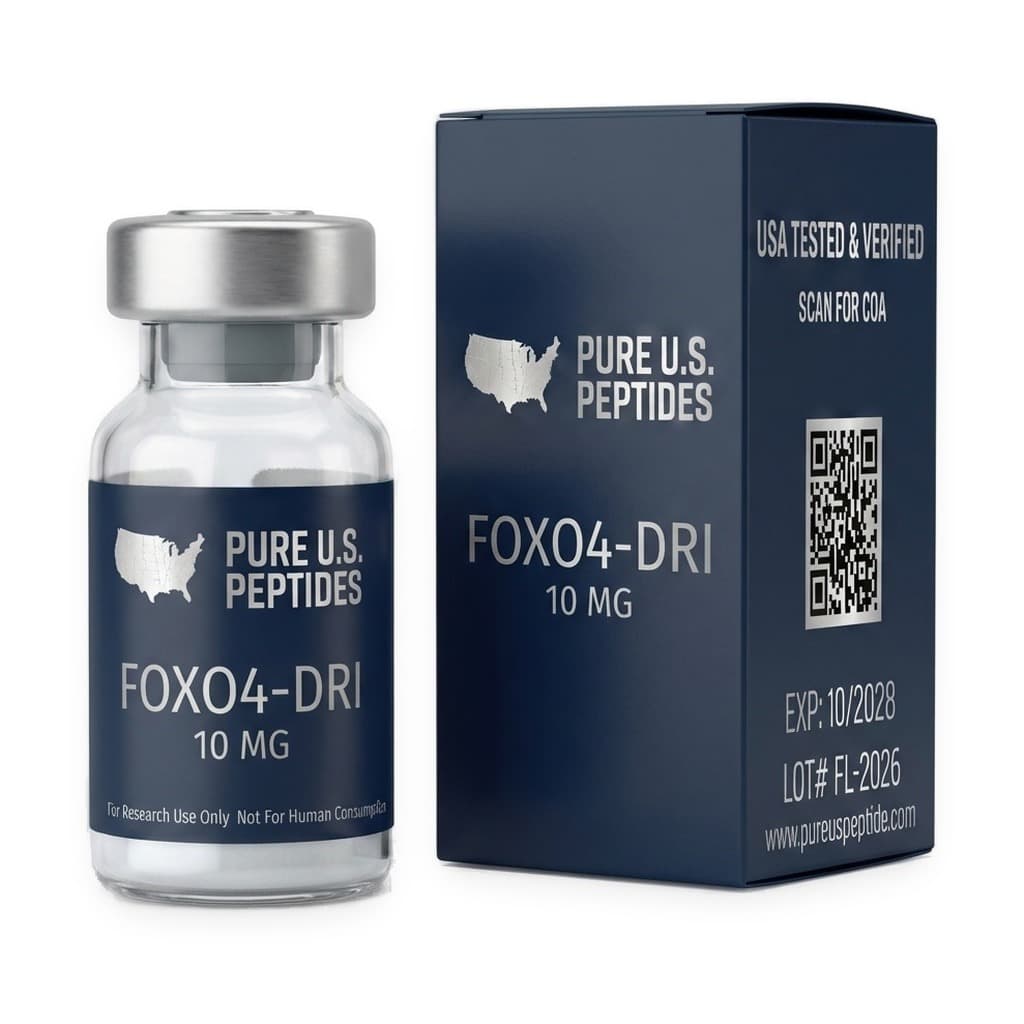
FOXO4 10mg
Em Estoque e Pronto para Envio dos EUA
Frete GRÁTIS em todos os pedidos nos EUA
Checkout seguro via processador de pagamento criptografado


 +2.9k
+2.9kApenas para Uso em Pesquisa
Estes produtos sao destinados exclusivamente a pesquisa laboratorial e nao se destinam ao uso medico. Nao sao aprovados pela FDA para diagnosticar, tratar, curar ou prevenir qualquer doenca. Ao adquirir, voce certifica que os produtos serao utilizados exclusivamente para pesquisa e nao para consumo humano ou animal.
Resumo da Pesquisa
18 Citacoes PubMedVisao Geral da Pesquisa FOXO4-DRI (Proxofim) is a first-in-class senolytic peptide projetado(a) para selectively eliminate celulas senescentes — damaged, non-dividing "zombie" cells que accumulate with age and secrete harmful inflammatory factors conhecido(a) como the Senescence-Associated Secretory Phenotype (SASP). O peptideo foi desenvolvido(a) por Peter L.J. de Keizer and colleagues no(a) Erasmus University Medical Center Rotterdam and descrito(a) pela primeira vez em a landmark 2017 publication in Cell.[1] FOXO4-DRI is derivado(a) de the Forkhead domain do(a) human FOXO4 transcricao factor — specifically a regiao que interage com p53. Its name reflects two key modificacoes estruturais: "D" denotes the use of D-aminoacidos (mirror images of natural L-aminoacidos), and "Retro-Inverso" means the aminoacido sequence is reversed. Together, these modifications produce a peptide que mimics the 3D surface do(a) original protein enquanto being highly resistant to enzymatic degradacao by proteases. O peptideo is further fused para o(a) HIV-TAT protein transduction domain to enable rapido(a)...
FOXO4 — Dados de Pesquisa em Resumo
| Propriedade | Valor |
|---|---|
| Citacoes PubMed Referenciadas | 18 |
| Pesquisadores Colaboradores | 3 |
| Condicoes de Armazenamento | Liofilizado: -20°C ou inferior (estável a longo prazo), evite congelamento-descongelamento repetido. |
| Padrao de Pureza | >99.80% por HPLC (certificado publicado) |
| Apenas para Uso em Pesquisa | Nao destinado ao consumo humano. Apenas para uso em pesquisa. |
Research guide
What is FOXO4? Read the full research guideVisao Geral
Visao Geral da Pesquisa
FOXO4-DRI (Proxofim) is a first-in-class senolytic peptide projetado(a) para selectively eliminate celulas senescentes — damaged, non-dividing "zombie" cells que accumulate with age and secrete harmful inflammatory factors conhecido(a) como the Senescence-Associated Secretory Phenotype (SASP). O peptideo foi desenvolvido(a) por Peter L.J. de Keizer and colleagues no(a) Erasmus University Medical Center Rotterdam and descrito(a) pela primeira vez em a landmark 2017 publication in Cell.[1]
FOXO4-DRI is derivado(a) de the Forkhead domain do(a) human FOXO4 transcricao factor — specifically a regiao que interage com p53. Its name reflects two key modificacoes estruturais: "D" denotes the use of D-aminoacidos (mirror images of natural L-aminoacidos), and "Retro-Inverso" means the aminoacido sequence is reversed. Together, these modifications produce a peptide que mimics the 3D surface do(a) original protein enquanto being highly resistant to enzymatic degradacao by proteases. O peptideo is further fused para o(a) HIV-TAT protein transduction domain to enable rapido(a) cellular uptake within 2–4 hours.[1][2]
The fundamental insight behind FOXO4-DRI is que celulas senescentes resist apoptose by upregulating FOXO4, que binds and sequesters p53 within PML nuclear bodies, preventing p53 from executing its normal pro-apoptotic functions. FOXO4-DRI acts como um(a) competitive decoy, outcompeting endogenous FOXO4 for p53 binding and liberating p53 to translocate para o(a) mitochondria and trigger caspase-dependent apoptose. Because non-celulas senescentes express minimal FOXO4 and nao depend on this survival mechanism, they are spared — achieving remarkable selectivity.[1][3]
Preclinical research demonstrou FOXO4-DRI's potencial terapeutico across a broad spectrum of age-related conditions incluindo chemotherapy-induziu toxicity, renal function decline, male hypogonadism (testosterone deficiency), vascular aging, pulmonar fibrose, osteoartrite, liver fibrose, and therapy-resistant cancers. Fur-density, physical-activity and kidney-function endpoints were reported in fast-aging and naturally aged mice (5 mg/kg).[1][4][5]
The biotechnology company Cleara Biotech B.V., founded by de Keizer, is advancing optimized 4th-generation variants (CL04183/CL04177) with aprimorou afinidade de ligacao and melhorou pharmacokinetic profiles toward desenvolvimento clinico. A structural milestone was reached in 2025 quando Bourgeois et al. solved the NMR structure do(a) FOXO4-DRI/p53 complex, identifying the p53 Transativacao Domain 2 (TAD2) como o(a) specific binding site and demonstrating que p53 fosforilacao at Ser46 and Thr55 aprimora afinidade de ligacao.[2][3]
Mecanismo de Acao
Mecanismo de Acao
FOXO4-DRI functions como um(a) competitive peptide antagonist que disrupts the critico(a) survival interaction between FOXO4 and p53 in celulas senescentes, triggering a process called Targeted Apoptosis of Senescent Cells (TASC).[1]
Primary Target & Binding Characteristics
| Property | Detail | Evidence |
|---|---|---|
| Primary Target | FOXO4-p53 protein-protein interaction interface | Baar et al. (2017)[1] |
| Specific Binding Site on p53 | Transativacao Domain 2 (TAD2) of p53 | Bourgeois et al. (2025) NMR structure[2] |
| Binding Dynamics | Ambos(as) FOXO4-DRI and p53 TAD2 are intrinsically disordered; fold synergistically upon binding to form a transiently folded complex | Bourgeois et al. (2025)[2] |
| Affinity Modulation | Phosphorylation of p53 at Ser46 and Thr55 significantly aprimora FOXO4-DRI afinidade de ligacao | Bourgeois et al. (2025)[2] |
| HIV-TAT Contribution | Cationic HIV-TAT residues contribute additional contacts with p53 TAD2, stabilizing a interacao | Bourgeois et al. (2025)[2] |
| Cell Penetration | Intracellular uptake within 2–4 hours; detectable for ≥72 hours | Baar et al. (2017)[1] |
The Senescence Lock (Pre-Treatment State)
In celulas senescentes, FOXO4 is upregulou and physically interage com p53 dentro do(a) nucleus, specifically localizing to PML bodies (Promyelocytic Leukemia bodies) and DNA-SCARS (DNA Segments with Chromatin Alterations Reinforcing Senescence). This binding sequesters p53 no(a) nucleus, preventing it from initiating pro-apoptotic functions — effectively keeping the senescent cell in a suspended "zombie" state.[1][3]
Downstream Signaling Cascade (TASC Pathway)
| Step | Event | Molecular Detail |
|---|---|---|
| 1. Competitive Inhibition | FOXO4-DRI competes with endogenous FOXO4 for p53 binding | Binds p53 TAD2 with alto(a) affinity, displacing endogenous FOXO4[1][2] |
| 2. Nuclear Exclusion | Liberated p53 is excluded do(a) nucleus | p53 liberado(a) de PML bodies / DNA-SCARS[1] |
| 3. Mitochondrial Translocation | Active, mono-ubiquitinated p53 translocates to mitochondria | Transcription-independent apoptose pathway[1] |
| 4. BAX/BAK Activation | p53 interage com BAX and BAK (pro-apoptotic Bcl-2 family members) | Mitochondrial outer membrane permeabilization (MOMP)[1][5] |
| 5. Cytochrome C Release | BAX/BAK pores release Cytochrome C no(a) cytosol | Initiates the intrinsic apoptose cascade[1] |
| 6. Caspase Activation | Cytochrome C desencadeia cleavage of Caspase-3 and Caspase-7 | Terminal effector caspases execute apoptose[1][5] |
| 7. Selective Senolysis | Senescent cell undergoes intrinsic apoptose e e eliminated | Non-celulas senescentes unaffected (low FOXO4, no dependency on FOXO4-p53 axis)[1] |
Cellular & Tissue-Level Effects
| Effect | Detail | Evidence |
|---|---|---|
| Senolysis | Selective eliminacao of senescent fibroblastos (IMR90), condrocitos, and Leydig cells; 11.73-fold selectivity over non-celulas senescentes | Baar et al. (2017); Huang et al. (2021)[1][6] |
| SASP Suppression | Downregulacao of IL-6, IL-1β, TNF-α, TGF-β, e outros(as) pro-inflamatorio(a) cytokines | Zhang et al. (2020); Hu et al. (2026)[4][5] |
| Marker Modulation | Decreased p16 and p21 expression; aumentou Ki-67 (proliferacao marker) and Lamin B1 (nuclear envelope marker) | Hu et al. (2026)[5] |
| Renal Restoration | Normalized plasma urea and creatinine; reduziu tubular senescencia markers | Baar et al. (2017)[1] |
| Testosterone Restoration | Selective apoptose of senescent Leydig cells; melhorou testicular microenvironment; restaurou testosterone secretion | Zhang et al. (2020)[4] |
| Vascular Health | Reduced aortic wall thickness, reduziu ROS levels, melhorou endothelial-dependent vasodilatacao, reduziu Pulse Wave Velocity | Hu et al. (2026)[5] |
Selectivity vs. Related Compounds
| Comparison | FOXO4-DRI | Comparator |
|---|---|---|
| vs. ABT-737 / Navitoclax (BCL-2 inhibitors) | No thrombocytopenia; direciona p53/FOXO4 axis specifically | Causes baixo(a) plaqueta counts by affecting non-celulas senescentes[1] |
| vs. Dasatinib + Quercetin | Peptide-based; single-target mechanism (FOXO4-p53); DRI stability | Small molecule combination; multi-target kinase inibicao |
| vs. CL04183 (4th-generation) | Original compound; shorter meia-vida; narrower janela terapeutica at alto(a) concentrations | Enhanced afinidade de ligacao; melhorou liver enzyme stability; broader janela terapeutica[2] |
| vs. Endogenous FOXO4 | Antagonist: competes for p53 to trigger apoptose; protease-resistant DRI form | Agonist of senescencia maintenance: sequesters p53 to keep celulas senescentes alive[1] |
FOXO Family Specificity: O peptideo design focused on a region of FOXO4 que differs from FOXO1 and FOXO3 to minimize cross-reactivity with these essencial transcricao factors. Cross-species conservation do(a) binding domain allows direto(a) traducaoal studies between mice and humans.[1]
Aplicacoes de Pesquisa
Aplicacoes de Pesquisa
FOXO4-DRI is utilized in preclinical research to study o efeitos of clearing celulas senescentes (senolysis) across 9+ research domains:
- General Aging & Frailty — FOXO4-DRI restaura tissue homeostasis in naturally camundongos idosos (104–130 weeks). Benefits include melhorou fur density, aumentou physical activity (running wheel activity), melhorou responsiveness, and reduziu p16-driven bioluminescence (senescencia burden). Treatment of XpdTTD/TTD fast-aging mice yielded fur insulation restoration (approaching wildtype levels) and aumentou running from 1.37 km/day to near-wildtype levels.[1]
- Chemotherapy-Induced Toxicity — In Doxorubicin-treated C57BL/6J mice, FOXO4-DRI (5 mg/kg i.v., 3 doses) neutralized chemotherapy-induziu liver toxicity (normalized plasma AST), preveniu peso corporal loss, and reduziu IL-6 and FOXO4 foci in liver tissue.[1]
- Renal Function Decline — In ambos(as) fast-aging and naturally camundongos idosos, FOXO4-DRI normalizes plasma urea and creatinine levels, restoring kidney filtering capacity and reducing tubular senescencia markers. Significant reductions observado(a) 30 days after 3 administrations.[1]
- Male Hypogonadism / Testosterone Deficiency — In aged male mice (20–24 months), FOXO4-DRI selectively induz apoptose in senescent Leydig cells, reducing SASP factors (IL-1β, IL-6, TGF-β), improving the testicular microenvironment, and significantly restoring serum testosterone levels (p<0.05).[4]
- Cardiovascular Aging & Endothelial Dysfunction — FOXO4-DRI reduz reactive oxygen species (ROS) no(a) aorta, suprime vascular aging markers (p16, p21), thins the aortic wall, lowers Pulse Wave Velocity (melhorou elasticity), and melhora endothelial-dependent vasodilatacao in ambos(as) naturally aged and D-galactose progeroid mice.[5]
- Pulmonary Fibrosis — FOXO4-DRI melhora bleomycin-induziu pulmonar fibrose by targeting senescent myofibroblastos, downregulating matriz extracelular receptor interaction pathways, attenuating deposicao de colageno, and increasing Type 2 alveolar celula epitelials (AEC2).[8][9]
- Osteoarthritis & Cartilage Regeneration — In expanded human condrocitos, FOXO4-DRI (25 µM, 5 days) selectively removed >50% of celulas senescentes (PDL9), reduziu SA-β-gal to <5%, and diminuiu expression of SASP factors (IL-6, IL-8) in engineered cartilage tissue.[6]
- Cancer & Metastasis — FOXO4-DRI is being explored against therapy-resistant and metastatic cancers (triple-negative breast cancer, metastatic colon cancer) by targeting "scarred" cancer cells que share features with celulas senescentes, and for radiosensitizing non-small cell lung cancer.[10][11]
- Liver Fibrosis — FOXO4-DRI and optimized variants (CL04183) counter the CD44-high dediferenciacao state in hepatocitos driven by senescencia, restoring liver function markers in fibrose models.[10]
Caracteristicas Bioquimicas
| Propriedade | Valor |
|---|---|
| Molecular Formula | C₂₂₈H₃₈₈N₈₆O₆₄ |
| Molecular Weight | 5358.05 Da |
| CAS Number | 2460055-10-9 |
| PubChem CID | 167312269 |
| Sequence (1-Letter) | H-ltlrkepaseiaqsileaysqngwanrrsggkrppprrrqrrkkrg-OH (all D-aminoacidos) |
| Sequence (3-Letter) | H-D-Leu-D-Thr-D-Leu-D-Arg-D-Lys-D-Glu-D-Pro-D-Ala-D-Ser-D-Glu-D-Ile-D-Ala-D-Gln-D-Ser-D-Ile-D-Leu-D-Glu-D-Ala-D-Tyr-D-Ser-D-Gln-D-Asn-D-Gly-D-Trp-D-Ala-D-Asn-D-Arg-D-Arg-D-Ser-D-Gly-D-Gly-D-Lys-D-Arg-D-Pro-D-Pro-D-Pro-D-Arg-D-Arg-D-Arg-D-Gln-D-Arg-D-Arg-D-Lys-D-Lys-D-Arg-D-Gly-OH |
| Structure | 46-aminoacido D-retro-inverso peptide; all D-aminoacidos in reversed sequence; fused to HIV-TAT cell-penetrating domain (GRKKRRQRRR); derivado(a) de FOXO4 Forkhead domain (N-terminal disordered region + alpha-helix 1) |
| Origin | Designed by Peter L.J. de Keizer at Erasmus University Medical Center Rotterdam / Cleara Biotech B.V. |
| Classification | Senolytic Peptide / D-Retro-Inverso Peptide / Research Peptide |
| Half-Life | Short in vivo meia-vida (drives development of newer variants); intracellular detection up to 72 hours post-administration |
| Bioavailability | Cell-permeable via HIV-TAT domain; intracellular uptake within 2-4 hours |
Identificadores
| Synonyms | |
|---|---|
| InChI Key | |
| Developer |
Resumo da Pesquisa Pre-clinica
Resumo da Pesquisa Pre-clinica
Key Preclinical Animal Studies
| Estudo | Modelo | Principais Achados | Ref |
|---|---|---|---|
| Baar et al. (2017) Cell | C57BL/6J mice — Doxorubicin chemotoxicity; 5 mg/kg i.v., 3 doses over 5 days | Neutralized plasma AST elevation (liver toxicity); preveniu peso corporal loss; reduziu IL-6 and FOXO4 foci in liver tissue | [1] |
| Baar et al. (2017) Cell | XpdTTD/TTD fast-aging mice; 5 mg/kg, iniciou at ~26 weeks | Fur density restaurou (infrared imaging); running activity aumentou from 1.37 km/day toward wildtype 9.37 km/day; plasma urea normalized | [1] |
| Baar et al. (2017) Cell | Naturally aged C57BL/6J (p16::3MR), 104–130 wks; 5 mg/kg i.p., 3 doses over 5 days; observado(a) 30 days | Reduced plasma urea and creatinine (restaurou renal function); reduziu p16-driven bioluminescence; melhorou responsiveness to stimuli | [1] |
| Zhang et al. (2020) Aging | Naturally aged male C57BL/6 (20–24 mo); 5 mg/kg, 3 doses over 5 days; analyzed 30 days post-treatment | Serum testosterone aumentou significativamente (p<0.05); diminuiu p53, p21, p16 in testes; reduziu IL-1β, IL-6, TGF-β; no change in body/testis weight | [4] |
| Hu et al. (2026) Front. Bioeng. Biotech. | Naturally camundongos idosos (17 mo); 5 mg/kg, alternate-day exposure for 1 month | Aortic wall significantly thinner (p<0.05); lower PWV (melhorou elasticity); downregulou P21/P16; upregulou Ki-67/Lamin B; diminuiu IL-1β, IL-6, CXCL15, TNF-α | [5] |
| Hu et al. (2026) Front. Bioeng. Biotech. | D-galactose progeroid mice (200 mg/kg/day D-gal for 8 wks); 5 mg/kg, alternate-day exposure for 4 weeks | Reduced aortic wall thickness; reduziu ROS (DHE staining); melhorou blood flow; confirmou p53/Bcl-2/Caspase-3 pathway ativacao | [5] |
| Han et al. (2022) J. Cell. Mol. Med. | Bleomycin-induziu pulmonar fibrose modelo de camundongo | Decreased celulas senescentes; atenuou BLM-induziu deposicao de colageno; aumentou AEC2 percentage; diminuiu myofibroblastos | [8] |
| Toxicity Data Cleara/Patent | C57BL/6J mice; MTD, 4-week design; agudo(a) toxicity up to 100 mg/kg dose unica (BALB/c) | At 5 mg/kg: well tolerated, no obvious adverse findings. At MTD: diminuiu peso corporal, elevated plaqueta counts, elevated ALP/ALT/AST. Acute 100 mg/kg: no mortality or observable toxicity within 24h | [1] |
In Vitro / Human Cell Studies
| Estudo | Cell Type | Key Results | Ref |
|---|---|---|---|
| Baar et al. (2017) | Human IMR90 fibroblastos (IR/Doxorubicin-induziu senescencia) | Potent, selective reduction in senescent cell viability; 11.73-fold selectivity vs non-celulas senescentes; p53 mitochondrial translocation; caspase-3/7 ativacao; non-celulas senescentes unaffected | [1] |
| Huang et al. (2021) | Human condrocitos (PDL9 senescent vs PDL3 non-senescent) | 25 µM for 5 days: removed >50% celulas senescentes; SA-β-gal <5% remaining; diminuiu p16, p21, p53; reduziu IL-6, IL-8 SASP; non-senescent PDL3 cells unaffected | [6] |
| Zhang et al. (2020) | Human testicular tissue (observational immunofluorescence) | FOXO4 subcellular localization in Leydig cells compared in human tissue samples by donor age; steroidogenic enzyme expression examined | [4] |
| Bourgeois et al. (2025) | Solution NMR structural analysis (p53-FOXO4-DRI complex) | Identified p53 TAD2 as specific binding site; ambos(as) peptide and p53 TAD2 fold synergistically upon binding; phospho-Ser46/Thr55 aprimora affinity; HIV-TAT contributes stabilizing contacts | [2] |
Clinical / Human Trial Status
There are atualmente no completed or published human ensaios clinicos for FOXO4-DRI. O composto remains no(a) preclinical stage. Cleara Biotech describes itself como um(a) "preclinical-stage company" e e preparing the lead candidate CL04183 for Investigational New Drug (IND) applications. Some private wellness clinics offer FOXO4-DRI off-label; these nao sao registered ensaios clinicos e o(a) substance nao e FDA-aprovado(a) para human use.[1]
Concentrations Used in Published Studies
| Setting | Concentration / Amount | Schedule | Notes |
|---|---|---|---|
| In Vitro (standard) | 25 µM | Cell culture; 5 days exposure | Most common eficaz concentration[1][6] |
| In Vitro (range) | 6.25–50 µM | Cell culture | Dose-dependent senolytic effect[1] |
| In Vivo (standard) | 5 mg/kg | 3 administrations over 5 days, or alternate-day exposure for 1 month | Used across all principal efficacy studies[1][4][5] |
| Acute Toxicity | Up to 100 mg/kg | Single administration (BALB/c mice) | No mortality or observable toxicity within 24h |
Perfil de Seguranca
| Parametro | At 5 mg/kg (mice) | At MTD (mice) |
|---|---|---|
| Body Weight | No significant change | Decreased total peso corporal |
| Platelet Counts | No thrombocytopenia (diferentemente de BCL-2 inhibitors) | Elevated plaqueta counts |
| Liver Enzymes | Normal ALT, AST levels | Elevated ALP, ALT, AST (liver toxicity) |
| Kidney Function | Normal BUN, creatinine | Not separately relatado(a) |
| Long-term Tolerability | Over 10 months of repeated exposure: no obvious adverse findings | Narrower janela terapeutica[1] |
| In Vitro (human cells) | Non-senescent fibroblastos and condrocitos consistently unaffected at senolytic concentrations[1][6] | |
Os produtos oferecidos neste site são fornecidos apenas para estudos in vitro. Estudos in vitro (do latim: em vidro) são realizados fora do corpo. Estes produtos não são medicamentos ou fármacos e não foram aprovados pelo FDA dos EUA para prevenir, tratar ou curar qualquer condição médica, enfermidade ou doença. A introdução corporal de qualquer tipo em humanos ou animais é estritamente proibida por lei.
Apenas para Pesquisa Laboratorial. Não se destina ao uso humano, uso médico, uso diagnóstico ou uso veterinário.
TODOS OS ARTIGOS E INFORMAÇÕES SOBRE PRODUTOS FORNECIDOS NESTE SITE SÃO APENAS PARA FINS INFORMATIVOS E EDUCACIONAIS.
Autores e Atribuicao
✍️ Autor do Artigo
Peter L.J. de Keizer
Peter L.J. de Keizer, PhD, is o(a) principal inventor of FOXO4-DRI and founder of Cleara Biotech B.V. in Utrecht, Netherlands. He held research positions at Erasmus University Medical Center Rotterdam (Department of Molecular Genetics), University Medical Center Utrecht (Center for Molecular Medicine), and The Buck Institute for Research on Aging. De Keizer conceptualized and designed the FOXO4-DRI peptide after identifying FOXO4 como o(a) critico(a) pivot maintaining senescent cell viability through p53 sequestration. His landmark 2017 paper in Cell demonstrated que disrupting the FOXO4-p53 interaction could selectively eliminate celulas senescentes, restoring tissue homeostasis in aging and chemotherapy models. He founded Cleara Biotech to translate estes achados into clinical therapies, developing 4th-generation optimized variants (CL04183). His key publications include "Targeted Apoptosis of Senescent Cells Restores Tissue Homeostasis in Response to Chemotoxicity and Aging" (2017, Cell) and "The disordered p53 transativacao domain e o(a) target of FOXO4 e o(a) senolytic compound FOXO4-DRI" (2025, Nature Communications). Peter L.J. de Keizer is being referenced as one do(a) leading scientists envolveu in FOXO4-DRI research. De forma alguma este(a) médico(a)/cientista endossa ou defende a compra, venda ou uso deste produto por qualquer motivo. Não existe afiliação ou relação, implícita ou de outra forma, entre a Pure US Peptide e este(a) médico(a).
Ver Perfil Completo do Pesquisador →🎓 Autor de Revista Cientifica
Tobias Madl, PhD
Tobias Madl, PhD, is a structural biologist no(a) Medical University of Graz (Institute of Molecular Biology & Biochemistry, Center of Molecular Medicine) and co-founder of Cleara Biotech B.V. He is a leader in NMR spectroscopy who played um(a) principal role no(a) drug design platform for FOXO4-DRI. His structural work caracterizado(a) a interacao domain between FOXOs and p53, confirming que FOXO4-DRI competes with endogenous FOXO4 for p53 binding. In 2025, his team solved the solution NMR structure do(a) p53 transativacao domain in complex with FOXO4-DRI, identifying p53 TAD2 como o(a) specific binding site and revealing que fosforilacao of p53 at Ser46 and Thr55 significantly aprimora afinidade de ligacao. His key publications include "Targeted Apoptosis of Senescent Cells Restores Tissue Homeostasis in Response to Chemotoxicity and Aging" (2017, Cell), "Regulation of cellular senescencia via o(a) FOXO4-p53 axis" (2018, FEBS Letters), and "The disordered p53 transativacao domain e o(a) target of FOXO4 e o(a) senolytic compound FOXO4-DRI" (2025, Nature Communications). Tobias Madl is being referenced as one do(a) leading scientists envolveu in FOXO4-DRI research. De forma alguma este(a) médico(a)/cientista endossa ou defende a compra, venda ou uso deste produto por qualquer motivo. Não existe afiliação ou relação, implícita ou de outra forma, entre a Pure US Peptide e este(a) médico(a).
Ver Perfil Completo do Pesquisador →Tobias Madl, PhD is being referenced as one of the leading scientists involved in the research and development of FOXO4. In no way is this doctor/scientist endorsing or advocating the purchase, sale, or use of this product for any reason. There is no affiliation or relationship, implied or otherwise, between Pure US Peptide and this doctor. The purpose of citing the doctor is to acknowledge, recognize, and credit the exhaustive research and development efforts conducted by the scientists studying this peptide.
🔬 Pesquisador Colaborador
Guihua Liu, MD/PhD
Guihua Liu, MD/PhD, is affiliated with The First Affiliated Hospital of Sun Yat-sen University (Department of Andrology) and The Sixth Affiliated Hospital of Sun Yat-sen University (Reproductive Medicine Research Center). He designed and guided research demonstrating que FOXO4-DRI alleviates age-related testosterone secretion insufficiency by selectively targeting senescent Leydig cells in camundongos idosos. His team mostrou que FOXO4-DRI melhora the testicular microenvironment by reducing senescencia-associated secretory phenotype (SASP) factors, decreasing senescencia markers (p53, p21, p16), and significantly restoring serum testosterone levels. His key publications include "FOXO4-DRI alleviates age-related testosterone secretion insufficiency by targeting senescent Leydig cells in camundongos idosos" (2020, Aging) and "FOXO4-DRI melhora spermatogenesis in camundongos idosos through reducing senescencia-associated secretory phenotype secretion from Leydig cells" (2024, Experimental Gerontology). Guihua Liu is being referenced as one do(a) leading scientists envolveu in FOXO4-DRI research. De forma alguma este(a) médico(a)/cientista endossa ou defende a compra, venda ou uso deste produto por qualquer motivo. Não existe afiliação ou relação, implícita ou de outra forma, entre a Pure US Peptide e este(a) médico(a).
Ver Perfil Completo do Pesquisador →Guihua Liu, MD/PhD is being referenced as one of the leading scientists involved in the research and development of FOXO4. In no way is this doctor/scientist endorsing or advocating the purchase, sale, or use of this product for any reason. There is no affiliation or relationship, implied or otherwise, between Pure US Peptide and this doctor. The purpose of citing the doctor is to acknowledge, recognize, and credit the exhaustive research and development efforts conducted by the scientists studying this peptide.
Citacoes Referenciadas
Baar MP, et al. Targeted Apoptosis of Senescent Cells Restores Tissue Homeostasis in Response to Chemotoxicity and Aging. Cell, 169(1), 132-147.e16, 2017.
PubMedBourgeois B, et al. The disordered p53 transativacao domain e o(a) target of FOXO4 e o(a) senolytic compound FOXO4-DRI. Nature Communications, 16(1), 5672, 2025.
PubMedBourgeois B, Madl T. Regulation of cellular senescencia via o(a) FOXO4-p53 axis. FEBS Letters, 592(12), 2083-2097, 2018.
PubMedZhang C, et al. FOXO4-DRI alleviates age-related testosterone secretion insufficiency by targeting senescent Leydig cells in camundongos idosos. Aging, 12(2), 1272-1284, 2020.
PubMedHu Z, et al. FOXO4-DRI regula celula endotelial senescencia via o(a) P53 via de sinalizacao. Frontiers in Bioengineering and Biotechnology, 13, 1729166, 2026.
PubMedHuang Y, et al. Frontiers in Bioengineering and Biotechnology, 9, 677576, 2021.
PubMedLi Y, et al. FOXO4-DRI melhora spermatogenesis in camundongos idosos through reducing senescencia-associated secretory phenotype secretion from Leydig cells. Experimental Gerontology, 195, 112522, 2024.
PubMedHan X, et al. FOXO4 peptide direciona myofibroblaspara melhorars bleomycin-induziu pulmonar fibrose in mice through ECM-receptor interaction pathway. Journal of Cellular and Molecular Medicine, 26(11), 3269-3280, 2022.
PubMedLiu Y, et al. FOXO4-D-Retro-Inverso direciona matriz extracelular production in fibroblastos and melhora bleomycin-induziu pulmonar fibrose in mice. Naunyn-Schmiedeberg's Archives of Pharmacology, 396(10), 2393-2403, 2023.
PubMedPutavet DA, et al. Cancer Research, 81(5_Supplement), IA002, 2021.
PubMedMeng J, et al. Targeting senescencia-like fibroblastos radiosensitizes non-small cell lung cancer and reduz radiation-induziu pulmonar fibrose. JCI Insight, 6(23), e146334, 2021.
PubMedKrimpenfort P, Berns A. Cell, 169(1), 3-5, 2017.
PubMedMandal R, et al. FOXO4 interage com p53 TAD and CRD and inibe its binding to DNA. Protein Science, 31(5), e4287, 2022.
PubMedKong YX, et al. FOXO4-DRI induz keloid senescent fibroblasto apoptose by promoting nuclear exclusion of upregulou p53-serine 15 fosforilacao. Communications Biology, 8(1), 299, 2025.
PubMedvan Willigenburg H, de Keizer PLJ, de Bruin RWF. Pharmacological Research, 130, 322-330, 2018.
PubMedPutavet D, et al. Abstract P1-19-02: Repurposing the FOXO4 senolytic against triple-negative breast cancer. Cancer Research, 82(4_Supplement), P1-19-02, 2022.
PubMedNwankwo N, Okafor I. Bioinformatics procedure for investigating senolytic (anti-envelhecimento) agents: A digital signal processing technique. Aging Medicine, 6(4), 338-346, 2024.
PubMedTimucin E, et al. Novel Senolytic Peptides. United States Patent Application, US20200255489A1, 2020.
SourceAviso de Uso em Pesquisa
Apenas para Uso em Pesquisa (RUO). Nao destinado ao consumo humano, uso clinico, ou como medicamento, alimento, cosmetico ou dispositivo medico. Este produto nao foi avaliado pelo FDA e e fornecido exclusivamente para pesquisa laboratorial in vitro por profissionais qualificados.
Certificado de Analise
Published certificates come from third-party laboratories. If this listing's certificate is still pending, the card below says so.
Ultimo Relatorio de Laboratorio
Armazenamento e Manuseio
Resumo
Liofilizado: -20°C ou inferior (estável a longo prazo), evite congelamento-descongelamento repetido.
Pó Liofilizado
Store at -20°C or lower para manter stability. The liofilizado form is highly estavel due to D-aminoacido composition. Keep sealed, away from moisture and light.
Solubilidade
Solúvel em PBS ou água estéril.
Manuseio
White liofilizado powder, typically supplied como um(a) TFA (trifluoroacetic acid) salt. Os certificados publicados informam a pureza por HPLC e as endotoxinas quando testadas. The D-Retro-Inverso modification provides exceptional resistance to proteolytic degradacao, with intracellular detection até 72 hours post-administration.
“Resumo da Pesquisa Pre-clinica Key Preclinical Animal Studies Estudo Modelo Principais Achados Ref Baar et al.”
Compostos de Pesquisa Relacionados
5-Amino 1MQ
50mg
NAD+
1000mg
MOTS-C
40mg