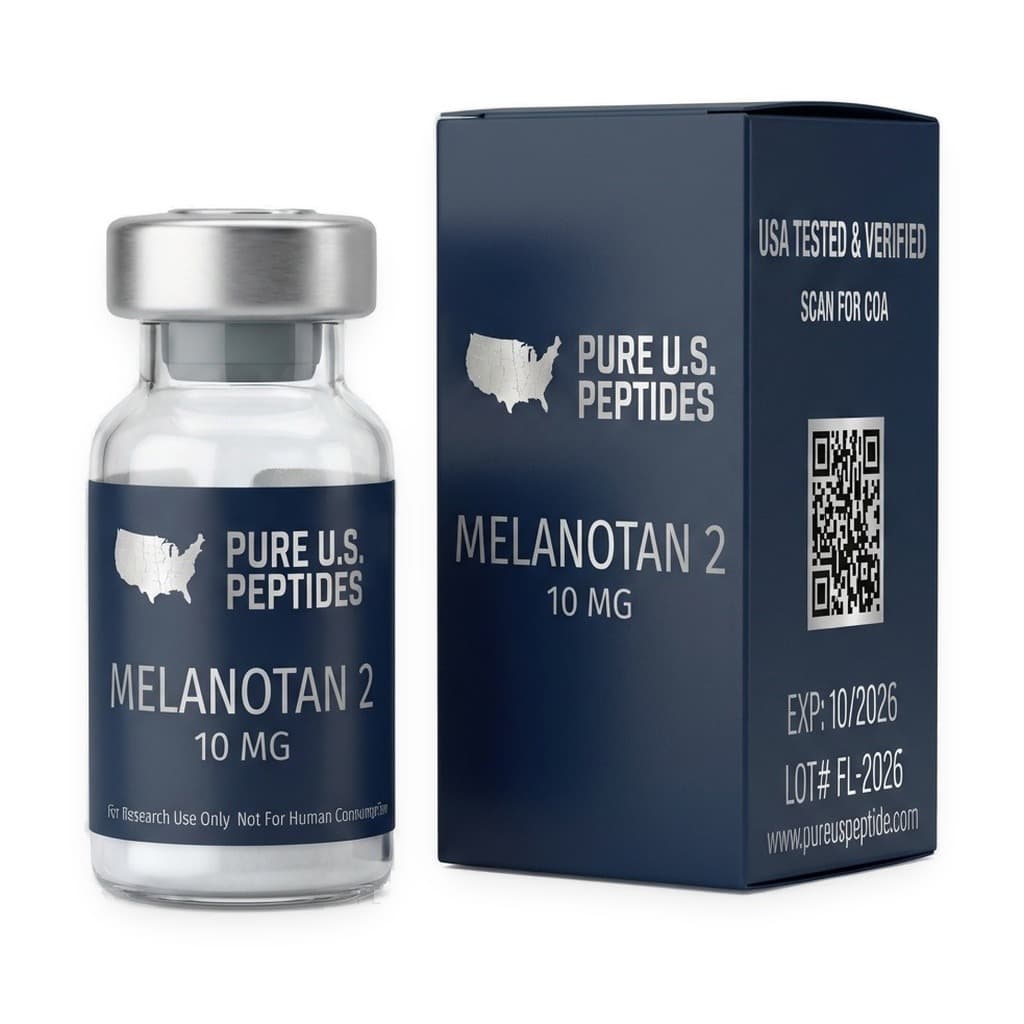
Melanotan 2 10mg
In Stock & Ready to Ship from USA
FREE shipping on every U.S. order
Secure checkout via encrypted payment processor


 +2.9k
+2.9kResearch Use Only
These products are for laboratory research only and not intended for medical use. They are not FDA-approved to diagnose, treat, cure, or prevent any disease. By purchasing, you certify they will be used solely for research and not for human or animal consumption.
Research Summary
24 PubMed CitationsOverview Melanotan II (MT-II) is a synthetic, cyclic heptapeptide analog of the endogenous 13-amino-acid hormone α-melanocyte-stimulating hormone (α-MSH). It was originally synthesized at the University of Arizona in the late 1980s by Victor Hruby, Mac Hadley, and Robert Dorr.[1] Chemically, MT-II is defined as Ac-Nle-c[Asp-His-D-Phe-Arg-Trp-Lys]-NH₂, a shortened variant of α-MSH with key modifications: a lactam bridge cyclization (Asp→Lys) increases enzymatic resistance, and D-Phenylalanine substitution enhances potency. These make MT-II "superpotent" compared to native α-MSH and enable it to cross the blood-brain barrier — a key distinction from the linear Melanotan I (afamelanotide).[1][3] MT-II acts as a non-selective agonist at melanocortin receptors MC1R, MC3R, MC4R, and MC5R with high nanomolar affinity (Ki ~1.1–1.3 nM), but does NOT bind MC2R (the ACTH receptor). This broad receptor activation drives its diverse effects — tanning, erectogenic, anorexigenic, and social behavioral modulation.[2] The active metabolite of MT-II — Bremelanotide (PT-141) — is bremelanotide, an FDA-approved...
Melanotan 2 — Research Data at a Glance
| Property | Value |
|---|---|
| PubMed Citations Referenced | 24 |
| Contributing Researchers | 3 |
| Storage Conditions | Lyophilized powder: -20°C, dark, airtight, protected from moisture. |
| Purity Standard | >99.80% HPLC (published certificate) |
| Research Use Only | Not for human consumption. RUO only. |
Compare Melanotan 2 with Other Peptides
Research guide
What is Melanotan 2? Read the full research guideOverview
Overview
Melanotan II (MT-II) is a synthetic, cyclic heptapeptide analog of the endogenous 13-amino-acid hormone α-melanocyte-stimulating hormone (α-MSH). It was originally synthesized at the University of Arizona in the late 1980s by Victor Hruby, Mac Hadley, and Robert Dorr.[1]
Chemically, MT-II is defined as Ac-Nle-c[Asp-His-D-Phe-Arg-Trp-Lys]-NH₂, a shortened variant of α-MSH with key modifications: a lactam bridge cyclization (Asp→Lys) increases enzymatic resistance, and D-Phenylalanine substitution enhances potency. These make MT-II "superpotent" compared to native α-MSH and enable it to cross the blood-brain barrier — a key distinction from the linear Melanotan I (afamelanotide).[1][3]
MT-II acts as a non-selective agonist at melanocortin receptors MC1R, MC3R, MC4R, and MC5R with high nanomolar affinity (Ki ~1.1–1.3 nM), but does NOT bind MC2R (the ACTH receptor). This broad receptor activation drives its diverse effects — tanning, erectogenic, anorexigenic, and social behavioral modulation.[2]
The active metabolite of MT-II — Bremelanotide (PT-141) — is bremelanotide, an FDA-approved pharmaceutical; that approval does not apply to this research-grade material. MT-II itself remains unapproved by any regulatory body.[2]
Discovery and design rationale
The MT-II scaffold emerged from a structure-activity exploration of the alpha-MSH minimum-active sequence. Investigators at the University of Arizona introduced two key modifications to the linear parent: D-phenylalanine substitution at position 7 to block proteolytic cleavage at the Phe–Arg bond, and a Asp–Lys lactam bridge cyclization to lock the bioactive beta-turn conformation. These modifications increased melanocortin-receptor potency and conferred sufficient metabolic and blood-brain-barrier permeability for centrally mediated effects to emerge in animal studies.[1][2]
Research framework
Within the melanocortin-system research domain, MT-II is most directly compared with KPV for the receptor-engagement versus PepT1-uptake distinction, with afamelanotide for the linear-versus-cyclic structural class, and with the deaminated metabolite Bremelanotide (PT-141) for tissue-specific receptor-affinity profiles. The compound is supplied here strictly as a research reference standard for in vitro and animal-model investigation, and is not intended for human or veterinary use.
Mechanism of Action
Mechanism of Action
Melanocortin Receptor Binding
MT-II is a non-selective agonist at four of five melanocortin receptors (MCRs), all members of the GPCR superfamily:
| Receptor | Primary Location | Function When Activated | Affinity |
|---|---|---|---|
| MC1R | Melanocytes (skin) | Eumelanin synthesis → tanning/photoprotection | High |
| MC3R | Hypothalamus, NAcc | Energy homeostasis, feeding behavior | Ki ~1.3 nM |
| MC4R | Hypothalamus (PVN), spinal cord | Erectile function, food-intake regulation, thermogenesis | Ki ~1.1 nM |
| MC5R | Exocrine glands, lymphocytes | Sebum production, immune modulation | Moderate |
| MC2R | Adrenal cortex | ACTH receptor — NO MT-II binding | None |
Primary Signaling: cAMP-PKA Pathway
Upon MCR binding, MT-II activates Gs-coupled adenylate cyclase → increased intracellular cAMP → PKA activation:[2]
- Melanogenesis (MC1R): PKA → CREB phosphorylation → MITF transcription → tyrosinase upregulation → eumelanin production
- Erectile function (MC4R/CNS): Hypothalamic PVN activation → dopaminergic/oxytocinergic downstream → neuronal NO release → intracavernosal pressure increase[5]
- Food-intake regulation (MC3R/MC4R): Hypothalamic MCR activation → reduced food intake + increased thermogenesis[6]
- Social behavior (MC4R): Selective nucleus accumbens activation → oxytocin-dependent social learning[7]
Off-Target: Mast Cell Activation
MT-II cross-reacts with MRGPRB2/MRGPRX2 receptors on mast cells, causing pseudo-allergic histamine release → H1 receptor activation → hypothermia (in mice).[8]
Receptor Conformational Bias
The cyclic D-Phe7 substitution stabilizes the beta-turn conformation of the core His-Phe-Arg-Trp pharmacophore, producing a ligand profile that resembles ago-allosteric modulation rather than pure orthosteric agonism. This conformational bias has been studied for its differential coupling efficiency across the MC1R/MC3R/MC4R/MC5R receptor subtypes, particularly with respect to sustained Gs/cAMP signaling versus transient receptor internalization.[2]
Central versus Peripheral Effect Compartmentalization
MT-II's blood-brain-barrier permeability separates it pharmacologically from the linear parent peptide afamelanotide, which engages predominantly peripheral MC1R for melanogenesis without robust CNS entry. As a result, MT-II preclinical models can interrogate combined peripheral (skin pigment, exocrine gland) and central (hypothalamic feeding/erectile, nucleus-accumbens social-behavior) MCR pharmacology in a single compound — a property leveraged extensively in melanocortin behavioral neuroscience.[7][11]
vs. Related Compounds
| Compound | Structure | BBB | Key Difference |
|---|---|---|---|
| MT-II | Cyclic heptapeptide | Yes | Non-selective MCR agonist; tanning + erectogenic + anorexigenic |
| Melanotan I (Afamelanotide) | Linear [Nle⁴,D-Phe⁷]-α-MSH | No | Tanning only (peripheral MC1R); no CNS effects; TGA/EMA approved for EPP |
| Bremelanotide (PT-141) | Deaminated MT-II metabolite | Yes | FDA-approved pharmaceutical; that approval does not apply to this material |
| α-MSH (native) | Linear tridecapeptide | Limited | Short half-life; rapidly degraded; weak potency |
Research Applications
Research Applications
Melanotan II research spans dermatology, sexual medicine, neuroendocrinology, oncology, and behavioral neuroscience across 7+ indication categories:
- Skin Pigmentation & Photoprotection — MC1R stimulation → eumelanin synthesis → tanning without UV exposure; tanning endpoints were reported in Phase I trials.[1]
- Sexual Dysfunction — Erectile-response endpoints were reported in small crossover studies; proceptive-behavior endpoints were reported in female rats.[3][9]
- Metabolic Regulation & Obesity — Central MC3R/MC4R activation: intraabdominal fat -35% (low dose) to -55% (high dose); iBAT thermogenesis 3-fold increase; food-intake endpoints via NAcc.[6][10]
- Autism & Social Behavior — Sociability index increased from 3.1 to 26.3 (p<0.0001) in MIA autism model mice; oxytocin-dependent NAcc activation in social contexts; partner preference facilitation in prairie voles.[11][7]
- Neuroprotection & Nerve Regeneration — 20 µg/kg every 48h enhanced sensory function recovery in rat sciatic nerve crush model.[12]
- Addiction Research — Synergistic augmentation of naltrexone to reduce binge-like ethanol intake in mice.[13]
- Oncology — Topical MT-II suppressed melanoma tumor growth via MC1R → PTEN upregulation + COX-2/PGE2 inhibition; systemic use carries melanoma risk.[14]
- Receptor-Subtype Selectivity Profiling — Investigated as a non-selective tool ligand to dissect the relative contributions of MC1R, MC3R, MC4R, and MC5R signaling in animal models, often paired with subtype-selective antagonists (SHU 9119, JKC 363) to isolate individual receptor pharmacology.[2][5]
- Mast-Cell-Crosstalk Studies — Examined for off-target activation of MRGPRB2/MRGPRX2 receptors and the ensuing pseudo-allergic histamine release, supporting research into peptide-induced mast-cell activation as a confound or independent endpoint in dermatology models.[8]
Comparative Research Context
Within the melanocortin-system research literature, MT-II is most directly compared with KPV (PepT1 entry, anti-inflammatory) for the receptor-binding versus intracellular-target distinction, with afamelanotide for the central-permeable cyclic versus peripheral-only linear structural class, and with the deaminated metabolite Bremelanotide (PT-141) for differential receptor-affinity profiles. These cross-comparisons inform research designs investigating the boundary between MCR engagement and downstream behavioral/dermatological output.[3]
Biochemical Characteristics
| Property | Value |
|---|---|
| Molecular Formula | C₅₀H₆₉N₁₅O₉ |
| Molecular Weight | 1024.18 Da |
| CAS Number | 121062-08-6 |
| PubChem CID | 92432 |
| Sequence | Ac-Nle-c[Asp-His-D-Phe-Arg-Trp-Lys]-NH₂ |
| Structure | Cyclic heptapeptide; lactam bridge (Asp-Lys); Ac-Nle replaces α-MSH Ser-Tyr-Ser-Met; D-Phe replaces L-Phe |
| Parent Molecule | α-MSH (alpha-melanocyte-stimulating hormone) |
| InChI Key | JDKLPDJLXHXHNV-MFVUMRCOSA-N |
| Half-Life (Human) | ~1–2 hours (enhanced vs α-MSH by cyclic structure) |
| BBB Penetration | Yes (unlike Melanotan I) |
| Receptor Profile | Non-selective MCR agonist: MC1R, MC3R (Ki 1.3 nM), MC4R (Ki 1.1 nM), MC5R; NO activity at MC2R |
Identifiers
| Identity Confirmation | |
|---|---|
| Counter-Ion | |
| Synonyms | |
| Detection Methods |
Preclinical Research Summary
Preclinical Research Summary
Key Preclinical Studies
| Study | Model | Key Findings | Ref |
|---|---|---|---|
| Côté et al. (2017) | F344BN rats — 40-day design | Fat pads -35% to -55% (p<0.01/0.001); iBAT thermogenesis 3-fold ↑; food intake returned to normal by day 5 — body-mass endpoint attributed to ↑ energy expenditure | [6] |
| Vemulapalli et al. (2001) | NZW rabbits — 66–133 µg/kg | Cavernosal pressure 3.2-fold ↑ (p<0.05); abolished by MC3/4 antagonist SHU 9119, pudendal nerve transection, or L-NAME → centrally-mediated NO release | [5] |
| Minakova et al. (2019) | MIA autism-model mice — 7-day design | Sociability index 3.1 → 26.3 (p<0.0001); anxiety unchanged; rescued social deficits to control levels | [11] |
| Ford et al. (2024) | Prairie voles (WT vs Oxtr-KO) | Social context → NAcc Fos ↑ (p<0.01) in WT but NOT Oxtr-KO; non-social → PVN activation only → oxytocin-dependent social learning mechanism | [7] |
| Jain et al. (2018) | C57BL/6J mice — 10 mg/kg | Plasma histamine 4-fold ↑ (p<0.0001); profound hypothermia abolished in mast cell-deficient mice | [8] |
| Eliason et al. (2022) | C57BL/6J mice — NAcc microinjection | All doses ↓ food intake at 1,2,4,6h (p<0.05); decreased lever-pressing motivation; no aversive state or metabolic rate change | [10] |
| Wu et al. (2020) | B16-F10 melanoma mice — topical | Dramatically slowed tumor growth; ↑PTEN, ↓COX-2/PGE2, induced cell death; inhibited migration/invasion | [14] |
Human Clinical Data
| Study | Population | Key Results | Ref |
|---|---|---|---|
| Dorr et al. (1996) — Phase I | n=3 healthy males | Tanning and tolerability endpoints | [1] |
| Wessells et al. (1998) — Psychogenic ED | n=10 men; double-blind crossover | Erectile-response endpoints | [3] |
| Wessells et al. (2000) — Organic ED | n=10 men; double-blind crossover | Erectile-response and sexual-desire endpoints | [9] |
Pharmacokinetics Summary
| Parameter | Value |
|---|---|
| Human Half-Life | ~1–2 hours (enhanced vs α-MSH by cyclic structure) |
| BBB Penetration | Yes (unlike Melanotan I) |
| Active Metabolite | Bremelanotide (PT-141) — deaminated, lacks C-terminal amide |
The products offered on this website are furnished for in-vitro studies only. In-vitro studies (Latin: in glass) are performed outside of the body. These products are not medicines or drugs and have not been approved by the FDA to prevent, treat or cure any medical condition, ailment or disease. Bodily introduction of any kind into humans or animals is strictly forbidden by law.
For Laboratory Research Only. Not for human use, medical use, diagnostic use, or veterinary use.
ALL ARTICLES AND PRODUCT INFORMATION PROVIDED ON THIS WEBSITE ARE FOR INFORMATIONAL AND EDUCATIONAL PURPOSES ONLY.
Authors & Attribution
✍️ Article Author
Dr. Victor J. Hruby, PhD
Victor J. Hruby, PhD, is a Regents Professor in the Department of Chemistry and Biochemistry at the University of Arizona. He led the design and synthesis of the superpotent melanotropic peptides, creating the cyclic lactam analog structure of Melanotan II that provided increased stability and potency compared to the natural hormone α-MSH. His key publications include: 'Potent and prolonged acting cyclic lactam analogues of alpha-melanotropin: Design based on molecular dynamics' (1989), 'Evaluation of melanotan-II, a superpotent cyclic melanotropic peptide in a pilot phase-I clinical study' (1996), and 'Melanocortin Receptors, Melanotropic Peptides and Penile Erection' (2007). Victor Hruby is referenced as a foundational chemist in melanocortin peptide research. In no way is this doctor/scientist endorsing or advocating the purchase, sale, or use of this product for any reason. There is no affiliation or relationship, implied or otherwise, between Pure US Peptide and this doctor.
View Full Researcher Profile →🎓 Scientific Journal Author
Dr. Mac E. Hadley, PhD
Mac E. Hadley, PhD (deceased), was a Professor of Cell Biology & Anatomy at the University of Arizona. He collaborated on the biological characterization of melanocortin analogs and is credited with the observation of the erectogenic properties of Melanotan II, which pivoted research toward sexual dysfunction. Key publications: 'Evaluation of melanotan-II in a pilot phase-I clinical study' (1996), 'Discovery that a melanocortin regulates sexual functions in male and female humans' (2005), and 'Melanocortin peptide therapeutics: Historical milestones' (2006). Mac Hadley is referenced as a foundational biologist in melanocortin peptide research. In no way is this doctor/scientist endorsing or advocating the purchase, sale, or use of this product for any reason. There is no affiliation or relationship, implied or otherwise, between Pure US Peptide and this doctor.
View Full Researcher Profile →Dr. Mac E. Hadley, PhD is being referenced as one of the leading scientists involved in the research and development of Melanotan 2. In no way is this doctor/scientist endorsing or advocating the purchase, sale, or use of this product for any reason. There is no affiliation or relationship, implied or otherwise, between Pure US Peptide and this doctor. The purpose of citing the doctor is to acknowledge, recognize, and credit the exhaustive research and development efforts conducted by the scientists studying this peptide.
🔬 Contributing Researcher
Dr. Robert T. Dorr, PhD
Robert T. Dorr, PhD (deceased), was a Professor in the College of Medicine (Pharmacology Department) at the University of Arizona. He led the therapeutic development scientific program and conducted the initial pilot Phase I clinical trials involving human volunteers to evaluate the safety and tanning activity of Melanotan II. Key publications: 'Evaluation of melanotan-II, a superpotent cyclic melanotropic peptide in a pilot phase-I clinical study' (1996), 'Increased Eumelanin Expression and Tanning is Induced by a Superpotent Melanotropin in Humans' (2000), and 'Melanocortin peptide therapeutics: Historical milestones' (2006). Robert Dorr is referenced as a foundational pharmacologist in melanocortin peptide research. In no way is this doctor/scientist endorsing or advocating the purchase, sale, or use of this product for any reason. There is no affiliation or relationship, implied or otherwise, between Pure US Peptide and this doctor.
View Full Researcher Profile →Dr. Robert T. Dorr, PhD is being referenced as one of the leading scientists involved in the research and development of Melanotan 2. In no way is this doctor/scientist endorsing or advocating the purchase, sale, or use of this product for any reason. There is no affiliation or relationship, implied or otherwise, between Pure US Peptide and this doctor. The purpose of citing the doctor is to acknowledge, recognize, and credit the exhaustive research and development efforts conducted by the scientists studying this peptide.
Referenced Citations
Dorr RT, Lines R, Levine N, et al. Life Sciences. 1996;58(20):1777-1784.
DOIHadley ME, Dorr RT. Peptides. 2006;27(4):921-930.
PubMedWessells H, Fuciarelli K, Hansen J, et al. The Journal of Urology. 1998;160(2):389-393.
PubMedFDA. Warning Letter to LightEyez Limited (MARCS-CMS 665450), February 15, 2024. Cites unapproved new drug and misbranding violations for eye-drop products marketed with claims referencing Melanotan I & II. This is the only letter returned by FDA's warning-letter database for "melanotan".
FDA.govVemulapalli R, Kurowski S, Salisbury B, et al. Activation of central melanocortin receptors by MT-II increases cavernosal pressure in rabbits by the neuronal release of NO. British Journal of Pharmacology. 2001;134(8):1705-1710.
DOICôté I, et al. Activation of the central melanocortin system chronically reduces body mass without the necessity of long-term caloric restriction. Canadian Journal of Physiology and Pharmacology. 2017.
PubMedFord CL, McDonough AA, Horie K, Young LJ. Melanocortin agonism in a social context selectively activates nucleus accumbens in an oxytocin-dependent manner. Neuropharmacology. 2024;247:109848.
DOIJain S, Panyutin A, Liu N, et al. Melanotan II causes hypothermia in mice by activation of mast cells and stimulation of histamine 1 receptors. American Journal of Physiology-Endocrinology and Metabolism. 2018;315(3):E357-E366.
DOIWessells H, Levine N, Hadley ME, Dorr RT, Hruby VJ. Urology. 2000;56(4):641-646.
DOIEliason NL, Martin L, Low MJ, Sharpe AL. Melanocortin receptor agonist melanotan-II microinjected in the nucleus accumbens decreases appetitive and consumptive responding for food. Neuropeptides. 2022;96:102289.
DOIMinakova E, Lang J, Medel-Matus JS, et al. PLoS ONE. 2019;14(1):e0210389.
DOITer Laak MP, Brakkee JH, Adan RA, et al. The potent melanocortin receptor agonist melanotan-II promotes peripheral nerve regeneration and has neuroprotective properties in the rat. Eur J Pharmacol. 2003;462(1-3):179-183.
PubMedEvans-Brown M, Dawson RT, Chandler MD, McVeigh J. Use of melanotan I and II in the general population. BMJ. 2009;338:b566.
DOIWu JC, Tsai HE, Hsiao YH, et al. International Journal of Molecular Sciences. 2020;21(2):681.
DOIDreyer BA, Amer T, Fraser M. BMJ Case Reports. 2019;12(2):e227644.
DOINelson ME, Bryant SM, Aks SE. Clinical Toxicology. 2012;50(10):1169-1173.
DOIPeters B, Hadimeri H, Wahlberg R, Afghahi H. CEN Case Reports. 2020;9(2):159-161.
DOISivyer GW. Dermatology Practical & Conceptual. 2012;2(3):203a10.
PubMedRyakhovsky VV, Khachiyan GA, Kosovova NF, et al. The first preparative solution phase synthesis of melanotan II. Beilstein Journal of Organic Chemistry. 2008;4:39.
DOIHjuler KF, Lorentzen HF. Melanoma associated with the use of melanotan-II. Dermatology. 2014;228(1):34-36.
PubMedGiuliano F, Clement P, Droupy S, et al. Neuroscience. 2006;138(1):293-301.
DOILi G, Zhang Y, Wilsey JT, Scarpace PJ. Unabated anorexic and enhanced thermogenic responses to melanotan II in diet-induced obese rats. Journal of Endocrinology. 2004;182(1):123-132.
DOIKing SH, et al. Current Topics in Medicinal Chemistry. 2007;7(11):1111-1119.
PubMedWessells H, Levine N, Hadley ME, Dorr RT, Hruby VJ. International Journal of Impotence Research. 2000;12(Suppl 4):S74-S79.
DOIRUO Disclaimer
For Research Use Only (RUO). Not intended for human consumption, clinical use, or as a drug, food, cosmetic, or medical device. This product has not been evaluated by the FDA and is supplied solely for in-vitro laboratory research by qualified professionals.
Certificate of Analysis
Published certificates come from third-party laboratories. If this listing's certificate is still pending, the card below says so.
Latest Lab Report
Storage & Handling
Summary
Lyophilized powder: -20°C, dark, airtight, protected from moisture. Avoid repeated freeze-thaw cycles.
Recommended Laboratory Storage Conditions
Lyophilized Powder: Store at -20°C in dark, airtight container protected from moisture and light. Stable for months to years under these conditions.
Handling: Do not subject to repeated freeze-thaw cycles.
Form: Lyophilized white powder in sealed vials.
“Preclinical Research Summary Key Preclinical Studies Study Model Key Findings Ref Côté et al.”
Related Research Compounds
PT-141
10mg
Oxytocin
10mg
Kisspeptin
10mg