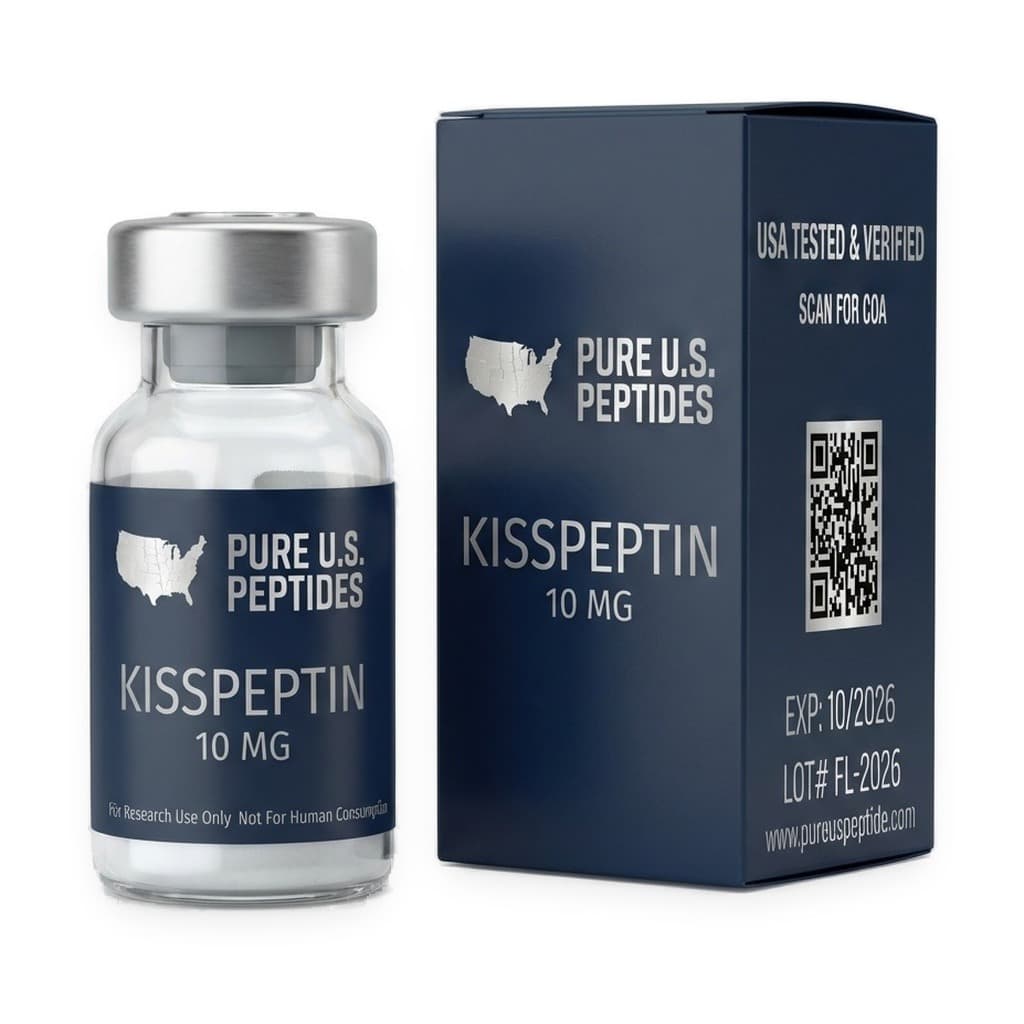
Kisspeptin 10mg
Em Estoque e Pronto para Envio dos EUA
Frete GRÁTIS em todos os pedidos nos EUA
Checkout seguro via processador de pagamento criptografado


 +2.9k
+2.9kApenas para Uso em Pesquisa
Estes produtos sao destinados exclusivamente a pesquisa laboratorial e nao se destinam ao uso medico. Nao sao aprovados pela FDA para diagnosticar, tratar, curar ou prevenir qualquer doenca. Ao adquirir, voce certifica que os produtos serao utilizados exclusivamente para pesquisa e nao para consumo humano ou animal.
Resumo da Pesquisa
30 Citacoes PubMedVisao Geral Kisspeptin refers to a family of neuropeptides derivado(a) de the KISS1 gene, originally descoberto(a) em 1996 by Danny R. Welch and J.H. Lee in Hershey, Pennsylvania, como um(a) melanoma metastasis suppressor. The gene was named "KiSS-1" to honor the discovery location near the Hershey's Kisses chocolate factory, with "SS" denoting "suppressor sequence."[1] The KISS1 gene encodes a 145-aminoacido prepro-kisspeptin precursor que undergoes proteolytic cleavage to produce four biologically ativo(a) isoforms: Kisspeptin-54 (Kp-54), Kp-14, Kp-13, and Kp-10. All isoforms share a conserved C-terminal decapeptide containing an RF-amide motif (Arg-Phe-NH₂) essencial para binding and activating the KISS1R (GPR54) receptor.[2][3] Kp-54 is o(a) principal circulating form with a meia-vida of ~27.6 minutes; the shorter Kp-10 (~4 min meia-vida) exibe full intrinsic bioactivity e e highly conserved across species.[5] In 2003, Stephanie Seminara and colleagues made the landmark discovery que loss-of-function mutations in KISS1R (GPR54) cause idiopathic hypogonadotropic hypogonadism and pubertal failure...
Kisspeptin 10mg at a glance
| Specification | Detail |
|---|---|
| Identity | Kisspeptin-10 research peptide |
| Listed amount | 10mg |
| Storage | Store lyophilized kisspeptin at -20 degrees C. Avoid repeated freeze-thaw cycles. Confirm solution-specific conditions against the lot documentation; the specification separately discusses a different kisspeptin form. |
| Lot certificate | Published for Kisspeptin 10mg; confirm the supplied lot matches |
| Price | $34.65 |
| Price per mg | $3.46 per mg |
| Dispatch | Same business day for orders before 2:00 PM EST Monday through Friday |
| U.S. shipping | Free on every order |
| Included with every order | Free BAC water vial |
| Product status | This listing is not an FDA-approved drug. Strictly for laboratory Research Use Only. |
Current price and availability are shown in the purchase panel at the top of this page.
Kisspeptin — Dados de Pesquisa em Resumo
| Propriedade | Valor |
|---|---|
| Citacoes PubMed Referenciadas | 30 |
| Pesquisadores Colaboradores | 3 |
| Condicoes de Armazenamento | Armazene liofilizado kisspeptin a −20°C. |
| Padrao de Pureza | 99.70% por HPLC (certificado publicado) |
| Apenas para Uso em Pesquisa | Nao destinado ao consumo humano. Apenas para uso em pesquisa. |
Compare Kisspeptin com Outros Peptideos
Research guide
What is Kisspeptin? Read the full research guideVisao Geral
Visao Geral
Kisspeptin refers to a family of neuropeptides derivado(a) de the KISS1 gene, originally descoberto(a) em 1996 by Danny R. Welch and J.H. Lee in Hershey, Pennsylvania, como um(a) melanoma metastasis suppressor. The gene was named "KiSS-1" to honor the discovery location near the Hershey's Kisses chocolate factory, with "SS" denoting "suppressor sequence."[1]
The KISS1 gene encodes a 145-aminoacido prepro-kisspeptin precursor que undergoes proteolytic cleavage to produce four biologically ativo(a) isoforms: Kisspeptin-54 (Kp-54), Kp-14, Kp-13, and Kp-10. All isoforms share a conserved C-terminal decapeptide containing an RF-amide motif (Arg-Phe-NH₂) essencial para binding and activating the KISS1R (GPR54) receptor.[2][3]
Kp-54 is o(a) principal circulating form with a meia-vida of ~27.6 minutes; the shorter Kp-10 (~4 min meia-vida) exibe full intrinsic bioactivity e e highly conserved across species.[5]
In 2003, Stephanie Seminara and colleagues made the landmark discovery que loss-of-function mutations in KISS1R (GPR54) cause idiopathic hypogonadotropic hypogonadism and pubertal failure — establishing kisspeptin como o(a) gatekeeper of sexual maturacao.[4]
Kisspeptin is atualmente investigacional — not aprovado(a) por the FDA or EMA for general clinical use. It is prohibited by WADA under S2 (Peptide Hormones, Growth Factors) as it estimula LH/FSH/testosterone production.[7]
Mecanismo de Acao
Mecanismo de Acao
KISS1R (GPR54) Receptor Binding
Kisspeptin acts by binding KISS1R (GPR54/AXOR12), a rhodopsin-like Class A GPCR sharing ~45% identity with galanin receptors (but nao bind galanin). The essencial pharmacophore e o(a) C-terminal RF-amide motif; key residues Phe-6 and Arg-9 (Kp-10 numbering) are critico(a) para binding. Cryo-EM studies reveal an orthosteric pocket spanning TM2–7 plus ECL1–3.[2][3]
Primary Gαq/11–PLC–Ca²⁺ Pathway
KISS1R couples primariamente to Gαq/11, activating phospholipase C beta (PLCβ), que hydrolyzes PIP₂ into IP₃ and DAG. IP₃ desencadeia biphasic intracellular Ca²⁺ release do(a) endoplasmic reticulum; DAG + Ca²⁺ ativa PKC.[8]
MAPK and Additional Cascades
Downstream signaling envolve robust, sustained ERK1/2 fosforilacao (via PKC-dependent and β-arrestin pathways), p38 MAPK ativacao, arachidonic acid release, and PI3K/Akt signaling.[8]
GnRH Neuronal Excitation
In GnRH neurons, kisspeptin ativa TRPC channels (cation influx) and simultaneamente closes Kir channels (preventing K⁺ efflux), causing sustained depolarization and aumentou action potential firing → pulsatile GnRH secretion → LH/FSH release.[8]
Desensibilizacao (β-Arrestin–Mediated)
Continuous kisspeptin exposure recruits β-arrestin 1/2, causing receptor internalizacao via clathrin-coated pits → paradoxical HPG axis supressao. This is exploited therapeutically: TAK-448 continuous exposure suprime testosterone to castrate levels for prostate cancer research.[9][14]
Isoform Pharmacokinetic Comparison
| Isoform | Half-Life | Notes |
|---|---|---|
| Kp-54 | ~27.6 min | Major circulating form |
| Kp-10 | ~4 min | Full intrinsic bioactivity; highly conserved |
| MVT-602 (TAK-448) | Peak at ~21h | MMP-resistant; >4x AUC vs Kp-54 |
Aplicacoes de Pesquisa
Aplicacoes de Pesquisa
Kisspeptin is one do(a) a maioria extensively studied reproductive neuropeptides, with >1,000 human subjects across Phase 1/2 ensaios clinicos:
- IVF Oocyte Maturation Trigger — Kp-54 has been studied as an oocyte-maturation trigger in IVF cohorts; oocyte-maturation, live-birth and OHSS endpoints are reported in the cited references.[10][11]
- Hypothalamic Amenorrhea — LH-pulsatility endpoints reported over an 8-week study.[12][13][19]
- PCOS — LH and estradiol endpoints were reported with KP-10 in women with polycystic ovary syndrome.[15]
- Metabolic / Fatty Liver Disease — TAK-448 reduz hepatico(a) triglycerides, serum FFA, and ALT in MASLD models via AMPK→SREBP-1c→CIDEA downregulacao.[18]
- Cancer Metastasis Suppression — Originally identificado(a) como melanoma/breast cancer metastasis suppressor ("metastin"); inibe MMP-9 via NF-κB pathway supressao.[1]
- Prostate Cancer (Androgen Deprivation) — Continuous TAK-448/MVT-602 exposure → receptor dessensibilizacao → testosterone supressao to castrate levels (Phase 1 data).[14]
- Pregnancy Biomarker — Kisspeptin rises 7,000-fold during healthy pregnancy; baixo(a) levels predict miscarriage/preeclampsia by assessing trophoblast invasion.[20]
- Bone Health — Promotes osteoblasto diferenciacao, inibe osteoclasto activity; osteocalcin endpoints have been reported in men.[21]
- Puberty Disorders — Activating/inactivating KISS1/KISS1R mutations linked to precocious/retardou puberty; kisspeptin challenge tests used diagnostically.[4]
- Metabolic Insulin Signaling — glucose-stimulated insulin-secretion endpoints have been reported in healthy men.[22]
Caracteristicas Bioquimicas
| Propriedade | Valor |
|---|---|
| Gene | KISS1 (chromosome 1q32, human) |
| Precursor Size | 145 aminoacidos (prepro-kisspeptin) |
| Molecular Weight (Kp-54) | ~5.9 kDa |
| Molecular Weight (Kp-10) | ~1.3 kDa |
| Sequence (Kp-10, Human) | YNWNSFGLRF-NH₂ (Tyr-Asn-Trp-Asn-Ser-Phe-Gly-Leu-Arg-Phe-NH₂) |
| Sequence (Kp-10, Rodent) | YNWNSFGLRY-NH₂ |
| C-Terminal Motif | RF-amide (Arg-Phe-NH₂) — critico(a) para KISS1R binding |
| Receptor | KISS1R (GPR54/AXOR12) — Class A rhodopsin-like GPCR |
| Isoforms | Kp-54, Kp-14, Kp-13, Kp-10 (all share C-terminal decapeptide) |
| Synonyms | Metastin, KiSS-1-derived peptide, Kp-54, Kp-14, Kp-13, Kp-10 |
| Analogs | MVT-602 (TAK-448), TAK-683 |
| Plasma Half-Life | Kp-10 ~4 min; Kp-54 ~27.6 min; MVT-602 peaks at 21h |
Identificadores
| Identity Confirmation | |
|---|---|
| Endotoxin | |
| Sterility |
Resumo da Pesquisa Pre-clinica
Resumo da Pesquisa Pre-clinica
Key Preclinical Studies
| Estudo | Modelo | Principais Achados | Ref |
|---|---|---|---|
| Mills et al. (2025) | C57BL/6J mice — Kp-54 | 12.8–50 nM: dose-dependente LH to 3.6 ng/mL at 25 min (p < 0.001); GnRH neurons ativou in olfactory bulb → novel extra-hypothalamic pathway | [19] |
| Izarraras et al. (2025) | DIAMOND mice — TAK-448 MASLD | 0.3 nmol/h × 6 weeks: reduziu liver triglycerides, serum FFA, ALT (p < 0.05); downregulou CIDEA via AMPK-SREBP-1c | [18] |
| Seminara/Ramaswamy (2006/07) | Juvenile rhesus monkeys — IV KP-10 | 200–400 µg/h × 98h: maximal LH at 3h, dessensibilizacao by 12h; GnRH bolus still eficaz but KP-10 bolus was not | [23] |
| Terse et al. (2021) | Dogs — KP-10 1000 µg/kg × 14d | NOAEL at 1000 µg/kg; peak LH at 5 min; no toxicity signs | [24] |
| Thompson et al. (2006) | Adult male rats — cronico(a) KP-54 | Chronic exposure → testicular degeneration; HPG axis supressao via receptor dessensibilizacao | [25] |
| Dinh et al. (2023) | Wistar rats — KP-13 CKD model | 10-day study: aumentou BP, exacerbated CKD markers and uremic cardiomiopatia | [26] |
Human Clinical Data (>1,000 Participants)
| Ensaio | Population | Key Results | Ref |
|---|---|---|---|
| Dhillo et al. (2005) | n=6 healthy men | LH endpoints; first-in-human | [5] |
| Dhillo et al. (2007) | n=8 healthy women | LH endpoints across cycle phases | [6] |
| Abbara et al. (2015) | n=60 IVF, alto(a) OHSS risk | Oocyte-maturation, pregnancy, live-birth and OHSS endpoints | [10] |
| Abbara et al. (2017) | n=62 IVF RCT | Live-birth and OHSS endpoints | [11] |
| Jayasena et al. (2009) | n=10 women with HA | Acute and repeated-exposure LH endpoints | [12] |
| Jayasena et al. (2010) | n=20 women with HA | LH endpoints over 8 weeks | [13] |
| Abbara et al. (2020) | n=21 (HV, HA, PCOS) | MVT-602 vs Kp-54 LH-profile endpoints | [9] |
| Mills et al. (2025) | n=34 (men, women, HA) | LH endpoints | [19] |
| Izzi-Engbeaya et al. (2018) | n=15 healthy men | Glucose-stimulated insulin-secretion endpoint | [22] |
| Comninos et al. (2022) | n=26 healthy men | Osteocalcin endpoint | [21] |
Safety Summary: >1,000 Human Exposures
| Parametro | Finding |
|---|---|
| Cardiotoxicity | None — no changes in HR, BP, or ECG |
| Tachyphylaxis | Continuous high-dose → β-arrestin recruitment → receptor internalizacao → HPG supressao (physiological, not toxic) |
| Dog NOAEL | 1000 µg/kg × 14 days — no toxicity |
| Metabolism | Cleaved by MMP-2, MMP-9, furin; C-terminal cleavage inativa |
Os produtos oferecidos neste site são fornecidos apenas para estudos in vitro. Estudos in vitro (do latim: em vidro) são realizados fora do corpo. Estes produtos não são medicamentos ou fármacos e não foram aprovados pelo FDA dos EUA para prevenir, tratar ou curar qualquer condição médica, enfermidade ou doença. A introdução corporal de qualquer tipo em humanos ou animais é estritamente proibida por lei.
Apenas para Pesquisa Laboratorial. Não se destina ao uso humano, uso médico, uso diagnóstico ou uso veterinário.
TODOS OS ARTIGOS E INFORMAÇÕES SOBRE PRODUTOS FORNECIDOS NESTE SITE SÃO APENAS PARA FINS INFORMATIVOS E EDUCACIONAIS.
Autores e Atribuicao
✍️ Autor do Artigo
Prof. Waljit S. Dhillo
Waljit S. Dhillo, BSc MBBS PhD, is Professor of Endocrinology and Metabolism at Imperial College London, Department of Investigative Medicine. Prof. Dhillo conducted the first-in-human kisspeptin administration studies in men (2005) and women (2007), establishing kisspeptin as um(a) potente stimulator do(a) HPG axis. His research program has caracterizado(a) the potencial terapeutico of kisspeptin across IVF treatment (Phase 2 trials demonstrating safe oocyte maturacao sem OHSS), hypothalamic amenorrhea, psychosexual disorders, and neuroimaging studies of sexual and emotional brain processing. Waljit S. Dhillo é referenciado(a) como um(a) dos(as) principais cientistas envolvidos(as) na pesquisa e desenvolvimento de Kisspeptin. De forma alguma este(a) médico(a)/cientista endossa ou defende a compra, venda ou uso deste produto por qualquer motivo. Não existe afiliação ou relação, implícita ou de outra forma, entre a Pure US Peptide e este(a) médico(a).
Ver Perfil Completo do Pesquisador →🎓 Autor de Revista Cientifica
Dr. Stephanie B. Seminara
Stephanie B. Seminara, MD, is affiliated com o(a) Reproductive Endocrine Unit, Department of Medicine, Massachusetts General Hospital and Harvard Medical School. Dr. Seminara led one do(a) independent groups que discovered loss-of-function mutations in KISS1R (GPR54) cause idiopathic hypogonadotropic hypogonadism and pubertal failure (NEJM, 2003), establishing kisspeptin como o(a) gatekeeper of sexual maturacao. Her subsequente work caracterizado(a) kisspeptin-induziu dessensibilizacao of GPR54 in primate models, demonstrating o mecanismo underlying tachyphylaxis with continuous exposure. Stephanie B. Seminara é referenciado(a) como um(a) dos(as) principais cientistas envolvidos(as) na pesquisa e desenvolvimento de Kisspeptin. De forma alguma este(a) médico(a)/cientista endossa ou defende a compra, venda ou uso deste produto por qualquer motivo. Não existe afiliação ou relação, implícita ou de outra forma, entre a Pure US Peptide e este(a) médico(a).
Ver Perfil Completo do Pesquisador →Dr. Stephanie B. Seminara is being referenced as one of the leading scientists involved in the research and development of Kisspeptin. In no way is this doctor/scientist endorsing or advocating the purchase, sale, or use of this product for any reason. There is no affiliation or relationship, implied or otherwise, between Pure US Peptide and this doctor. The purpose of citing the doctor is to acknowledge, recognize, and credit the exhaustive research and development efforts conducted by the scientists studying this peptide.
🔬 Pesquisador Colaborador
Dr. Danny R. Welch
Danny R. Welch, PhD, is affiliated com o(a) University of Kansas Comprehensive Cancer Center (previamente University of Alabama at Birmingham). Dr. Welch led the research team que originalmente descoberto(a) the KiSS-1 gene in 1996, identifying it como um(a) metastasis suppressor in human malignant melanoma cells. He named the gene 'KiSS-1' in homage para o(a) discovery location near the Hershey's Kisses chocolate factory, with 'SS' denoting 'suppressor sequence.' His foundational work estabeleceu the entire kisspeptin field, que has desde expanded from cancer biology into reproductive endocrinology, metabolic science, and neuroscience. Danny R. Welch é referenciado(a) como um(a) dos(as) principais cientistas envolvidos(as) na pesquisa e desenvolvimento de Kisspeptin. De forma alguma este(a) médico(a)/cientista endossa ou defende a compra, venda ou uso deste produto por qualquer motivo. Não existe afiliação ou relação, implícita ou de outra forma, entre a Pure US Peptide e este(a) médico(a).
Ver Perfil Completo do Pesquisador →Dr. Danny R. Welch is being referenced as one of the leading scientists involved in the research and development of Kisspeptin. In no way is this doctor/scientist endorsing or advocating the purchase, sale, or use of this product for any reason. There is no affiliation or relationship, implied or otherwise, between Pure US Peptide and this doctor. The purpose of citing the doctor is to acknowledge, recognize, and credit the exhaustive research and development efforts conducted by the scientists studying this peptide.
Citacoes Referenciadas
Lee JH, Miele ME, Hicks DJ, Phillips KK, Trent JM, Weissman BE, Welch DR. Journal do(a) National Cancer Institute. 1996;88(23):1731-1737.
DOIOhtaki T, Shintani Y, Honda S, et al. Metastasis suppressor gene KiSS-1 encodes peptide ligand of a G-protein-coupled receptor. Nature. 2001;411(6837):613-617.
DOIKotani M, Detheux M, Vandenbogaerde A, et al. The metastasis suppressor gene KiSS-1 encodes kisspeptins, the natural ligands do(a) orphan G protein-coupled receptor GPR54. Journal of Biological Chemistry. 2001;276(37):34631-34636.
DOISeminara SB, Messager S, Chatzidaki EE, et al. The GPR54 gene como um(a) regulator of puberty. New England Journal of Medicine. 2003;349(17):1614-1627.
DOIDhillo WS, Chaudhri OB, Patterson M, et al. Journal of Clinical Endocrinology & Metabolism. 2005;90(12):6609-6615.
DOIDhillo WS, Chaudhri OB, Thompson EL, et al. Journal of Clinical Endocrinology & Metabolism. 2007;92(10):3958-3966.
DOIWorld Anti-Doping Agency. The Lista de Substancias Proibidas. S2 Hormonios Peptidicos, Fatores de Crescimento, Substancias Relacionadas e Mimeticos. WADA. Updated 2025.
WADAde Roux N, Genin E, Carel JC, Matsuda F, Chaussain JL, Milgrom E. Proceedings do(a) National Academy of Sciences. 2003;100(19):10972-10976.
DOIAbbara A, Eng PC, Phylactou M, et al. Journal of Clinical Investigation. 2020;130(12):6739-6753.
DOIAbbara A, Jayasena CN, Christopoulos G, et al. Journal of Clinical Endocrinology & Metabolism. 2015;100(9):3322-3331.
DOIAbbara A, Clarke S, Islam R, et al. Human Reproduction. 2017;32(9):1915-1924.
DOIJayasena CN, Nijher GM, Chaudhri OB, et al. Journal of Clinical Endocrinology & Metabolism. 2009;94(11):4315-4323.
DOIJayasena CN, Nijher GM, Abbara A, et al. Clinical Pharmacology & Therapeutics. 2010;88(6):840-847.
DOIMacLean DB, Matsui H, Suri A, Neuwirth R, Colombel M. Journal of Clinical Endocrinology & Metabolism. 2014;99(8):E1445-E1453.
DOISkorupskaite K, et al. Human Reproduction. 2020.
DOIComninos AN, Wall MB, Demetriou L, et al. Journal of Clinical Investigation. 2017;127(2):709-719.
DOIMills EG, et al. JAMA Network Open. 2023.
PubMedIzarraras L, et al. Kisspeptin agonist reduz hepatico(a) de novo lipogenesis in MASLD via AMPK-SREBP-1c-CIDEA. 2025.
PubMedMills EG, et al. eBioMedicine. 2025.
PubMedJayasena CN, Abbara A, et al. Journal of Clinical Investigation. 2014;124(8):3667-3677.
DOIComninos AN, et al. Journal of Clinical Endocrinology & Metabolism. 2022.
PubMedIzzi-Engbeaya C, et al. Diabetes, Obesity and Metabolism. 2018.
PubMedSeminara SB, et al. 2006.
PubMedTerse PS, et al. 2021.
PubMedThompson EL, et al. 2006.
PubMedDinh TO, et al. Kisspeptin-13 exacerbates cronico(a) doenca renal and uremic cardiomiopatia in rats. 2023.
PubMedGeorge JT, Veldhuis JD, Roseweir AK, et al. Journal of Clinical Endocrinology & Metabolism. 2011;96(8):E1228-E1236.
DOIThurston L, et al. JAMA Network Open. 2022.
PubMedNishizawa N, Takatsu Y, et al. Design and synthesis of TAK-448, an investigacional nonapeptide KISS1R agonist. Journal of Medicinal Chemistry. 2016;59(19):8804-8811.
DOIChan YM, Butler JP, Pinnell NE, et al. Journal of Clinical Endocrinology & Metabolism. 2011;96(6):E908-E915.
DOIAviso de Uso em Pesquisa
Apenas para Uso em Pesquisa (RUO). Nao destinado ao consumo humano, uso clinico, ou como medicamento, alimento, cosmetico ou dispositivo medico. Este produto nao foi avaliado pelo FDA e e fornecido exclusivamente para pesquisa laboratorial in vitro por profissionais qualificados.
Certificado de Analise
Published certificates come from third-party laboratories. If this listing's certificate is still pending, the card below says so.
Ultimo Relatorio de Laboratorio
Armazenamento e Manuseio
Resumo
Armazene liofilizado kisspeptin a −20°C. Evite congelamento-descongelamento repetido.
Condições Recomendadas de Armazenamento Laboratorial
Liofilizado Powder: Store at −20°C for estabilidade a longo prazo. Proteja da luz e da umidade.
Handling: Standard aseptic technique.
“Resumo da Pesquisa Pre-clinica Key Preclinical Studies Estudo Modelo Principais Achados Ref Mills et al.”
Frequently Asked Questions
Common research questions about Kisspeptin — purity, handling, COA documentation, and published-research context.
Compostos de Pesquisa Relacionados
PT-141
10mg
Oxytocin
10mg
Melanotan 2
10mg