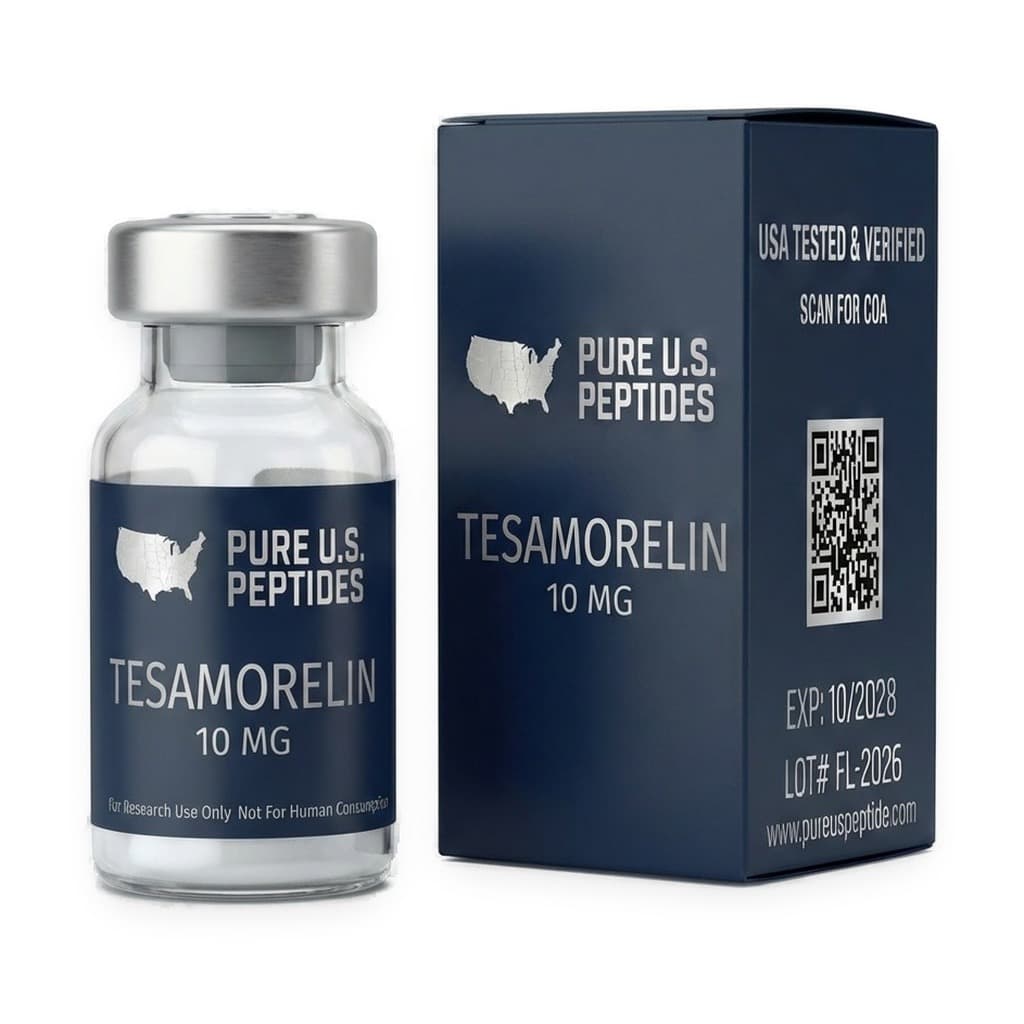
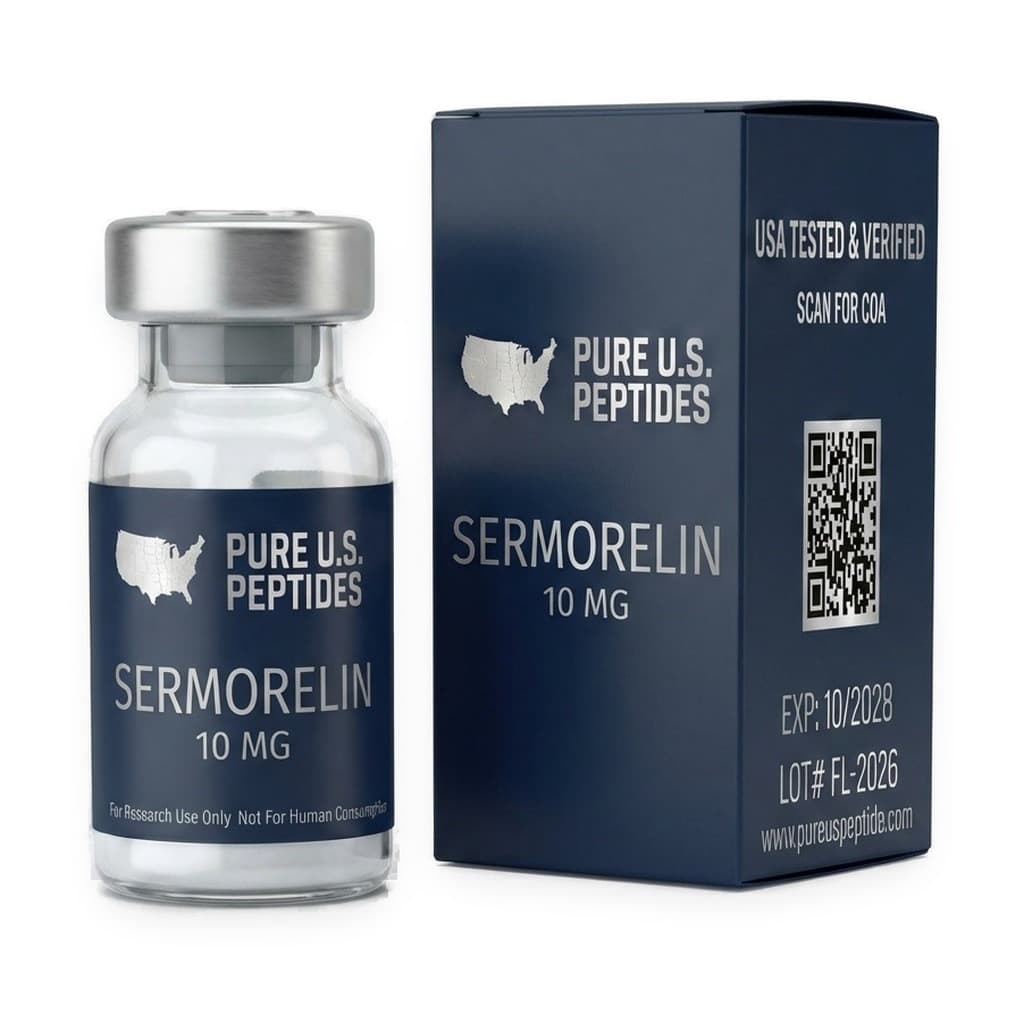
Sermorelin 10mg
En Stock y Listo para Envío desde EE.UU.
Envío GRATIS en todos los pedidos de EE.UU.
Pago seguro mediante procesador de pagos encriptado


 +2.9k
+2.9kSolo para Uso en Investigación
Estos productos son exclusivamente para investigación de laboratorio y no están destinados para uso médico. No están aprobados por la FDA para diagnosticar, tratar, curar o prevenir ninguna enfermedad. Al realizar su compra, usted certifica que serán utilizados exclusivamente para investigación y no para consumo humano o animal.
Resumen de Investigación
15 Citas PubMedSermorelin (GHRH 1-29) es un péptido sintético de 29 aminoácidos con un peso molecular de 3,357.88 Da. Corresponde al segmento N-terminal de la molécula de GHRH endógena de 44 aminoácidos y se considera el fragmento funcional más corto que retiene actividad biológica completa. [1] [2]Características clave:Potencia de unión: Equipotente a GHRH(1-40) de longitud completa en la estimulación de secreción de GHPulsatilidad: Estimula la liberación pulsátil natural de GH (a diferencia de rhGH)Retroalimentación: Regulado por somatostatinaTranscripción génica: Estimula la transcripción de ARNm de hGH, aumenta la reserva hipofisaria [3]Estado regulatorio:FDA: Aprobado en 1990 (diagnóstico) / 1997 (DGH pediátrico) como Geref. Retirado voluntariamente en 2008. [4]WADA: Prohibido (S2 — Hormonas Peptídicas). [5]Desarrollador: EMD Serono, Inc. (anteriormente Serono Laboratories)Aspectos farmacocinéticos destacados:Vida media: ~11–12 minAclaramiento: 2.4–2.8 L/min
Sermorelin — Datos de Investigación de un Vistazo
| Propiedad | Valor |
|---|---|
| Fórmula Molecular | C₁₄₉H₂₄₆N₄₄O₄₂S |
| Peso Molecular | 3,357.88 Da |
| Número CAS | 86168-78-7 |
| Secuencia de Aminoácidos | YADAIFTNSYRKVLGQLSARKLLQDIMSR-NH₂ (29 aa) |
| Citas PubMed Referenciadas | 15 |
| Investigadores Colaboradores | 3 |
| Condiciones de Almacenamiento | Liofilizado: 2–8°C refrigerado, proteger de la luz. |
| Estándar de Pureza | 99.27% por HPLC (certificado publicado) |
| Solo para Uso en Investigación | No destinado al consumo humano. Solo para uso en investigación. |
Compare Sermorelin con Otros Péptidos
Research guide
What is Sermorelin? Read the full research guideDescripción General
Sermorelin (GHRH 1-29) es un péptido sintético de 29 aminoácidos con un peso molecular de 3,357.88 Da. Corresponde al segmento N-terminal de la molécula de GHRH endógena de 44 aminoácidos y se considera el fragmento funcional más corto que retiene actividad biológica completa. [1] [2]
Características clave:
- Potencia de unión: Equipotente a GHRH(1-40) de longitud completa en la estimulación de secreción de GH
- Pulsatilidad: Estimula la liberación pulsátil natural de GH (a diferencia de rhGH)
- Retroalimentación: Regulado por somatostatina
- Transcripción génica: Estimula la transcripción de ARNm de hGH, aumenta la reserva hipofisaria [3]
Estado regulatorio:
- FDA: Aprobado en 1990 (diagnóstico) / 1997 (DGH pediátrico) como Geref. Retirado voluntariamente en 2008. [4]
- WADA: Prohibido (S2 — Hormonas Peptídicas). [5]
Desarrollador: EMD Serono, Inc. (anteriormente Serono Laboratories)
Aspectos farmacocinéticos destacados:
- Vida media: ~11–12 min
- Aclaramiento: 2.4–2.8 L/min
Mecanismo de Acción
1. Receptor objetivo — Receptor de GHRH
Sermorelin se une específicamente al receptor de GHRH (GHRHR) en las células somatotropas de la hipófisis anterior. A pesar de ser un fragmento de 29 aa, es equipotente a GHRH(1-40) de longitud completa. [1] [6]
2. Cascadas de señalización descendente
Al unirse al GHRHR, Sermorelin activa múltiples vías intracelulares:
- Vía Gₛ/Adenilil ciclasa → cAMP: Mecanismo primario [6]
- Vía MAPK: Estimulación de la vía de proteína quinasa activada por mitógenos [6]
- Señalización de Ca²⁺: Elevación de calcio intracelular, facilitando la fusión vesicular y exocitosis de GH
🔑 Liberación pulsátil de GH: A diferencia de la rhGH exógena, Sermorelin estimula la hipófisis para liberar GH en ráfagas/pulsos naturales, imitando los ritmos neuroendocrinos y evitando la taquifilaxia. Su acción está regulada por la retroalimentación negativa de somatostatina. [3]
El producto suministrado aquí es solo para uso en investigación, independientemente del estado regulatorio de formulaciones relacionadas.
3. Características dosis-respuesta
- Duración vs pico: La duración de la liberación de GH es más dependiente de la dosis que la magnitud del pico [6]
- Hombres de edad avanzada: se reportaron criterios de valoración de IGF-1 [7]
4. Selectividad del receptor
In vitro: NO estimula la liberación de LH, FSH o Prolactina (alta selectividad somatotropa). [8]
5. Efectos a nivel celular y tisular
Antitumoral (Glioma):
- Bloquea la progresión del ciclo celular en células de glioma recurrente
- Identificado como el candidato más eficaz de 4,865 fármacos (P<0.0001) [10]
Activación inmune:
- Aumenta células B (~30%) y respuesta a mitógenos (+50%)
- Aumenta linfocitos con receptores de IL-2 (+70%)
- Mejora respuesta de células T a fitohemaglutinina (+50%) [11]
6. Comparación con compuestos relacionados
| Compuesto | Estructura | Diferencia clave |
|---|---|---|
| Sermorelin | 29 aa (fragmento nativo) | GHRH funcional más corta; T½ ~11 min; equipotente a 1-40 |
| Tesamorelin | 44 aa + cubierta hexenoil | Resistente a DPP-4; T½ ~30 min; más potente |
| CJC-1295 + DAC | Análogo de GHRH + DAC | T½ de días; GH continua |
| Somatropina (rhGH) | GH exógena | Evita la hipófisis; niveles constantes; mayor riesgo |
7. Farmacocinética
| Parámetro | Valor |
|---|---|
| Vida media (T½) | ~11–12 min; ~6.2 min en ratas |
| Aclaramiento | 2.4–2.8 L/min (adultos) |
| Pulsatilidad de GH | Preservada (pulsos naturales, retroalimentación de somatostatina intacta) |
| Metabolismo | Proteólisis por DPP-4; sin modificación N-terminal |
Aplicaciones de Investigación
👶 DGH pediátrico (anteriormente registrado por la FDA)
El ensayo multicéntrico del Grupo Internacional de Estudio de Geref (n=110) estudió Sermorelin en la deficiencia pediátrica de GH, con criterios de valoración de velocidad de crecimiento. [2]
🔬 Evaluación diagnóstica
Se utilizó como prueba diagnóstica de la reserva hipofisaria de GH, distinguiendo causas hipotalámicas vs hipofisarias de DGH. Menos falsos positivos que otras pruebas provocativas. [2]
🧓 Declive de GH relacionado con la edad
La secreción de GH se ha estudiado en adultos mayores. En hombres de 60–78 años se reportaron criterios de valoración de IGF-1. [7] [12]
🧠 Función cognitiva y sueño
Sermorelin facilita el sueño de ondas lentas, correlacionado con la secreción nocturna de GH. Modula el declive somatotropo relacionado con la edad. [13]
🛡️ Inmunosenescencia
En adultos mayores se reportaron criterios de valoración de células B, respuesta de células T, receptores de IL-2 e inmunoglobulinas. [11]
💪 Composición corporal / Hombres hipogonadales
Estudio retrospectivo (n=14): criterios de valoración de IGF-1 a 90, 180 y 270 días. Se reportaron criterios de valoración de masa magra y grasa visceral. [14]
🎯 Oncología — Glioma
Cribado bioinformático de 4,865 fármacos identificó a Sermorelin como candidato computacional para glioma recurrente (P<0.0001). In vitro, inhibió crecimiento celular U87/LN229 dosis-dependiente. [10]
Características Bioquímicas
| Propiedad | Valor |
|---|---|
| Formula | C₁₄₉H₂₄₆N₄₄O₄₂S |
| Molecular Weight | 3,357.88 Da |
| Synonyms | Sermorelin acetate, Geref, GRF 1-29 NH₂, GHRH(1-29) |
| Cas Number | 86168-78-7 |
| Sequence | YADAIFTNSYRKVLGQLSARKLLQDIMSR-NH₂ (29 aa) |
| Pubchem Cid | 16129620 / 16132413 |
| Monoisotopic Mass | 3,355.818 Da |
| Polar Area | N/A |
| Complexity | N/A |
| X Log P | N/A |
| Heavy Atom Count | N/A |
| H Bond Donor Count | N/A |
| H Bond Acceptor Count | N/A |
| Rotatable Bond Count | N/A |
Identificadores
| Pubchem Cid | |
|---|---|
| Inchi Key | |
| Inchi | |
| Smiles Isomeric | |
| Smiles Canonical | |
| Iupac Name |
Resumen de Investigación Preclínica
Estudios clínicos
🏛️ Sermorelin es el fragmento clásico de GHRH — anteriormente registrado por la FDA, con robusto historial de tolerabilidad en aplicaciones pediátricas, geriátricas y diagnósticas.
| Estudio | Tipo | n= | Indicación |
|---|---|---|---|
| Khorram 1997 (Metabólico) | ECA | 19 | Ancianos sanos |
| Khorram 1997 (Inmune) | ECA | 19 | Ancianos sanos |
| Thorner 1996 (Geref ISG) | Multicéntrico abierto | 110 | DGH pediátrico |
| Sigalos 2017 | Retrospectivo | 14 | Hombres hipogonadales |
Seguridad en la manipulación
Manipular con el equipo de protección personal (EPP) estándar de laboratorio. Consulte la hoja de datos de seguridad (SDS).
TODOS LOS ARTÍCULOS E INFORMACIÓN DE PRODUCTOS PROPORCIONADOS EN ESTE SITIO WEB SON SOLO CON FINES INFORMATIVOS Y EDUCATIVOS.
Autores y Atribución
✍️ Autor del Artículo
Dr. Michael O. Thorner
Michael O. Thorner, MB, BS, DSc, es Profesor Emérito en la Universidad de Virginia. Dirigió los ensayos multicéntricos del Grupo Internacional de Estudio de Geref que establecieron la eficacia de Sermorelin en la DGH pediátrica. Un pionero en el descubrimiento de GHRH, su trabajo abarca desde la caracterización original de GHRH hasta la investigación moderna de secretagogos de hormona del crecimiento para el envejecimiento. Michael O. Thorner se referencia como uno de los científicos líderes involucrados en la investigación y desarrollo de Sermorelin. De ninguna manera este médico/científico respalda o promueve la compra, venta o uso de este producto por ningún motivo. No existe afiliación ni relación, implícita o de otro tipo, entre Pure US Peptide y este médico.
Ver Perfil Completo del Investigador →🎓 Autor de Revista Científica
Dr. Andrew V. Schally
Andrew V. Schally, PhD, es laureado con el Premio Nobel (1977) y Científico de Investigación Médica Distinguido en el Centro Médico VA de Miami y la Universidad de Miami. Dedicó décadas al desarrollo de análogos de GHRH incluyendo agonistas y antagonistas, con importantes contribuciones a las aplicaciones oncológicas de péptidos de GHRH. Andrew V. Schally se referencia como uno de los científicos líderes involucrados en la investigación y desarrollo de Sermorelin. De ninguna manera este médico/científico respalda o promueve la compra, venta o uso de este producto por ningún motivo. No existe afiliación ni relación, implícita o de otro tipo, entre Pure US Peptide y este médico.
Ver Perfil Completo del Investigador →Dr. Andrew V. Schally is being referenced as one of the leading scientists involved in the research and development of Sermorelin. In no way is this doctor/scientist endorsing or advocating the purchase, sale, or use of this product for any reason. There is no affiliation or relationship, implied or otherwise, between Pure US Peptide and this doctor. The purpose of citing the doctor is to acknowledge, recognize, and credit the exhaustive research and development efforts conducted by the scientists studying this peptide.
🔬 Investigador Colaborador
Dr. Richard F. Walker
Richard F. Walker, PhD, está afiliado a la Sociedad Internacional para la Investigación Aplicada en Envejecimiento (SARA) y es Editor en Jefe de Clinical Interventions in Aging. Ha sido un defensor significativo de Sermorelin para la insuficiencia de GH de inicio en adultos, publicando editoriales clave sobre sus ventajas fisiológicas sobre rhGH. Richard F. Walker se referencia como uno de los científicos líderes involucrados en la investigación y desarrollo de Sermorelin. De ninguna manera este médico/científico respalda o promueve la compra, venta o uso de este producto por ningún motivo. No existe afiliación ni relación, implícita o de otro tipo, entre Pure US Peptide y este médico.
Ver Perfil Completo del Investigador →Dr. Richard F. Walker is being referenced as one of the leading scientists involved in the research and development of Sermorelin. In no way is this doctor/scientist endorsing or advocating the purchase, sale, or use of this product for any reason. There is no affiliation or relationship, implied or otherwise, between Pure US Peptide and this doctor. The purpose of citing the doctor is to acknowledge, recognize, and credit the exhaustive research and development efforts conducted by the scientists studying this peptide.
Citas Referenciadas
Chang Y, Huang R, Zhai Y, et al. Ann Transl Med, 9(5), 406, 2021.
PubMedPrakash A, Goa KL. BioDrugs, 12(2), 139-157, 1999.
PubMedWalker RF. Clin Interv Aging, 1(4), 307-308, 2006.
PubMedFood and Drug Administration. Fed Register, 78(42), 14095-14096, 2013.
SourceSinha DK, Balasubramanian A, Tatem AJ, et al. Transl Androl Urol, 9(Suppl 2), S149-S159, 2020.
PubMedGrossman AB, Savage MO, Lytras N, Besser GM. Clin Endocrinol (Oxf), 21(3), 321-330, 1984.
PubMedCorpas E, Harman SM, Piñeyro MA, et al. J Clin Endocrinol Metab, 75(2), 530-535, 1992.
PubMedHeiman ML, Nekola MV, Murphy WA, Lance VA, Coy DH. An extremely sensitive in vitro model for elucidating structure-activity relationships of growth hormone-releasing factor analogs. Endocrinology, 116(1), 410-415, 1985.
PubMedGelander L, Lindstedt G, Selstam G, et al. Horm Res, 31(5-6), 213-220, 1989.
PubMedKhorram O, Laughlin GA, Yen SS. J Clin Endocrinol Metab, 82(5), 1472-1479, 1997.
PubMedKhorram O, Yeung M, Vu L, Yen SS. J Clin Endocrinol Metab, 82(11), 3590-3596, 1997.
PubMedVittone J, Blackman MR, Busby-Whitehead J, et al. Metabolism, 46(1), 89-96, 1997.
PubMedVitiello MV, Schwartz RS, Moe KE, Mazzoni G, Merriam GR. Dialogues Clin Neurosci, 3(3), 229-236, 2001.
PubMedSigalos JT, Pastuszak AW, Allison A, et al. Am J Mens Health, 11(6), 1752-1757, 2017.
PubMedSchally AV, Wang H, He J, et al. PNAS, 115(47), 12028-12033, 2018.
PubMedAviso de Uso en Investigación
Solo para Uso en Investigación (RUO). No destinado al consumo humano, uso clínico, ni como medicamento, alimento, cosmético o dispositivo médico. Este producto no ha sido evaluado por la FDA y se suministra exclusivamente para investigación de laboratorio in vitro por profesionales calificados.
Certificado de Análisis
Published certificates come from third-party laboratories. If this listing's certificate is still pending, the card below says so.
Último Informe de Laboratorio
Almacenamiento y Manejo
Resumen
Liofilizado: 2–8°C refrigerado, proteger de la luz. No congelar.
❄️ Almacenamiento del polvo liofilizado
Almacenar los viales sellados refrigerados a 2°C a 8°C (36–46°F). Proteger de la luz. El péptido se suministra como un polvo liofilizado con manitol como agente estabilizante.
No congelar.
🔬 Documentación de calidad
Los certificados publicados informan la pureza por HPLC y las endotoxinas cuando se analizaron. Este producto es solo para uso en investigación (RUO).
“Estudios clínicos 🏛️ Sermorelin es el fragmento clásico de GHRH — anteriormente registrado por la FDA, con robusto historial de tolerabilidad en aplicaciones pediátricas, geriátricas y diagnósticas.”
Compuestos de Investigación Relacionados
Tesamorelin/Ipamorelin Blend 11mg/6mg
Tesamorelin 10mg + Ipamorelin 10mg Bundle
Tesamorelin
20mg