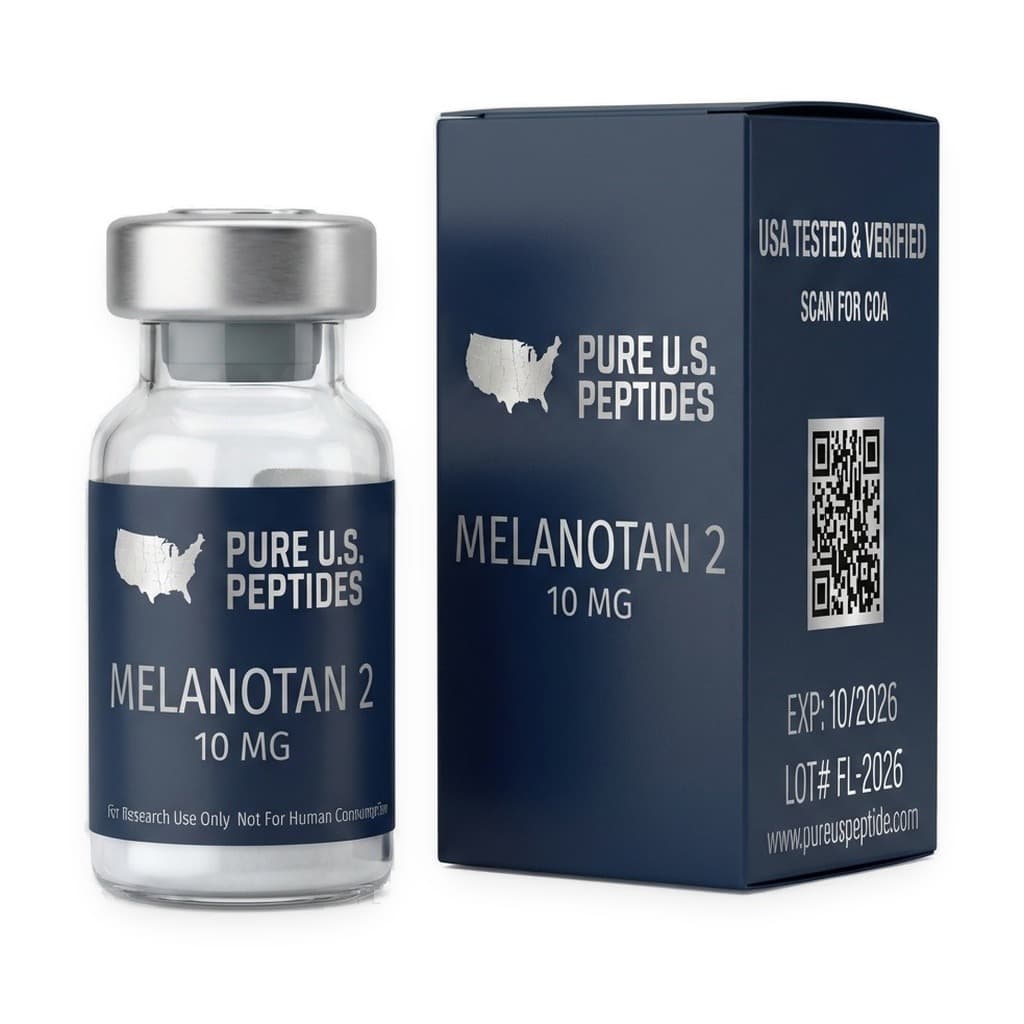
Melanotan 2 10mg
Em Estoque e Pronto para Envio dos EUA
Frete GRÁTIS em todos os pedidos nos EUA
Checkout seguro via processador de pagamento criptografado


 +2.9k
+2.9kApenas para Uso em Pesquisa
Estes produtos sao destinados exclusivamente a pesquisa laboratorial e nao se destinam ao uso medico. Nao sao aprovados pela FDA para diagnosticar, tratar, curar ou prevenir qualquer doenca. Ao adquirir, voce certifica que os produtos serao utilizados exclusivamente para pesquisa e nao para consumo humano ou animal.
Resumo da Pesquisa
24 Citacoes PubMedVisao Geral Melanotan II (MT-II) e um(a) sintetico(a), cyclic heptapeptide analog do(a) endogenous 13-amino-acid hormone α-melanocyte-stimulating hormone (α-MSH). It was originally synthesized no(a) University of Arizona no(a) late 1980s by Victor Hruby, Mac Hadley, and Robert Dorr.[1] Chemically, MT-II is defined as Ac-Nle-c[Asp-His-D-Phe-Arg-Trp-Lys]-NH₂, a shortened variant of α-MSH with key modifications: a lactam bridge cyclization (Asp→Lys) aumenta enzymatic resistance, and D-Phenylalanine substitution aprimora potency. These make MT-II "superpotent" comparado(a) a native α-MSH and enable it to cross the blood-brain barrier — um(a) principal distinction do(a) linear Melanotan I (afamelanotide).[1][3] MT-II acts como um(a) non-selective agonist at melanocortin receptors MC1R, MC3R, MC4R, and MC5R with alto(a) nanomolar affinity (Ki ~1.1–1.3 nM), but does NOT bind MC2R (the ACTH receptor). This broad receptor ativacao drives its diverse effects — tanning, erectogenic, anorexigenic, and social behavioral modulacao.[2] The ativo(a) metabolite of MT-II — Bremelanotide (PT-141) — is bremelanotide, an FDA-approved pharmaceutical; that approval...
Melanotan 2 — Dados de Pesquisa em Resumo
| Propriedade | Valor |
|---|---|
| Citacoes PubMed Referenciadas | 24 |
| Pesquisadores Colaboradores | 3 |
| Condicoes de Armazenamento | Pó liofilizado: -20°C, escuro, hermético, protegido de moisture. |
| Padrao de Pureza | >99.80% por HPLC (certificado publicado) |
| Apenas para Uso em Pesquisa | Nao destinado ao consumo humano. Apenas para uso em pesquisa. |
Compare Melanotan 2 com Outros Peptideos
Research guide
What is Melanotan 2? Read the full research guideVisao Geral
Visao Geral
Melanotan II (MT-II) e um(a) sintetico(a), cyclic heptapeptide analog do(a) endogenous 13-amino-acid hormone α-melanocyte-stimulating hormone (α-MSH). It was originally synthesized no(a) University of Arizona no(a) late 1980s by Victor Hruby, Mac Hadley, and Robert Dorr.[1]
Chemically, MT-II is defined as Ac-Nle-c[Asp-His-D-Phe-Arg-Trp-Lys]-NH₂, a shortened variant of α-MSH with key modifications: a lactam bridge cyclization (Asp→Lys) aumenta enzymatic resistance, and D-Phenylalanine substitution aprimora potency. These make MT-II "superpotent" comparado(a) a native α-MSH and enable it to cross the blood-brain barrier — um(a) principal distinction do(a) linear Melanotan I (afamelanotide).[1][3]
MT-II acts como um(a) non-selective agonist at melanocortin receptors MC1R, MC3R, MC4R, and MC5R with alto(a) nanomolar affinity (Ki ~1.1–1.3 nM), but does NOT bind MC2R (the ACTH receptor). This broad receptor ativacao drives its diverse effects — tanning, erectogenic, anorexigenic, and social behavioral modulacao.[2]
The ativo(a) metabolite of MT-II — Bremelanotide (PT-141) — is bremelanotide, an FDA-approved pharmaceutical; that approval does not apply to this research-grade material. MT-II itself remains unaprovado(a) por qualquer regulatory body.[3]
Mecanismo de Acao
Mecanismo de Acao
Melanocortin Receptor Binding
MT-II is a non-selective agonist at four of five melanocortin receptors (MCRs), all members do(a) GPCR superfamily:
| Receptor | Primary Location | Function When Activated | Affinity |
|---|---|---|---|
| MC1R | Melanocytes (skin) | Eumelanin synthesis → tanning/photoprotection | High |
| MC3R | Hypothalamus, NAcc | Energy homeostasis, feeding behavior | Ki ~1.3 nM |
| MC4R | Hypothalamus (PVN), spinal cord | Erectile function, appetite supressao, thermogenesis | Ki ~1.1 nM |
| MC5R | Exocrine glands, linfocitos | Sebum production, immune modulacao | Moderate |
| MC2R | Adrenal cortex | ACTH receptor — NO MT-II binding | None |
Primary Signaling: cAMP-PKA Pathway
Upon MCR binding, MT-II ativa Gs-coupled adenylate cyclase → aumentou intracellular cAMP → PKA ativacao:[2]
- Melanogenesis (MC1R): PKA → CREB fosforilacao → MITF transcricao → tyrosinase upregulacao → eumelanin production
- Erectile function (MC4R/CNS): Hypothalamic PVN ativacao → dopaminergic/oxytocinergic downstream → neuronal NO release → intracavernosal pressure increase[5]
- Food-intake regulation (MC3R/MC4R): Hypothalamic MCR ativacao → reduziu food intake + aumentou thermogenesis[6]
- Social behavior (MC4R): Selective nucleus accumbens ativacao → oxytocin-dependent social learning[7]
Off-Target: Mast Cell Activation
MT-II cross-reacts with MRGPRB2/MRGPRX2 receptors on mast cells, causing pseudo-allergic histamine release → H1 receptor ativacao → hypothermia (in mice).[8]
vs. Related Compounds
| Compound | Structure | BBB | Key Difference |
|---|---|---|---|
| MT-II | Cyclic heptapeptide | Yes | Non-selective MCR agonist; tanning + erectogenic + anorexigenic |
| Melanotan I (Afamelanotide) | Linear [Nle⁴,D-Phe⁷]-α-MSH | No | Tanning apenas (peripheral MC1R); no CNS effects; TGA/EMA aprovado(a) para EPP |
| Bremelanotide (PT-141) | Deaminated MT-II metabolite | Yes | FDA-approved pharmaceutical; that approval does not apply to this material |
| α-MSH (native) | Linear tridecapeptide | Limited | Short meia-vida; rapidamente degradado(a); weak potency |
Aplicacoes de Pesquisa
Aplicacoes de Pesquisa
Melanotan II research spans dermatology, sexual medicine, neuroendocrinology, oncology, and behavioral neuroscience across 7+ indication categories:
- Skin Pigmentation & Photoprotection — MC1R estimulacao → eumelanin synthesis; pigmentation endpoints reported in Phase I trials.[1]
- Sexual Function Research — Erectile-response endpoints reported in small Phase I/II studies; proceptive-behavior endpoints in female rats.[3][9]
- Metabolic Models — Central MC3R/MC4R ativacao in rats: fat-pad mass, iBAT-thermogenesis and food-intake endpoints reported.[6][10]
- Autism & Social Behavior — Sociability index aumentou from 3.1 to 26.3 (p<0.0001) in MIA autism model mice; oxytocin-dependent NAcc ativacao in social contexts; partner preference facilitation in prairie voles.[11][7]
- Neuroprotection & Nerve Regeneration — 20 µg/kg every 48h aprimorou sensory function recovery in rat sciatic nerve crush model.[12]
- Addiction Research — Synergistic augmentation of naltrexone para reduzir binge-like ethanol intake in mice.[13]
- Oncology — Topical MT-II suprimiu melanoma tumor growth via MC1R → PTEN upregulacao + COX-2/PGE2 inibicao; sistemico(a) use carries melanoma risk.[14]
Caracteristicas Bioquimicas
| Propriedade | Valor |
|---|---|
| Molecular Formula | C₅₀H₆₉N₁₅O₉ |
| Molecular Weight | 1024.18 Da |
| CAS Number | 121062-08-6 |
| PubChem CID | 92432 |
| Sequence | Ac-Nle-c[Asp-His-D-Phe-Arg-Trp-Lys]-NH₂ |
| Structure | Cyclic heptapeptide; lactam bridge (Asp-Lys); Ac-Nle replaces α-MSH Ser-Tyr-Ser-Met; D-Phe replaces L-Phe |
| Parent Molecule | α-MSH (alpha-melanocyte-stimulating hormone) |
| InChI Key | JDKLPDJLXHXHNV-MFVUMRCOSA-N |
| Half-Life (Human) | ~1–2 hours (aprimorou vs α-MSH by cyclic structure) |
| BBB Penetration | Yes (diferentemente de Melanotan I) |
| Receptor Profile | Non-selective MCR agonist: MC1R, MC3R (Ki 1.3 nM), MC4R (Ki 1.1 nM), MC5R; NO activity at MC2R |
Identificadores
| Identity Confirmation | |
|---|---|
| Counter-Ion | |
| Synonyms | |
| Detection Methods |
Resumo da Pesquisa Pre-clinica
Resumo da Pesquisa Pre-clinica
Key Preclinical Studies
| Estudo | Modelo | Principais Achados | Ref |
|---|---|---|---|
| Côté et al. (2017) | F344BN rats — 40-day study | Fat pads -35% to -55% (p<0.01/0.001); iBAT thermogenesis 3-fold ↑; food intake returned to normal by day 5 — body-weight endpoint via ↑ energy expenditure | [6] |
| Vemulapalli et al. (2001) | NZW rabbits — 66–133 µg/kg IV | Cavernosal pressure 3.2-fold ↑ (p<0.05); abolished by MC3/4 antagonist SHU 9119, pudendal nerve transection, or L-NAME → centrally-mediated NO release | [5] |
| Minakova et al. (2019) | MIA autism-model mice — 7-day study | Sociability index 3.1 → 26.3 (p<0.0001); anxiety unchanged; rescued social deficits to control levels | [11] |
| Ford et al. (2024) | Prairie voles (WT vs Oxtr-KO) — IP/ICV | Social context → NAcc Fos ↑ (p<0.01) in WT but NOT Oxtr-KO; non-social → PVN ativacao apenas → oxytocin-dependent social learning mechanism | [7] |
| Jain et al. (2018) | C57BL/6J mice — 10 mg/kg IP | Plasma histamine 4-fold ↑ (p<0.0001); profound hypothermia abolished in mast cell-deficient mice; SC route ↓ histamine 63% | [8] |
| Eliason et al. (2022) | C57BL/6J mice — NAcc microinjection | All doses ↓ food intake at 1,2,4,6h (p<0.05); diminuiu lever-pressing motivation; no aversive state or metabolic rate change | [10] |
| Wu et al. (2020) | B16-F10 melanoma mice — topical | Dramatically slowed tumor growth; ↑PTEN, ↓COX-2/PGE2, induziu cell death; inibiu migration/invasion | [14] |
Human Clinical Data
| Estudo | Population | Key Results | Ref |
|---|---|---|---|
| Dorr et al. (1996) — Phase I | n=3 healthy males | Tanning and tolerability endpoints | [1] |
| Wessells et al. (1998) — Psychogenic ED | n=10 men; duplo-cego crossover | Erectile-response endpoints | [3] |
| Wessells et al. (2000) — Organic ED | n=10 men; duplo-cego crossover | Erectile-response and sexual-desire endpoints | [9] |
Pharmacokinetics
| Parametro | Valor |
|---|---|
| Human Half-Life | ~1–2 hours (aprimorou vs α-MSH by cyclic structure) |
| BBB Penetration | Yes (diferentemente de Melanotan I) |
| Active Metabolite | Bremelanotide (PT-141) — deaminated, lacks C-terminal amide |
Os produtos oferecidos neste site são fornecidos apenas para estudos in vitro. Estudos in vitro (do latim: em vidro) são realizados fora do corpo. Estes produtos não são medicamentos ou fármacos e não foram aprovados pelo FDA dos EUA para prevenir, tratar ou curar qualquer condição médica, enfermidade ou doença. A introdução corporal de qualquer tipo em humanos ou animais é estritamente proibida por lei.
Apenas para Pesquisa Laboratorial. Não se destina ao uso humano, uso médico, uso diagnóstico ou uso veterinário.
TODOS OS ARTIGOS E INFORMAÇÕES SOBRE PRODUTOS FORNECIDOS NESTE SITE SÃO APENAS PARA FINS INFORMATIVOS E EDUCACIONAIS.
Autores e Atribuicao
✍️ Autor do Artigo
Dr. Victor J. Hruby, PhD
Victor J. Hruby, PhD, is a Regents Professor no(a) Department of Chemistry and Biochemistry no(a) University of Arizona. He led the design and synthesis do(a) superpotent melanotropic peptides, creating the cyclic lactam analog structure of Melanotan II que provided aumentou stability and potency comparado(a) a the natural hormone α-MSH. His key publications include: 'Potent and prolonged acting cyclic lactam analogues of alpha-melanotropin: Design based on molecular dynamics' (1989), 'Evaluation of melanotan-II, a superpotent cyclic melanotropic peptide in a pilot phase-I clinical study' (1996), and 'Melanocortin Receptors, Melanotropic Peptides and Penile Erection' (2007). Victor Hruby is referenced como um(a) foundational chemist in melanocortin peptide research. De forma alguma este(a) médico(a)/cientista endossa ou defende a compra, venda ou uso deste produto por qualquer motivo. Não existe afiliação ou relação, implícita ou de outra forma, entre a Pure US Peptide e este(a) médico(a).
Ver Perfil Completo do Pesquisador →🎓 Autor de Revista Cientifica
Dr. Mac E. Hadley, PhD
Mac E. Hadley, PhD (deceased), was a Professor of Cell Biology & Anatomy no(a) University of Arizona. He collaborated no(a) biological characterization of melanocortin analogs e e credited with early characterization of the erectogenic properties of Melanotan II, que pivoted research toward sexual function. Key publications: 'Evaluation of melanotan-II in a pilot phase-I clinical study' (1996), 'Discovery que a melanocortin regula sexual functions in male and female humans' (2005), and 'Melanocortin peptide therapeutics: Historical milestones' (2006). Mac Hadley is referenced como um(a) foundational biologist in melanocortin peptide research. De forma alguma este(a) médico(a)/cientista endossa ou defende a compra, venda ou uso deste produto por qualquer motivo. Não existe afiliação ou relação, implícita ou de outra forma, entre a Pure US Peptide e este(a) médico(a).
Ver Perfil Completo do Pesquisador →Dr. Mac E. Hadley, PhD is being referenced as one of the leading scientists involved in the research and development of Melanotan 2. In no way is this doctor/scientist endorsing or advocating the purchase, sale, or use of this product for any reason. There is no affiliation or relationship, implied or otherwise, between Pure US Peptide and this doctor. The purpose of citing the doctor is to acknowledge, recognize, and credit the exhaustive research and development efforts conducted by the scientists studying this peptide.
🔬 Pesquisador Colaborador
Dr. Robert T. Dorr, PhD
Robert T. Dorr, PhD (deceased), was a Professor no(a) College of Medicine (Pharmacology Department) no(a) University of Arizona. He led the therapeutic development scientific program and conducted the initial pilot Phase I ensaios clinicos involving human volunteers to evaluate a seguranca, tanning activity, and tolerability of Melanotan II. Key publications: 'Evaluation of melanotan-II, a superpotent cyclic melanotropic peptide in a pilot phase-I clinical study' (1996), 'Increased Eumelanin Expression and Tanning is Induced by a Superpotent Melanotropin in Humans' (2000), and 'Melanocortin peptide therapeutics: Historical milestones' (2006). Robert Dorr is referenced como um(a) foundational pharmacologist in melanocortin peptide research. De forma alguma este(a) médico(a)/cientista endossa ou defende a compra, venda ou uso deste produto por qualquer motivo. Não existe afiliação ou relação, implícita ou de outra forma, entre a Pure US Peptide e este(a) médico(a).
Ver Perfil Completo do Pesquisador →Dr. Robert T. Dorr, PhD is being referenced as one of the leading scientists involved in the research and development of Melanotan 2. In no way is this doctor/scientist endorsing or advocating the purchase, sale, or use of this product for any reason. There is no affiliation or relationship, implied or otherwise, between Pure US Peptide and this doctor. The purpose of citing the doctor is to acknowledge, recognize, and credit the exhaustive research and development efforts conducted by the scientists studying this peptide.
Citacoes Referenciadas
Dorr RT, Lines R, Levine N, et al. Life Sciences. 1996;58(20):1777-1784.
DOIHadley ME, Dorr RT. Peptides. 2006;27(4):921-930.
PubMedWessells H, Fuciarelli K, Hansen J, et al. The Journal of Urology. 1998;160(2):389-393.
PubMedFDA Warning Letters regarding unauthorized marketing of Melanotan products.
FDA.govVemulapalli R, Kurowski S, Salisbury B, et al. Activation of central melanocortin receptors by MT-II aumenta cavernosal pressure in rabbits pelo(a) neuronal release of NO. British Journal of Pharmacology. 2001;134(8):1705-1710.
DOICôté I, et al. Activation do(a) central melanocortin system chronically reduz body mass sem the necessity of longo prazo caloric restriction. Canadian Journal of Physiology and Pharmacology. 2017.
PubMedFord CL, McDonough AA, Horie K, Young LJ. Melanocortin agonism in a social context ativa seletivamente nucleus accumbens in an oxytocin-dependent manner. Neuropharmacology. 2024;247:109848.
DOIJain S, Panyutin A, Liu N, et al. Melanotan II causes hypothermia in mice by ativacao of mast cells and estimulacao of histamine 1 receptors. American Journal of Physiology-Endocrinology and Metabolism. 2018;315(3):E357-E366.
DOIWessells H, Levine N, Hadley ME, Dorr RT, Hruby VJ. Urology. 2000;56(4):641-646.
DOIEliason NL, Martin L, Low MJ, Sharpe AL. Melanocortin agonista do receptor melanotan-II microinjected no(a) nucleus accumbens diminui appetitive and consumptive responding for food. Neuropeptides. 2022;96:102289.
DOIMinakova E, Lang J, Medel-Matus JS, et al. PLoS ONE. 2019;14(1):e0210389.
DOITer Laak MP, et al. Melanotan II promove periferico(a) regeneracao nervosa in a rat sciatic nerve crush model. 2003.
PubMedEvans-Brown M, Dawson RT, Chandler MD, McVeigh J. Use of melanotan I and II no(a) general population. BMJ. 2009;338:b566.
DOIWu JC, Tsai HE, Hsiao YH, et al. International Journal of Molecular Sciences. 2020;21(2):681.
DOIDreyer BA, Amer T, Fraser M. BMJ Case Reports. 2019;12(2):e227644.
DOINelson ME, Bryant SM, Aks SE. Clinical Toxicology. 2012;50(10):1169-1173.
DOIPeters B, Hadimeri H, Wahlberg R, Afghahi H. CEN Case Reports. 2020;9(2):159-161.
DOISivyer GW. Dermatology Practical & Conceptual. 2012.
PubMedRyakhovsky VV, Khachiyan GA, Kosovova NF, et al. The primeiro(a) preparative solution phase synthesis of melanotan II. Beilstein Journal of Organic Chemistry. 2008;4:39.
DOIHjuler KF, Lorentzen HF. Melanoma associado(a) com the use of melanotan-II. Dermatology. 2014;228(1):34-36.
PubMedGiuliano F, Clement P, Droupy S, et al. Neuroscience. 2006;138(1):293-301.
DOILi G, Zhang Y, Wilsey JT, Scarpace PJ. Unabated anorexic and aprimorou thermogenic responses to melanotan II in diet-induziu ratos obesos. Journal of Endocrinology. 2004;182(1):123-132.
DOIKing SH, et al. Current Topics in Medicinal Chemistry. 2007;7(11):1111-1119.
PubMedWessells H, Levine N, Hadley ME, Dorr RT, Hruby VJ. International Journal of Impotence Research. 2000;12(Suppl 4):S74-S79.
DOIAviso de Uso em Pesquisa
Apenas para Uso em Pesquisa (RUO). Nao destinado ao consumo humano, uso clinico, ou como medicamento, alimento, cosmetico ou dispositivo medico. Este produto nao foi avaliado pelo FDA e e fornecido exclusivamente para pesquisa laboratorial in vitro por profissionais qualificados.
Certificado de Analise
Published certificates come from third-party laboratories. If this listing's certificate is still pending, the card below says so.
Ultimo Relatorio de Laboratorio
Armazenamento e Manuseio
Resumo
Pó liofilizado: -20°C, escuro, hermético, protegido de moisture. Evite congelamento-descongelamento repetido.
Condições Recomendadas de Armazenamento Laboratorial
Liofilizado Powder: Store at -20°C in dark, airtight container protegeu from moisture and light. Stable for months to years under these conditions.
Handling: Do not subject to repeated freeze-thaw cycles.
Form: Liofilizado white powder in sealed vials.
“Resumo da Pesquisa Pre-clinica Key Preclinical Studies Estudo Modelo Principais Achados Ref Côté et al.”
Compostos de Pesquisa Relacionados
PT-141
10mg
Oxytocin
10mg
Kisspeptin
10mg