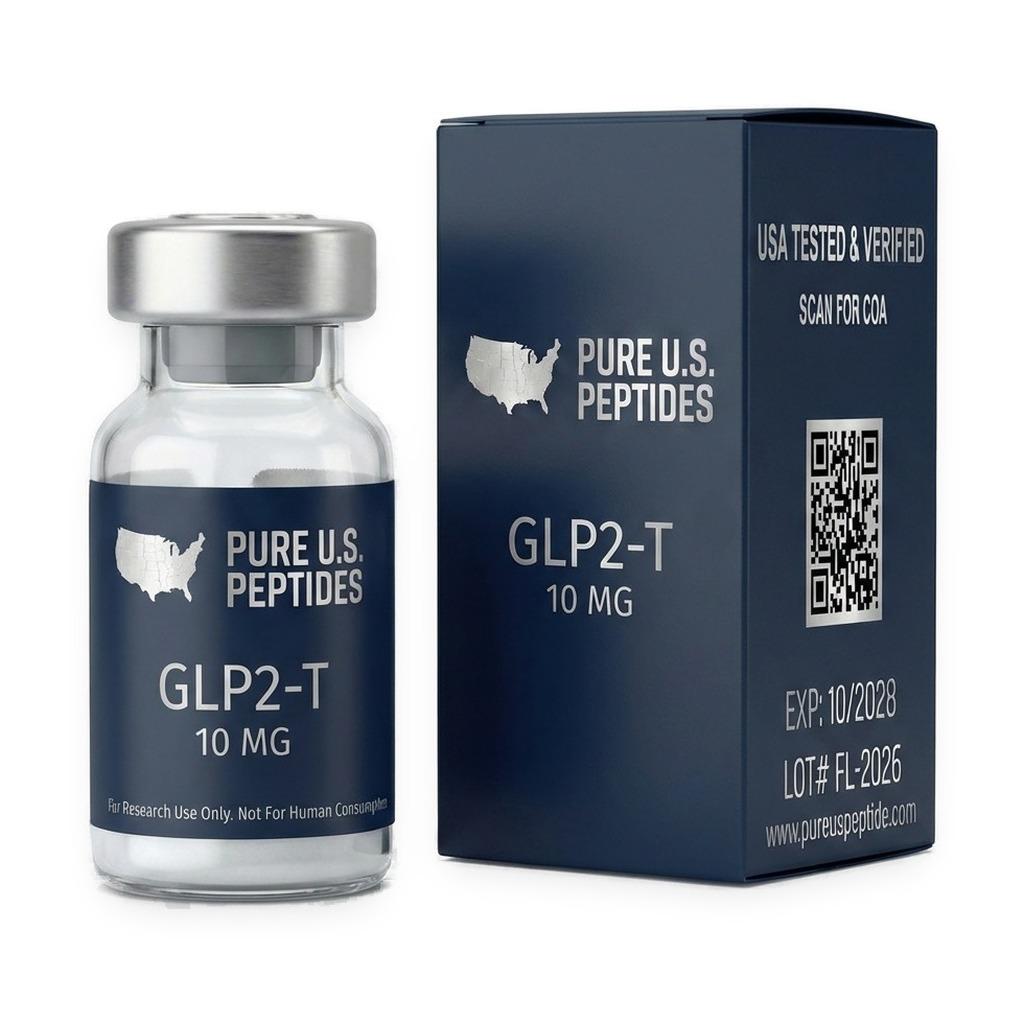
Péptido GLP2-T 10mg
Péptido GLP2-T 10mg figura como un vial de 10mg solo para uso en investigación de laboratorio. Precio publicado: $69.30. Este producto tiene publicado un certificado de lote de un laboratorio externo (lote T26C421). Ver los 4 tamaños de GLP2-T.
En Stock y Listo para Envío desde EE.UU.
Envío GRATIS en todos los pedidos de EE.UU.
Pago seguro mediante procesador de pagos encriptado


 +2.9k
Solo para Uso en Investigación
Estos productos son exclusivamente para investigación de laboratorio y no están destinados para uso médico. No están aprobados por la FDA para diagnosticar, tratar, curar o prevenir ninguna enfermedad. Al realizar su compra, usted certifica que serán utilizados exclusivamente para investigación y no para consumo humano o animal.
Resumen de Investigación
8 Citas PubMedOverview Tirzepatide (LY3298176) is a 39-amino-acid synthetic peptide engineered as a dual agonist of the GIP and GLP-1 receptors - the two principal incretin receptors. The peptide backbone is derived from the native GIP sequence and includes two 2-aminoisobutyric acid (Aib) residues that confer resistance to DPP-IV degradation, together with a C20 fatty-diacid chain attached at Lys20 that promotes reversible albumin binding and a circulating half-life of roughly five days.[1][4] Native GIP and GLP-1 are incretin hormones released from intestinal K-cells and L-cells respectively in response to nutrient intake, and both potentiate glucose-dependent insulin secretion from pancreatic beta-cells. Tirzepatide is studied as a single molecule that engages both pathways simultaneously, allowing investigators to probe the combined and interacting effects of GIP-receptor and GLP-1-receptor signaling on insulin secretion, glucagon dynamics, and metabolic endpoints.[2][7] Discovery and design rationale Tirzepatide was reported by Coskun and colleagues at Eli Lilly as the first unimolecular...
GLP2-T 10mg at a glance
| Specification | Detail |
|---|---|
| Identity | GLP2-T, synthetic research peptide |
| Listed amount | 10mg |
| Listed sizes | 10mg, 20mg, 30mg, and 60mg |
| Storage | Store lyophilized GLP2-T refrigerated at 2-8 degrees C. |
| Lot certificate | Published for 10mg, 30mg and 60mg; 20mg shows the 10mg lot (T26C421), its own is pending |
| Price | $69.30 |
| Price per mg | $6.93 per mg |
| Dispatch | Same business day for orders before 2:00 PM EST Monday through Friday |
| U.S. shipping | Free on every order |
| Included with every order | Free BAC water vial |
| Product status | This listing is not an FDA-approved drug. Strictly for laboratory Research Use Only. |
Current price and availability are shown in the purchase panel at the top of this page.
GLP2-T — Datos de Investigación de un Vistazo
| Propiedad | Valor |
|---|---|
| Fórmula Molecular | C225H348N48O68 |
| Peso Molecular | 4813.5 Da |
| Número CAS | 2023788-19-2 |
| Secuencia de Aminoácidos | Tyr-Aib-Glu-Gly-Thr-Phe-Thr-Ser-Asp-Tyr-Ser-Ile-Aib-Leu-Asp-Lys-Ile-Ala-Gln-L... |
| Citas PubMed Referenciadas | 8 |
| Investigadores Colaboradores | 2 |
| Condiciones de Almacenamiento | Store lyophilized at 2-8C (refrigerated), protected from light. |
| Estándar de Pureza | >99.80% por HPLC (certificado publicado) |
| Solo para Uso en Investigación | No destinado al consumo humano. Solo para uso en investigación. |
Guía de investigación
¿Qué es GLP2-T? Lea la guía de investigación completaDescripción General
Overview
Tirzepatide (LY3298176) is a 39-amino-acid synthetic peptide engineered as a dual agonist of the GIP and GLP-1 receptors - the two principal incretin receptors. The peptide backbone is derived from the native GIP sequence and includes two 2-aminoisobutyric acid (Aib) residues that confer resistance to DPP-IV degradation, together with a C20 fatty-diacid chain attached at Lys20 that promotes reversible albumin binding and a circulating half-life of roughly five days.[1][4]
Native GIP and GLP-1 are incretin hormones released from intestinal K-cells and L-cells respectively in response to nutrient intake, and both potentiate glucose-dependent insulin secretion from pancreatic beta-cells. Tirzepatide is studied as a single molecule that engages both pathways simultaneously, allowing investigators to probe the combined and interacting effects of GIP-receptor and GLP-1-receptor signaling on insulin secretion, glucagon dynamics, and metabolic endpoints.[2][7]
Discovery and design rationale
Tirzepatide was reported by Coskun and colleagues at Eli Lilly as the first unimolecular dual GIP/GLP-1 receptor agonist to reach clinical proof of concept. The design objective was to combine GIP-receptor and GLP-1-receptor agonism in a single fatty-acylated peptide, testing the hypothesis that balanced co-agonism produces greater metabolic effects than GLP-1-receptor agonism alone.[1]
Research framework
Within the incretin research-peptide family, tirzepatide is most directly compared with selective GLP-1-receptor agonists such as semaglutide and with the triple GIP/GLP-1/glucagon agonist retatrutide. Tirzepatide is the dual-agonist reference compound in this set, giving investigators a tool to isolate the contribution of added GIP-receptor engagement relative to GLP-1-only agonism.[5][6]
Mecanismo de Acción
Mechanism of Action
Dual Incretin Receptor Agonism
Tirzepatide is a full agonist at both the GIP receptor and the GLP-1 receptor - class B (secretin-family) Gs-coupled GPCRs expressed on pancreatic beta-cells and alpha-cells, adipocytes, and central-nervous-system neurons. Receptor occupancy elevates intracellular cAMP and activates PKA signaling, which in the beta-cell potentiates glucose-dependent insulin secretion.[4][2]
Imbalanced / Biased Agonism
Pharmacology studies describe tirzepatide as an imbalanced dual agonist: it behaves much like native GIP at the GIP receptor, but shows biased agonism at the GLP-1 receptor, with comparatively weaker beta-arrestin recruitment relative to cAMP signaling. This distinctive signaling profile is an active area of research into how co-agonism differs mechanistically from single GLP-1-receptor agonism.[4]
DPP-IV Resistance and Pharmacokinetics
The two Aib substitutions eliminate the N-terminal DPP-IV cleavage sites, and the C20 fatty-diacid moiety drives reversible albumin binding. Together these modifications extend the circulating half-life to about five days.[1]
Metabolic Endpoints in Research Models
| Endpoint | Direction | Model Context |
|---|---|---|
| Glucose-dependent insulin secretion | Increased | Isolated islet and rodent glucose-tolerance models[1] |
| Glucagon (fasting) | Modulated | Clamp and mixed-meal research protocols[2] |
| Gastric emptying | Slowed | Acetaminophen-absorption and imaging models[2] |
| Peripheral insulin sensitivity | Increased | Metabolic-phenotyping research models[7] |
Receptor Selectivity
Tirzepatide engages the GIP and GLP-1 receptors with high potency and does not significantly activate the glucagon receptor, distinguishing it from triple-agonist peptides such as retatrutide.[6]
Aplicaciones de Investigación
Research Applications
Tirzepatide is studied in preclinical and clinical research that probes dual GIP/GLP-1 receptor biology and its downstream metabolic effects. Reported research applications include:
- Dual-Incretin-Receptor Pharmacology - Used as a high-potency, DPP-IV-resistant co-agonist probe to characterize GIP-receptor and GLP-1-receptor coupling, cAMP/beta-arrestin balance, and receptor desensitization kinetics in recombinant cell-line and primary islet systems.[4]
- Glucose-Dependent Insulin Secretion - Isolated pancreatic-islet and beta-cell-line preparations are used to quantify glucose-dependent insulin release and to dissect the additive contribution of GIP-receptor engagement over GLP-1-receptor agonism alone.[1]
- Rodent Metabolic-Phenotyping Models - Rodent models are used for metabolic-phenotyping endpoints (see references).[7]
- Comparative Incretin Research - Head-to-head research designs compare tirzepatide against selective GLP-1-receptor agonists to isolate the GIP-receptor contribution to incretin-receptor endpoints.[5]
- Glucagon and Lipid-Metabolism Profiling - Clamp and mixed-meal research protocols are used to characterize effects on glucagon dynamics, lipolysis, and lipid handling.[2]
Comparative Research Context
Within the incretin research-peptide family, investigators routinely compare tirzepatide with selective GLP-1-receptor agonists (e.g., semaglutide) and with the triple GIP/GLP-1/glucagon agonist retatrutide. Tirzepatide is the dual-agonist reference of this comparator set, isolating the effect of adding GIP-receptor engagement to GLP-1-receptor agonism.[6]
Características Bioquímicas
| Propiedad | Valor |
|---|---|
| Fórmula | C225H348N48O68 |
| Peso molecular | 4813.5 Da |
| Sinónimos | Tirzepatide, LY3298176, Dual GIP/GLP-1 Receptor Agonist, GIP/GLP-1 RA |
| Número CAS | 2023788-19-2 |
| Secuencia | Tyr-Aib-Glu-Gly-Thr-Phe-Thr-Ser-Asp-Tyr-Ser-Ile-Aib-Leu-Asp-Lys-Ile-Ala-Gln-Lys-Ala-Phe-Val-Gln-Trp-Leu-Ile-Ala-Gly-Gly-Pro-Ser-Ser-Gly-Ala-Pro-Pro-Pro-Ser (Aib at positions 2 and 13; Lys20 conjugated to a gamma-Glu / C20 fatty-diacid moiety) |
| CID de PubChem | 156588324 |
| Masa monoisotópica | N/A |
| Área polar | N/A |
| Complejidad | N/A |
| XLogP | N/A |
| Número de átomos pesados | N/A |
| Donadores de enlaces de hidrógeno | N/A |
| Aceptores de enlaces de hidrógeno | N/A |
| Enlaces rotables | N/A |
Identificadores
| CID de PubChem | |
|---|---|
| Clave InChI | |
| InChI | |
| SMILES isomérico | |
| SMILES canónico | |
| Nombre IUPAC |
Resumen de Investigación Preclínica
Research Summary
Foundational Studies
| Study | Model | Key Findings | Ref |
|---|---|---|---|
| Coskun et al. (2018) | Cell/rodent + phase 1 | First unimolecular dual GIP/GLP-1 receptor agonist; discovery-to-proof-of-concept characterization | [1] |
| Willard et al. (2020) | Recombinant receptor assays | Characterized tirzepatide as an imbalanced/biased dual agonist (GIP-like at GIPR; biased at GLP-1R) | [4] |
| Rosenstock et al. (2021) | SURPASS-1 (Phase 3) | Phase 3, placebo-controlled trial of the pharmaceutical product; see reference | [6] |
| Frias et al. (2021) | SURPASS-2 (Phase 3) | Phase 3, active-comparator trial of the pharmaceutical product; see reference | [5] |
| Samms et al. (2020) | Review / preclinical | Mechanistic framework for how GIP-receptor agonism may enhance GLP-1 efficacy | [7] |
Tirzepatide is the active ingredient of FDA-approved pharmaceuticals; that approval does not apply to this research-grade material. See References.
Mechanistic Themes
- Dual incretin agonism - a single peptide engages both the GIP and GLP-1 receptors
- Imbalanced/biased signaling - GIP-like at GIPR, biased (cAMP-favoring) at GLP-1R
- Extended pharmacokinetics - Aib substitutions plus C20 fatty-diacid albumin binding support ~5-day half-life
- Glucose-dependent action - insulinotropic effect is conditioned on ambient glucose
Autores y Atribución
✍️ Autor del Artículo
Dr. Daniel J. Drucker
Daniel J. Drucker, OC, MD, FRSC, is a Senior Investigator at the Lunenfeld-Tanenbaum Research Institute, Mount Sinai Hospital, and Professor of Medicine at the University of Toronto. Dr. Drucker is one of the world's foremost authorities on incretin biology and the GIP and GLP-1 hormone systems that underlie dual incretin agonists such as tirzepatide, with over 800 publications and numerous awards including the Canada Gairdner International Award and the Banting Medal for Scientific Achievement. Daniel J. Drucker is being referenced as one of the leading scientists in the field of incretin (GIP/GLP-1) research relevant to Tirzepatide. In no way is this doctor/scientist endorsing or advocating the purchase, sale, or use of this product for any reason. There is no affiliation or relationship, implied or otherwise, between Pure US Peptide and this doctor.
Ver Perfil Completo del Investigador →🎓 Autor de Revista Científica
Dr. Juan P. Frias
Juan P. Frias, MD, is a clinical investigator specializing in incretin pharmacology and a principal investigator on multiple pivotal tirzepatide trials, including SURPASS-2, which compared tirzepatide with semaglutide in a Phase 3 trial. He has authored numerous peer-reviewed publications on incretin-based therapies. Juan P. Frias is being referenced as one of the leading clinical investigators involved in the research of Tirzepatide. In no way is this doctor/scientist endorsing or advocating the purchase, sale, or use of this product for any reason. There is no affiliation or relationship, implied or otherwise, between Pure US Peptide and this doctor.
Ver Perfil Completo del Investigador →Dr. Juan P. Frias se menciona como uno de los principales científicos que participaron en la investigación y el desarrollo de GLP2-T. De ninguna manera este médico/científico respalda o promueve la compra, venta o uso de este producto por ningún motivo. No existe ninguna afiliación ni relación, implícita o de otro tipo, entre Pure US Peptide y este médico. El propósito de citar al médico es reconocer, valorar y dar crédito a los exhaustivos esfuerzos de investigación y desarrollo realizados por los científicos que estudian este péptido.
Citas Referenciadas
Coskun T, Sloop KW, Loghin C, et al. Mol Metab. 2018;18:3-14.
PubMedMin T, Bain SC. Diabetes Ther. 2021;12(1):143-157.
PubMedJastreboff AM, Aronne LJ, Ahmad NN, et al. N Engl J Med. 2022;387(3):205-216.
PubMedWillard FS, Douros JD, Gabe MB, et al. Tirzepatide is an imbalanced and biased dual GIP and GLP-1 receptor agonist. JCI Insight. 2020;5(17):e140532.
PubMedFrias JP, Davies MJ, Rosenstock J, et al. N Engl J Med. 2021;385(6):503-515.
PubMedRosenstock J, Wysham C, Frias JP, et al. Lancet. 2021;398(10295):143-155.
PubMedSamms RJ, Coghlan MP, Sloop KW. Trends Endocrinol Metab. 2020;31(6):410-421.
PubMedHammoud R, Drucker DJ. Beyond the pancreas: contrasting cardiometabolic actions of GIP and GLP1. Nat Rev Endocrinol. 2023;19(4):201-216.
PubMedAviso de Uso en Investigación
Solo para Uso en Investigación (RUO). No destinado al consumo humano, uso clínico, ni como medicamento, alimento, cosmético o dispositivo médico. Este producto no ha sido evaluado por la FDA y se suministra exclusivamente para investigación de laboratorio in vitro por profesionales calificados.
Certificado de Análisis
Los certificados publicados provienen de laboratorios de terceros. Si el certificado de este producto aún está pendiente, la tarjeta de abajo lo indica.
Último Informe de Laboratorio
Almacenamiento y Manejo
Resumen
Store lyophilized at 2-8C (refrigerated), protected from light. For long-term storage, keep at -20C.
Lyophilized Peptide Storage
Store lyophilized tirzepatide vials at 2C to 8C (36F-46F), protected from light. For long-term storage, keep frozen at -20C. Stable for up to 24 months under recommended conditions.
Handling Precautions
Handle with standard laboratory PPE and consult the SDS. Los certificados publicados informan la pureza por HPLC y las endotoxinas cuando se analizaron. This product is for research use only (RUO).
“La literatura preclínica publicada caracteriza GLP2-T principalmente mediante estudios de unión a receptores y de modulación de vías en modelos de laboratorio y animales.”
Frequently Asked Questions
Common research questions about GLP2-T — purity, handling, COA documentation, and published-research context.
Compuestos de Investigación Relacionados
Cagriniltide
10mg
GLP3-R
60mg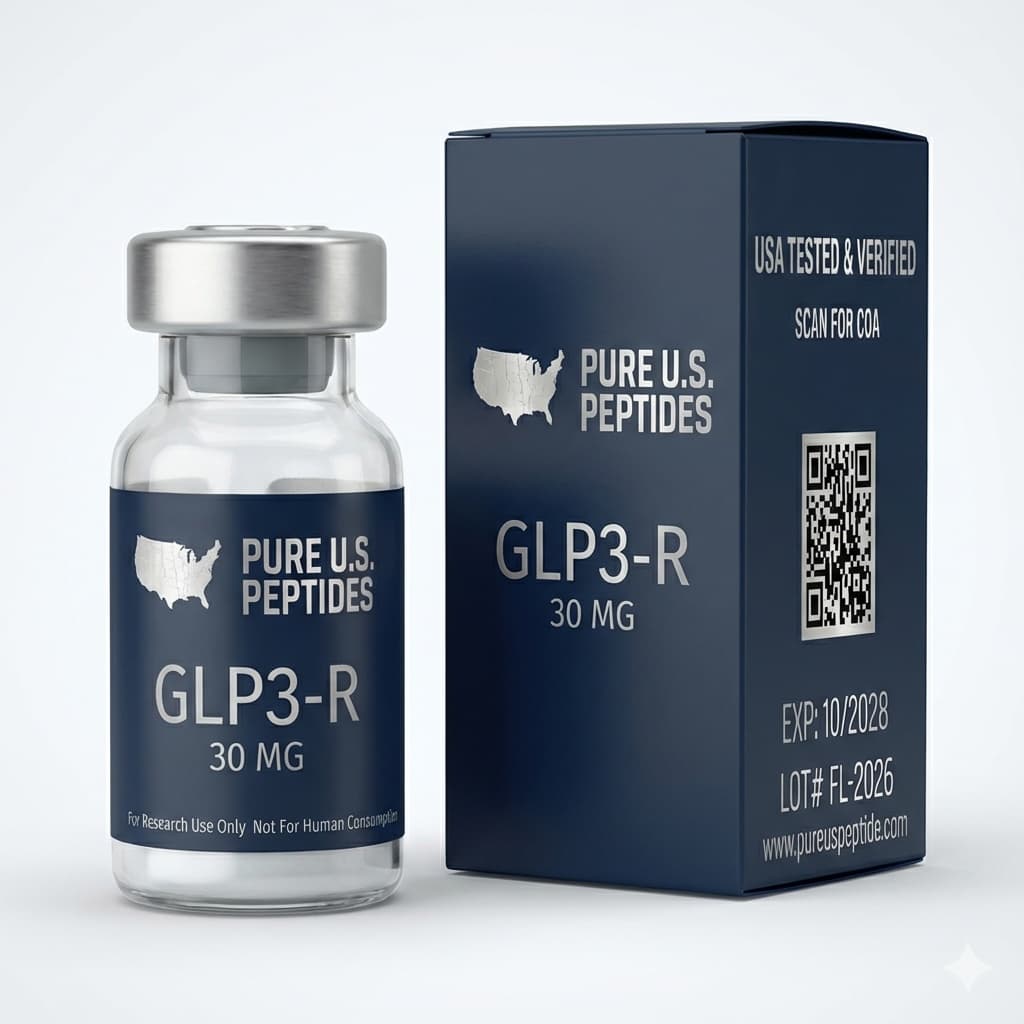
GLP3-R
30mg