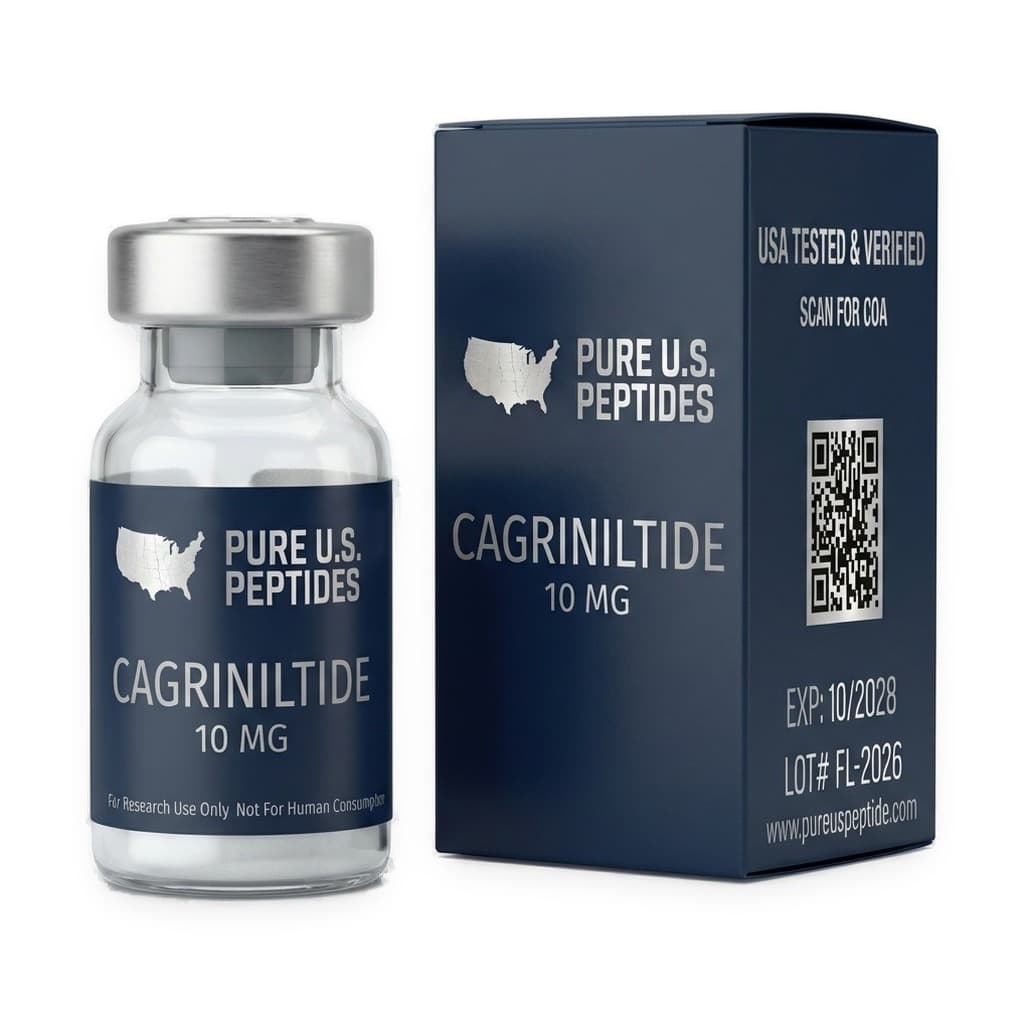
Cagriniltide 10mg
In Stock & Ready to Ship from USA
FREE shipping on every U.S. order
Secure checkout via encrypted payment processor


 +2.9k
+2.9kResearch Use Only
These products are for laboratory research only and not intended for medical use. They are not FDA-approved to diagnose, treat, cure, or prevent any disease. By purchasing, you certify they will be used solely for research and not for human or animal consumption.
Research Summary
19 PubMed CitationsResearch Overview Cagriniltide (AM833/NN1213) is a long-acting acylated analogue of human amylin — a 37-amino acid pancreatic hormone co-secreted with insulin that regulates satiety and glucose homeostasis. Native human amylin is unstable, prone to amyloid fibril formation, and has a very short half-life. The first-generation analogue, pramlintide, is short-acting.[2] Cagriniltide overcomes these limitations through C20 fatty diacid acylation (via γ-glutamic acid spacer at Lysine 1), which binds serum albumin, extending the half-life to 159–195 hours. Proline substitutions (Pro21, Pro27) and specific amino acid changes (N14E, V17R) prevent fibril formation and stabilize the peptide's alpha-helix.[3] Cagriniltide (AM833) is a long-acting acylated amylin analogue and a non-selective amylin/calcitonin-receptor agonist (Kruse 2021). It is investigational and not approved. See References.[3] Discovery and design rationale: The Kruse et al. (2021) program addressed the three core liabilities of native amylin — short half-life, beta-sheet aggregation into amyloid fibrils, and insufficient residence time at amylin receptors...
Cagriniltide — Research Data at a Glance
| Property | Value |
|---|---|
| PubMed Citations Referenced | 19 |
| Contributing Researchers | 3 |
| Storage Conditions | Lyophilized: -80°C (2 years) or -20°C (1 year); keep sealed, desiccated and protected from light. |
| Purity Standard | >99.80% HPLC (published certificate) |
| Research Use Only | Not for human consumption. RUO only. |
Research guide
What is Cagriniltide? Read the full research guideOverview
Research Overview
Cagriniltide (AM833/NN1213) is a long-acting acylated analogue of human amylin — a 37-amino acid pancreatic hormone co-secreted with insulin that regulates satiety and glucose homeostasis. Native human amylin is unstable, prone to amyloid fibril formation, and has a very short half-life. The first-generation analogue, pramlintide, is short-acting.[2]
Cagriniltide overcomes these limitations through C20 fatty diacid acylation (via γ-glutamic acid spacer at Lysine 1), which binds serum albumin, extending the half-life to 159–195 hours. Proline substitutions (Pro21, Pro27) and specific amino acid changes (N14E, V17R) prevent fibril formation and stabilize the peptide's alpha-helix.[3]
Cagriniltide (AM833) is a long-acting acylated amylin analogue and a non-selective amylin/calcitonin-receptor agonist (Kruse 2021). It is investigational and not approved. See References.[3]
Discovery and design rationale: The Kruse et al. (2021) program addressed the three core liabilities of native amylin — short half-life, beta-sheet aggregation into amyloid fibrils, and insufficient residence time at amylin receptors — through three coordinated structural changes: C20 fatty diacid acylation via a γ-glutamic-acid spacer at Lys¹ (drives 99% albumin binding and extends half-life ~8-fold), N14E and V17R substitutions (form an "ionic lock" stabilizing an alpha-helical "bypass" receptor conformation distinct from salmon calcitonin's "CT-like" mode), and Pro21/Pro27 introductions (block beta-sheet formation, eliminating fibrillation under thioflavin-T stress for >40 hours).[3] The result is a long-acting peptide with the unusual property of preventing AMYR/CTR desensitization through rapid receptor dissociation kinetics (3-6 min residence time vs ~45-60 min for salmon calcitonin).[9]
Research framework: Published work covers the structural pharmacology of dual AMYR/CTR agonism (Cao 2025 cryo-EM, Carvas 2025 RAMP1/3 knockout) and clinical trials of the pharmaceutical formulation, listed under References.[11][14]
Mechanism of Action
Mechanism of Action
Cagriniltide functions as a non-selective dual agonist of both calcitonin receptors (CTR) and amylin receptors (AMY1R, AMY2R, AMY3R) — heterodimers of CTR with RAMPs 1, 2, or 3.[3][12]
Receptor Targets & Binding
| Target | Interaction | Evidence |
|---|---|---|
| Calcitonin Receptor (CTR) | Non-selective agonist; class B1 GPCR; EC50 62 pM | Kruse et al. (2021); Cao et al. (2025) cryo-EM[3][9] |
| AMY1R (CTR+RAMP1) | Potent agonist; "bypass" conformation binding | RAMP1/3 KO abolishes the anorectic response (mice)[8] |
| AMY3R (CTR+RAMP3) | Potent agonist; EC50 49 pM (hAMY3R) | Carvas et al. (2025): required for the response in mice[8][13] |
| CGRPR / AM1R / AM2R | No or very low activity — selective for amylin/calcitonin axis | Fletcher et al. (2021)[12] |
Downstream Signaling
| Pathway | Effect | Consequence |
|---|---|---|
| Gs / Adenylyl Cyclase / cAMP | Gs-protein activation → adenylyl cyclase → intracellular cAMP accumulation | Primary signaling cascade for satiety[9] |
| Neuronal cFos (AP/NTS/LPBN) | Induces cFos expression in area postrema, nucleus of solitary tract, lateral parabrachial nucleus | Satiety signaling; 57% fewer AP neurons in RAMP1/3 KO[8] |
| Gastric Emptying | Delays gastric emptying | Gastric-emptying endpoints |
| Glucagon Suppression | Suppresses postprandial glucagon from pancreatic α-cells | Pancreatic signaling endpoints[6] |
Unique Binding Characteristics
| Property | Cagriniltide | Salmon Calcitonin |
|---|---|---|
| Receptor Conformation | "Bypass" (stabilized by ionic lock N14E–V17R) | "CT-like" conformation |
| Residence Time | 3–6 minutes (rapid dissociation) | 45–60 minutes (slow dissociation) |
| Desensitization | Prevents receptor downregulation | Causes receptor downregulation |
RAMP Dependence: Carvas et al. (2025) demonstrated that the food-intake responses to cagriniltide in mice are strictly dependent on AMY1R and AMY3R — knockout of RAMP1 and RAMP3 abolished the response, with 57% fewer neurons activated in the area postrema.[8]
Cryo-EM Structural Insights
Cao et al. (2025) and Gu et al. (2026) resolved the cagriniltide-bound calcitonin-receptor and amylin-receptor cryo-EM structures, revealing the distinct "bypass" binding conformation stabilized by the engineered N14E-V17R ionic lock. Unlike salmon calcitonin (which adopts a deep "CT-like" pose with prolonged residence time and progressive receptor desensitization), cagriniltide engages the receptor extracellular domain in a more shallow, dynamic geometry that produces full Gαs-coupled cAMP signaling but allows rapid dissociation. This kinetic difference is proposed as the molecular basis for maintained receptor responsiveness with repeat exposure rather than progressive downregulation.[9][10]
Hindbrain Satiety Circuitry
The principal central site of action is the area postrema (AP), a circumventricular organ outside the blood-brain barrier where AMY1R/AMY3R-expressing neurons project to the nucleus of the solitary tract (NTS) and the lateral parabrachial nucleus (LPBN). cFos mapping studies show robust neuronal activation across this AP→NTS→LPBN→hypothalamic axis after cagriniltide exposure; RAMP1/3 knockout eliminates 57% of AP cFos induction and abolishes the anorectic response — establishing AMY1R/AMY3R (rather than the calcitonin receptor in isolation) as the primary target.[8] Downstream effects include delayed gastric emptying, suppression of postprandial glucagon from pancreatic α-cells, and reduced caloric intake (-51% over 24 h in mouse food-intake studies at 30 nmol/kg).[6][8]
Research Applications
Research Applications
Published literature (clinical trials used the pharmaceutical formulation; see References) covers:
- Receptor Pharmacology — Cryo-EM structural biology of dual AMYR/CTR agonism; RAMP-dependent signaling; "bypass" vs "CT-like" receptor conformations; rapid-dissociation kinetics preventing desensitization.[9][10]
- Mechanism of Anti-Desensitization — Rapid 3-6 min receptor residence time prevents the AMYR/CTR downregulation that historically limits chronic salmon-calcitonin exposure.[9]
Comparative Research Context
Cagriniltide sits at the intersection of two adjacent neuropeptide-pharmacology research programs: the amylin/calcitonin axis (historically dominated by pramlintide, a short-acting analogue, and salmon calcitonin, limited by receptor desensitization) and the modern incretin program (semaglutide, tirzepatide, and next-generation poly-agonists). The Carvas 2025 RAMP1/3 knockout, Cao 2025 cryo-EM, and the Kruse 2021 SAR work together establish cagriniltide as the canonical research tool for dissecting AMY1R/AMY3R signaling separately from generic calcitonin-receptor activation.
Biochemical Characteristics
| Property | Value |
|---|---|
| Molecular Formula | C₁₉₄H₃₁₂N₅₄O₅₉S₂ |
| Molecular Weight | 4409.01 Da |
| CAS Number | 1415456-99-3 |
| PubChem CID | 171397054 |
| Sequence (1-Letter) | K(Eicosanedioic acid-γ-Glu)-CNTATCATQRLAEFLRHSSNNFGPILPPTNVGSNTP-NH₂ |
| Sequence (3-Letter) | {Eicosanedioic acid-γ-Glu}-Lys-Cys-Asn-Thr-Ala-Thr-Cys-Ala-Thr-Gln-Arg-Leu-Ala-Glu-Phe-Leu-Arg-His-Ser-Ser-Asn-Asn-Phe-Gly-Pro-Ile-Leu-Pro-Pro-Thr-Asn-Val-Gly-Ser-Asn-Thr-Pro-NH₂ |
| Structure | 37-amino acid lipidated amylin analogue; C20 fatty diacid via γ-Glu spacer at Lys1; Cys2–Cys7 disulfide bridge; Pro21/Pro27 anti-fibrillation substitutions; N14E/V17R ionic lock |
| Origin | Engineered from human amylin scaffold by Novo Nordisk A/S |
| Classification | Long-Acting Amylin Analogue / DACRA / Research Peptide |
| Half-Life | ~159–195 hours (human); ~24h (rat), ~50h (rabbit), ~76h (dog), ~115h (minipig) |
| Bioavailability | ~40% (rat) |
Identifiers
| Synonyms | |
|---|---|
| InChI Key | |
| Developer |
Preclinical Research Summary
Preclinical Research Summary
Key Preclinical Studies
| Study | Model | Key Findings | Ref |
|---|---|---|---|
| Carvas et al. (2025) | 129S2/SvEv mice — WT vs RAMP1/3 KO; 3–300 nmol/kg | 30 nmol/kg: 24h food intake ↓51%; 57% fewer AP neurons activated in KO | [8] |
| Kruse et al. (2021) | Male SD rats — 0.1–30 nmol/kg; PK: 10 nmol/kg | Food intake reduced for several days at 1–10 nmol/kg; T½ 20–27h | [3] |
| Dahl et al. (2024) | Rats — 30 nmol/kg single exposure | Food intake reduced 85% at 0–24h and 84% at 24–48h; EC50: hAMY3R 49 pM, hCTR 62 pM | [13] |
Published Clinical Trials (design only)
| Trial | Phase | n | Study Design |
|---|---|---|---|
| REDEFINE 1 NCT05567796 | 3 | 3,417 | 68-week RCT (CagriSema vs semaglutide vs cagriniltide vs placebo)[5] |
| REDEFINE 2 NCT05394519 | 3 | 1,206 | 68-week RCT (CagriSema vs placebo)[6] |
| REIMAGINE 2 NCT06065540 | 3 | 2,728 | 68-week active-controlled (CagriSema vs semaglutide) |
| Phase 2 combination study | 2 | 92 | 32-week (CagriSema vs semaglutide vs cagriniltide)[4] |
| Phase 2 monotherapy study | 2 | 706 | 26-week (cagriniltide vs liraglutide vs placebo)[2] |
| Phase 1b | 1b | 95 | Cagriniltide with semaglutide; 20-week[1] |
Outcomes are reported in the cited references and do not apply to this research-grade material.
The products offered on this website are furnished for in-vitro studies only. In-vitro studies (Latin: in glass) are performed outside of the body. These products are not medicines or drugs and have not been approved by the FDA to prevent, treat or cure any medical condition, ailment or disease. Bodily introduction of any kind into humans or animals is strictly forbidden by law.
For Laboratory Research Only. Not for human use, medical use, diagnostic use, or veterinary use.
ALL ARTICLES AND PRODUCT INFORMATION PROVIDED ON THIS WEBSITE ARE FOR INFORMATIONAL AND EDUCATIONAL PURPOSES ONLY.
Authors & Attribution
✍️ Article Author
Thomas Kruse
Thomas Kruse is a lead scientist at Novo Nordisk A/S in Måløv, Denmark. He played a central role in the chemical development and structural engineering of cagriniltide, leading the structure-activity relationship (SAR) efforts to create a long-acting, stable amylin analog that activates both amylin receptors and the calcitonin receptor while overcoming the instability and fibrillation issues of native human amylin. His key publications include "Development of Cagrilintide, a Long-Acting Amylin Analogue" (2021, Journal of Medicinal Chemistry) and "NN1213 – A Potent, Long-Acting, and Selective Analog of Human Amylin" (2024, Journal of Medicinal Chemistry). Thomas Kruse is being referenced as one of the leading scientists involved in cagriniltide research. In no way is this doctor/scientist endorsing or advocating the purchase, sale, or use of this product for any reason. There is no affiliation or relationship, implied or otherwise, between Pure US Peptide and this doctor.
View Full Researcher Profile →🎓 Scientific Journal Author
W. Timothy Garvey, MD
W. Timothy Garvey, MD is a professor in the Department of Nutrition Sciences at the University of Alabama at Birmingham. He served as principal investigator for the Phase 3 REDEFINE program evaluating cagriniltide combined with semaglutide (CagriSema) in a 3,417-participant trial. He is an author of REDEFINE-program publications. W. Timothy Garvey is being referenced as one of the leading scientists involved in cagriniltide research. In no way is this doctor/scientist endorsing or advocating the purchase, sale, or use of this product for any reason. There is no affiliation or relationship, implied or otherwise, between Pure US Peptide and this doctor.
View Full Researcher Profile →W. Timothy Garvey, MD is being referenced as one of the leading scientists involved in the research and development of Cagriniltide. In no way is this doctor/scientist endorsing or advocating the purchase, sale, or use of this product for any reason. There is no affiliation or relationship, implied or otherwise, between Pure US Peptide and this doctor. The purpose of citing the doctor is to acknowledge, recognize, and credit the exhaustive research and development efforts conducted by the scientists studying this peptide.
🔬 Contributing Researcher
David C.W. Lau, MD, PhD
David C.W. Lau, MD, PhD is based at the University of Calgary Cumming School of Medicine. He led the Phase 2 dose-finding study of cagriniltide monotherapy and the Phase 1b safety/tolerability trial of cagriniltide with semaglutide; both were published in The Lancet (2021). David C.W. Lau is being referenced as one of the leading scientists involved in cagriniltide research. In no way is this doctor/scientist endorsing or advocating the purchase, sale, or use of this product for any reason. There is no affiliation or relationship, implied or otherwise, between Pure US Peptide and this doctor.
View Full Researcher Profile →David C.W. Lau, MD, PhD is being referenced as one of the leading scientists involved in the research and development of Cagriniltide. In no way is this doctor/scientist endorsing or advocating the purchase, sale, or use of this product for any reason. There is no affiliation or relationship, implied or otherwise, between Pure US Peptide and this doctor. The purpose of citing the doctor is to acknowledge, recognize, and credit the exhaustive research and development efforts conducted by the scientists studying this peptide.
Referenced Citations
Enebo LB, et al. Lancet, 397(10286), 1736-1748, 2021.
PubMedLau DCW, et al. Lancet, 398(10317), 2160-2172, 2021.
PubMedKruse T, et al. Development of Cagrilintide, a Long-Acting Amylin Analogue. Journal of Medicinal Chemistry, 64(15), 11183-11194, 2021.
PubMedFrias JP, et al. Lancet, 402(10403), 720-730, 2023.
PubMedGarvey WT, et al. New England Journal of Medicine, 393(7), 635-647, 2025.
PubMedDavies MJ, et al. New England Journal of Medicine, 393(7), 648-659, 2025.
PubMedVerma S, et al. Hypertension, 83(2), e26055, 2026.
PubMedCarvas AO, et al. Cagrilintide lowers bodyweight through brain amylin receptors 1 and 3. EBioMedicine, 118, 105836, 2025.
PubMedCao J, et al. Structural and dynamic features of cagrilintide binding to calcitonin and amylin receptors. Nature Communications, 16, 3389, 2025.
PubMedGu YM, et al. Structural and mechanistic insights into dual activation of cagrilintide in amylin and calcitonin receptors. Acta Pharmacologica Sinica, 47(1), 162-172, 2026.
PubMedWang Y, Feng Z, Yu L. The Innovation Medicine, 3(3), 100150, 2025.
DOIFletcher MM, et al. AM833 Is a Novel Agonist of Calcitonin Family G Protein-Coupled Receptors: Pharmacological Comparison with Six Selective and Nonselective Agonists. JPET, 377(3), 417-440, 2021.
PubMedDahl K, et al. Journal of Medicinal Chemistry, 67(14), 11688–11700, 2024.
PubMedBecerril S, Frühbeck G. Lancet, 397(10286), 1687-1689, 2021.
PubMedD'Ascanio AM, et al. Cardiology in Review, 32(1), 83-90, 2024.
PubMedMikhail N, Wali S. Clinical Trials and Clinical Research, 2(5), 2023.
DOIHales CM. New England Journal of Medicine, 393(7), 712-714, 2025.
PubMedGadde KM, Allison DB. Lancet, 398(10317), 2132-2134, 2021.
PubMedDehestani B, et al. Journal of Obesity & Metabolic Syndrome, 30(4), 320-325, 2021.
PubMedRUO Disclaimer
For Research Use Only (RUO). Not intended for human consumption, clinical use, or as a drug, food, cosmetic, or medical device. This product has not been evaluated by the FDA and is supplied solely for in-vitro laboratory research by qualified professionals.
Certificate of Analysis
Published certificates come from third-party laboratories. If this listing's certificate is still pending, the card below says so.
Latest Lab Report
Storage & Handling
Summary
Lyophilized: -80°C (2 years) or -20°C (1 year); keep sealed, desiccated and protected from light.
Lyophilized Powder
Store at -80°C for up to 2 years or -20°C for up to 1 year. Keep sealed, away from moisture and light, preferably under inert gas (N₂).
Handling
White to off-white powder. Published certificates report HPLC purity and endotoxin where tested. Physical stability: Thioflavin T (ThT) assay confirms >40 hours fibril-free under stress conditions.
“Preclinical Research Summary Key Preclinical Studies Study Model Key Findings Ref Carvas et al.”
Related Research Compounds
GLP2-T
60mg
GLP3-R
60mg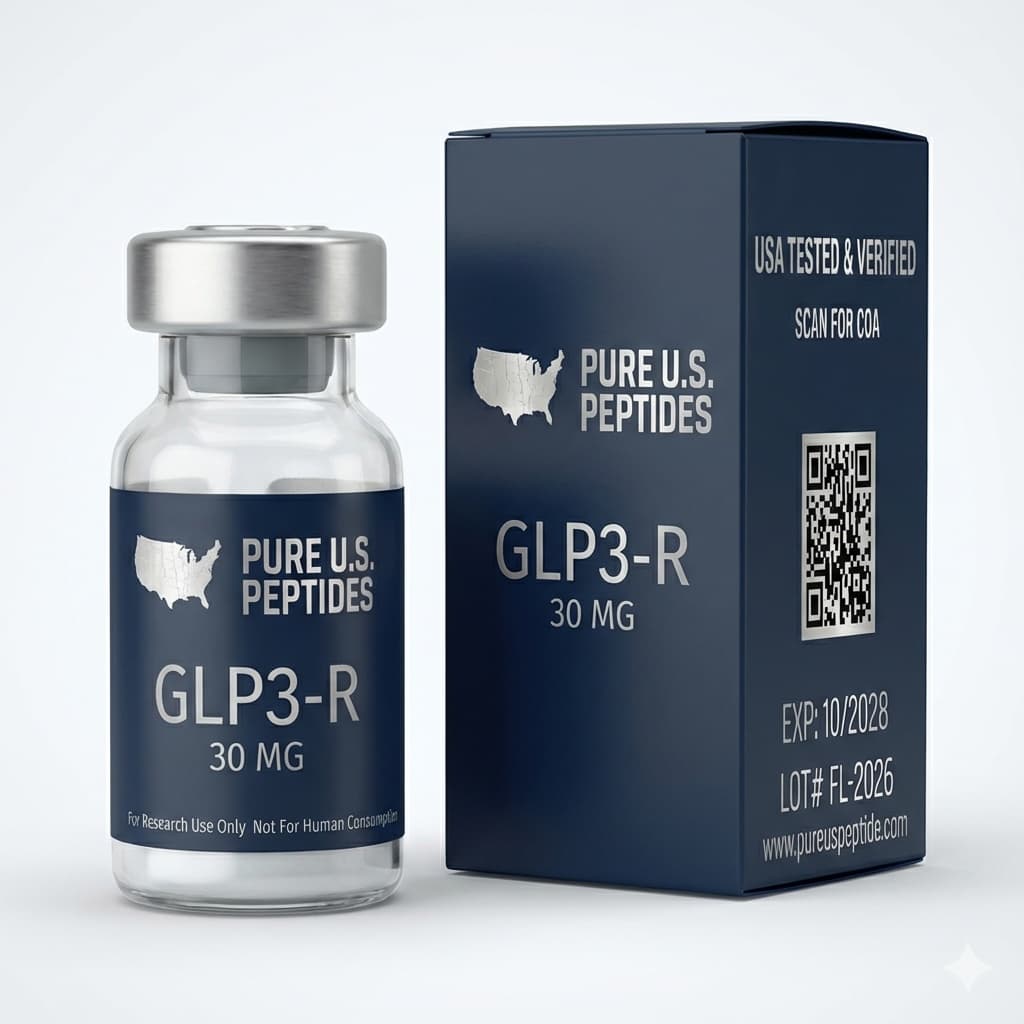
GLP3-R
30mg