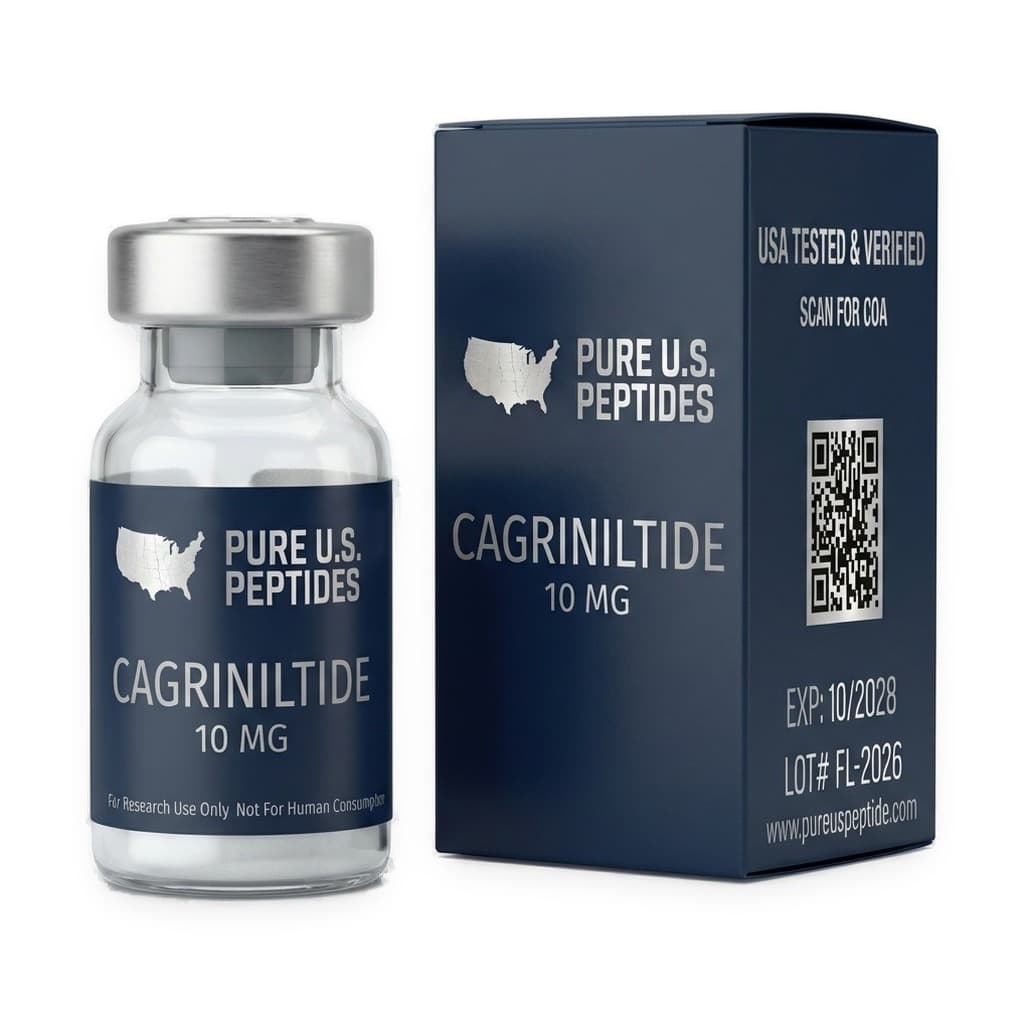
Cagriniltide 10mg
Em Estoque e Pronto para Envio dos EUA
Frete GRÁTIS em todos os pedidos nos EUA
Checkout seguro via processador de pagamento criptografado


 +2.9k
+2.9kApenas para Uso em Pesquisa
Estes produtos sao destinados exclusivamente a pesquisa laboratorial e nao se destinam ao uso medico. Nao sao aprovados pela FDA para diagnosticar, tratar, curar ou prevenir qualquer doenca. Ao adquirir, voce certifica que os produtos serao utilizados exclusivamente para pesquisa e nao para consumo humano ou animal.
Resumo da Pesquisa
19 Citacoes PubMedVisao Geral da Pesquisa Cagriniltide (AM833/NN1213) is a long-acting acylated analogue of human amylin — a 37-aminoacido pancreatic hormone co-secreted with insulin que regula satiety and glucose homeostasis. Native human amylin is unstable, prone to amyloid fibril formation, and has a muito short meia-vida. The first-generation analogue, pramlintide, requer multiplas administracoes diarias.[2] Cagriniltide overcomes these limitations through C20 fatty diacid acylation (via γ-glutamic acid spacer at Lysine 1), que binds serum albumin, extending the meia-vida to 159–195 hours. Proline substitutions (Pro21, Pro27) and specific aminoacido changes (N14E, V17R) prevent fibril formation and stabilize o peptideo's alpha-helix.[3] Cagriniltide (AM833) is a long-acting acylated amylin analogue and a non-selective amylin/calcitonin-receptor agonist (Kruse 2021). It is investigational and not approved. See References.[3]
Cagriniltide — Dados de Pesquisa em Resumo
| Propriedade | Valor |
|---|---|
| Citacoes PubMed Referenciadas | 19 |
| Pesquisadores Colaboradores | 3 |
| Condicoes de Armazenamento | Liofilizado: -80°C (2 anos) ou -20°C (1 ano), vedado e protegido da luz e da umidade. |
| Padrao de Pureza | >99.80% por HPLC (certificado publicado) |
| Apenas para Uso em Pesquisa | Nao destinado ao consumo humano. Apenas para uso em pesquisa. |
Research guide
What is Cagriniltide? Read the full research guideVisao Geral
Visao Geral da Pesquisa
Cagriniltide (AM833/NN1213) is a long-acting acylated analogue of human amylin — a 37-aminoacido pancreatic hormone co-secreted with insulin que regula satiety and glucose homeostasis. Native human amylin is unstable, prone to amyloid fibril formation, and has a muito short meia-vida. The first-generation analogue, pramlintide, requer multiplas administracoes diarias.[2]
Cagriniltide overcomes these limitations through C20 fatty diacid acylation (via γ-glutamic acid spacer at Lysine 1), que binds serum albumin, extending the meia-vida to 159–195 hours. Proline substitutions (Pro21, Pro27) and specific aminoacido changes (N14E, V17R) prevent fibril formation and stabilize o peptideo's alpha-helix.[3]
Cagriniltide (AM833) is a long-acting acylated amylin analogue and a non-selective amylin/calcitonin-receptor agonist (Kruse 2021). It is investigational and not approved. See References.[3]
Mecanismo de Acao
Mecanismo de Acao
Cagriniltide functions como um(a) non-selective dual agonist of ambos(as) calcitonin receptors (CTR) and amylin receptors (AMY1R, AMY2R, AMY3R) — heterodimers of CTR with RAMPs 1, 2, or 3.[3][12]
Receptor Targets & Binding
| Target | Interaction | Evidence |
|---|---|---|
| Calcitonin Receptor (CTR) | Non-selective agonist; class B1 GPCR; EC50 62 pM | Kruse et al. (2021); Cao et al. (2025) cryo-EM[3][9] |
| AMY1R (CTR+RAMP1) | Potent agonist; "bypass" conformation binding | RAMP1/3 KO abolishes the anorectic response (mice)[8] |
| AMY3R (CTR+RAMP3) | Potent agonist; EC50 49 pM (hAMY3R) | Carvas et al. (2025): required for the response in mice[8][13] |
| CGRPR / AM1R / AM2R | No or muito baixo(a) activity — selective for amylin/calcitonin axis | Fletcher et al. (2021)[12] |
Sinalizacao a Jusante
| Pathway | Effect | Consequence |
|---|---|---|
| Gs / Adenylyl Cyclase / cAMP | Gs-protein ativacao → adenylyl cyclase → intracellular cAMP accumulation | Primary cascata de sinalizacao for satiety[9] |
| Neuronal cFos (AP/NTS/LPBN) | Induces cFos expression in area postrema, nucleus of solitary tract, lateral parabrachial nucleus | Satiety signaling; 57% fewer AP neurons in RAMP1/3 KO[8] |
| Gastric Emptying | Delays gastric emptying | Gastric-emptying endpoints |
| Glucagon Suppression | Suppresses postprandial glucagon from pancreatic α-cells | Pancreatic signaling endpoints[6] |
Unique Binding Characteristics
| Property | Cagriniltide | Salmon Calcitonin |
|---|---|---|
| Receptor Conformation | "Bypass" (stabilized by ionic lock N14E–V17R) | "CT-like" conformation |
| Residence Time | 3–6 minutes (rapid dissociation) | 45–60 minutes (slow dissociation) |
| Desensibilizacao | Less receptor downregulacao reported | Receptor downregulacao reported |
RAMP Dependence: Carvas et al. (2025) demonstrated que the food-intake responses to cagriniltide in mice are strictly dependent on AMY1R and AMY3R — knockout of RAMP1 and RAMP3 abolished the response, with 57% fewer neurons ativou no(a) area postrema.[8]
Aplicacoes de Pesquisa
Aplicacoes de Pesquisa
Published literature (clinical trials used the pharmaceutical formulation; see References) covers:
Caracteristicas Bioquimicas
| Propriedade | Valor |
|---|---|
| Molecular Formula | C₁₉₄H₃₁₂N₅₄O₅₉S₂ |
| Molecular Weight | 4409.01 Da |
| CAS Number | 1415456-99-3 |
| PubChem CID | 171397054 |
| Sequence (1-Letter) | K(Eicosanedioic acid-γ-Glu)-CNTATCATQRLAEFLRHSSNNFGPILPPTNVGSNTP-NH₂ |
| Sequence (3-Letter) | {Eicosanedioic acid-γ-Glu}-Lys-Cys-Asn-Thr-Ala-Thr-Cys-Ala-Thr-Gln-Arg-Leu-Ala-Glu-Phe-Leu-Arg-His-Ser-Ser-Asn-Asn-Phe-Gly-Pro-Ile-Leu-Pro-Pro-Thr-Asn-Val-Gly-Ser-Asn-Thr-Pro-NH₂ |
| Structure | 37-aminoacido lipidated amylin analogue; C20 fatty diacid via γ-Glu spacer at Lys1; Cys2–Cys7 ponte dissulfeto; Pro21/Pro27 anti-fibrillation substitutions; N14E/V17R ionic lock |
| Origin | Engineered from human amylin scaffold by Novo Nordisk A/S |
| Classification | Long-Acting Amylin Analogue / DACRA / Research Peptide |
| Half-Life | ~159–195 hours (human); ~24h (rat), ~50h (rabbit), ~76h (dog), ~115h (minipig) |
| Bioavailability | ~40% (rat) |
Identificadores
| Synonyms | |
|---|---|
| InChI Key | |
| Developer |
Resumo da Pesquisa Pre-clinica
Resumo da Pesquisa Pre-clinica
Key Preclinical Studies
| Estudo | Modelo | Principais Achados | Ref |
|---|---|---|---|
| Carvas et al. (2025) | 129S2/SvEv mice — WT vs RAMP1/3 KO; 3–300 nmol/kg | 30 nmol/kg: 24h food intake ↓51%; 57% fewer AP neurons ativou in KO | [8] |
| Kruse et al. (2021) | Male SD rats — 0.1–30 nmol/kg; PK: 10 nmol/kg | Food intake reduziu for varios(as) days at 1–10 nmol/kg; T½ 20–27h | [3] |
| Dahl et al. (2024) | Rats — 30 nmol/kg single administration | Food intake reduziu 85% at 0–24h and 84% at 24–48h; EC50: hAMY3R 49 pM, hCTR 62 pM | [13] |
Ensaios Clínicos Publicados (apenas desenho)
| Ensaio | Desenho | Ref |
|---|---|---|
| REDEFINE 1 NCT05567796 | Phase 3; n=3,417; 68-week RCT; CagriSema vs sema vs cagri vs placebo | [5] |
| REDEFINE 2 NCT05394519 | Phase 3; n=1,206; 68-week RCT; CagriSema vs placebo | [6] |
| REIMAGINE 2 NCT06065540 | Phase 3; n=2,728; 68-week active-controlled; CagriSema vs sema | |
| Phase 2 combination study | n=92; 32-week; CagriSema vs sema vs cagri | [4] |
| Phase 2 monotherapy study | n=706; 26-week dose-finding; cagri (dose-ranging) vs liraglutide vs placebo | [2] |
| Phase 1b | n=95; 20-week; cagri + sema | [1] |
Os produtos oferecidos neste site são fornecidos apenas para estudos in vitro. Estudos in vitro (do latim: em vidro) são realizados fora do corpo. Estes produtos não são medicamentos ou fármacos e não foram aprovados pelo FDA dos EUA para prevenir, tratar ou curar qualquer condição médica, enfermidade ou doença. A introdução corporal de qualquer tipo em humanos ou animais é estritamente proibida por lei.
Apenas para Pesquisa Laboratorial. Não se destina ao uso humano, uso médico, uso diagnóstico ou uso veterinário.
TODOS OS ARTIGOS E INFORMAÇÕES SOBRE PRODUTOS FORNECIDOS NESTE SITE SÃO APENAS PARA FINS INFORMATIVOS E EDUCACIONAIS.
Autores e Atribuicao
✍️ Autor do Artigo
Thomas Kruse
Thomas Kruse is a lead scientist at Novo Nordisk A/S in Måløv, Denmark. He played a central role no(a) chemical development and structural engineering of cagriniltide, leading a estrutura-activity relationship (SAR) efforts to create a long-acting, estavel amylin analog que ativa ambos(as) amylin receptors e o(a) calcitonin receptor enquanto overcoming the instability and fibrillation issues of native human amylin. His key publications include "Development of Cagrilintide, a Long-Acting Amylin Analogue" (2021, Journal of Medicinal Chemistry) and "NN1213 – A Potent, Long-Acting, and Selective Analog of Human Amylin" (2024, Journal of Medicinal Chemistry). Thomas Kruse is being referenced as one do(a) leading scientists envolveu in cagriniltide research. De forma alguma este(a) médico(a)/cientista endossa ou defende a compra, venda ou uso deste produto por qualquer motivo. Não existe afiliação ou relação, implícita ou de outra forma, entre a Pure US Peptide e este(a) médico(a).
Ver Perfil Completo do Pesquisador →🎓 Autor de Revista Cientifica
W. Timothy Garvey, MD
W. Timothy Garvey, MD, é professor no Departamento de Ciências da Nutrição da University of Alabama at Birmingham. Foi investigador principal do programa de Fase 3 REDEFINE, que avaliou cagriniltide combinado com semaglutida (CagriSema), incluindo um ensaio com 3.417 participantes. É autor de publicações do programa REDEFINE. W. Timothy Garvey is being referenced as one do(a) leading scientists envolveu in cagriniltide research. De forma alguma este(a) médico(a)/cientista endossa ou defende a compra, venda ou uso deste produto por qualquer motivo. Não existe afiliação ou relação, implícita ou de outra forma, entre a Pure US Peptide e este(a) médico(a).
Ver Perfil Completo do Pesquisador →W. Timothy Garvey, MD is being referenced as one of the leading scientists involved in the research and development of Cagriniltide. In no way is this doctor/scientist endorsing or advocating the purchase, sale, or use of this product for any reason. There is no affiliation or relationship, implied or otherwise, between Pure US Peptide and this doctor. The purpose of citing the doctor is to acknowledge, recognize, and credit the exhaustive research and development efforts conducted by the scientists studying this peptide.
🔬 Pesquisador Colaborador
David C.W. Lau, MD, PhD
David C.W. Lau, MD, PhD, trabalha na Cumming School of Medicine da University of Calgary. Liderou o estudo de Fase 2 de cagriniltide em monoterapia e estudos de Fase 1b de segurança e tolerabilidade em combinação com semaglutida. Esses estudos foram publicados no The Lancet em 2021. David C.W. Lau is being referenced as one do(a) leading scientists envolveu in cagriniltide research. De forma alguma este(a) médico(a)/cientista endossa ou defende a compra, venda ou uso deste produto por qualquer motivo. Não existe afiliação ou relação, implícita ou de outra forma, entre a Pure US Peptide e este(a) médico(a).
Ver Perfil Completo do Pesquisador →David C.W. Lau, MD, PhD is being referenced as one of the leading scientists involved in the research and development of Cagriniltide. In no way is this doctor/scientist endorsing or advocating the purchase, sale, or use of this product for any reason. There is no affiliation or relationship, implied or otherwise, between Pure US Peptide and this doctor. The purpose of citing the doctor is to acknowledge, recognize, and credit the exhaustive research and development efforts conducted by the scientists studying this peptide.
Citacoes Referenciadas
Enebo LB, et al. Lancet, 397(10286), 1736-1748, 2021.
PubMedLau DCW, et al. Lancet, 398(10317), 2160-2172, 2021.
PubMedKruse T, et al. Development of Cagrilintide, a Long-Acting Amylin Analogue. Journal of Medicinal Chemistry, 64(15), 11183-11194, 2021.
PubMedFrias JP, et al. Lancet, 402(10403), 720-730, 2023.
PubMedGarvey WT, et al. New England Journal of Medicine, 393(7), 635-647, 2025.
PubMedDavies MJ, et al. New England Journal of Medicine, 393(7), 648-659, 2025.
PubMedVerma S, et al. Hypertension, 83(2), e26055, 2026.
PubMedCarvas AO, et al. Cagrilintide lowers bodyweight through brain amylin receptors 1 and 3. EBioMedicine, 118, 105836, 2025.
PubMedCao J, et al. Structural and dynamic features of cagrilintide binding to calcitonin and amylin receptors. Nature Communications, 16, 3389, 2025.
PubMedGu YM, et al. Structural and mechanistic insights into dual ativacao of cagrilintide in amylin and calcitonin receptors. Acta Pharmacologica Sinica, 47(1), 162-172, 2026.
PubMedWang Y, Feng Z, Yu L. The Innovation Medicine, 3(3), 100150, 2025.
PubMedFletcher MM, et al. AM833 Is a Novel Agonist of Calcitonin Family G Protein-Coupled Receptors: Pharmacological Comparison with Six Selective and Nonselective Agonists. JPET, 377(3), 417-440, 2021.
PubMedDahl K, et al. Journal of Medicinal Chemistry, 67(14), 11688–11700, 2024.
PubMedBecerril S, Frühbeck G. Lancet, 397(10286), 1687-1689, 2021.
PubMedD'Ascanio AM, et al. Cardiology in Review, 32(1), 83-90, 2024.
PubMedMikhail N, Wali S. Clinical Trials and Clinical Research, 2(5), 2023.
PubMedHales CM. New England Journal of Medicine, 393(7), 712-714, 2025.
PubMedGadde KM, Allison DB. Lancet, 398(10317), 2132-2134, 2021.
PubMedDehestani B, et al. Journal of Obesity & Metabolic Syndrome, 30(4), 320-325, 2021.
PubMedAviso de Uso em Pesquisa
Apenas para Uso em Pesquisa (RUO). Nao destinado ao consumo humano, uso clinico, ou como medicamento, alimento, cosmetico ou dispositivo medico. Este produto nao foi avaliado pelo FDA e e fornecido exclusivamente para pesquisa laboratorial in vitro por profissionais qualificados.
Certificado de Analise
Published certificates come from third-party laboratories. If this listing's certificate is still pending, the card below says so.
Ultimo Relatorio de Laboratorio
Armazenamento e Manuseio
Resumo
Liofilizado: -80°C (2 anos) ou -20°C (1 ano), vedado e protegido da luz e da umidade.
Pó Liofilizado
Store at -80°C por até 2 years or -20°C por até 1 year. Keep sealed, away from moisture and light, preferably under inert gas (N₂).
Manuseio
White to off-white powder. Os certificados publicados informam a pureza por HPLC e as endotoxinas quando testadas. Physical stability: Thioflavin T (ThT) assay confirma >40 hours fibril-free under stress conditions.
“Resumo da Pesquisa Pre-clinica Key Preclinical Studies Estudo Modelo Principais Achados Ref Carvas et al.”
Compostos de Pesquisa Relacionados
GLP2-T
60mg
GLP3-R
60mg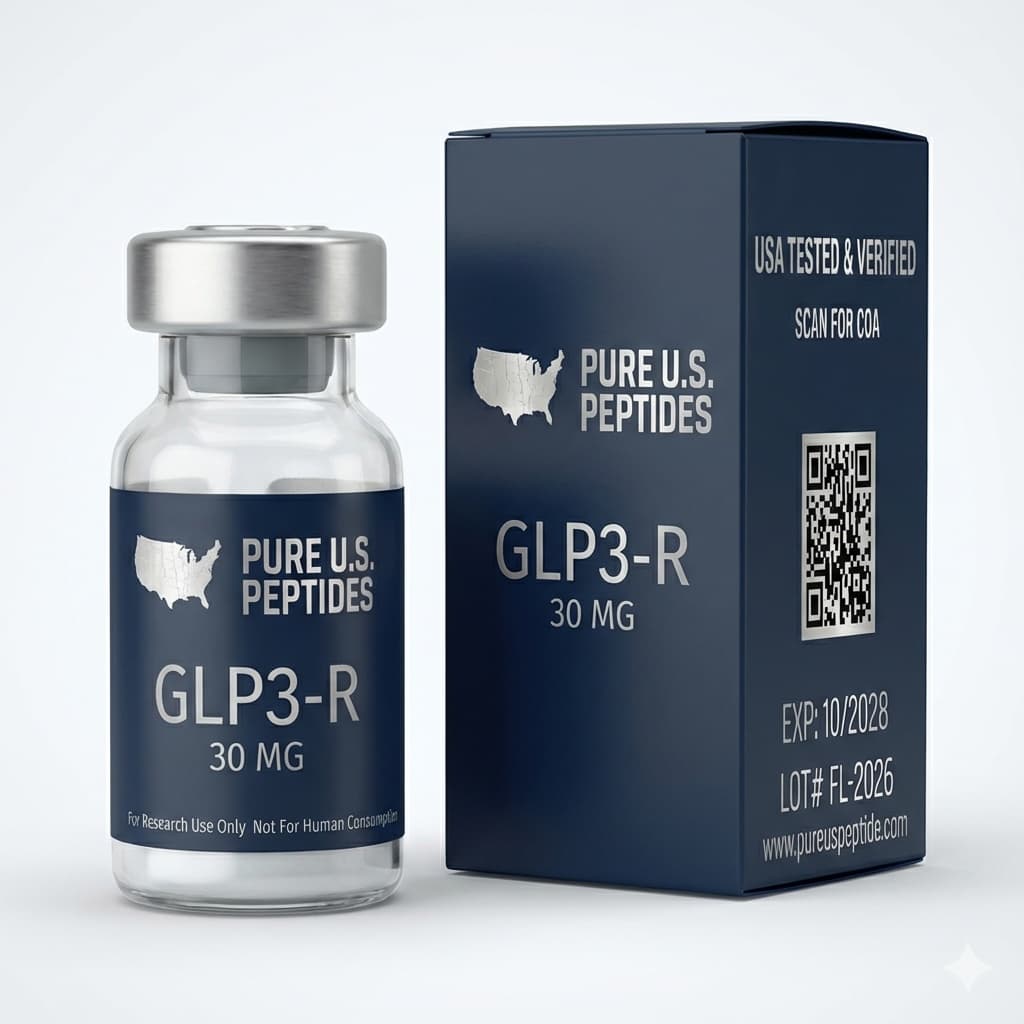
GLP3-R
30mg