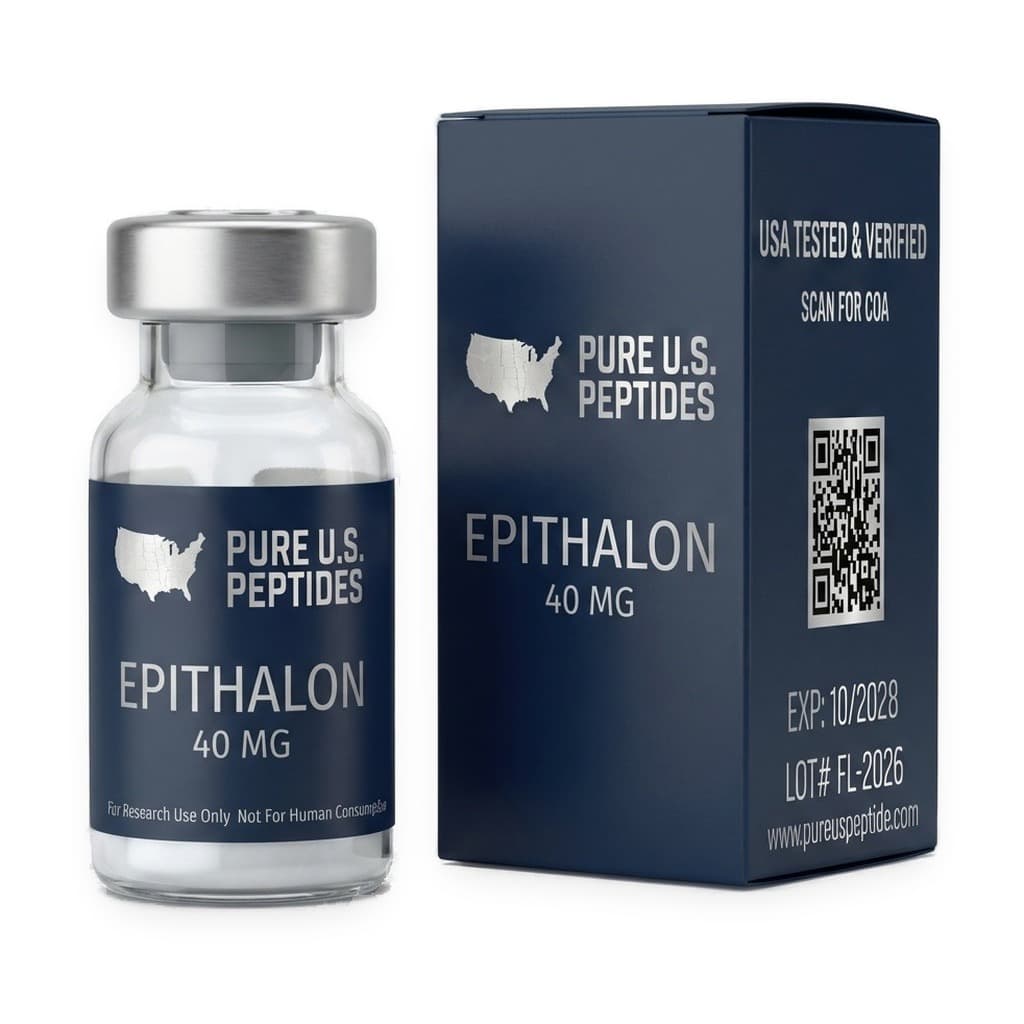
Epithalon 40mg
In Stock & Ready to Ship from USA
FREE shipping on every U.S. order
Secure checkout via encrypted payment processor


 +2.9k
+2.9kResearch Use Only
These products are for laboratory research only and not intended for medical use. They are not FDA-approved to diagnose, treat, cure, or prevent any disease. By purchasing, you certify they will be used solely for research and not for human or animal consumption.
Research Summary
21 PubMed CitationsResearch Overview Epithalon (Ala-Glu-Asp-Gly) is a synthetic tetrapeptide geroprotector developed by Prof. Vladimir Khavinson at the St. Petersburg Institute of Bioregulation and Gerontology as the active component of Epithalamin (bovine pineal gland extract). Its discovery originated from 1970s Soviet military research to protect soldiers from radiation and accelerated aging.[4] Epithalon's mechanism is fundamentally different from classical receptor-ligand pharmacology. Rather than binding a cell surface receptor, it enters the nucleus and interacts directly with DNA (targeting CAG repeats and ATTTC promoter sequences) and histone proteins (H1.3, H1.6) — functioning as an epigenetic switch that converts heterochromatin to euchromatin, making silenced genes accessible for transcription.[1][3] Research spans 10+ indication categories across gerontology, oncology, ophthalmology, endocrinology, and neuroscience — with over 50 years of study (1970s–2025). The "Epithalon Paradox" — activating telomerase while simultaneously inhibiting cancer — challenges conventional oncological assumptions and remains a major focus of current research.[7] Discovery and historical context:...
Epithalon 40mg at a glance
| Specification | Detail |
|---|---|
| Identity | Epithalon (Epitalon), synthetic tetrapeptide |
| Listed amount | 40mg |
| Storage | Store lyophilized Epithalon at -20 degrees C, protected from moisture and light. Avoid freeze-thaw cycles. |
| Lot certificate | Report pending; no published lot certificate today |
| Price | $103.95 |
| Price per mg | $2.60 per mg |
| Dispatch | Same business day for orders before 2:00 PM EST Monday through Friday |
| U.S. shipping | Free on every order |
| Included with every order | Free BAC water vial |
| Product status | This listing is not an FDA-approved drug. Strictly for laboratory Research Use Only. |
Current price and availability are shown in the purchase panel at the top of this page.
Epithalon — Research Data at a Glance
| Property | Value |
|---|---|
| PubMed Citations Referenced | 21 |
| Contributing Researchers | 3 |
| Storage Conditions | Store lyophilized at -20°C (years-stable). |
| Purity Standard | Certificate pending |
| Research Use Only | Not for human consumption. RUO only. |
Compare Epithalon with Other Peptides
Research guide
What is Epithalon? Read the full research guideOverview
Research Overview
Epithalon (Ala-Glu-Asp-Gly) is a synthetic tetrapeptide geroprotector developed by Prof. Vladimir Khavinson at the St. Petersburg Institute of Bioregulation and Gerontology as the active component of Epithalamin (bovine pineal gland extract). Its discovery originated from 1970s Soviet military research to protect soldiers from radiation and accelerated aging.[4]
Epithalon's mechanism is fundamentally different from classical receptor-ligand pharmacology. Rather than binding a cell surface receptor, it enters the nucleus and interacts directly with DNA (targeting CAG repeats and ATTTC promoter sequences) and histone proteins (H1.3, H1.6) — functioning as an epigenetic switch that converts heterochromatin to euchromatin, making silenced genes accessible for transcription.[1][3]
Research spans 10+ indication categories across gerontology, oncology, ophthalmology, endocrinology, and neuroscience — with over 50 years of study (1970s–2025). The "Epithalon Paradox" — activating telomerase while simultaneously inhibiting cancer — challenges conventional oncological assumptions and remains a major focus of current research.[7]
Discovery and historical context: The Khavinson program's "peptide theory of aging" emerged from analysis of bovine pineal extracts that protected animals from radiation-induced premature aging. Sequence analysis identified Ala-Glu-Asp-Gly as the active fragment; synthesis confirmed that the tetrapeptide reproduced the geroprotective activity of the parent extract. Epithalon's signature pharmacology includes a bell-shaped dose-response curve with peak activity at ultra-low concentrations (10⁻¹⁷ to 10⁻¹⁵ M), consistent with the modern view that bioregulator peptides act as informational rather than mass-action signaling molecules. The N-terminal glutamic acid is prone to spontaneous cyclization to pyroglutamate, requiring careful storage and HPLC purity verification (≥98% standard).[2][4]
Research framework: Modern Epithalon investigation organizes around three principal mechanism-of-action lines: direct DNA/histone binding (Khavinson 2020 binding studies, with high-affinity engagement of CAG repeats, ATTTC promoter sequences, and histones H1.3/H1.6), telomere maintenance (Al-dulaimi 2025 dual-mechanism — telomerase upregulation in normal cells, ALT pathway in cancer cells), and circadian/melatonin axis restoration (Goncharova 2001 in old rhesus monkeys, Ivko 2021 in human pineal gene expression). Researchers studying related geroprotector and bioregulator peptides commonly cross-reference our DSIP, Selank, and Thymosin Alpha-1 pages for parallel pineal-gland and immune-rejuvenation pharmacology.
Mechanism of Action
Mechanism of Action
Epithalon operates via a receptor-independent, epigenetic mechanism — bypassing cell surface receptors to directly interact with the genome. It penetrates the cell nucleus and binds to DNA and histone proteins, functioning as a master gene regulator.[3][1]
Primary Epigenetic Targets
| Target | Mechanism | Downstream Effect |
|---|---|---|
| DNA — CAG repeats & ATTTC sequences | Binds major groove of DNA double helix | Lowers chromatin melting temperature → prevents genomic "hardening" with age |
| Histone H1.3 & H1.6 | High-affinity binding → decondenses heterochromatin → euchromatin | Silenced genes become accessible for transcription |
| hTERT gene promoter | Direct promoter binding → upregulates hTERT mRNA (12-fold at 1 µg/mL) | Telomerase synthesis → TTAGGG repeat elongation |
Dual Telomere Mechanism (Al-dulaimi et al., 2025)
| Cell Type | Mechanism | Markers |
|---|---|---|
| Normal somatic cells | Telomerase-mediated elongation (classic pathway) | ↑ hTERT mRNA → ↑ telomerase activity → TTAGGG addition |
| Cancer cells | ALT (Alternative Lengthening of Telomeres) via replication stress | C-circles, PML bodies — NOT increased telomerase activity |
Downstream Signaling Cascades
| Pathway | Targets | Effect |
|---|---|---|
| Melatonin Synthesis | ↑ AANAT + pCREB in pinealocytes | Restores nighttime melatonin production |
| Antioxidant Defense | Keap1/Nrf2 pathway activation | ↑ SOD, Catalase, Glutathione Peroxidase |
| Immune Signaling | ↑ STAT1 + ERK1/2 phosphorylation; ↑ IL-2 mRNA (within 5h) | T-cell proliferation; NO STAT3 activation |
| Circadian Clock | Modulates Clock, Cry2, Csnk1e genes | Circadian-rhythm endpoints reported |
No opioid receptor binding — Epithalon does not interact with µ or δ opioid receptors despite being a peptide. Its STAT1 phosphorylation is believed to be receptor-independent.[3]
Chromatin Remodeling Detail
Khavinson 2003 demonstrated direct chromatin activation in aged human lymphocytes — Epithalon binding to histones H1.3 and H1.6 lowers chromatin melting temperature, decondenses heterochromatin, and converts silent genome regions into transcriptionally accessible euchromatin. This rescue of "genomic hardening" appears to underlie the broader signature of restored gene expression observed across aged tissues — including AANAT/pCREB upregulation in pinealocytes (restoring nighttime melatonin production), Nrf2 pathway activation (driving SOD/catalase/glutathione peroxidase induction), and STAT1/ERK1/2 phosphorylation with IL-2 mRNA upregulation in T cells (within 5 hours of exposure).[21][3]
Telomere Length Resolution
Al-dulaimi 2025 resolved the long-standing question of whether Epithalon's telomere effects rely solely on telomerase upregulation. Cell-line studies showed two distinct pathways: in normal somatic cells, Epithalon increases hTERT mRNA up to 12-fold and drives canonical telomerase-mediated TTAGGG repeat elongation; in cancer cells, telomere extension proceeds via the alternative lengthening of telomeres (ALT) pathway, marked by C-circles and PML bodies but not increased telomerase activity. This dual mechanism appears to be the molecular substrate for the "Epithalon Paradox" — telomere maintenance through pathway selection rather than uniform telomerase activation, allowing normal-cell rejuvenation without driving cancer cells through telomerase-amplified proliferation.[1]
Bell-Shaped Dose Response & Pharmacokinetic Constraints
Epithalon exhibits a non-classical bell-shaped dose-response curve with peak activity at ultra-low concentrations (10⁻¹⁷ to 10⁻¹⁵ M), consistent with informational-bioregulator pharmacology. This profile constrains experimental design — higher concentrations frequently produce reduced effects, and most published rodent studies use intermittent monthly exposure schedules rather than continuous high-dose exposure.[2]
Research Applications
Research Applications
Epithalon research spans 10+ indication categories with over 50 years of investigation (1970s–2025):
- Telomere Extension & Cellular Senescence — In telomerase-negative human fetal fibroblast culture, Epithalon induced expression of the telomerase catalytic subunit, telomerase enzymatic activity, and telomere elongation; peptide-treated aging cultures completed roughly 10 additional passages (44 vs 34) relative to control, i.e. surpassed the Hayflick limit in vitro.[5][18]
- Cancer Prevention Paradox — Inhibits spontaneous tumors in HER-2/neu mice; reduces oncogene expression 3.7-fold; anti-metastatic — despite telomerase activation.[7][14]
- Retinal Degeneration / Retinitis Pigmentosa — in Campbell rats, intensified retinal bioelectric and functional activity with preserved morphological structure.[9]
- Circadian Rhythm & Sleep Regulation — Endpoints reported for melatonin secretion and cortisol rhythms in aged monkeys and humans.[11][15]
- Neuroprotection & Neurogenesis — Upregulates Nestin, GAP43, Beta-Tubulin III in stem cells; promotes neuronal differentiation.[3]
- Immune Aging — ↑ IL-2, T-cell proliferation; corrects age-related CD4+/CD8+ ratios.[4]
- Antioxidant Defense — ↑ SOD (+41%), catalase (+20%), glutathione peroxidase; ↓ lipid peroxidation and ROS.[6]
- Diabetic Retinopathy / Wound Healing — Inhibits EMT and fibrosis in high-glucose RPE cells.[12]
- Reproductive Health — Restores estrous cycles in aged rats; improves oocyte quality and blastocyst hatching.[10]
- Aging Biology — Maximum lifespan increased 12–13% in mice; up to 24% in CBA model; reduced chromosomal aberrations.[7][8]
- Nephroprotection — Zamorskii 2015, cisplatin-induced acute renal failure in rats: AEDG normalized diuresis, urinary creatinine concentration and excretion, glomerular filtration rate, and absolute sodium resorption, and reduced urinary protein concentration and excretion.[13]
- Oocyte Quality & Reproductive Aging — Yue 2022 demonstrated post-ovulatory aging protection in mouse oocytes; Ullah 2025 showed activated telomerase, improved blastocyst hatching, and reduced ROS in bovine oocytes — implicating Epithalon as a tool peptide for studying telomere-mediated reproductive senescence.[10][20]
Comparative Research Context
Epithalon sits at the intersection of three adjacent peptide-pharmacology research programs: the Khavinson "peptide bioregulator" family (vilon, livagen, pinealon — short peptides with epigenetic activity), the geroprotector / circadian-modulator class (DSIP, melatonin), and the modern telomere-biology field (TA-65, GRN163L). Its receptor-independent direct DNA/histone binding mechanism distinguishes it from receptor-targeted geroprotector candidates and supports its use as a research tool for studying chromatin-state pharmacology. Researchers comparing Epithalon with related bioregulator and geroprotector peptides commonly cross-reference our DSIP, Selank, and Thymosin Alpha-1 pages for parallel pineal-axis, immune-rejuvenation, and stress-resilience pharmacology in matched aging models. The Khavinson 2003 telomerase upregulation, Anisimov 2003 lifespan-extension, and Al-dulaimi 2025 dual-mechanism studies together establish Epithalon as the canonical research peptide for investigating the telomere-aging axis in cell and rodent systems.
Biochemical Characteristics
| Property | Value |
|---|---|
| Molecular Formula | C₁₄H₂₂N₄O₉ |
| Molecular Weight | 390.35 Da |
| CAS Number | 307297-39-8 |
| PubChem CID | 219042 |
| Sequence (1-Letter) | AEDG |
| Sequence (3-Letter) | Ala-Glu-Asp-Gly |
| Structure | Linear tetrapeptide; four L-amino acids; no disulfide bridges |
| InChI Key | HGHOBRRUMWJWCU-FXQIFTODSA-N |
| Origin | Synthetic analog of Epithalamin (bovine pineal gland extract) |
| Classification | Peptide Bioregulator / Geroprotector / Research Peptide |
| Dose-Response | Bell-shaped / non-linear — peak activity at ultra-low concentrations (10⁻¹⁷ to 10⁻¹⁵ M) |
Identifiers
| SMILES | |
|---|---|
| IUPAC Name | |
| Synonyms | |
| UNII Code | |
| Salt Forms |
Preclinical Research Summary
Preclinical Research Summary
Key Preclinical Studies
| Study | Model | Key Findings | Ref |
|---|---|---|---|
| Anisimov/Popovich et al. (2003) | SHR mice — 5d/month design from 3 mo | Last 10% lifespan increased 13.3%; chromosomal aberrations ↓17.1%; leukemia inhibited 6-fold | [7] |
| Anisimov et al. (2002) | HER-2/neu transgenic mice — monthly design | HER-2/neu mRNA reduced 3.7-fold; breast adenocarcinoma incidence significantly reduced | [14] |
| Kossoy et al. (2006) | C3H/He mice — 6.5-mo design | Reduced tumor metastasis and multiplicity | [8] |
| Anisimov et al. (2001) | CBA mice — monthly design | Oldest treated mouse lived 34 months vs 24 mo control; mice reaching 23 mo increased 4-fold | [4] |
| Khavinson et al. (2002–03) | Campbell rats — retinal-degeneration model | Retinal function prolonged 43.9%; 90% of retinal layers preserved at day 41 vs complete destruction | [9] |
| Zamorskii et al. (2015) | Rats — cisplatin-induced acute renal failure | AEDG normalized diuresis, urinary creatinine and its excretion, GFR, and sodium resorption; reduced urinary protein | [13] |
| Goncharova et al. (2001–05) | Old female rhesus monkeys — 10 µg/kg IM | Restored nighttime melatonin synthesis; normalized cortisol circadian rhythm; improved glucose tolerance | [11] |
| Khavinson et al. (2000–01) | Drosophila — 0.00001–0.001% in medium | Mean lifespan +11–16%, max +14%; SOD +41%, catalase +20%; mortality reduced | [6] |
| Ullah et al. (2025) | Bovine oocytes in vitro | Activated telomerase; improved blastocyst hatching; reduced ROS | [10] |
Clinical / Human Studies
| Trial | Population | Intervention | Key Results | Ref |
|---|---|---|---|---|
| Circadian Gene Expression | Older adults (pineal-function study) | Not specified in source abstract | Urinary 6-sulfatoxymelatonin and circadian gene-expression (Clock, Csnk1e, Cry2) endpoints | [15] |
| Telomere Elongation (in vitro) | Human fetal fibroblast culture — not human subjects | Peptide added to culture medium | Induced telomerase catalytic subunit expression and telomere elongation; treated cultures reached 44 passages vs 34 in control | [5][18] |
| Genome Instability in Pulmonary TB (ex vivo) | Mitogen-stimulated cell cultures from TB patients — peptide applied to cultures, not administered to patients | Peptide added to short-term culture | Reduced mean frequency of aberrant cells on the chromosome-aberration test; elevated chromosome fragility persisted | [16] |
Safety Summary
| Parameter | Finding |
|---|---|
| Long-term Animal Studies | No toxicity in mice/rats from 3 months of age until natural death; reduced mortality and spontaneous tumors |
| Human Studies | The published human reports cited here are small and largely single-centre; they are not adequate to characterize a safety profile |
| Cancer Risk Paradox | Despite telomerase activation, animal studies consistently show ANTI-tumor and anti-metastatic effects |
| Degradation | N-terminal glutamic acid can cyclize to pyroglutamate; TFA salt affects net peptide content |
Authors & Attribution
✍️ Article Author
Prof. Vladimir Khavinson, M.D., Ph.D.
Prof. Vladimir Khavinson is the Director of the St. Petersburg Institute of Bioregulation and Gerontology, a Member of the Russian Academy of Sciences, and a retired Colonel of Medical Service. He is the primary inventor and pioneer of peptide bioregulators, leading the original discovery of Epithalamin (pineal gland extract) and the subsequent synthesis of Epithalon (Ala-Glu-Asp-Gly). His research established the 'peptide theory of aging,' demonstrating Epithalon's ability to reactivate telomerase, elongate telomeres, and regulate gene expression at the epigenetic level. Foundational research began in the 1970s at the S.M. Kirov Military Medical Academy in the Soviet Union. Key publications include 'Epithalon Peptide Induces Telomerase Activity and Telomere Elongation in Human Somatic Cells' (2003) and 'AEDG Peptide Stimulates Gene Expression during Neurogenesis' (2020). Prof. Vladimir Khavinson is referenced as the leading scientist in Epithalon research. In no way is this doctor/scientist endorsing or advocating the purchase, sale, or use of this product for any reason. There is no affiliation or relationship, implied or otherwise, between Pure US Peptide and this doctor.
View Full Researcher Profile →🎓 Scientific Journal Author
Prof. Vladimir N. Anisimov, M.D., Ph.D.
Prof. Vladimir N. Anisimov is a researcher at the N.N. Petrov Research Institute of Oncology (St. Petersburg, Russia). He has been instrumental in characterizing the geroprotective and oncostatic properties of Epithalon in animal models, providing decades of critical evidence that while Epithalon extends telomeres, it does not promote cancer — paradoxically inhibiting spontaneous tumor development and extending lifespan in mice. His work established the 'Epithalon Paradox' in gerontological research. Key publications include 'Effect of Epitalon on biomarkers of aging, life span and spontaneous tumor incidence in SHR mice' (Biogerontology, 2003) and 'Inhibitory effect on HER-2/neu mammary tumors' (2002). Prof. Vladimir Anisimov is referenced as a leading scientist in Epithalon research. In no way is this doctor/scientist endorsing or advocating the purchase, sale, or use of this product for any reason. There is no affiliation or relationship, implied or otherwise, between Pure US Peptide and this doctor.
View Full Researcher Profile →Prof. Vladimir N. Anisimov, M.D., Ph.D. is being referenced as one of the leading scientists involved in the research and development of Epithalon. In no way is this doctor/scientist endorsing or advocating the purchase, sale, or use of this product for any reason. There is no affiliation or relationship, implied or otherwise, between Pure US Peptide and this doctor. The purpose of citing the doctor is to acknowledge, recognize, and credit the exhaustive research and development efforts conducted by the scientists studying this peptide.
🔬 Contributing Researcher
Prof. Natalia S. Linkova
Prof. Natalia S. Linkova is a Doctor of Biological Sciences at the St. Petersburg Institute of Bioregulation and Gerontology and the Academy of Postgraduate Education under FSBU FSCC of FMBA of Russia. She is a prominent researcher in the molecular mechanisms of peptide bioregulators, focusing on how Epithalon interacts with DNA and histone proteins to regulate gene expression, neurogenesis, and cell differentiation — providing the mechanistic explanation for the peptide's broad biological effects. Key publications include 'AEDG Peptide Stimulates Gene Expression and Protein Synthesis during Neurogenesis: Possible Epigenetic Mechanism' (Molecules, 2020) and 'Peptide Regulation of Gene Expression: A Systematic Review' (2021). Prof. Natalia Linkova is referenced as a leading scientist in Epithalon research. In no way is this doctor/scientist endorsing or advocating the purchase, sale, or use of this product for any reason. There is no affiliation or relationship, implied or otherwise, between Pure US Peptide and this doctor.
View Full Researcher Profile →Prof. Natalia S. Linkova is being referenced as one of the leading scientists involved in the research and development of Epithalon. In no way is this doctor/scientist endorsing or advocating the purchase, sale, or use of this product for any reason. There is no affiliation or relationship, implied or otherwise, between Pure US Peptide and this doctor. The purpose of citing the doctor is to acknowledge, recognize, and credit the exhaustive research and development efforts conducted by the scientists studying this peptide.
Referenced Citations
Al-Dulaimi S, Thomas R, Matta S, Roberts T. Biogerontology. 2025;26(5):178.
PubMedAraj SK, Brzezik J, Mądra-Gackowska K, Szeleszczuk Ł. Overview of Epitalon—Highly Bioactive Pineal Tetrapeptide with Promising Properties. Int J Mol Sci. 2025;26(6):2691.
PubMedKhavinson V, Diomede F, Mironova E, et al. AEDG Peptide (Epitalon) Stimulates Gene Expression and Protein Synthesis during Neurogenesis: Possible Epigenetic Mechanism. Molecules. 2020;25(3):609.
PubMedAnisimov VN, Khavinson VK. Peptide bioregulation of aging: results and prospects. Biogerontology. 2010;11(2):139-149.
PubMedKhavinson VK, Bondarev IE, Butyugov AA. Bull Exp Biol Med. 2003;135(6):590-592.
PubMedKhavinson VK, Izmaylov DM, Obukhova LK, Malinin VV. Effect of epitalon on the lifespan increase in Drosophila melanogaster. Mech Ageing Dev. 2000;120(1):141-149.
PubMedAnisimov VN, Khavinson VK, Popovich IG, et al. Effect of Epitalon on biomarkers of aging, life span and spontaneous tumor incidence in female Swiss-derived SHR mice. Biogerontology. 2003;4(4):193-202.
PubMedKossoy G, Anisimov VN, Ben-Hur H, et al. Effect of the synthetic pineal peptide epitalon on spontaneous carcinogenesis in female C3H/He mice. In Vivo. 2006;20(2):253-257.
PubMedKhavinson V, Razumovsky M, Trofimova S, et al. Neuro Endocrinol Lett. 2002;23(4):365-368.
PubMedUllah S, Haider Z, Perera CD, et al. Epitalon-activated telomerase enhance bovine oocyte maturation rate and post-thawed embryo development. Life Sciences. 2025;362:123381.
PubMedGoncharova ND, Khavinson BK, Lapin BA. Regulatory Effect of Epithalon on Production of Melatonin and Cortisol in Old Monkeys. Bull Exp Biol Med. 2001;131(4):394-396.
PubMedGatta M, Dovizio M, Milillo C, et al. The Antioxidant Tetrapeptide Epitalon Enhances Delayed Wound Healing in an in Vitro Model of Diabetic Retinopathy. Stem Cell Rev Rep. 2025;21(6):1822-1834.
PubMedZamorskii II, Shchudrova TS, Lin'kova NS, Nichik TE, Khavinson VK. Peptides Restore Functional State of the Kidneys During Cisplatin-Induced Acute Renal Failure. Bull Exp Biol Med. 2015;159(6):736-739.
PubMedAnisimov VN, Khavinson VK, Alimova IN, et al. Epithalon Decelerates Aging and Suppresses Development of Breast Adenocarcinomas in Transgenic HER-2/neu Mice. Bull Exp Biol Med. 2002;134(2):187-190.
PubMedIvko OM, Linkova NS, Ilina AR, Sharova AA, Ryzhak GA. Adv Gerontol. 2020;33(3):429-435.
PubMedDzhokhadze TA, Buadze TZh, Rubanov KD, Kiriia NA, Lezhava TA. Georgian Med News. 2013;(224):77-81.
PubMedAnisimov VN, Khavinson VK, Popovich IG, Zabezhinski MA. Inhibitory effect of peptide Epitalon on colon carcinogenesis induced by 1,2-dimethylhydrazine in rats. Cancer Letters. 2002;183(1):1-8.
PubMedKhavinson VK, Bondarev IE, Butyugov AA, Smirnova TD. Bull Exp Biol Med. 2004;137(5):503-506.
PubMedKozina LS, et al. Effects of vilon and epithalon peptides on neprilysin and insulin-degrading enzyme in neuroblastoma NB7 cells. Neurochem J. 2008;2(1):69-71.
DOIYue X, Liu SL, Guo JN, et al. Epitalon protects against post-ovulatory aging-related damage of mouse oocytes in vitro. Aging (Albany NY). 2022;14(7):3191-3202.
PubMedKhavinson VK, Lezhava TA, Monaselidze JR, et al. Peptide Epitalon activates chromatin at the old age. Neuro Endocrinol Lett. 2003;24(5):329-333.
PubMedRUO Disclaimer
For Research Use Only (RUO). Not intended for human consumption, clinical use, or as a drug, food, cosmetic, or medical device. This product has not been evaluated by the FDA and is supplied solely for in-vitro laboratory research by qualified professionals.
Certificate of Analysis
Published certificates come from third-party laboratories. If this listing's certificate is still pending, the card below says so.
Latest Lab Report
Storage & Handling
Summary
Store lyophilized at -20°C (years-stable). Protect from moisture and light.
❄️ Lyophilized Powder Storage
Store Epithalon (Epitalon) lyophilized powder at -20°C in a sealed container, protected from light and moisture. Under these conditions, the peptide is stable for several years. For long-term archival storage, -80°C is recommended. Keep vials desiccated; the tetrapeptide Ala-Glu-Asp-Gly is hygroscopic and will absorb atmospheric moisture if exposed.
⚗️ Salt Form & Solubility
Epithalon is water-soluble as the free peptide. If supplied as the TFA (trifluoroacetic acid) salt, the TFA counterion contributes to the mass — net peptide content is lower than the stated weight. If supplied as the acetate salt, net peptide content is higher.
⚠️ Degradation Pathway
The N-terminal glutamic acid (Glu) residue in the AEDG sequence can cyclize to pyroglutamate, a spontaneous non-enzymatic degradation pathway. This reaction is accelerated by heat and repeated freeze-thaw cycles. Storage at -20°C minimizes this pathway. Purity verification should be performed by RP-HPLC and mass spectrometry before use.
For Research Use Only. This product is furnished for in-vitro laboratory studies only. Not approved by the FDA for any medical indication.
“Preclinical Research Summary Key Preclinical Studies Study Model Key Findings Ref Anisimov/Popovich et al.”
Frequently Asked Questions
Common research questions about Epithalon — purity, handling, COA documentation, and published-research context.
Related Research Compounds
5-Amino 1MQ
50mg
NAD+
1000mg
MOTS-C
40mg