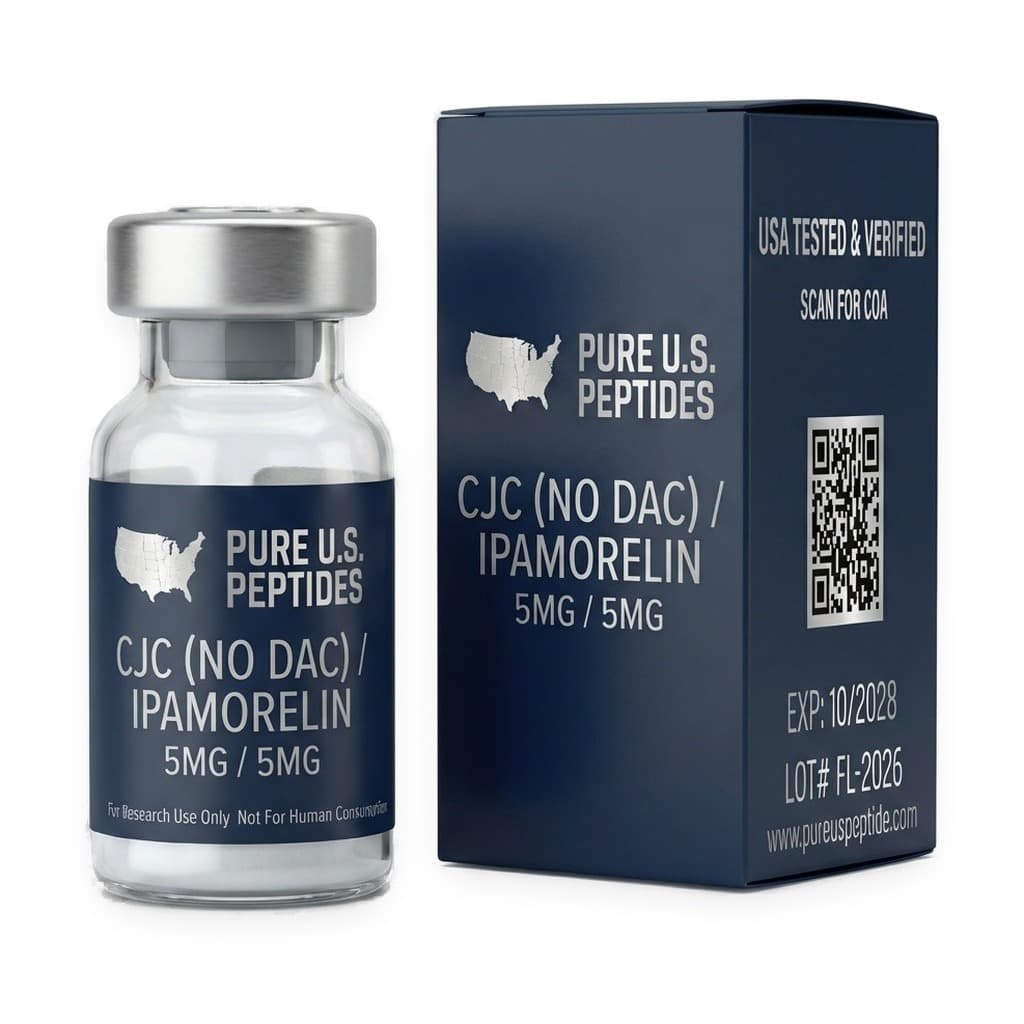
CJC (no DAC)/Ipamorelin 5mg/5mg
En Stock y Listo para Envío desde EE.UU.
Envío GRATIS en todos los pedidos de EE.UU.
Pago seguro mediante procesador de pagos encriptado


 +2.9k
+2.9kSolo para Uso en Investigación
Estos productos son exclusivamente para investigación de laboratorio y no están destinados para uso médico. No están aprobados por la FDA para diagnosticar, tratar, curar o prevenir ninguna enfermedad. Al realizar su compra, usted certifica que serán utilizados exclusivamente para investigación y no para consumo humano o animal.
Bundle / Blend Research
This product contains CJC-1295 (no DAC) + Ipamorelin. Select a tab below to view the full Gold Standard research profile for each component.
Descripción General
Descripción General de la Investigación
CJC-1295 (sin DAC), frecuentemente referido en la literatura científica como GRF Modificado (1-29) o Mod GRF 1-29, es un péptido sintético análogo de la hormona liberadora de hormona del crecimiento (GHRH) endógena. Se deriva de los primeros 29 aminoácidos de la molécula nativa de GHRH de 44 aminoácidos producida en el hipotálamo, representando el fragmento biológicamente activo responsable de estimular la liberación de hormona del crecimiento (GH) desde la hipófisis anterior.[1][2] El péptido fue originalmente desarrollado por ConjuChem Biotechnologies Inc. (Montreal, Canadá) como parte del programa de desarrollo del fármaco CJC-1295, donde el péptido central tetrasustituido sirvió como precursor de la variante conjugada con DAC de acción prolongada.[4]
El término "tetrasustituido" se refiere a cuatro sustituciones estratégicas de aminoácidos en la secuencia nativa de GHRH(1-29): D-Alanina en la posición 2, Glutamina en la posición 8, Alanina en la posición 15 y Leucina en la posición 27.[2][3] Cada sustitución cumple un propósito específico: la posición 2 (D-Ala) previene la escisión enzimática por DPP-4, la posición 8 (Gln) reduce el reordenamiento de asparagina o la hidrólisis de amida a ácido aspártico, la posición 15 (Ala) mejora la bioactividad, y la posición 27 (Leu) previene la oxidación de metionina. Estas modificaciones colectivamente extienden la vida media desde los escasos minutos característicos de la GHRH nativa a aproximadamente 30 minutos para CJC-1295 (sin DAC), mejorando drásticamente la biodisponibilidad mientras se preservan las características de unión al receptor.[1][5]
La designación "sin DAC" es críticamente importante para que los investigadores la comprendan. CJC-1295 con DAC (Complejo de Afinidad por Fármacos) contiene un enlazador de N-épsilon-3-maleimidopropionil-lisina que se une covalentemente a la albúmina sérica, extendiendo la vida media a 6–8 días y creando una estimulación continua, no fisiológica de GH.[4][8] En contraste, CJC-1295 (sin DAC) carece completamente de esta conjugación, produciendo una liberación pulsátil de GH que imita el ritmo circadiano natural del cuerpo. La FDA, en su informe del Comité Asesor de Formulación Magistral de diciembre de 2024, señaló explícitamente que muchos estudios citados bajo el nombre "CJC-1295" en realidad utilizaron la variante con DAC, y que no existen ensayos clínicos en humanos ni estudios de eficacia preclínica publicados específicamente para CJC-1295 sin DAC.[9]
Estudios de química forense y analítica de Henninge et al. (2010) y Hartvig et al. (2014) han confirmado que los productos comercializados como "CJC-1295" en el mercado gris frecuentemente contienen la variante sin DAC (GRF Modificado 1-29) en lugar del genuino CJC-1295 con DAC, subrayando la importancia de una nomenclatura precisa y una verificación analítica rigurosa mediante RP-HPLC y LC-MS/MS.[1][3][13]
Mecanismo de Acción
Mecanismo de Acción
CJC-1295 (sin DAC) funciona como un agonista selectivo del receptor de GHRH que se une a los receptores de la hormona liberadora de hormona del crecimiento (GHRHr) en las células somatotróficas de la hipófisis anterior, iniciando una cascada de señalización dependiente de cAMP que estimula la transcripción del gen de la hormona del crecimiento (GH), su síntesis y secreción pulsátil.[7][8]
Receptor Diana Principal y Características de Unión
| Propiedad | Detalle | Evidencia |
|---|---|---|
| Diana Principal | Receptor de la Hormona Liberadora de Hormona del Crecimiento (GHRHr) en somatotrofos de la hipófisis anterior | Teichman et al. (2006); Alba et al. (2006)[8] |
| Clase de Receptor | Receptor acoplado a proteína G (GPCR) de Clase B1 (familia de la secretina) | Farmacología establecida del receptor de GHRH[7] |
| Afinidad de Unión | Alta afinidad; imita la estructura de la GHRH nativa con estabilidad mejorada por la tetrasustitución | Jetté et al. (2005)[4] |
| Reversibilidad de Unión | Unión reversible; crucial para mantener el equilibrio fisiológico y prevenir la sobreestimulación del eje de GH | Perfil farmacocinético[5] |
| Vida Media | ~30 minutos (vs. minutos para GHRH nativa; vs. 6–8 días para CJC-1295 con DAC) | Soule et al. (1994); Henninge et al. (2010)[2][1] |
| Selectividad | Altamente selectivo para GHRHr en somatotrofos hipofisarios; posible reactividad cruzada de bajo nivel dentro de la familia de receptores de secretina | 86% de homología con la GHRH endógena[7] |
| Resistencia a DPP-4 | La D-Alanina en la posición 2 previene la escisión por dipeptidil peptidasa-4 que degrada rápidamente la GHRH nativa | Jetté et al. (2005); Soule et al. (1994)[4][2] |
Cascada de Señalización Descendente
| Paso | Evento | Detalle Molecular |
|---|---|---|
| 1. Unión al Receptor | CJC-1295 (sin DAC) se une al GHRHr en la superficie de la célula somatotrópica | Interacción de alta afinidad, reversible, tipo "llave-cerradura" que imita la GHRH nativa[7] |
| 2. Activación de Proteína G | La interacción ligando-receptor activa las proteínas G estimuladoras (Gs) | La subunidad Gsα se disocia y activa efectores descendentes[7] |
| 3. Producción de cAMP | Gs activa la adenilil ciclasa; el ATP se convierte en AMP cíclico (cAMP) | Los niveles intracelulares de cAMP aumentan significativamente (dependiente de la dosis)[7][14] |
| 4. Activación de PKA | El cAMP elevado activa las cascadas de fosforilación de la Proteína Quinasa A (PKA) | PKA fosforila factores de transcripción incluyendo CREB[7] |
| 5. Transcripción del Gen de GH | La cascada de PKA estimula la transcripción del gen de GH y la síntesis proteica en los somatotrofos | Aumento del ARNm de GH y del ARN total hipofisario[7][8] |
| 6. Secreción Pulsátil de GH | La GH se libera en un pulso fisiológico desde la hipófisis anterior | La vida media de ~30 min produce una liberación pulsátil (no continua) de GH[5][6] |
| 7. Estimulación de IGF-1 | La GH liberada estimula al hígado a producir Factor de Crecimiento Similar a la Insulina-1 (IGF-1) | La activación del eje GH/IGF-1 impulsa los efectos anabólicos descendentes[8] |
Vías de Señalización Alternativas
Si bien la cascada Gs/cAMP/PKA es la vía de señalización principal, CJC-1295 (sin DAC) también puede activar las vías MAPK (proteína quinasa activada por mitógenos) y PI3K/Akt, que contribuyen a los efectos anabólicos (síntesis proteica a través de mTOR), la señalización antiapoptótica y la proliferación celular.[7]
Efectos a Nivel Celular y Tisular
| Efecto | Detalle | Evidencia |
|---|---|---|
| Proliferación de Somatotrofos | Estimula la proliferación de las células somatotróficas hipofisarias; aumenta el ARN total hipofisario y el ARNm de GH | Alba et al. (2006) (variante con DAC)[8] |
| Eje GH/IGF-1 | Estimula la liberación pulsátil de GH; el hígado produce IGF-1; elevación dependiente de la dosis de GH e IGF-1 | Teichman et al. (2006) (variante con DAC)[8] |
| Daño al ADN (Hipófisis) | La estimulación intensa de cAMP por CJC-1295 en células hipofisarias de ratón indujo daño al ADN (fosforilación de H2AX y ensayos cometa) | Ben-Shlomo et al. (2020) (probablemente variante con DAC)[14] |
Comparación: CJC-1295 Sin DAC vs. Compuestos Relacionados
| Parámetro | CJC-1295 Sin DAC (Mod GRF 1-29) | CJC-1295 Con DAC | GHRH(1-29) Nativa / Sermorelina |
|---|---|---|---|
| Vida Media | ~30 minutos | 6–8 días | Minutos |
| Patrón de Liberación de GH | Pulsátil (fisiológico) | Continuo (no fisiológico) | Pulsátil (muy breve) |
| Resistencia a DPP-4 | Sí (sustitución D-Ala²) | Sí (sustitución D-Ala²) | No (escisión rápida) |
| Unión a Albúmina | Ninguna | Covalente (mediante enlazador MPA-Lys) | Ninguna |
| Riesgo de Desensibilización del Receptor | Bajo (aclaramiento pulsátil) | Mayor (estimulación crónica) | Bajo (demasiado breve para causarla) |
| Ensayos Clínicos | Ninguno identificado para este compuesto específico | Fase I/II completada (Teichman 2006; Ionescu 2006) | Aprobado por FDA (como Sermorelina, discontinuado) |
Aplicaciones de Investigación
Aplicaciones de Investigación
CJC-1295 (sin DAC) / GRF Modificado (1-29) es un análogo tetrasustituido de GHRH(1-29). El informe de la FDA para el Comité Asesor de Formulación Magistral (PCAC) de diciembre de 2024 no identificó estudios de eficacia clínicos ni preclínicos publicados para esta sustancia específica; el trabajo publicado es analítico/forense (Henninge 2010; Hartvig 2014).[9]
Aplicaciones Analíticas y Forenses
CJC-1295 (sin DAC) ha sido objeto de investigación forense y antidopaje. Henninge et al. (2010) y Hartvig et al. (2014) desarrollaron métodos de LC-MS/MS para identificar GRF Modificado 1-29 en preparaciones farmacéuticas incautadas, confirmando su amplia distribución en el mercado gris. Estos métodos analíticos también sirven como base para los protocolos de pruebas antidopaje de la WADA.[1][3][13]
Características Bioquímicas
| Propiedad | Valor |
|---|---|
| Molecular Formula | C₁₅₂H₂₅₂N₄₄O₄₂ |
| Molecular Weight | 3367.95 g/mol |
| CAS Number | 863288-34-0 |
| PubChem CID | 56841945 |
| Sequence (1-Letter) | Y-a-D-A-I-F-T-Q-S-Y-R-K-V-L-A-Q-L-S-A-R-K-L-L-Q-D-I-L-S-R-NH₂ (a = D-Alanine) |
| Sequence (3-Letter) | Tyr-D-Ala-Asp-Ala-Ile-Phe-Thr-Gln-Ser-Tyr-Arg-Lys-Val-Leu-Ala-Gln-Leu-Ser-Ala-Arg-Lys-Leu-Leu-Gln-Asp-Ile-Leu-Ser-Arg-NH₂ |
| Structure | Péptido lineal de 29 aminoácidos; análogo tetrasustituido de GHRH(1-29) con sustituciones D-Ala², Gln⁸, Ala¹⁵, Leu²⁷; amida C-terminal; carece del resto DAC (Complejo de Afinidad por Fármacos) |
| Origin | Análogo sintético del fragmento 1-29 de la hormona liberadora de hormona del crecimiento (GHRH) humana, también conocida como Sermorelina. Desarrollado por ConjuChem Biotechnologies Inc. (Montreal, Canadá) |
| Classification | Análogo de GHRH / Secretagogo de Hormona del Crecimiento / Péptido de Investigación |
| Half-Life | Aproximadamente 30 minutos (vs. 6–8 días para CJC-1295 con DAC; vs. minutos para GHRH nativa) |
| Bioavailability | Resistente a la degradación enzimática por DPP-4 (D-Ala²); eliminación rápida del torrente sanguíneo |
Identifiers
| Synonyms | |
|---|---|
| Alternate CAS | |
| Monoisotopic Mass | |
| IUPAC Name |
Resumen de Investigación Preclínica
Resumen de Investigación
Estado de los Datos Clínicos y Preclínicos
Según una evaluación exhaustiva de la FDA preparada para el Comité Asesor de Formulación Magistral (diciembre de 2024), no existen ensayos clínicos en humanos publicados ni estudios de eficacia o toxicidad preclínica específicamente para CJC-1295 sin DAC (GRF Modificado 1-29). Todos los ensayos clínicos prominentes asociados con el nombre "CJC-1295" en la literatura médica fueron realizados con la variante con DAC, que es farmacocinéticamente distinta debido a su Complejo de Afinidad por Fármacos que se une a la albúmina.[9][10]
Estudios Clave de CJC-1295 (Variante con DAC) — Frecuentemente Atribuidos Erróneamente a Sin DAC
| Estudio | Modelo | Hallazgos Clave | Ref |
|---|---|---|---|
| Teichman et al. (2006) J Clin Endocrinol Metab | Adultos humanos sanos; CJC-1295 con DAC | Se reportaron criterios de valoración de GH e IGF-1 y la vida media. Nota: variante con DAC, no aplicable a sin DAC. | [8] |
| Ionescu y Frohman (2006) J Clin Endocrinol Metab | Adultos humanos sanos; CJC-1295 con DAC | Confirmó que la secreción pulsátil de GH persiste durante la estimulación continua por CJC-1295 (DAC). Nota: Variante con DAC. | [15] |
| Jetté et al. (2005) Endocrinology | Ratas Sprague-Dawley; 1 µmol/kg | Describió la síntesis del núcleo tetrasustituido de GHRH y la conjugación con DAC. Demostró elevación de GH con vida media >72 horas. Nota: Variante con DAC. | [4] |
| Alba et al. (2006) Am J Physiol | Ratones knockout de GHRH | Normalizó el crecimiento; aumentó la longitud corporal y la masa magra; aumentó el ARNm de GH hipofisario y la proliferación de somatotrofos. Nota: Variante con DAC. | [8] |
| Ben-Shlomo et al. (2020) J Clin Invest | Ratones C57BL/6 y cultivos hipofisarios primarios; 10–50 ng/mL in vitro | La estimulación intensa de cAMP indujo daño al ADN en somatotrofos (fosforilación de H2AX, ensayos cometa). Aumento de los niveles de GH y del peso hipofisario in vivo. Nota: Probablemente variante con DAC según la evaluación de la FDA. | [14] |
Estudios Específicos de CJC-1295 Sin DAC (Solo Analíticos/Forenses)
| Estudio | Contexto | Hallazgos Clave | Ref |
|---|---|---|---|
| Henninge et al. (2010) Drug Test Anal | Laboratorio Noruego de Control de Dopaje; preparaciones farmacéuticas incautadas | Identificó GRF Modificado 1-29 (CJC-1295 sin DAC) en productos incautados mediante espectrometría de masas. Confirmó la amplia distribución de la variante sin DAC etiquetada erróneamente como CJC-1295. | [1] |
| Hartvig et al. (2014) Scand J Forensic Sci | Autoridades danesas; compuestos de dopaje decomisados 2007–2013 | Identificó CJC-1295 (sin DAC) entre las preparaciones peptídicas decomisadas. No se generaron datos de eficacia terapéutica o seguridad. | [3] |
| Fabresse et al. (2017) Toxicol Anal Clin | Identificación por LC-HRMS/MS de análogos de CJC-1295 | Desarrolló métodos de espectrometría de masas de alta resolución para identificar análogos del péptido CJC-1295 en entornos de química analítica. | [13] |
Resumen de la Evaluación de la FDA (Diciembre de 2024)
| Categoría | Hallazgo de la FDA para CJC-1295 Sin DAC |
|---|---|
| Ensayos Clínicos | Ninguno identificado. No existen ensayos de Fase I, II o III para CJC-1295 (base libre) o CJC-1295 acetato.[9] |
| Farmacología Preclínica | Ninguno identificado. No existen estudios farmacológicos no clínicos para esta sustancia específica.[9] |
| Toxicidad Preclínica | Ninguno identificado. No existen estudios de toxicidad aguda, toxicidad de dosis repetida, genotoxicidad, toxicidad del desarrollo/reproductiva ni carcinogenicidad.[9] |
| Perfil de Seguridad | Desconocido en humanos. Los riesgos potenciales incluyen inmunogenicidad según las características del péptido.[9] |
| Clasificación Regulatoria | Categoría 2. Riesgos significativos de seguridad o evidencia insuficiente; restringido de formulación magistral.[9][10] |
Consideraciones de Seguridad
| Parámetro | Hallazgo |
|---|---|
| Datos de Seguridad Clínica | No se han presentado ni identificado estudios de seguridad clínica para CJC-1295 (base libre) o acetato[9] |
| Datos de Toxicidad Preclínica | No se han identificado estudios de toxicidad no clínica (aguda, dosis repetida, genotoxicidad)[9] |
| Inmunogenicidad | Riesgo teórico de formación de anticuerpos; 86% de homología con la GHRH endógena[9] |
| Nota de Seguridad de la Variante con DAC | CJC-1295 con DAC fue discontinuado durante ensayos de Fase 2 tras la muerte de un sujeto (atribuida a enfermedad coronaria subyacente, no al fármaco); ningún evento similar vinculado a la variante sin DAC[7] |
Aviso Importante
Este producto se vende estrictamente para investigación in vitro y uso de laboratorio exclusivamente. Los productos ofrecidos en este sitio web se proporcionan exclusivamente para estudios in vitro. Los estudios in vitro (del latín: en vidrio) se realizan fuera del cuerpo. Estos productos no son medicamentos ni fármacos y no han sido aprobados por la FDA para prevenir, tratar o curar ninguna condición médica, dolencia o enfermedad. La introducción corporal de cualquier tipo en humanos o animales está estrictamente prohibida por la ley. Solo para Investigación de Laboratorio. No para uso humano, uso médico, uso diagnóstico ni uso veterinario.
Acerca de Este Perfil de Investigación
Este perfil de investigación fue compilado a partir de fuentes revisadas por pares, documentos regulatorios (materiales informativos de la FDA), publicaciones de química analítica forense y literatura farmacológica establecida sobre GHRH. Todas las citas han sido verificadas contra PubMed, DOI y repositorios regulatorios oficiales. Es importante señalar que la FDA no ha identificado ensayos clínicos ni estudios de eficacia/toxicidad preclínica específicos para CJC-1295 sin DAC; el contexto de investigación aquí presentado proviene de la literatura más amplia de análogos de GHRH y la farmacología del eje GH/IGF-1. TODOS LOS ARTÍCULOS E INFORMACIÓN DE PRODUCTOS PROPORCIONADOS EN ESTE SITIO WEB SON SOLO PARA FINES INFORMATIVOS Y EDUCATIVOS.
Autores y Atribución
✍️ Article Author
Lucie Jetté, PhD
Lucie Jetté, PhD, fue una investigadora principal en ConjuChem Biotechnologies Inc. (Montreal, Canadá), la empresa que desarrolló la clase de péptidos CJC-1295. Ella y su equipo sintetizaron el análogo tetrasustituido de la hormona liberadora de hormona del crecimiento (GHRH) conocido como GRF Modificado (1-29), que sirve como el péptido central tanto para CJC-1295 (sin DAC) como para CJC-1295 (con DAC). Su artículo fundacional de 2005 en Endocrinology describió las modificaciones estructurales (tetrasustitución en las posiciones 2, 8, 15 y 27) que confieren al péptido resistencia a la degradación enzimática por DPP-4, y caracterizó el mecanismo de unión a albúmina del Complejo de Afinidad por Fármacos (DAC) diseñado para extender la vida media del péptido. Este trabajo estableció la base farmacológica para toda la investigación subsecuente sobre CJC-1295, incluyendo los ensayos clínicos realizados por Teichman et al. (2006). Su publicación clave es "Human Growth Hormone-Releasing Factor (hGRF)1-29-Albumin Bioconjugates Activate the GRF Receptor on the Anterior Pituitary in Rats: Identification of CJC-1295 as a Long-Lasting GRF Analog" (2005, Endocrinology). Lucie Jetté es referenciada como una de las científicas líderes involucradas en la investigación de CJC-1295 (sin DAC). De ninguna manera esta doctora/científica respalda ni promueve la compra, venta o uso de este producto por ningún motivo. No existe afiliación ni relación, implícita o de otro tipo, entre Pure US Peptide y esta doctora.
🎓 Scientific Journal Author
Lawrence A. Frohman, MD
Lawrence A. Frohman, MD (1935–2018), fue un distinguido neuroendocrinólogo y una de las autoridades más reconocidas en la fisiología y farmacología de la hormona liberadora de hormona del crecimiento (GHRH). Se desempeñó como Profesor Catedrático Edmund F. Foley y Jefe del Departamento de Medicina en la Facultad de Medicina de la Universidad de Illinois en Chicago (1992–2001), y anteriormente dirigió la División de Endocrinología y Metabolismo en la Universidad de Cincinnati (1981–1992). Su extensa carrera abarcó investigación fundamental sobre el descubrimiento, la regulación y las aplicaciones clínicas de la GHRH. Como investigador sénior en los ensayos clínicos emblemáticos de Teichman et al. (2006) e Ionescu & Frohman (2006), estableció el perfil farmacocinético y farmacodinámico dependiente de la dosis de CJC-1295, demostrando la elevación sostenida de GH e IGF-1 en adultos sanos. Sus publicaciones clave incluyen "Prolonged stimulation of growth hormone (GH) and insulin-like growth factor I secretion by CJC-1295" (2006, J Clin Endocrinol Metab) y "Pulsatile secretion of growth hormone persists during continuous stimulation by CJC-1295" (2006, J Clin Endocrinol Metab). Lawrence A. Frohman es referenciado como uno de los científicos líderes involucrados en la investigación de CJC-1295 (sin DAC). De ninguna manera este doctor/científico respalda ni promueve la compra, venta o uso de este producto por ningún motivo. No existe afiliación ni relación, implícita o de otro tipo, entre Pure US Peptide y este doctor.
🔬 Contributing Researcher
Anat Ben-Shlomo, MD
Anat Ben-Shlomo, MD, es endocrinóloga e investigadora en el Centro Médico Cedars-Sinai (Los Ángeles, California) y miembro del Laboratorio de Investigación Melmed, uno de los grupos de investigación hipofisaria más preeminentes del mundo. Obtuvo su título de médico en la Universidad de Tel Aviv y se especializa en el estudio de los cambios genómicos subyacentes al desarrollo y progresión de los tumores hipofisarios, particularmente los adenomas somatotrofos secretores de hormona del crecimiento que conducen a acromegalia. Su estudio emblemático de 2020 en The Journal of Clinical Investigation demostró que la estimulación intensa de cAMP por CJC-1295 en células hipofisarias de ratón indujo daño al ADN, medido por fosforilación de H2AX y ensayos cometa. Este trabajo reveló un vínculo crítico entre la actividad secretora mediada por el receptor de GHRH y el estrés celular en los somatotrofos, mostrando que las alteraciones somáticas del número de copias (SCNAs) en lugar de las mutaciones genéticas son los rasgos distintivos de estos tumores. Su publicación clave es "DNA damage and growth hormone hypersecretion in pituitary somatotroph adenomas" (2020, The Journal of Clinical Investigation). Anat Ben-Shlomo es referenciada como una de las científicas líderes involucradas en la investigación de CJC-1295 (sin DAC). De ninguna manera esta doctora/científica respalda ni promueve la compra, venta o uso de este producto por ningún motivo. No existe afiliación ni relación, implícita o de otro tipo, entre Pure US Peptide y esta doctora.
Citas Referenciadas
Henninge J, Pepaj M, Hullstein I, Hemmersbach P. Identification of CJC-1295, a growth-hormone-releasing peptide, in an unknown pharmaceutical preparation. Drug Testing and Analysis, 2(11-12), 647-650, 2010.
DOISoule S, King JA, Millar RP. The Journal of Clinical Endocrinology and Metabolism, 79(4), 1208-1211, 1994.
DOIHartvig RA, Holm NB, Dalsgaard PW, Reitzel LA, Müller IB, Linnet K. Identification of peptide and protein doping related drug compounds confiscated in Denmark between 2007-2013. Scandinavian Journal of Forensic Science, 20(2), 42-49, 2014.
DOIJetté L, et al. Endocrinology, 146(7), 3052-3058, 2005.
DOILance VA, Murphy WA, Sueiras-Diaz J, Coy DH. Super-active analogs of growth hormone-releasing factor (1-29)-amide. Biochemical and Biophysical Research Communications, 119(1), 265-272, 1984.
DOIVan Hout MC, Hearne E. Netnography of Female Use of the Synthetic Growth Hormone CJC-1295: Pulses and Potions. Substance Use & Misuse, 51(1), 73-84, 2016.
PubMedSigalos JT, Pastuszak AW. Sexual Medicine Reviews, 6(1), 45-53, 2018.
PubMedTeichman SL, Neale A, Lawrence B, Gagnon C, Castaigne JP, Frohman LA. The Journal of Clinical Endocrinology & Metabolism, 91(3), 799-805, 2006.
DOIFood and Drug Administration. FDA Evaluation of CJC-1295 Related Bulk Drug Substances. FDA Briefing Document: Pharmacy Compounding Advisory Committee (PCAC) Meeting, December 4, 2024.
FDA.govFood and Drug Administration. Final Summary Minutes of the Pharmacy Compounding Advisory Committee Meeting. Center for Drug Evaluation and Research, December 4, 2024.
FDA.govWorld Anti-Doping Agency. The 2024 Prohibited List: International Standard. World Anti-Doping Code, 2024.
SourceSinha DK, Balasubramanian A, Tatem AJ, Kovac JR, Pastuszak AW, Lipshultz LI. Translational Andrology and Urology, 9(Suppl 2), S149-S159, 2020.
PubMedFabresse N, Grassin-Delyle S, Etting I, Alvarez JC. Identification of a GHRH peptide analogue, the CJC-1295, using LC-HRMS/MS. Toxicologie Analytique et Clinique, 29(2), 205-211, 2017.
DOIBen-Shlomo A, et al. DNA damage and growth hormone hypersecretion in pituitary somatotroph adenomas. The Journal of Clinical Investigation, 130(11), 5738-5755, 2020.
SourceIonescu M, Frohman LA. Pulsatile secretion of growth hormone (GH) persists during continuous stimulation by CJC-1295, a long-acting GH-releasing hormone analog. The Journal of Clinical Endocrinology & Metabolism, 91(12), 4792-4797, 2006.
DOIMemdouh S, Gavrilović I, Ng K, Cowan D, Abbate V. Advances in the detection of growth hormone releasing hormone synthetic analogs. Drug Testing and Analysis, 13(11-12), 1871-1887, 2021.
DOIAlmacenamiento y Manejo
Summary
Almacenar el liofilizado a -20°C (largo plazo) o 2–8°C (corto plazo), sellado y protegido de la luz.
Polvo Liofilizado
Almacenar a -20°C para estabilidad a largo plazo. La forma liofilizada es estable a temperaturas de refrigeración (2–8°C) o incluso a temperatura ambiente por períodos más cortos, pero debe mantenerse sellada, protegida de la humedad y la luz directa para una preservación óptima.
Calidad
Polvo liofilizado de blanco a blanquecino. Los certificados publicados informan la pureza por HPLC y las endotoxinas cuando se analizaron. Las modificaciones de tetrasustitución proporcionan resistencia a la degradación enzimática por DPP-4, extendiendo la vida media funcional a aproximadamente 30 minutos desde los escasos minutos característicos de la GHRH nativa.
Aviso de Uso en Investigación
For Research Use Only (RUO). This product is intended solely for in-vitro research and laboratory experimentation. It is not a drug, food, cosmetic, or medical device and has not been approved by the FDA for any human or veterinary use. It must not be used for therapeutic, diagnostic, or any other non-research purpose. Pure US Peptide does not condone or encourage the use of this product for anything other than strictly defined research applications. Users assume full responsibility for compliance with all applicable regulations and guidelines.
Certificado de Análisis
Published certificates come from third-party laboratories. If this listing's certificate is still pending, the card below says so.
Latest Lab Report
Compuestos de Investigación Relacionados
Tesamorelin/Ipamorelin Blend 11mg/6mg
Tesamorelin 10mg + Ipamorelin 10mg Bundle
Tesamorelin
20mg